Khan, Muhammad Umer

Loading...
Profile Picture
Name Variants
Khan, Muhammad Umer
K.,Muhammad Umer
Muhammad Umer, Khan
Khan,Muhammad Umer
M.U.Khan
M., Khan
M.,Khan
Khan U.
Khan M.
Khan,M.U.
M. U. Khan
Umer Khan M.
K., Muhammad Umer
Muhammad Umer Khan
Khan, Umer
Khan, Muhammed Umer
Khan, M. U.
Khan, M.U
Job Title
Yardımcı Doçent
Email Address
umer.khan@atilim.edu.tr
Main Affiliation
Mechatronics Engineering
Status
Website
Scopus Author ID
Turkish CoHE Profile ID
Google Scholar ID
WoS Researcher ID

Sustainable Development Goals

2

ZERO HUNGER
ZERO HUNGER Logo

4

Research Products

11

SUSTAINABLE CITIES AND COMMUNITIES
SUSTAINABLE CITIES AND COMMUNITIES Logo

0

Research Products

14

LIFE BELOW WATER
LIFE BELOW WATER Logo

0

Research Products

6

CLEAN WATER AND SANITATION
CLEAN WATER AND SANITATION Logo

0

Research Products

1

NO POVERTY
NO POVERTY Logo

0

Research Products

5

GENDER EQUALITY
GENDER EQUALITY Logo

0

Research Products

9

INDUSTRY, INNOVATION AND INFRASTRUCTURE
INDUSTRY, INNOVATION AND INFRASTRUCTURE Logo

1

Research Products

16

PEACE, JUSTICE AND STRONG INSTITUTIONS
PEACE, JUSTICE AND STRONG INSTITUTIONS Logo

0

Research Products

17

PARTNERSHIPS FOR THE GOALS
PARTNERSHIPS FOR THE GOALS Logo

1

Research Products

15

LIFE ON LAND
LIFE ON LAND Logo

0

Research Products

10

REDUCED INEQUALITIES
REDUCED INEQUALITIES Logo

0

Research Products

7

AFFORDABLE AND CLEAN ENERGY
AFFORDABLE AND CLEAN ENERGY Logo

4

Research Products

8

DECENT WORK AND ECONOMIC GROWTH
DECENT WORK AND ECONOMIC GROWTH Logo

0

Research Products

4

QUALITY EDUCATION
QUALITY EDUCATION Logo

0

Research Products

12

RESPONSIBLE CONSUMPTION AND PRODUCTION
RESPONSIBLE CONSUMPTION AND PRODUCTION Logo

0

Research Products

3

GOOD HEALTH AND WELL-BEING
GOOD HEALTH AND WELL-BEING Logo

1

Research Products

13

CLIMATE ACTION
CLIMATE ACTION Logo

0

Research Products
Documents

37

Citations

625

h-index

13

Documents

30

Citations

463

Scholarly Output

36

Articles

14

Views / Downloads

178/1580

Supervised MSc Theses

10

Supervised PhD Theses

0

WoS Citation Count

240

Scopus Citation Count

358

WoS h-index

7

Scopus h-index

8

Patents

0

Projects

0

WoS Citations per Publication

6.67

Scopus Citations per Publication

9.94

Open Access Source

10

Supervised Theses

10

Google Analytics Visitor Traffic

JournalCount
2018 14th IEEE/ASME International Conference on Mechatronic and Embedded Systems and Applications, MESA 2018 -- 14th IEEE/ASME International Conference on Mechatronic and Embedded Systems and Applications, MESA 2018 -- 2 July 2018 through 4 July 2018 -- Oulu -- 1391112
Applied Sciences2
2019 2nd International Conference on Communication, Computing and Digital Systems, C-CODE 2019 -- 2nd International Conference on Communication, Computing and Digital Systems, C-CODE 2019 -- 6 March 2019 through 7 March 2019 -- Islamabad -- 1469971
2020 7th International Conference on Electrical and Electronics Engineering, ICEEE 2020 -- 7th International Conference on Electrical and Electronics Engineering, ICEEE 2020 -- 14 April 2020 through 16 April 2020 -- Antalya -- 1604501
2021 IEEE International Conference on Robotics, Automation and Artificial Intelligence, RAAI 2021 -- 2021 IEEE International Conference on Robotics, Automation and Artificial Intelligence, RAAI 2021 -- 21 April 2021 through 23 April 2021 -- Virtual, Online -- 1767941
Current Page: 1 / 5

Scopus Quartile Distribution

Competency Cloud

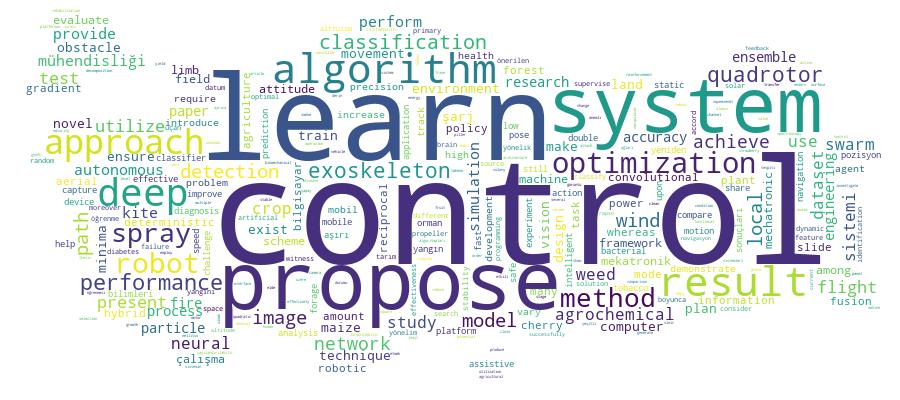
GCRIS Competency Cloud

Scholarly Output Search Results

Now showing 1 - 10 of 26
  • Article
    Citation - WoS: 31
    Citation - Scopus: 38
    A Computationally Efficient Method for Hybrid Eeg-Fnirs Bci Based on the Pearson Correlation
    (Hindawi Ltd, 2020) Hasan, Mustafa A. H.; Khan, Muhammad U.; Mishra, Deepti
    A hybrid brain computer interface (BCI) system considered here is a combination of electroencephalography (EEG) and functional near-infrared spectroscopy (fNIRS). EEG-fNIRS signals are simultaneously recorded to achieve high motor imagery task classification. This integration helps to achieve better system performance, but at the cost of an increase in system complexity and computational time. In hybrid BCI studies, channel selection is recognized as the key element that directly affects the system's performance. In this paper, we propose a novel channel selection approach using the Pearson product-moment correlation coefficient, where only highly correlated channels are selected from each hemisphere. Then, four different statistical features are extracted, and their different combinations are used for the classification through KNN and Tree classifiers. As far as we know, there is no report available that explored the Pearson product-moment correlation coefficient for hybrid EEG-fNIRS BCI channel selection. The results demonstrate that our hybrid system significantly reduces computational burden while achieving a classification accuracy with high reliability comparable to the existing literature.
  • Master Thesis
    Bilinmeyen Ortamlarda Robot Sürüleri için Algoritma Planlamada Etkin Bir Yol
    (2020) Abdı, Mohammed Isam Ismael; Khan, Muhammad Umer
    Birçok durumda birkaç mobil robot —bağımsız ajan— tek bir robot için gerçekleştirilmesi zor veya imkânsız hedefleri elde etmek amacıyla ekip halinde bir araya gelebilirler. Bu mobil robotlar belli bir görevi yerine getirmek için iş birliği yapabilirler, bu, sürünün büyüklüğüyle tam bir karşılıklı ilişki halindedir. Tek tek her robot sensörlerini kullanarak yerel ortamla karşılıklı olarak etkileşir. Sürü açısından birincil endişe başlangıçtan hedef yere kadar güvenli bir yolun tanımlanması ve izlenmesidir. Literatürde bu hedefin gerçekleştirilmesiyle ilgili Neural Network (Sinir Ağları), Genetic Algorithms (Genetik Algoritmalar), Bacterial Foraging Optimization (Bakteriyel Besin Arama Optimizasyonu), Ant Colony Optimization (Karınca Kolonisi Optimizasyonu), Artificial Potential Field (Yapay Potansiyel Alan), v.b. gibi pek çok algoritma mevcuttur. Bunlar arasında Bacterial Foraging Optimization (BFO) algoritması çalışma ortamında bilinen tüm engelleri göz önüne alarak güvenliği ve hedefin bulunmasını sağlamaktaki etkinliği nedeniyle pek çok bilimcinin dikkatini çekmektedir. Ayrıca, belirlenen yolu keşfeder ve doğru olarak izler. BFO kümeleşme prensiplerini ve doğadaki sosyal davranışlar analojisini kullanan, ilhamını biyolojiden alan doğrudan yaklaşımlı ama güçlü bir optimizasyon yöntemidir. BFO yassı bir yüzey haritası üzerinde engellerin varlığında başlangıçtan hedef noktaya kadar optimal yolu başarıyla araştırır. Ancak bu algoritma, konveks olmayan engellerin işe karışması durumunda yerel asgari şartlara sıkışmak gibi bir zayıflığa sahiptir. Sürünün robotlarından herhangi birinin sıkışıp kalması durumu görevinin tamamının başarısızlığı olarak görülmektedir. Bu araştırma BFO algoritmasının hem konveks olan hem de olmayan niteliklerdeki engellerden başarıyla kaçınılmasını sağlayan iyileştirilmiş bir versiyonunu önermektedir. Önerilen algoritma engele zıt yöndeki belli bir mesafeyi kapsayarak robotun yerel asgari değerlerden kurtulmasına yardım eder. Sert bir açıyla karşılaşıldığında algoritma güvenli bir yol oluşturmak için görsel engeller oluşturmaya başlar. Daha sonra bu bilgi diğer robotlara aktarılarak onların da yerel minimumlardan kaçınmaları sağlanır. Önerilen algoritmanın etkinliğinin test edilmesi için mevcut BFO algoritmasıyla bir karşılaştırma yapılmıştır. Her iki algoritmanın performansı bilinmeyen dinamik ve statik ortamlarda test edilmiştir. Sonuçlara göre, önerilen algoritmanın yerel minimumlardan başarıyla kurtulduğu ve BFO'nun sıkışıp kaldığı gözlenmiştir.
  • Article
    Citation - WoS: 21
    Citation - Scopus: 35
    Deep Learning-Based Computer-Aided Diagnosis (cad): Applications for Medical Image Datasets
    (Mdpi, 2022) Kadhim, Yezi Ali; Khan, Muhammad Umer; Mishra, Alok
    Computer-aided diagnosis (CAD) has proved to be an effective and accurate method for diagnostic prediction over the years. This article focuses on the development of an automated CAD system with the intent to perform diagnosis as accurately as possible. Deep learning methods have been able to produce impressive results on medical image datasets. This study employs deep learning methods in conjunction with meta-heuristic algorithms and supervised machine-learning algorithms to perform an accurate diagnosis. Pre-trained convolutional neural networks (CNNs) or auto-encoder are used for feature extraction, whereas feature selection is performed using an ant colony optimization (ACO) algorithm. Ant colony optimization helps to search for the best optimal features while reducing the amount of data. Lastly, diagnosis prediction (classification) is achieved using learnable classifiers. The novel framework for the extraction and selection of features is based on deep learning, auto-encoder, and ACO. The performance of the proposed approach is evaluated using two medical image datasets: chest X-ray (CXR) and magnetic resonance imaging (MRI) for the prediction of the existence of COVID-19 and brain tumors. Accuracy is used as the main measure to compare the performance of the proposed approach with existing state-of-the-art methods. The proposed system achieves an average accuracy of 99.61% and 99.18%, outperforming all other methods in diagnosing the presence of COVID-19 and brain tumors, respectively. Based on the achieved results, it can be claimed that physicians or radiologists can confidently utilize the proposed approach for diagnosing COVID-19 patients and patients with specific brain tumors.
  • Conference Object
    Citation - Scopus: 4
    Convolution Neural Network (cnn) Based Automatic Sorting of Cherries
    (Institute of Electrical and Electronics Engineers Inc., 2021) Park,H.; Khan,M.U.
    Cherries are spring fruits enriched with nutrients, and are easily available in food markets around the world. Due to their excess demand, many enterprises solely focused on their processing. Cherries are especially susceptible to pathological-, physiological-diseases and structural degradation due to their soft outer skin. The post-harvest life of the fruit is limited by various characteristics. The agricultural industry has also been at the forefront to get benefits from the advanced machine learning tools. This study presents an image processing-based system for sorting cherries using the convolutional neural network (CNN). For this study, Prunus avium L cherries of export quality, available in Turkey, tagged as ‘0900 Ziraat’, are used. Surprisingly, there exists no dataset for these cherries; hence, we developed our dataset. Through the proposed approach based upon U-Net, the binary classification accuracy of 99% is achieved. Clear identification is demonstrated by the test results of varying mixture ratios of good and bad cherries. It can therefore be said that for cherry sorting and grading, U-Net can be applied as a reliable and promising machine learning tool. ©2021 IEEE
  • Article
    Citation - WoS: 5
    Citation - Scopus: 4
    Avoiding Contingent Incidents by Quadrotors Due To One or Two Propellers Failure
    (Public Library Science, 2023) Altinuc, Kemal Orcun; Khan, Muhammad Umer; Iqbal, Jamshed
    With the increasing impact of drones in our daily lives, safety issues have become a primary concern. In this study, a novel supervisor-based active fault-tolerant (FT) control system is presented for a rotary-wing quadrotor to maintain its pose in 3D space upon losing one or two propellers. Our approach allows the quadrotor to make controlled movements about a primary axis attached to the body-fixed frame. A multi-loop cascaded control architecture is designed to ensure robustness, stability, reference tracking, and safe landing. The altitude control is performed using a proportional-integral-derivative (PID) controller, whereas linear-quadratic-integral (LQI) and model-predictive-control (MPC) have been investigated for reduced attitude control and their performance is compared based on absolute and mean-squared error. The simulation results affirm that the quadrotor remains in a stable region, successfully performs the reference tracking, and ensures a safe landing while counteracting the effects of propeller(s) failures.
  • Article
    Citation - Scopus: 1
    Investigation of Harmonic Losses To Reduce Rotor Copper Loss in Induction Motors for Traction Applications
    (Multidisciplinary Digital Publishing Institute (MDPI), 2025) Siddique, M.S.; Ertan, H.B.; Alam, M.S.; Khan, M.U.
    The focus of this paper is to seek means of increasing induction motor efficiency to a comparable level to a permanent magnet motor. Harmonic and high-frequency losses increase the rotor core and copper loss, often limiting IM efficiency. The research in this study focuses on reducing rotor core and copper losses for this purpose. An accurate finite element model of a prototype motor is developed. The accuracy of this model in predicting the performance and losses of the prototype motor is verified with experiments over a 32 Hz–125 Hz supply frequency range. The verified model of the motor is used to identify the causes of the rotor core and copper losses of the motor. It is found that the air gap flux density of the motor contains many harmonics, and the slot harmonics are dominant. The distribution of the core loss and the copper loss is investigated on the rotor side. It is discovered that up to 35% of the rotor copper losses and 90% rotor core losses occur in the regions up to 4 mm from the airgap where the harmonics penetrate. To reduce these losses, one solution is to reduce the magnitude of the air gap flux density harmonics. For this purpose, placing a sleeve to cover the slot openings is investigated. The FEA indicates that this measure reduces the harmonic magnitudes and reduces the core and bar losses. However, its effect on efficiency is observed to be limited. This is attributed to the penetration depth of flux density harmonics inside the rotor conductors. To remedy this problem, several FEA-based modifications to the rotor slot shape are investigated to place rotor bars deeper than the harmonic penetration. It is found that placing the bars further away from the rotor surface is very effective. Using a 1 mm sleeve across the stator’s open slots combined with a rotor tapered slot lip positions the bars slightly deeper than the major harmonic penetration depth, making it the optimal solution. This reduces the bar loss by 70% and increases the motor efficiency by 1%. Similar loss reduction is observed over the tested supply frequency range. © 2025 by the authors.
  • Master Thesis
    Derin öğrenme ile orman yangını tespiti
    (2024) Özel, Berk; Khan, Muhammad Umer
    Yangın algılama sistemleri can güvenliği ve maddi hasarın en aza indirilmesi açısından kritik öneme sahiptir. Bu tür sistemlerin hayati önem taşıdığı alanlardan biri de orman yangınlarıdır. Son yıllarda büyüklük, süre ve tahribat açısından rekor sayıda orman yangını yaşandı. Duman veya ısı sensörleri gibi geleneksel yangın algılama yöntemlerinin sınırlamaları vardır ve bu da ileri teknolojilere dayalı yenilikçi yaklaşımların ortaya çıkmasına neden olur. Bu tez, orman yangını tespiti için bir derin öğrenme modeli olan ResNet ile birlikte Batch-Instance Normalizasyonunun uygulanmasını incelemektedir. Çalışma, Batch-Instance Normalizasyonunun performansını diğer normalleştirme yaklaşımlarıyla karşılaştırmaktadır. Bu çalışmada modelin eğitimi için orman yangını veri seti kullanılmıştır. Bu veri seti 4609 görsel içermektedir. Bu görseller 2120 Yangın, 2499 yangın içermeyen görselden oluşmaktadır. ResNet modeli sekiz farklı optimize edici ile test edilmiş ve en iyi sonuçları veren ile eğitilmiştir. Deneyler, normalizasyon tekniklerinin ve optimize edicilerin yangın tespitinin doğruluğu üzerindeki etkisini değerlendirmektedir. Sonuçlar, tek üstel düzeltmeyle Batch-Instance Normalizasyonunun modelin doğruluğunu önemli ölçüde artırdığını göstermektedir. Deneyde model, 96.14% F1 skoruna, 96.56% doğruluğa ve 99.49% kesinlik değerlerine ulaşmıştır. Diğer yaklaşımlardan minimum %1 doğruluk farkı, %0,6 F1 skor farkı, %1,05 kesinlik farkı elde edilmiştir. Derin öğrenmenin yeteneklerini Batch-Instance Normalizasyonunuyla birleştirmek, orman yangını tespiti için umut verici ve etkili bir çözüm ortaya koydu.
  • Article
    Citation - WoS: 25
    Citation - Scopus: 33
    Hybrid Eeg-Fnirs Bci Fusion Using Multi-Resolution Singular Value Decomposition (msvd)
    (Frontiers Media Sa, 2020) Khan, Muhammad Umer; Hasan, Mustafa A. H.
    Brain-computer interface (BCI) multi-modal fusion has the potential to generate multiple commands in a highly reliable manner by alleviating the drawbacks associated with single modality. In the present work, a hybrid EEG-fNIRS BCI system-achieved through a fusion of concurrently recorded electroencephalography (EEG) and functional near-infrared spectroscopy (fNIRS) signals-is used to overcome the limitations of uni-modality and to achieve higher tasks classification. Although the hybrid approach enhances the performance of the system, the improvements are still modest due to the lack of availability of computational approaches to fuse the two modalities. To overcome this, a novel approach is proposed using Multi-resolution singular value decomposition (MSVD) to achieve system- and feature-based fusion. The two approaches based up different features set are compared using the KNN and Tree classifiers. The results obtained through multiple datasets show that the proposed approach can effectively fuse both modalities with improvement in the classification accuracy.
  • Article
    Citation - WoS: 6
    Citation - Scopus: 6
    Ensemble Transfer Learning Using Maizeset: a Dataset for Weed and Maize Crop Recognition at Different Growth Stages
    (Elsevier Sci Ltd, 2024) Das, Zeynep Dilan; Alam, Muhammad Shahab; Khan, Muhammad Umer
    Maize holds significant importance as a staple food source globally. Increasing maize yield requires the effective removal of weeds from maize fields, as they pose a detrimental threat to the growth of maize plants. In recent years, there has been a drive towards Precision Agriculture (PA), involving the integration of farming methods with artificial intelligence and advanced automation techniques. In the realm of PA, deep learning techniques present a promising solution for addressing the complex challenge of classifying maize plants and weeds. In this work, a deep learning method based on transfer learning and ensemble techniques is developed. The proposed method is implementable on any number of existing CNN models irrespective of their architecture and complexity. The developed ensemble model is trained and tested on our custom-built dataset, namely MaizeSet, comprising 3330 images of maize plants and weeds under varying environmental conditions. The performance of the ensemble model is compared against individual pre-trained VGG16 and InceptionV3 models using two experiments: the identification of weeds and maize plants, and the identification of the various vegetative growth stages of maize plants. VGG16 attained an accuracy of 83% in Experiment 1 and 71% in Experiment 2, while InceptionV3 showcased improved performance, boasting an accuracy of 98% in Experiment 1 and 81% in Experiment 2. With the proposed ensemble approach, VGG16 when combined with InceptionV3, achieved an accuracy of 90% for Experiment 1 and 80% for Experiment 2. The findings demonstrate that integrating a suboptimal pre-defined classifier, specifically VGG16, with a more proficient model like InceptionV3, yields enhanced performance across various analytical metrics. This underscores the efficacy of ensemble techniques in the context of maize classification and analogous applications within the agricultural domain.
  • Master Thesis
    Pervane Arızası Durumunda Kuadrotorun Stabilitesini Sağlamak
    (2021) Altınuç, Kemal Orçun; Khan, Muhammad Umer
    Bu tezde, sabit kanatlı bir kuadrotorun, yalpalama hareketinden feragat ederek bir veya iki zıt pervanesini kaybetmesine rağmen 3 boyutlu uzayda konumunu koruması için bir çözüm sunulmaktadır. Bu kontrol stratejisinde, kuadrotor, araca göre sabitlenmiş bir birincil eksen etrafında döner ve bu ekseni ötelenme hareketi gerçekleştirmek için değiştirir. Bir pervane veya iki karşıt pervane kaybetmesine rağmen kuadrotorun tutumunu ve konumunu stabilize etmek için çok döngülü bir kademeli kontrol kanunu geliştirilmiştir. İlk olarak, motor arıza senaryoları için denge çözümleri hesaplanır. Daha sonra, bir referans ve bir özel kuadrotor için doğrusallaştırılmış sistem etrafında bir azaltılmış durum denetleyicisi ve konum denetleyicisi tasarlanır. Matlab/Simulink ve Matlab/Simscape üzerinde simülasyonlar yapılarak sonuçlar karşılaştırılır. Son olarak, özel yapım bir kuadrotorun CAD çizimleri, kuadrotorun eylemsizlik momentini hesaplamak için kullanılır ve sonuçlar Çift Telli Pendulum deneyi ile doğrulanır. Sonuçlar, kuadrotorun pervane arızası durumunda stabiliteye ulaştığını göstermektedir.