Eryılmaz, Serkan

Loading...
Profile Picture
Name Variants
E., Serkan
Eryilmaz, S
E.,Serkan
S., Eryilmaz
Eryılmaz, Serkan
Eryilmaz, S.
Eryilmaz,S.
Eryilmaz, Serkan
S.,Eryılmaz
Eryilmaz S.
Serkan, Eryılmaz
Erylmaz S.
Eryılmaz S.
Eryilmaz, SN
S., Eryılmaz
Eryılmaz,S.
Serkan, Eryilmaz
S.,Eryilmaz
EryIlmaz S.
Eryilmaz S., Professor,
Job Title
Profesor Doktor
Email Address
serkan.eryilmaz@atilim.edu.tr
Main Affiliation
Industrial Engineering
Status
Website
Scopus Author ID
Turkish CoHE Profile ID
Google Scholar ID
WoS Researcher ID

Sustainable Development Goals

2

ZERO HUNGER
ZERO HUNGER Logo

0

Research Products

11

SUSTAINABLE CITIES AND COMMUNITIES
SUSTAINABLE CITIES AND COMMUNITIES Logo

0

Research Products

14

LIFE BELOW WATER
LIFE BELOW WATER Logo

0

Research Products

6

CLEAN WATER AND SANITATION
CLEAN WATER AND SANITATION Logo

0

Research Products

1

NO POVERTY
NO POVERTY Logo

0

Research Products

5

GENDER EQUALITY
GENDER EQUALITY Logo

0

Research Products

9

INDUSTRY, INNOVATION AND INFRASTRUCTURE
INDUSTRY, INNOVATION AND INFRASTRUCTURE Logo

0

Research Products

16

PEACE, JUSTICE AND STRONG INSTITUTIONS
PEACE, JUSTICE AND STRONG INSTITUTIONS Logo

0

Research Products

17

PARTNERSHIPS FOR THE GOALS
PARTNERSHIPS FOR THE GOALS Logo

0

Research Products

15

LIFE ON LAND
LIFE ON LAND Logo

0

Research Products

10

REDUCED INEQUALITIES
REDUCED INEQUALITIES Logo

0

Research Products

7

AFFORDABLE AND CLEAN ENERGY
AFFORDABLE AND CLEAN ENERGY Logo

12

Research Products

8

DECENT WORK AND ECONOMIC GROWTH
DECENT WORK AND ECONOMIC GROWTH Logo

0

Research Products

4

QUALITY EDUCATION
QUALITY EDUCATION Logo

0

Research Products

12

RESPONSIBLE CONSUMPTION AND PRODUCTION
RESPONSIBLE CONSUMPTION AND PRODUCTION Logo

0

Research Products

3

GOOD HEALTH AND WELL-BEING
GOOD HEALTH AND WELL-BEING Logo

0

Research Products

13

CLIMATE ACTION
CLIMATE ACTION Logo

0

Research Products
Documents

219

Citations

4733

h-index

39

Documents

211

Citations

4163

Scholarly Output

181

Articles

170

Views / Downloads

771/2215

Supervised MSc Theses

2

Supervised PhD Theses

0

WoS Citation Count

2972

Scopus Citation Count

3444

WoS h-index

30

Scopus h-index

31

Patents

0

Projects

0

WoS Citations per Publication

16.42

Scopus Citations per Publication

19.03

Open Access Source

26

Supervised Theses

2

Google Analytics Visitor Traffic

JournalCount
Reliability Engineering & System Safety28
Journal of Computational and Applied Mathematics20
IEEE Transactions on Reliability15
Applied Stochastic Models in Business and Industry10
Statistics & Probability Letters9
Current Page: 1 / 9

Scopus Quartile Distribution

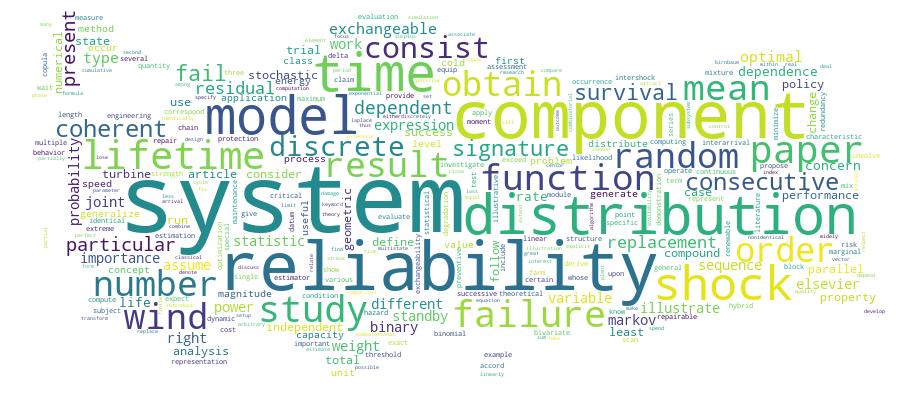
Competency Cloud

GCRIS Competency Cloud

Scholarly Output Search Results

Now showing 1 - 8 of 8
  • Article
    Citation - WoS: 2
    Citation - Scopus: 2
    Computing Waiting Time Probabilities Related To (k1< k2< ..., kl< Pattern
    (Springer, 2023) Chadjiconstantinidis, Stathis; Eryilmaz, Serkan
    For a sequence of multi-state trials with l possible outcomes denoted by {1, 2, ..., l}, let E be the event that at least k(1) consecutive is followed by at least k(2) consecutive 2s,..., followed by at least k(l) consecutive ls. Denote by T-r the number of trials for the rth occurrence of the event E in a sequence of multi-state trials. This paper studies the distribution of the waiting time random variable T-r when the sequence consists of independent and identically distributed multi-state trials. In particular, distributional properties of T-r are examined via matrix-geometric distributions.
  • Article
    Citation - WoS: 11
    Citation - Scopus: 12
    A New Mixed Δ-Shock Model With a Change in Shock Distribution
    (Springer, 2023) Chadjiconstantinidis, Stathis; Tuncel, Altan; Eryilmaz, Serkan
    In this paper, reliability properties of a system that is subject to a sequence of shocks are investigated under a particular new change point model. According to the model, a change in the distribution of the shock magnitudes occurs upon the occurrence of a shock that is above a certain critical level. The system fails when the time between successive shocks is less than a given threshold, or the magnitude of a single shock is above a critical threshold. The survival function of the system is studied under both cases when the times between shocks follow discrete distribution and when the times between shocks follow continuous distribution. Matrix-based expressions are obtained for matrix-geometric discrete intershock times and for matrix-exponential continuous intershock times, as well.
  • Article
    On 𝜹-Shock Model With a Change Point in Intershock Time Distribution
    (Statistics & Probability Letters, 2024) Chadjiconstantinidis, Stathis; Eryılmaz, Serkan
    In this paper, we study the reliability of a system that works under 𝛿-shock model. That is, the system failure occurs when the time between two successive shocks is less than a given thresh old 𝛿. In a traditional setup of the 𝛿 shock model, the intershock times are assumed to have the same distribution. In the present setup, a change occurs in the distribution of the intershock times due to an environmental effect. Thus, the distribution of the intershock times changes after a random number of shocks. The reliability of the system is studied under this change point setup.
  • Article
    Citation - WoS: 6
    Citation - Scopus: 6
    Reliability Assessment for Censored Δ-Shock Models
    (Springer, 2022) Chadjiconstantinidis, Stathis; Eryilmaz, Serkan
    This paper is devoted to study censored delta-shock models for both cases when the intershock times have discrete and continuous distributions. In particular, the distribution and moments of the system's lifetime are studied via probability generating functions and Laplace transforms. For discrete intershock time distributions, several recursions for evaluating the probability mass function, the survival function and the moments of the system's lifetime are given. As it is shown for the discrete case, the distribution of the system's lifetime is directly linked with matrix-geometric distributions for particular classes of intershock time distributions, such as phase-type distributions. Thus, matrix-based expressions are readily obtained for the exact distribution of the system's lifetime under discrete setup. Also, discrete uniform intershock time distributions are examined. For the case of continuous intershock time distributions, it is shown that the shifted lifetime has a compound geometric distribution, and based on this, the distribution of the system's lifetime is approximated via discrete mixture distributions having a mass at delta and matrix-exponential distributions for the continuous part. Both for the discrete and the continuous case, Lundberg-type bounds and asymptotics for the survival function of system's lifetime are given. To illustrate the results, some numerical examples, both for the discrete and the continuous case, are also given.
  • Article
    Citation - WoS: 12
    Citation - Scopus: 14
    The Markov Discrete Time Δ-Shock Reliability Model and a Waiting Time Problem
    (Wiley, 2022) Chadjiconstantinidis, Stathis; Eryilmaz, Serkan
    delta-shock model is one of the widely studied shock models in reliability theory and applied probability. In this model, the system fails due to the arrivals of two consecutive shocks which are too close to each other. That is, the system breaks down when the time between two successive shocks falls below a fixed threshold delta. In the literature, the delta-shock model has been mostly studied by assuming that the time between shocks have continuous distribution. In the present paper, the discrete time version of the model is considered. In particular, a proper waiting time random variable is defined based on a sequence of two-state Markov dependent binary trials and the problem of finding the distribution of the system's lifetime is linked with the distribution of the waiting time random variable, and we study the joint as well as the marginal distributions of the lifetime, the number of shocks and the number of failures associated with these binary trials.
  • Article
    Citation - WoS: 6
    Citation - Scopus: 7
    DISTRIBUTIONS OF RANDOM VARIABLES INVOLVED IN DISCRETE CENSORED δ-SHOCK MODELS
    (Cambridge Univ Press, 2023) Chadjiconstantinidis, Stathis; Eryilmaz, Serkan
    Suppose that a system is affected by a sequence of random shocks that occur over certain time periods. In this paper we study the discrete censored delta-shock model, delta <= 1 , for which the system fails whenever no shock occurs within a -length time period from the last shock, by supposing that the interarrival times between consecutive shocks are described by a first-order Markov chain (as well as under the binomial shock process, i.e., when the interarrival times between successive shocks have a geometric distribution). Using the Markov chain embedding technique introduced by Chadjiconstantinidis et al. (Adv. Appl. Prob. 32, 2000), we study the joint and marginal distributions of the system's lifetime, the number of shocks, and the number of periods in which no shocks occur, up to the failure of the system. The joint and marginal probability generating functions of these random variables are obtained, and several recursions and exact formulae are given for the evaluation of their probability mass functions and moments. It is shown that the system's lifetime follows a Markov geometric distribution of order (a geometric distribution of order under the binomial setup) and also that it follows a matrix-geometric distribution. Some reliability properties are also given under the binomial shock process, by showing that a shift of the system's lifetime random variable follows a compound geometric distribution. Finally, we introduce a new mixed discrete censored delta -shock model, for which the system fails when no shock occurs within a -length time period from the last shock, or the magnitude of the shock is larger than a given critical threshold . gamma > 0. Similarly, for this mixed model, we study the joint and marginal distributions of the system's lifetime, the number of shocks, and the number of periods in which no shocks occur, up to the failure of the system, under the binomial shock process.
  • Article
    Citation - WoS: 23
    Citation - Scopus: 24
    Reliability of a Mixed Δ-Shock Model With a Random Change Point in Shock Magnitude Distribution and an Optimal Replacement Policy
    (Elsevier Sci Ltd, 2023) Chadjiconstantinidis, Stathis; Eryilmaz, Serkan
    A mixed delta-shock model when there is a change in the distribution of the magnitudes of shocks is defined and studied. Such a model which is a combination of the delta-shock model and the extreme shock model with a random change point (studied by Eryilmaz and Kan, 2019), is useful in practice since a sudden change in environmental conditions may cause a larger shock. In particular, the reliability and the mean time to failure of the system are evaluated by assuming that the random change point has a discrete phase-type distribution. Analytical results for evaluating the reliability function of the system for several joint distributions of the interarrival times and the magnitudes of shocks, are also given. The optimal replacement policy that is based on a control limit is also proposed when the number of shocks until the change point follows geometric distribution. The results are illustrated by numerical examples.
  • Article
    Citation - WoS: 7
    Citation - Scopus: 8
    On δ-shock model with a change point in intershock time distribution
    (Elsevier, 2024) Chadjiconstantinidis, Stathis; Eryilmaz, Serkan
    In this paper, we study the reliability of a system that works under o-shock model. That is, the system failure occurs when the time between two successive shocks is less than a given threshold o. In a traditional setup of the o shock model, the intershock times are assumed to have the same distribution. In the present setup, a change occurs in the distribution of the intershock times due to an environmental effect. Thus, the distribution of the intershock times changes after a random number of shocks. The reliability of the system is studied under this change point setup.