
Mertol, Halit Cenan
Loading...
Profile URL
Name Variants
Mertol, Halit Cenan
Halit Cenan Mertol
M., Halit Cenan
H. C. Mertol
H.,Mertol
M.,Halit Cenan
H., Mertol
Mertol,H.C.
Mertol,Halit Cenan
H.C.Mertol
Mertol H.
Halit Cenan, Mertol
Cenan Mertol H.
Mertol, Halit
Halit Cenan Mertol
M., Halit Cenan
H. C. Mertol
H.,Mertol
M.,Halit Cenan
H., Mertol
Mertol,H.C.
Mertol,Halit Cenan
H.C.Mertol
Mertol H.
Halit Cenan, Mertol
Cenan Mertol H.
Mertol, Halit
Job Title
Doktor Öğretim Üyesi
Email Address
cenan.mertol@atilim.edu.tr
Main Affiliation
Civil Engineering
Status
ORCID ID
Scopus Author ID
Turkish CoHE Profile ID
Google Scholar ID
WoS Researcher ID
Sustainable Development Goals
 1
1NO POVERTY
0
Research Products
 2
2ZERO HUNGER
0
Research Products
 3
3GOOD HEALTH AND WELL-BEING
0
Research Products
 4
4QUALITY EDUCATION
1
Research Products
 5
5GENDER EQUALITY
0
Research Products
 6
6CLEAN WATER AND SANITATION
0
Research Products
 7
7AFFORDABLE AND CLEAN ENERGY
0
Research Products
 8
8DECENT WORK AND ECONOMIC GROWTH
1
Research Products
 9
9INDUSTRY, INNOVATION AND INFRASTRUCTURE
0
Research Products
 10
10REDUCED INEQUALITIES
0
Research Products
 11
11SUSTAINABLE CITIES AND COMMUNITIES
12
Research Products
 12
12RESPONSIBLE CONSUMPTION AND PRODUCTION
1
Research Products
 13
13CLIMATE ACTION
0
Research Products
 14
14LIFE BELOW WATER
0
Research Products
 15
15LIFE ON LAND
0
Research Products
 16
16PEACE, JUSTICE AND STRONG INSTITUTIONS
0
Research Products
 17
17PARTNERSHIPS FOR THE GOALS
0
Research Products

Documents
18
Citations
365
h-index
10

Documents
14
Citations
310

Scholarly Output
34
Articles
18
Views / Downloads
38/0
Supervised MSc Theses
14
Supervised PhD Theses
1
WoS Citation Count
272
Scopus Citation Count
306
Patents
0
Projects
1
WoS Citations per Publication
8.00
Scopus Citations per Publication
9.00
Open Access Source
8
Supervised Theses
15
| Journal | Count |
|---|---|
| PCI Journal | 2 |
| Buildings | 2 |
| Journal of the Croatian Association of Civil Engineers | 2 |
| Journal of Performance of Constructed Facilities | 2 |
| Journal of Reinforced Plastics and Composites | 1 |
Current Page: 1 / 3
Scopus Quartile Distribution
Competency Cloud
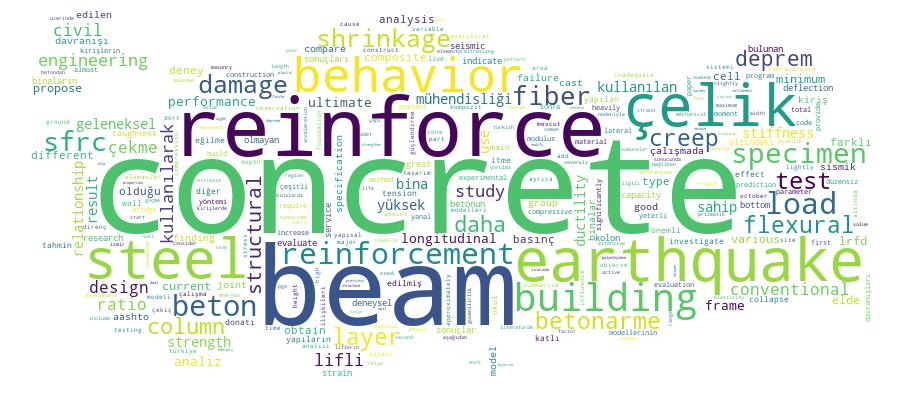
34 results
Scholarly Output Search Results
Now showing 1 - 10 of 34
Master Thesis Türkiye'deki Yapım Şirketlerinde İş Sağlığı ve Güvenliğinin Değerlendirilmesi(2016) Uzunömeroğlu, Arda; Mertol, Halit Cenanİş kazaları ve bunların yol açtığı sakatlıklar Türkiye ve diğer bir çok ülkede ciddi problemlere yol açmaktadır. İş kazalarının zararları ekonomik ve sosyal olarak iki katagoriye ayrılabilir. Sonuç olarak iş kazaları, kalıcı sakatlıklara hatta ölümlere sebep olabilir. İşcilerde oluşan kalıcı sakatlıklar, sosyal ve psikolojik problemlere yol açar. Bu problemlerin sonucu olarak, inşaattaki güvenlik koşullarını değiştirmek ölümcül kazalardan sakınmak adına çok önemlidir. Bu çalışmada, Türkiye'deki inşaat sektöründe iş sağlığı ve güvenliği etkileyen faktörler ve bu faktörlerin nasıl iyileştirilebileceği açıklanmıştır. Güvenlik düzeyini hesaplamak adına, ana faktörlere bağlı olarak bir anket uygulanmıştır. Sonuçlar, eğitim, gözetim, kişisel tutum ve yönetim olarak dört ana faktör altında olarak değerlendirilmiştir. Bu değerlendirme sonunda işyeri güvenlik düzeyi belirlenmiştir. Bunlara ek olarak bu çalışmada, inşaat firmalarının büyüklükleri ve deneyimleri arasındaki ilişki ve güvenlik seviyeleride çalışılmıştır. Sonuçlara göre, inşaat firmalarının büyüklükleri ve deneyimleri arasında bir ilişki olduğu görülmüş, ve bu ilişkiye bağlı olan Türkiye'deki iş güvenliği düzeyinin genel olarak geliştirilebileceği belirlenmiştir. İş güvenliği seviyesinin eski ve büyük firmalarda yeni ve küçüklere oranla daha yüksek olduğu görülmüştür.Article Citation - WoS: 7Citation - Scopus: 6Influence of the Proportion of Frp To Steel Reinforcement on the Strength and Ductility of Hybrid Reinforced Concrete Beams(Taylor & Francis Ltd, 2023) Kartal, Saruhan; Kalkan, Ilker; Mertol, Halit Cenan; Baran, ErayThe present study pertains to the influence of variation of FRP (Fiber Reinforced Polymer) proportion in tension reinforcement on the flexural behavior of RC beams with FRP and steel reinforcing bars. A total of 25 beams, including FRP-, steel- and hybrid FRP-steel reinforced ones, were tested to failure under four-point bending. Two types of FRP bars, GFRP (Glass Fiber Reinforced Polymer) and BFRP (Basalt Fiber Reinforced Polymer), were used and both over- and under-reinforced beams were tested. The beams in each group were designed to have close flexural capacities to fully reveal the effect of FRP proportion in the tension zone on beam ductility for a fixed bending capacity. A new analytical model was developed for estimating the bending capacities of beams. Different deformation and curvature ductility definitions were adopted and an energy-based definition, revealing the expected tendency in beam ductility, was determined. The test results revealed that the presence of even a single FRP bar in the tension zone results in reductions up to 40% in beam ductility as compared to the beam with full steel reinforcement. Each additional replacement of a steel bar with FRP was found to cause a further decrease up to 20% in beam ductility.Master Thesis Kompozit Kolon-betonarme Kiriş Birleşim Bölgelerinin Deneysel Analizle Davranışının Belirlenmesi(2020) Dakhıl, Abdulrrahman A.; Tunç, Gökhan; Mertol, Halit CenanBu tezde, yüksek ve sınırlı süneklik düzeylerine sahip çelik-betonarme kompozit çerçevelerin deprem performansları deneysel olarak incelenmiştir. Yapılan deneysel çalışma ile SRC kolon ve betonarme kiriş kompozit birleşim bölgelerinin depreme karşı davranış ve hasar görebilirlik özelliği ile bu birleşim bölgelerinin deprem enerjisini elastik olmayan deplasmanlar yardımı ile soğurabilme yeteneği araştırılmış ve konu detaylı olarak irdelenmiştir. Bu kapsamda, akademik kaynak taraması yapılarak kolon-kiriş bağlantısının tasarımı ve davranışı için yeni bir bakış açısı elde edilmeye çalışılmıştır. Tez çalışmasında verimlilik esasına dayalı deprem mühendisliği kavramı çerçevesinde kullanılan temel tasarım parametresi ise sünekliktir. Bu çalışma ile yürürlükteki Türkiye Bina Deprem Yönetmeliği (TBDY 2018) uyarınca detayları elde edilen kompozit kolon-kiriş bağlantılarının tasarım gereği ihtiyaç duyulan değişken süneklik taleplerine göre davranışının belirlenmesi hedeflenmiştir. Kolon-kiriş bağlantılarındaki eksikliklerin ve enerji soğurma kapasitelerinin belirlenmesini müteakip, ½ ölçek oranındaki çerçeveler belirlenen süneklik hedeflerine uygun olarak tasarlanmış, deneysel ölçüm cihazları yerleştirilerek, testleri ve analizleri gerçekleştirilmiştir. Deneylerde, bağlantı noktalarına deplasman kontrollü yatay tersinir çekme ve basınç kuvvetleri ile sabit eksenel yük uygulanmıştır. Deneysel çalışmalarda kullanılan parametreler ise şunlardır: kolon donatı oranı, bağlantı ebat oranı, eksenel yük ve yatay tersinir yükler. Yapılan deneyler neticesinde SRC kolon-betonarme kirişlerden oluşan çerçevelerde ilave kolon donatı miktarlarının deprem davranışını olumlu yönde etkilediği görülmüştür.Master Thesis Çelik Lifli Betonun Çekme ve Basınç Altındaki Davranışı(2015) Abdussalam, Alfadhıl. A. Gheıt. Alfadhıl; Mertol, Halit Cenan; Baran, ErayÇelik lifli beton, içinde belirli uzunluktaki çelik liflerin gelişigüzel ve düzgün bir şekilde yayılımı ile elde edilen bir beton karışımıdır. Liflerin kalitesi ve miktarı betonun mekanik özelliklerini etkilemektedir. Çelik liflerin betona katılması, betonun çekme tokluğunu ve sünekliğini arttırdığı, basınç dayanımını da ufak da olsa iyileştirdiği genel olarak kabul edilmiştir. Betonun kırılmasından sonra çekme gerilmelerinin lifler arasındaki dağılımı sağlandığından dolayı çelik liflerin yararı daha belirgin olarak görülmektedir. Bu araştırmanın amacı, çelik lifli betonun çekme ve basınç altındaki davranışının, konvansiyonel ve çelik lifli beton kullanılan çeşitli numuneler üzerinde uygulanan yükleme deneyleri ile incelenmesidir. Deney numuneleri basınç silindirlerinden (100×200 ve 150×300 mm), prizmatik eğilme dayanımı elemanlarından (150×150×600 mm) oluşmaktadır. Ayrıca çelik donatıyı çevreleyen prizmatik beton numuneler üzerinde çekme deneyleri gerçekleştirilmiştir. Çelik donatı çevresindeki prizmatik numuneler için gerçekleştirilen çekme deneylerinde beton prizmaların uzunlukları (500, 1000, ve 1500 mm) ve kesit boyutları (60×60, 100×100,150×150, 200×200 mm) değişkenler olarak uygulanmıştır. Yük-deformasyon davranışları elde edilmiş ve çelik lifli betonun basınç ve çekme altındaki gerilme-birim uzama ilişkileri bulunmuştur. Prizmatik eğilme numunelerinden elde edilen yük-deformasyon davranışları, bu araştırmada bulunan basınç ve çekme altındaki gerilme-birim uzama ilişkileri kullanılarak tahmin edilen yük deformasyon davranışları ile karşılaştırılmıştır. Ayrıca literatürde bulunan farklı gerilme-birim uzama modelleri kullanılarak davranışlar yeniden tahmin edilmiştir.Master Thesis Farklı Katmanlarda Normal ve Çelik Lifli Beton Kullanılan Betonarme Kirişlerin Eğilme Davranışı(2015) Faeq, Mohammed Nozad Faeq; Mertol, Halit Cenan; Baran, ErayBu çalışmada farklı katmanlarda normal ve çelik lifli beton kullanılan betonarme kirişlerin eğilme davranışı incelenmiştir. 180×250×3500 mm boyutlarındaki beşer numuneden oluşan iki grup şeklindeki kirişler dört nokta eğilme yüklemesi altında test edilmiştir. İki grup kirişte de 416 betonarme çeliği kullanılmıştır. Bu araştırmadaki ana değişken, kiriş numunelerinin yüksekliği boyunca bulunan katmanlarda kullanılan beton tipidir. Kiriş numunelerinin kesit yüksekliği 50'şer mm kalınlığında 5 katmana ayrılmıştır. 'F' grubu numunelerde, normal beton katmanlarından oluşan kirişlere, aşağıdan başlayarak, çelik lifli beton katmanlar eklenmiştir. 'P' grubu numunelerde ise çelik lifli beton katmanları kesit üst seviyesinden başlanarak eklenmiştir. Yükleme deneyleri sonucunda kiriş numunelerinin yük-deformasyon davranışları elde edilmiş ve bu davranışlar yük taşıma kapasitesi, servis rijitliği, kapasite sonrası eğim ve tokluk paratmeleri göz önüne alınarak değerlendirilmiştir. Kiriş numunlerinin yük-deformasyon davranışlarının, literatürde bulunan malzeme modelleri kullanılarak sayısal olarak belirlenmesi için analitik bir çalışma gerçekleştirilmiştir.Article Citation - WoS: 21Citation - Scopus: 28Damage in Reinforced-Concrete Buildings During the 2011 Van, Turkey, Earthquakes(Asce-amer Soc Civil Engineers, 2014) Baran, Eray; Mertol, Halit Cenan; Gunes, BurcuTwo major earthquakes with magnitudes Mw=7.2 (ML=6.7) and ML=5.6 occurred in eastern Turkey on October 23 and November 19, 2011. The maximum measured peak ground accelerations for the two ground motions were 0.18g and 0.25g, respectively. The earthquakes resulted in various levels of damage to RC moment-resisting frame buildings ranging from minor cracking in brick partition walls to total collapse. This paper summarizes the field observations of the Atilim University Reconnaissance Team carried out in the region a few days after the two main shocks with an emphasis on the performance of RC buildings. A summary of the evolution of the Turkish seismic design code during the last 35 years is given, followed by an explanation of the behavior of RC buildings during the October 23 and November 9 earthquakes. The deformation types that were commonly observed in the heavily damaged or collapsed RC buildings include plastic hinging in columns attributable to stiffer beams, localization of damage in ground-story columns attributable to changes in the stiffness of the lateral load-resisting system caused by brick partition walls, and shear failure of columns caused by discontinuities in the partition walls adjacent to the columns. Poor concrete quality, inadequate development and lap splice length for reinforcement, and inadequate confinement in columns also contributed to the poor seismic behavior.Article Citation - WoS: 100Citation - Scopus: 114Flexural Behavior of Lightly and Heavily Reinforced Steel Fiber Concrete Beams(Elsevier Sci Ltd, 2015) Mertol, Halit Cenan; Baran, Eray; Bello, Hussain JibrilFlexural behavior of lightly and heavily reinforced steel fiber concrete beams was investigated. The test series consisted of 20 singly reinforced beams having 180 x 250 x 3500 mm dimensions. The main parameters in the testing program were the type of concrete and the amount of longitudinal reinforcement. Ten different longitudinal reinforcement ratios (with a minimum of 0.2% and a maximum of 2.5%) covering the range from under-reinforced to over-reinforced beam behavior were used in the testing program. Two specimens were cast for each longitudinal reinforcement ratio, one specimen using conventional concrete (CC) and another specimen using steel fiber reinforced concrete (SFRC). Load-deflection behaviors were obtained and evaluated in terms of ultimate load, ultimate deflection, service stiffness, post-peak stiffness, and flexural toughness. The results indicate that the use of SFRC increases the ultimate load and service stiffness of the beams slightly compared to that of CC specimens. As reinforcement ratio increases, the ultimate deflection of SFRC specimens becomes significantly greater than that of CC specimens. For over-reinforced sections, the post-peak stiffness of the SFRC specimens is observed to be significantly lower than that of CC specimens. The flexural toughness of SFRC specimens is greater than that of CC specimens with the difference being significantly larger for over-reinforced sections. Experimental load-deflection relationships were also compared to the load-deflection curves obtained from sectional analyses based on strain compatibility and best fit stress-strain relationships for SFRC in tension and compression. (C) 2015 Elsevier Ltd. All rights reserved.Article Citation - WoS: 6Citation - Scopus: 10Lessons Learned From Four Recent Turkish Earthquakes: Sivrice-Elazığ, Aegean Sea, and Dual Kahramanmaraş(Springer, 2024) Tunc, Goekhan; Mertol, Halit Cenan; Akis, TolgaT & uuml;rkiye is located in an earthquake-prone region where almost all of its population resides in risky areas. In the past 100 years, there has been a strong earthquake every two years and a major one every 3 years. This study investigates the impact of four recent earthquakes, that occurred between 2020 and 2023, on reinforced concrete (RC) buildings. The first, Sivrice-Elaz & imath;& gbreve;, struck the eastern part of T & uuml;rkiye on January 24, 2020, with a moment magnitude of Mw = 6.8. The second, the Aegean Sea, hit the western part of the country on October 30, 2020, with an Mw of 6.6. The third and fourth are the February 6, 2023 dual Kahramanmara & scedil; earthquakes with Mws of 7.7 and 7.6, which struck the eastern part of T & uuml;rkiye approximately 9 h apart. Immediately following these earthquakes, a technical team investigated each of the damaged areas. This study summarizes their findings on RC buildings. It was discovered that the majority of the collapsed or severely damaged RC buildings were constructed before 2000. The main reasons for this included technological limitations, specifically on producing high-quality concrete, as well as a lack of public policies and enforced laws in the construction sector to maintain an acceptable international standard. Furthermore, the damage patterns of buildings from these four earthquakes indicated poor workmanship, low material quality, improper structural framing, a common appearance of soft and weak stories, the inadequate use of shear walls, and defective reinforcement configuration. The significance of soil studies and the enforcement of building inspections are also discussed, along with the earthquake codes. The study concludes that the maximum peak ground accelerations from the dual Kahramanmara & scedil; earthquakes were almost triple the code-prescribed values. Therefore, it is recommended that the current mapped spectral acceleration values be revised and that buildings constructed before 2000 should be prioritized while determining their structural performances.Article Citation - WoS: 7Citation - Scopus: 7Finite Element Analysis of Frames With Reinforced Concrete Encased Steel Composite Columns(Mdpi, 2022) Tunc, Gokhan; Othman, Mohammed Moatasem; Mertol, Halit CenanStructural frame systems that consists of concrete-encased-steel-embedded composite columns and reinforced concrete beams are typically used in mid-rise to tall buildings. In order to understand their overall structural behavior, a total of 12 frame models with high and low ductility features were constructed and analyzed using LS-DYNA software. Two of these models were validated using the results of previously tested frames. The remaining 10 models were studied to predict the behavior of frames with varying concrete strengths, reinforcement configurations, and structural steel sections under vertical and lateral loads. The results were investigated in terms of cracks and failure patterns, load-deflection relationships, energy dissipation, and stiffness degradation. The analytical results indicated that the high ductile frame models showed slightly better lateral load carrying performances compared to low ductility frame models. Moreover, the analytical studies demonstrated that the existence of structural steel in a column, regardless of its cross-sectional shape, was the most important parameter in improving the lateral load carrying capacity of a frame.Article Citation - Scopus: 19Creep and shrinkage behavior of high-strength concrete and minimum reinforcement ratio for bridge columns(Precast/Prestressed Concrete Institute, 2010) Mertol,H.C.; Rizkalla,S.; Zia,P.; Mirmiran,A.This paper summarizes the findings of an extensive research program that examined the shrinkage and creep behavior of high-strength concrete (HSC) up to a strength of 18 ksi (124 MPa). Creep and shrinkage strains of 60 specimens were monitored for up to two years. The variables considered in this investigation were the concrete compressive strength, specimen size, curing type, age of concrete at loading, and loading stress level. Research findings indicate that the current American Association of State Highway and Transportation Officials' AASHTO LRFD Bridge Design Specifications could be used to estimate the creep coefficient and shrinkage strain of HSC up to 15 ksi (103 MPa). However, the current AASHTO LRFD specifications do not provide appropriate predictions for concrete compressive strength greater than 15 ksi (103 MPa). A revised time-development correction factor is proposed to obtain better predictions for HSC up to 18 ksi (124 MPa). For HSC compression members, the current AASHTO LRFD specifications require an excessive amount of minimum longitudinal reinforcement to account for the long-term effects due to shrinkage and creep. Based on an analysis, a new relationship is proposed for the required minimum reinforcement ratio.
