
Kılıç, Sadık Engin
Loading...
Profile URL
Name Variants
K.,Sadik Engin Sadık Engin, Kılıç Kılıç S. S. E. Kılıç Kılıç, Sadık Engin S.E.Kılıç Kiliç S. S.,Kılıç Kilic S. K.,Sadık Engin K., Sadik Engin Kilic,S.E. S. E. Kilic K., Sadık Engin Kılıç,S.E. Sadik Engin, Kilic Sadık Engin Kılıç S., Kilic Kilic, Sadik Engin Kilic,Sadik Engin S.E.Kilic Kilic, S. Engin
Job Title
Profesör Doktor
Email Address
engin.kilic@atilim.edu.tr
Main Affiliation
Manufacturing Engineering
Status
ORCID ID
Scopus Author ID
Turkish CoHE Profile ID
Google Scholar ID
WoS Researcher ID
Research Topics
Domains
Physical SciencesSocial Sciences
Fields
EngineeringBusiness, Management and Accounting
Subfields
Mechanical EngineeringElectrical and Electronic EngineeringManagement of Technology and InnovationBiomedical EngineeringIndustrial and Manufacturing Engineering
Specific Research Areas
Advanced machining processes and optimization
Advanced Machining and Optimization Techniques
Collaboration in agile enterprises
Advanced Surface Polishing Techniques
Manufacturing Process and Optimization
Sustainable Development Goals
 1
1NO POVERTY
0
Research Products
 2
2ZERO HUNGER
0
Research Products
 3
3GOOD HEALTH AND WELL-BEING
1
Research Products
 4
4QUALITY EDUCATION
0
Research Products
 5
5GENDER EQUALITY
0
Research Products
 6
6CLEAN WATER AND SANITATION
0
Research Products
 7
7AFFORDABLE AND CLEAN ENERGY
2
Research Products
 8
8DECENT WORK AND ECONOMIC GROWTH
0
Research Products
 9
9INDUSTRY, INNOVATION AND INFRASTRUCTURE
12
Research Products
 10
10REDUCED INEQUALITIES
0
Research Products
 11
11SUSTAINABLE CITIES AND COMMUNITIES
0
Research Products
 12
12RESPONSIBLE CONSUMPTION AND PRODUCTION
5
Research Products
 13
13CLIMATE ACTION
1
Research Products
 14
14LIFE BELOW WATER
0
Research Products
 15
15LIFE ON LAND
1
Research Products
 16
16PEACE, JUSTICE AND STRONG INSTITUTIONS
0
Research Products
 17
17PARTNERSHIPS FOR THE GOALS
0
Research Products

Documents
40
Citations
1092
h-index
19

Documents
29
Citations
624
Publication Collaboration
| Affiliation Name | Count |
|---|---|
| Middle East Technical University | 30 |
| Atilim University | 24 |
| TOBB University of Economics and Technology | 14 |
| Turkish Aerospace Industries (Turkey) | 3 |
| Çankaya University | 2 |
1 / 4
Data obtained from OpenAlex

Scholarly Output
34
Articles
19
Views / Downloads
85/120
Supervised MSc Theses
4
Supervised PhD Theses
2
WoS Citation Count
393
Scopus Citation Count
505
Patents
0
Projects
0
WoS Citations per Publication
11.56
Scopus Citations per Publication
14.85
Open Access Source
10
Supervised Theses
6
| Journal | Count |
|---|---|
| The International Journal of Advanced Manufacturing Technology | 4 |
| Machining Science and Technology | 3 |
| Procedia CIRP | 3 |
| Journal of Cleaner Production | 2 |
| International Journal of Computer Integrated Manufacturing | 2 |
Current Page: 1 / 4
Scopus Quartile Distribution
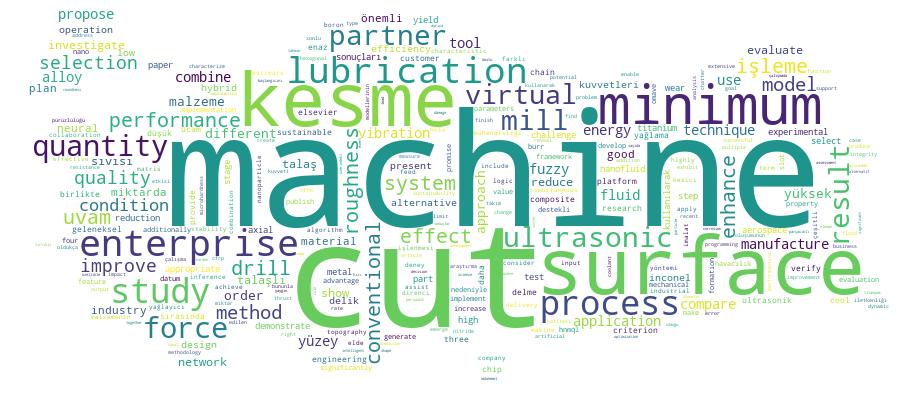
Competency Cloud
34 results
Scholarly Output Search Results
Now showing 1 - 10 of 34
Article Citation - Scopus: 6Micro-Wedm of Ni55.8ti Shape Memory Superalloy: Experimental Investigation and Optimisation(Inderscience Publishers, 2021) Meshri,H.A.M.; Akar,S.; Seyedzavvar,M.; Kiliç,S.E.Nickel-titanium superalloy has gained significant acceptance for engineering applications as orthotropic implants, orthodontic devices, automatic actuators, etc. Considering the unique properties of these alloys, such as high hardness, toughness, strain hardening, and development of straininduced martensite, micro-wire electro-discharge machining (μ-WEDM) process has been accepted as one of the main options for cutting intricate shapes of these alloys in micro-scale. This paper presents the results of a comprehensive study to address the material removal rate (MRR) and surface integrity of Ni55.8Ti shape memory superalloy (SMA) in the μ-WEDM process. The effects of discharge current, pulse on-time, pulse off-time, and servo voltage on the performance of this process, including MRR, white layer thickness, surface roughness, and micro-hardness of the machined surface, were investigated by multi-regression analysis using response surface methodology (RSM). The optimisation of input parameters based on the gradient and the swarm optimisation algorithms were also conducted to maximise the MRR and minimise the white layer thickness, surface roughness, and micro-hardness of the machined samples. © 2021 Inderscience Enterprises Ltd.. All rights reserved.Doctoral Thesis Havacılık Endüstrisinde Kullanılan Kesilmesi Zor Malzemeler Üzerinde Nanoakışkan Minimum Miktar Yağlama ile Çok Eksenli Ultrasonik Titreşi̇m Destekli Frezelemenin Etkileri Üzerine Bir İnceleme(2023) Namlu, Ramazan Hakkı; Lotfi, Bahram; Kılıç, Sadık EnginHavacılık sektörü, modern dünyanın önde gelen endüstrilerinden biri olarak öne çıkmaktadır. Bu sektörde Ti-6Al-4V malzemesinin yaygın olarak kullanılması, mükemmel mukavemet-ağırlık oranına ve iyi korozyon direnci gibi özelliklerine sahip olmasından kaynaklanmaktadır. İşleme, malzemeyi nihai şekline dönüştürmek için havacılık sektöründe vazgeçilmez bir süreçtir. Bununla birlikte, Ti-6Al-4V'nin işlenebilirliği, Geleneksel İşleme (Gİ) kapsamında, düşük termal iletkenliği, kesici takımlara yapışma eğilimi ve talaş kaldırmayla ilgili zorluklarla karakterize edilmekte ve bundan dolayı genellikle 'işlenmesi zor' bir malzeme olarak adlandırılmaktadır. İşleme verimliliğini artırmak için, Ultrasonik Titreşim Destekli İşleme (UTDİ) umut vaat eden bir teknik olarak ortaya çıkmıştır. UTDİ, yüksek frekansta, düşük genlikli titreşimleri çeşitli kesme yönlüklerine entegre ederek verimliliği artırmayı amaçlayan hibrit bir işleme yaklaşımıdır. Hibrid işleme stratejileri ile beraber, Ti-6Al-4V'nin işleme performansını artırmak için başka bir yol da soğutma sistemlerini içermektedir. Bu sistemler, malzemenin düşük termal iletkenliğinden kaynaklanan kesme bölgesindeki ısı birikimini azaltmayı amaçlar. Ancak, Geleneksel Kesme Sıvıları'nın (GKS) kullanımı, sınırlı performans artışları ve çevresel ve mesleki sağlık riskleri nedeniyle alternatif tekniklerle değiştirilmektedir. Bu alternatifler arasında, Minimum Miktar Yağlama (MMY), kesme bölgesine yüksek basınçlı hava ile birlikte minimum miktarda yağın aerosol formunda verilmesini içeren bir yöntem olarak ortaya çıkmıştır. Aerosol form, GKS'ye kıyasla kesici takım ile iş parçası arasına daha iyi penetre ederek verimliliğin artmasına katkıda bulunur. Ayrıca, MMY'nin avantajları, Nanoakışkan-MMY (NMMY) olarak bilinen nanoparçacıkların eklenmesi ile daha da artırılmaktadır. NMMY, MMY'de kullanılan yağa nanoparçacıkların entegre edilmesini içerir ve bunların termo-fiziksel özelliklerini kullanarak saf MMY'ye kıyasla üstün işleme verimliliği elde etmeyi amaçlar. Özellikle, en büyük gelişmeler, çeşitli nanoparçacık türlerini birleştiren Hibrid-NMMY (HNMMY) uygulamasıyla elde edilebilir. Bu tez, optimum konsantrasyonları ve uygulama metodolojilerini belirlemek amacıyla, değişik nanoparçacık konsantrasyonları ve bunlara karşılık gelen etkilerle karakterize edilen çeşitli nanoakışkanların kapsamlı bir incelemesini amaçlar. Daha sonra, tez, çok eksenli UTDİ ve NMMY yaklaşımlarının birleşik etkilerini araştırır. Mevcut literatüre göre, daha önce hiçbir araştırma, Ti-6Al-4V üzerinde kanal frezeleme operasyonlarında çok eksenli UTDİ ve NMMY/HNMMY uygulamalarını incelememiştir. Araştırma bulguları, çok eksenli UTDİ ve NMMY'nin birleşik kullanımının Ti-6Al-4V'nin işleme performansında önemli gelişmelere yol açtığını göstermektedir, bu da daha etkili ve sürdürülebilir bir uygulama sağlamaktadır.Conference Object Citation - WoS: 5Citation - Scopus: 6Investigation of the Effects of Axial Ultrasonic Vibrations on Chatter Stability in Milling with Bull Nose Cutters(Elsevier Science BV, 2023) Namlu, Ramazan Hakki; Kilic, Zekai Murat; Lorain, Raphael; Kilic, Sadik EnginUltrasonic vibrations-assisted machining has positive effects on the chatter stability and surface integrity of the process. Radial vibration-assisted milling is effective but it needs an advanced control of vibration trajectory hence is not easy to implement. The aim of this paper is to investigate the effects of axial ultrasonic vibrations on stability through disturbing the chip regeneration. A simple way of predicting the stability increase is proposed using missed-cut effect that reduces the effective number of teeth in cut. The axial vibrations are shown to introduce radial runout such that a regular cutter will show the characteristics of a serrated tool. For a 2-tooth bull nose cutter, the proposed method was verified by milling of Ti-6Al-4V material. The results showed that the axial ultrasonic vibrations increased limit axial depth of cut by more than 40%. Therefore, applying axial vibrations would be a simple solution to improve chatter resistance in machining difficult-to-cut materials while avoiding the cost and complexity of serrated rounded edges. The attention on using axial ultrasonic vibrations in milling is increasing, hence further research on modelling the machining dynamics combined with the velocity effects will be needed following this study. (c) 2023 The Authors. Published by Elsevier B.V. This is an open access article under the CC BY-NC-ND license (https://creativecommons.org/licenses/by-nc-nd/4.0)Article Citation - WoS: 11Citation - Scopus: 15A Neural Network Model for the Assessment of Partners' Performance in Virtual Enterprises(Springer London Ltd, 2006-06-15) Sari, Burak; Amaitik, Saleh; Kilic, S. EnginIn response to increasing international competition, enterprises have been investigating new ways of cooperating with each other to cope with today's unpredictable market behaviour. Advanced developments in information & communication technology (ICT) enabled reliable and fast cooperation to support real-time alliances. In this context, the virtual enterprise (VE) represents an appropriate cooperation alternative and competitive advantage for the enterprises. VE is a temporary network of independent companies or enterprises that can quickly bring together a set of core competencies to take advantage of market opportunity. In this emerging business model of VE, the key to enhancing the quality of decision making in the partner companies' performance evaluation function is to take advantage of the powerful computer-related concepts, tools and technique that have become available in the last few years. This paper attempts to introduce a neural network model, which is able to contribute to the extrapolation of the probable outcomes based on available pattern of events in a virtual enterprise. Quality, delivery and progress were selected as determinant factors effecting the performance assessment. Considering the features of partner performance assessment and neural network models, a back-propagation neural network that includes a two hidden layers was used to evaluate the partner performance.Conference Object Citation - WoS: 10Citation - Scopus: 13A Multi-Agent System Model for Partner Selection Process in Virtual Enterprise(Elsevier Science Bv, 2014) Sadigh, B. Lotfi; Arikan, F.; Ozbayoglu, A. M.; Unver, H. O.; Kilic, S. E.; Lotfi Sadigh, B.Virtual Enterprise (VE) is a collaboration model between multiple business partners in a value chain. VE information system deals with highly dynamic information from heterogeneous data sources. In order to manage and store dynamic VE information in the database, an ontology based VE model has been developed. To select winner enterprises in VE, a Multi Agent System (MAS) has been developed. Communication and data transition among agents and system entities are based on defined rules in VE ontology model. One of the most important contributions of agents in VE system is in partner selection step of VE formation phase. In this step several agents with different goals and strategies are collaborating and competing each other to win the negotiation procedure or maximize the profit for their assigned enterprise. Different strategies are developed for the agents depending on their appetite for winning the auction against maximizing the profit. Several simulations were run and the results are stored. These results are fed into a neural network in order to predict which enterprise will win the auction and what will be the profit margin. The motivation is to provide a forecasting agent for the customers about the outcomes of the auctions so that they can plan ahead and take the necessary action. Early results indicate such simulated multi-agent VE formations can be used in real systems. A Multi-Agent System Model for Partner Selection Process in Virtual Enterprise (C) 2014 Published by Elsevier B.V.Article Citation - WoS: 8Citation - Scopus: 11Combined Use of Ultrasonic-Assisted Drilling and Minimum Quantity Lubrication for Drilling of Niti Shape Memory Alloy(Taylor & Francis inc, 2023-06-24) Namlu, Ramazan Hakki; Lotfi, Bahram; Kilic, S. Engin; Yilmaz, Okan Deniz; Akar, SametThe drilling of shape-memory alloys based on nickel-titanium (Nitinol) is challenging due to their unique properties, such as high strength, high hardness and strong work hardening, which results in excessive tool wear and damage to the material. In this study, an attempt has been made to characterize the drillability of Nitinol by investigating the process/cooling interaction. Four different combinations of process/cooling have been studied as conventional drilling with flood cooling (CD-Wet) and with minimum quantity lubrication (CD-MQL), ultrasonic-assisted drilling with flood cooling (UAD-Wet) and with MQL (UAD-MQL). The drill bit wear, drilling forces, chip morphology and drilled hole quality are used as the performance measures. The results show that UAD conditions result in lower feed forces than CD conditions, with a 31.2% reduction in wet and a 15.3% reduction in MQL on average. The lowest feed forces are observed in UAD-Wet conditions due to better coolant penetration in the cutting zone. The UAD-Wet yielded the lowest tool wear, while CD-MQL exhibited the most severe. UAD demonstrated a & SIM;50% lower tool wear in the wet condition than CD and a 38.7% in the MQL condition. UAD is shown to outperform the CD process in terms of drilled-hole accuracy.Article Citation - WoS: 17Citation - Scopus: 20An Experimental Study on Ultrasonic-Assisted Drilling of Inconel 718 Under Different Cooling/Lubrication Conditions(Springer London Ltd, 2023-12-01) Erturun, Omer Faruk; Tekaut, Hasan; Cicek, Adem; Ucak, Necati; Namlu, Ramazan Hakki; Lotfi, Bahram; Kilic, S. EnginUltrasonic-assisted drilling (UAD) is one of the efficient and innovative methods to improve the drillability of difficult-to-cut materials. In the present study, the UAD of Inconel 718 was investigated under different cooling and/or lubrication conditions. The drilling tests were carried out at a constant cutting speed (15 m/min) and a feed (0.045 mm/rev) using uncoated and TiAlN-coated solid carbide drills under dry, conventional cutting fluid (CCF), and minimum quantity lubrication (MQL) conditions. The applicability of UAD to drilling Inconel 718 was evaluated in terms of thrust force, surface roughness, roundness error, burr formation, subsurface microstructure and microhardness, tool wear, and chip morphology. The test results showed that, when compared to conventional drilling (CD), UAD reduced the thrust force and improved the hole quality, tool life, and surface integrity under all conditions. Good surface finish, lower roundness error, and minimum burr heights were achieved under CCF conditions. MQL drilling provided lower thrust forces, better tool performance, and good subsurface quality characteristics. In addition, the simultaneous application of CCF-UAD and MQD-UAD showed significantly better performance, especially when using the coated tool.Master Thesis Partikül Takviyeli Alüminyum Metal Matris Kompozit Malzemelerin Talaşlı İşlenmesinin Sonlu Elemanlar Yöntemiyle Modellenmesi(2018) Rake, Nakka Lotfy Rake; Kılıç, Sadık Engin; Kılıç, Sadık Engin; Kılıç, Sadık Engin; Oliaei, Samad Nadimi Bavil; Manufacturing Engineering; Manufacturing EngineeringMetal matris kompozitleri (MMC'ler) otomotiv, havacılık ve nükleer santraller gibi birçok teknik alanda önemli malzemeler haline gelmiştir. Bu uygulamaların çoğunda, nihai ürünün istenen özelliklerine ulaşmak için talaşlı işleme süreçleri gereklidir. Bu nedenle, MMC'lerin talaşlı işlemesini incelemek ve işleme operasyonları sırasında davranışlarını anlamak için süreç modellerini geliştirmek önemlidir. Proses modellerine dayanarak, belirli MMC'lerin kesme koşullarını optimize ederek talaşlı işleme kalitesi ve maliyeti iyileştirilebilir. Bu hedefe doğru bir adım olarak, partikül takviyeli alüminyum metal matris kompozitlerinin (p-Al MMC'ler) talaşlı işlenmesini incelemek için sonlu eleman modellemesi (FEM) kullanılır. Seçilen matris malzemesi,% 20'lik bir hacim fraksiyonu ile 20 μm çapa sahip silikon karbür (SiC) parçacıkları ile güçlendirililmiş alüminyum alaşımı A359'dur. P-Al-MMC'nin ortogonal kesimi üç farklı yaklaşımla incelenmiştir. Birinci yaklaşımda, eşdeğer bir homojen malzeme modeli (EHM) uygulanmaya çalışılırken, ikinci ve üçüncü yaklaşımlarda p-AlMMC, iki fazlı bir heterojen malzeme olarak modellenmiştir. İkinci ve üçüncü yaklaşımlar sırasıyla donatı parçacıklarının periyodik karesi ve periyodik altıgen dağılımlarına dayanmaktadır. Matris / kesici takım, matris / takviye ve takviye/kesme aleti arasındaki etkileşim göz önüne alınmıştır. FE simülasyonlarının sonuçları literatürdeki deneysel veriler ile karşılaştırılmıştır. Sonuçlar, yüksek gerilme oranı testleri kullanılarak kalibre edilen EHM modellerinin kesme kuvvetlerinde iyi tahminler veremeyebileceğini ve talaşlı işleme simülasyonları için yeniden kalibre edilmesi gerektiğini ortaya çıkarmıştır. Sonuçlar ayrıca, p-MMC'lerin heterojen bir materyal olarak modellenmesiyle, kesme kuvveti tahminlerinin doğruluğunun önemli ölçüde geliştirilebileceğini ortaya koymuştur.Master Thesis Çökeltilerek Sertleştirilmiş Martensitik Paslanmaz Çelik Malzemede Ultrasonik Destekli Delik Delme(2023) Enis, Metin Berk; Kılıç, Sadık Engin; Lotfi, Bahram17PH4 Paslanmaz Çelik, önemli korozyon direnci, yüksek yorulma ve çekme mukavemeti, tokluk ve yüksek sertliği sayesinde nükleer sektör, havacılık ve savunma sanayi gibi sektörlerde kullanımı oldukça yaygındır. Bu sektörlerde ve genel talaşlı imalat süreçlerinde ise delik delme en çok kullanılan yöntemlerden birisidir fakat bu malzemenin yüksek aşınma direnci, sertliği ve ısıl iletim kapasitesi nedeniyle delik delme performansını oldukça düşürür. İlk kez, bu çalışmada 17-PH-4 paslanmaz çeliğinde delik delme operasyonunun verimini arttırmak için Ultrasonik Destekli Delik Delme (UDDD) yöntemi kullanılmıştır. UDDD düşük genlikli titreşimler ve yüksek frekans kullanarak talaş kaldırma sürecini kolaylaştıran hibrit bir yöntemdir. Test planı, hem geleneksel delik delme (GDD) yöntemi ve UDDD'yi kıyaslamak hem de UDDD'nin gagalama ve direkt delik delme üzerindeki etkisini görmek üzere hazırlanmıştır. Deney sonuçları, UDDD'nin geleneksel delik delme yöntemine göre kesme kuvvetlerini, delik çıkışındaki çapak oluşumunu ve yığıntı talaş (YT) oluşumunu azalttığını, boyutsal doğruluğu arttırdığını ve yüzey kalitesinin iyileştiğini göstermiştir. Test sonuçları, kesme hızının artmasının; kesme kuvvetleri, YT, yüzey pürüzlülüğü ve sürekli talaş formunun azalmasında bariz bir etkisi olduğunu göstermiştir. Ek olarak yüzey pürüzlülüğü, kesme kuvvetleri ve çapak oluşumu sonuçları incelendiğinde direkt delik delmede UDDD' nin olumlu etkisi, gagalamaya göre daha fazla olmuştur.Conference Object Citation - Scopus: 1Ontology Based Virtual Enterprise System Domain Modeling(DEStech Publications Inc., 2014) Lotfi Sadigh,B.; Ünver,H.Ö.; Dogdu,E.; Kiliç,S.E.A virtual enterprise (VE) is a product oriented temporary consortium which forms a collaboration platform to fulfil a specific common purpose (typically to create a product) by benefiting from various capabilities of multiple VE partner enterprises. VE lifecycle consists of 3 distinct phases including VE Formation, Operation and Dissolution. VE partner enterprises are selected from virtual breeding environment (VBE) based on specific criteria considering the new VE project specifications. In order to select the most appropriate partners for the forthcoming VE project, it is required to have comprehensive information regarding the VBE members, their current conditions, capabilities, capacities and their past performances. This database continuously changes and it is dynamic. Ontologies and the corresponding knowledge bases provide the best tools for modelling such complex domain knowledge and highly dynamic data requirements. Ontologies not only help model and capture complex domain knowledge, but also improve the sharing and reusability of data and knowledge providing a suitable environment for software agents and human communications. The VE system must be able to demonstrate what types of resources exist, where they are located, and how much resource capacity is available to be used by the consortium. In this paper a pilot Virtual Enterprise system model developed for OSTIM organized industrial park in Ankara will be presented in detail. The objective of this system model is to enable SMEs in the region to collaborate effectively in order to produce eco-friendly high value added products. © Copyright 2014 by DEStech Publications, Inc. All rights reserved.