
Şimşir, Caner
Loading...

Profile URL
Name Variants
C.,Simsir
Simsir, Caner
Şimşir, Caner
C., Simsir
Simsir,C.
C.,Şimşir
S.,Caner
S., Caner
Caner, Simsir
Şimşir,C.
Caner, Şimşir
Ş.,Caner
Simsir, C.
Simsir, Caner
Şimşir, Caner
C., Simsir
Simsir,C.
C.,Şimşir
S.,Caner
S., Caner
Caner, Simsir
Şimşir,C.
Caner, Şimşir
Ş.,Caner
Simsir, C.
Job Title
Doktor Öğretim Üyesi
Email Address
caner.simsir@atilim.edu.tr
Main Affiliation
Manufacturing Engineering
Status
Former Staff
Website
ORCID ID
Scopus Author ID
Turkish CoHE Profile ID
Google Scholar ID
WoS Researcher ID
Sustainable Development Goals
5
GENDER EQUALITY

0
Research Products
14
LIFE BELOW WATER

0
Research Products
10
REDUCED INEQUALITIES

0
Research Products
3
GOOD HEALTH AND WELL-BEING

2
Research Products
2
ZERO HUNGER

0
Research Products
9
INDUSTRY, INNOVATION AND INFRASTRUCTURE

3
Research Products
16
PEACE, JUSTICE AND STRONG INSTITUTIONS

0
Research Products
11
SUSTAINABLE CITIES AND COMMUNITIES

0
Research Products
8
DECENT WORK AND ECONOMIC GROWTH

0
Research Products
13
CLIMATE ACTION

0
Research Products
4
QUALITY EDUCATION

0
Research Products
6
CLEAN WATER AND SANITATION

0
Research Products
1
NO POVERTY

0
Research Products
15
LIFE ON LAND

0
Research Products
17
PARTNERSHIPS FOR THE GOALS

0
Research Products
7
AFFORDABLE AND CLEAN ENERGY

0
Research Products
12
RESPONSIBLE CONSUMPTION AND PRODUCTION

0
Research Products

This researcher does not have a Scopus ID.

This researcher does not have a WoS ID.

Scholarly Output
33
Articles
14
Views / Downloads
0/0
Supervised MSc Theses
12
Supervised PhD Theses
0
WoS Citation Count
176
Scopus Citation Count
228
WoS h-index
8
Scopus h-index
9
Patents
0
Projects
0
WoS Citations per Publication
5.33
Scopus Citations per Publication
6.91
Open Access Source
6
Supervised Theses
12
Google Analytics Visitor Traffic
| Journal | Count |
|---|---|
| Computational Materials Science | 3 |
| Materialwissenschaft und Werkstofftechnik | 3 |
| Hittite Journal of Science and Engineering | 2 |
| Materials Performance and Characterization | 2 |
| International Conference on the Technology of Plasticity (ICTP) -- SEP 17-22, 2017 -- Cambridge, ENGLAND | 1 |
Current Page: 1 / 3
Scopus Quartile Distribution
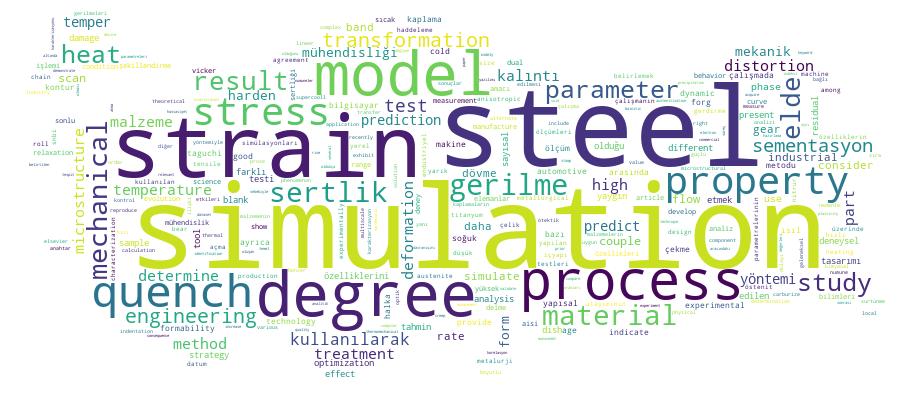
Competency Cloud
21 results
Scholarly Output Search Results
Now showing 1 - 10 of 21
Article Citation - WoS: 4Citation - Scopus: 4Simulation of Through-Hardening of Sae 52100 Steel Bearings - Part Ii: Validation at Industrial Scale(Wiley-v C H verlag Gmbh, 2016) Evcil, G. E.; Mustak, O.; Simsir, C.In this study, the material dataset presented in part I of this article is validated at industrial scale in batch through-hardening of bearing races. The material dataset acquired is implemented in a commercial heat treatment simulation software. Heat transfer coefficients for the oil and salt bath are determined by using a commercial standard quench probe. Zone temperatures and transfer times of the roller-belt furnace are measured directly from the system. Through-hardening of inner ring (IR) of 6813 bearing in oil and salt bath is simulated considering most of the industrial details. Finally, predicted dimensional changes are compared with the coordinate measurement results and a good agreement is achieved. It is concluded that determined material and process data, idealizations and simulation procedure can be considered "validated" for further improvement of the industrial process.Article Transformation Induced Plasticity (trip) of Sae 52100 Steel During Martensitic and Bainitic Transformations(2017) Şimşir, CanerTransformation induced plasticity (TRIP) of SAE 52100 steel during quenching is investigatedboth experimentally and theoretically. TRIP parameter (K) is determinedexperimentally for both martensitic and bainitic transformations by using the stresseddilatometry technique. A new method for extraction of for an incomplete transformationis suggested for the martensitic transformation. Theoretical calculations using wellestablishedmodels for the TRIP effect and the results from the literature are used forthe justification of the results of this work. The results for bainitic transformation isfound to be in good agreement with both the literature and theoretical calculations usingLeblond`s model. On the other hand, experimentally determined value is found to besignificantly different from the literature. Nevertheless, it is still in reasonable agreementwith the calculations using Leblond`s model.Article Citation - Scopus: 2Anisotropic Transformation Strain and Its Consequences on Distortion During Austenitization(Amer Soc Testing Materials, 2012) Simsir, Caner; Lubben, Thomas; Hunkel, Martin; Hoffmann, Franz; Zoch, Hans-WernerThe distribution of segregations, which is introduced in the continuous casting process and modified during succeeding manufacturing steps, is considered as an important "distortion potential carrier" for chemically banded steels. This article presents a recently developed mathematical model for integration of the effect of prior forming and cutting operations into heat-treatment simulations by considering "anisotropic transformation strain (ATS)." The model was justified experimentally by simulating the heating and austenitization of dilatometer specimens machined from the forged discs with distinct orientations with respect to the banded microstructure. After the verification, it is used in conjunction with former experimental work to demonstrate that the distribution of fiber flow is one of the important reasons of the dishing of carburized discs. The model provides promising results for process chain simulation to predict the heat-treatment distortion that cannot be predicted with currently available models.Article Strain Hardening Behavior Characterization of Dual Phase Steels(2018) Davut, Kemal; Şimşir, Caner; Çetin, BarişThe requirements for higher passenger safety, improved fuel economy and weight reductionin automobile industry necessitates the usage of advanced high strength steel (AHSS)grades. Dual phase (DP) steels are the most widely used one among AHSS. DP steels becomeincreasingly popular, since they provide a combination of sufficient formability at room temperatureand tensile strength over 1000 MPa. The current standards for DP steels only specifiesyield and tensile strength. Steels from various producers have considerably different compositionand microstructure; however they still have the same grade name. Combined withthe inherited heterogeneous microstructure, those steels exhibit different strain hardeningbehavior. The aim of this study is to evaluate the strain hardening behavior of DP800 steels,obtained from different vendors and thus having different compositions and microstructures.The strain hardening behavior was characterized with tensile tests performed along rollingand transverse directions. The microstructure has been characterized with optical andscanning electron microscopes. The martensite fraction, grain size of ferrite and chemicalcomposition has been correlated to the strain hardening behavior. The results show thatthe steel with more micro-alloying addition has finer ferritic grain size, which cause higherinitial strain hardening rate. The steel with higher Mn and Cr has higher martensite fraction,which cause strain hardening rate to be higher at higher strain levels.Article Citation - WoS: 7Citation - Scopus: 9Parameter Identification for an Armstrong-Frederick Hardening Law for Supercooled Austenite of Sae 52100 Steel(Elsevier, 2010) Wolff, Michael; Suhr, Bettina; Simsir, CanerThe mechanical properties of the supercooled austenite phase are sensitive parameters for the prediction of distortion of the components during heat treatments as the inelastic deformation occurs mostly on the soft austenite phase. Recent studies clarified that one of the overlooked issues related with the thermomechanical behavior of supercooled austenite during heat treatment and welding is its complicated cyclic hardening behavior (cf. Simsir et al., Acta Materialia, 2010). Based on those concerns, this article presents an optimization method for determination of temperature-dependent parameters for an Armstrong-Frederick model with combined non-linear kinematic and isotropic hardening, which can potentially pull the quality of simulations through. The results indicate that the proposed approach yields satisfactory results for simulation of heat treatments and welding even with a small and imperfect experimental data pool. (C) 2010 Elsevier B.V. All rights reserved.Conference Object Citation - WoS: 4Citation - Scopus: 4A Material Perspective on Consequence of Deformation Heating During Stamping of Dp Steels(Iop Publishing Ltd, 2017) Simsir, C.; Cetin, B.; Efe, M.; Davut, K.; Bayramin, B.Recent studies showed that, during stamping of high strength steels at industrially relevant production rates, local temperature in the blank may rise up to 200 degrees C - 300 degrees C due to deformation heating. Moreover, die temperature may also rise up to 100 degrees C - 150 degrees C for progressive stamping dies. Based on the common assumption that the blank softens as the temperature increases, thermal softening creates a margin in Forming Limit Diagram (FLD) and therefore the FLD determined at room temperature can safely be used for those cases. In this article, the validity of this assumption on DP590 steel is questioned by high temperature tensile tests (RT - 300 degrees C) at various strain rates (10(-3) s(-1) - 1 s(-1)). The results indicated a decrease both in uniform and total elongation in 200 degrees C - 300 degrees C range together with several other symptoms of Dynamic Strain Aging (DSA) at all strain rates. Concurrent with the DSA, the simulated FLD confirms the lower formability at high temperature and strain rates. Thus, it is concluded FLD determined at RT may not be valid for the investigated steels.Article Citation - WoS: 6Citation - Scopus: 6Excessive Damage Increase in Dual Phase Steels Under High Strain Rates and Temperatures(Sage Publications Ltd, 2021) Cobanoglu, Merve; Ertan, Rasim K.; Simsir, Caner; Efe, MertDamage formation in dual phase steels is a complex process and it may be sensitive to the deformation conditions and mechanisms. In this study, the damage parameter is measured and compared under quasi-static and industrial forming conditions (temperatures: 25 vs 200, 300 degrees C and strain rates: 10(-3)vs 10 s(-1)) for DP590 and DP800 steels. Resonance frequency and ultrasonic sound velocity techniques are utilized for the measurements to test the effectiveness and validity of each technique. At a given strain, the damage values can be up to 700% higher at industrial forming conditions, under which dynamic strain aging (DSA) controls the deformation behavior. DSA results in lower formability and is the likely mechanism responsible from the abnormal damage evolution. Measured damage parameters are also confirmed with the void fraction characterization by microscopy, which also provided details on the void shape and distribution with respect to the deformation conditions.Conference Object Citation - Scopus: 2Fem Modeling of the Distortion of Blank/Case Hardened Gear Blanks Due To Chemical Banding(2012) Şimşir,C.; Hunkel,M.; Lütjens,J.; Rentsch,R.In this study, a FEM process-chain simulation model is presented for the prediction of distortion of blank and case-hardened SAE 5120 (EN 20MnCr5) steel gear blanks. For this purpose, the evolution of the banded microstructure stemming from the continuous casting process was traced by computer simulations of subsequent shape rolling, forging and machining steps. The calculated flow-net was imported into the in-house heat treatment simulation module empowered with the recently developed "Anisotropic Transformation Strain (ATS)" model which enables the inclusion of the effect of banded microstructure on distortion. Then, both blank and case-hardening processes were simulated and verified experimentally. The results indicate good predictions of the dishing directions and dishing-free cutting strategy in both cases; the dishing magnitude is predicted well in blank-hardening simulations while the quality of the prediction is reasonable in case-hardening. Copyright © 2012 ASM International® All rights reserved.Article Citation - WoS: 46Citation - Scopus: 51Multiscale modeling of tempering of AISI H13 hot-work tool steel - Part 1: Prediction of microstructure evolution and coupling with mechanical properties(Elsevier, 2016) Eser, A.; Broeckmann, C.; Simsir, C.In the first part of this two part study, the mechanical properties necessary for the simulation of tempering of an AISI H13 (DIN 1.2344, X40CrMoV5-1) tool steel was derived using physically based precipitation simulations and microstructure-property relationships. For this purpose, the precipitation of fine carbides were simulated using a thermo-kinetic software which allows prediction of the evolution of precipitation/dissolution reactions and the particle sizes. Then, those microstructural findings were coupled with physically based microstructure-property models to predict the yield stress, flow curve and creep properties. The predicted mechanical properties were verified with corresponding experiments and a good agreement was found. In the second part of this study, those properties were coupled with a Finite Element (FE) model in order to predict the relaxation of internal stresses and the evolution of deformations at the macroscopic scale. (C) 2015 Elsevier B.V. All rights reserved.Conference Object Citation - WoS: 3Citation - Scopus: 4A Potential Solution To Mystical Materials in Indentation Test(Elsevier Science Bv, 2017) Billur, E.; Cetin, B.; Music, O.; Simsir, C.; Davut, K.Various methods have been designed to determine the elasto-plastic properties of metals. Instrumented indentation test (IIT) is considered to be a good candidate to determine local properties after manufacturing operations. In order to acquire elastoplastic properties from IIT, either dimensional analysis or inverse analysis of the force-displacement curve is performed. However, the major drawback of those methods is the uniqueness of the solution. Some materials may exhibit almost identical force-depth curves, although they have different elastoplastic properties. Those materials are referred as "mystical materials". In this contribution, topological features of the indentation surfaces, i.e. indent size, pile-up and sink-in behaviour, are investigated to find a differentiating property. According to the results, indent size, pile-up and sink-in behaviour may help to find the unique solution to the inverse problem. (C) 2017 The Authors. Published by Elsevier Ltd. Peer-review under responsibility of the scientific committee of the International Conference on the Technology of Plasticity.

- «
- 1 (current)
- 2
- 3
- »