Çiğdemoğlu, Ceyhan

Loading...
Profile Picture
Name Variants
Ceyhan, Çiğdemoğlu
Çiğdemoğlu C.
C.,Ceyhan
Çiğdemoğlu,C.
Çiğdemoğlu, Ceyhan
Cigdemoglu, Ceyhan
C., Ceyhan
C.,Çiğdemoğlu
C.,Cigdemoglu
Ceyhan, Cigdemoglu
Ç.,Ceyhan
Cigdemoglu C.
C., Cigdemoglu
Ç., Ceyhan
C., Çiğdemoğlu
Cigdemoglu,C.
Çığdemoğlu, Ceyhan
Cigdemoglu, C.
Job Title
Doçent Doktor
Email Address
ceyhan.cigdemoglu@atilim.edu.tr
Main Affiliation
Public Relations and Advertising
Status
Website
ORCID ID
Scopus Author ID
Turkish CoHE Profile ID
Google Scholar ID
WoS Researcher ID

Sustainable Development Goals

NO POVERTY1
NO POVERTY
0
Research Products
ZERO HUNGER2
ZERO HUNGER
0
Research Products
GOOD HEALTH AND WELL-BEING3
GOOD HEALTH AND WELL-BEING
1
Research Products
QUALITY EDUCATION4
QUALITY EDUCATION
5
Research Products
GENDER EQUALITY5
GENDER EQUALITY
0
Research Products
CLEAN WATER AND SANITATION6
CLEAN WATER AND SANITATION
0
Research Products
AFFORDABLE AND CLEAN ENERGY7
AFFORDABLE AND CLEAN ENERGY
0
Research Products
DECENT WORK AND ECONOMIC GROWTH8
DECENT WORK AND ECONOMIC GROWTH
2
Research Products
INDUSTRY, INNOVATION AND INFRASTRUCTURE9
INDUSTRY, INNOVATION AND INFRASTRUCTURE
0
Research Products
REDUCED INEQUALITIES10
REDUCED INEQUALITIES
0
Research Products
SUSTAINABLE CITIES AND COMMUNITIES11
SUSTAINABLE CITIES AND COMMUNITIES
0
Research Products
RESPONSIBLE CONSUMPTION AND PRODUCTION12
RESPONSIBLE CONSUMPTION AND PRODUCTION
3
Research Products
CLIMATE ACTION13
CLIMATE ACTION
3
Research Products
LIFE BELOW WATER14
LIFE BELOW WATER
0
Research Products
LIFE ON LAND15
LIFE ON LAND
0
Research Products
PEACE, JUSTICE AND STRONG INSTITUTIONS16
PEACE, JUSTICE AND STRONG INSTITUTIONS
0
Research Products
PARTNERSHIPS FOR THE GOALS17
PARTNERSHIPS FOR THE GOALS
1
Research Products
Documents

16

Citations

458

h-index

9

Documents

10

Citations

187

Scholarly Output

52

Articles

30

Views / Downloads

10/0

Supervised MSc Theses

17

Supervised PhD Theses

0

WoS Citation Count

275

Scopus Citation Count

458

Patents

0

Projects

0

WoS Citations per Publication

5.29

Scopus Citations per Publication

8.81

Open Access Source

13

Supervised Theses

17

JournalCount
Chemistry Education Research and Practice3
World Conference on Educational Technology Researches (WCETR) -- JUL 05-09, 2011 -- East Univ, Nicosia, CYPRUS2
İşletme Araştırmaları Dergisi2
Science & Education2
Science Education International2
Current Page: 1 / 4

Scopus Quartile Distribution

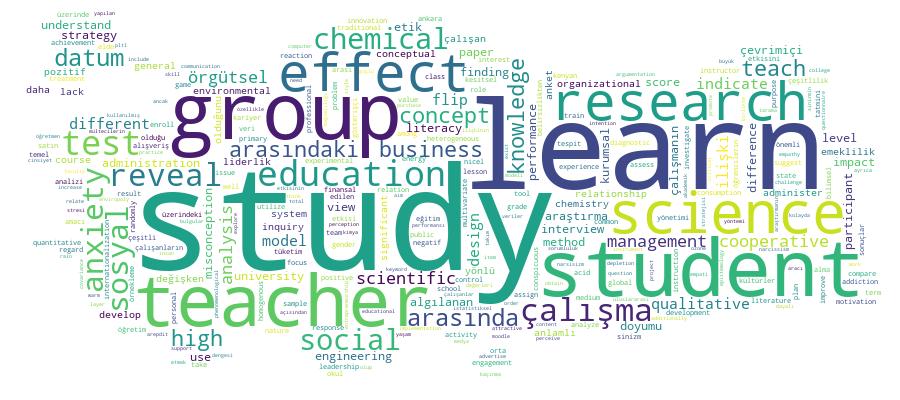
Competency Cloud

GCRIS Competency Cloud

Scholarly Output Search Results

Now showing 1 - 5 of 5
  • Article
    A Three-Tier Diagnostic Test To Assess Pre-Service Teachers’ Misconceptions About Global Warming, Greenhouse Effect, Ozone Layer Depletion, and Acid Rain
    (International Journal of Science Education, 2012) Arslan, Harika Özge; Çiğdemoğlu, Ceyhan; Moseley, Christine
    This study describes the development and validation of a three-tier multiple-choice diagnostic test, the atmosphere-related environmental problems diagnostic test (AREPDiT), to reveal common misconceptions of global warming (GW), greenhouse effect (GE), ozone layer depletion (OLD), and acid rain (AR). The development of a two-tier diagnostic test procedure as described by Treagust constitutes the framework for this study. To differentiate a lack of knowledge from a misconception, a certainty response index is added as a third tier to each item. Based on propositional knowledge statements, related literature, and the identified misconceptions gathered initially from 157 pre-service teachers, the AREPDiT was constructed and administered to 256 pre-service teachers. The Cronbach alpha reliability coefficient of the pre-service teachers’ scores was estimated to be 0.74. Content and face validations were established by senior experts. A moderate positive correlation between the participants’ both-tiers scores and their certainty scores indicated evidence for construct validity. Therefore, the AREPDiT is a reliable and valid instrument not only to identify pre-service teachers’ misconceptions about GW, GE, OLD, and AR but also to differentiate these misconceptions from lack of knowledge. The results also reveal that a majority of the respondents demonstrated limited understandings about atmosphere related environmental problems and held six common misconceptions. Future studies could test the AREPDiT as a tool for assessing the misconceptions held by pre-service teachers from different programs as well as in-service teachers and high school students.
  • Article
    A Phenomenological Study of Instructors’ Experiences on an Open Source Learning Management System
    (Procedia - Social and Behavioral Sciences, 2011) Çiğdemoğlu, Ceyhan; Arslan, Harika Özge; Akay, Hasan
    This paper focuses on instructors’ experiences on usage of an open-source Learning Management System (LMS), Moodle in their courses. The study was conducted in a private university in Ankara, Turkey where the widespread use of the Moodle has only recently started. The phenomenological design has been utilized as qualitative research method for this paper. The Participants comprised in structures from different faculties who are new users of the Moodle. Open-ended interviews were carried out, and the data was transcribed into codes and themes. The research findings indicate that instructors have different impressions from the system in terms of their effort and expectation.
  • Article
    Taking Attention on Environmental Issues by an Attractive Educational Game: Enviropoly
    (Procedia - Social and Behavioral Sciences, 2011) Arslan, Harika Özge; Moseley, Christine; Çiğdemoğlu, Ceyhan
    Researches in interdisciplinary teaching methodologies on environmental education and in assessing their impact were recommended in Thessaloniki Declaration (UNESCO, 1997). Therefore, the purpose of this qualitative study was to develop and field test an educational game, EnviroPoly, to promote environmental literacy. The game was piloted with 44 elementary/mid level pre-service teachers. Afterwards five pre-service teachers met in a focus group to discuss the game and its procedures. The discussions and observations of the large group of teachers during play and the smaller focus group indicated that EnviroPoly is attractive, motivating, enjoyable and useful. Additionally the game was found to be applicable for different grade levels by adapting reading and question cards.
  • Article
    Bilimsel Okuryazarlık
    (Bilim ve Teknoloji, 2012) Çiğdemoğlu, Ceyhan
    Fen ve matematik alanları eğitimi yüksek öğretime geçişte özellikle temel bilimler ve mühendislik gibi alanların alt yapısını oluşturduğu için önemlidir. Son zamanlarda bilim ve teknolojideki yüksek ivmeli gelişmeler özellikle bu alanlardaki bilgi birikiminin ürünü olarak düşünülebilir. Bilimsel bilginin, teknoloji ile birlikte hızla ilerlemesinde;araştıran, sorgulayan, problemlere çözümler arayan bireylerin rolü yadsınamaz. Çağın gereksinimleri doğrultusunda bireyler yetiştirmeyi hedefleyen tüm öğretim kurumlarının temel amaçlarından biri de öğrencileri bilimsel okuryazar olarak yetiştirmektir. Genellikle modern toplumlarda bireylerin sadece belirli uzmanlık alanları dışında, bazı temel konularda akılcı yorumlar yapabilmesi de beklenir. Bybee (1997) ye göre bilimsel okuryazarlık, bilimsel bilgiyi kullanabilmeyi, problemleri tanımlayıp kanıta dayalı sonuçlar çıkararak dünyayı anlamayı ve insan faaliyetlerinin neden olduğu değişimler konusunda karar verebilmeyi gerektirir. Öğrencilerin doğal çevrelerinde karşılaştıkları olayları merak etmesi, bu olaylara karşı duyarlı olup uygun davranışlar sergilemesi, sorunlara akılcı çözümler bulabilmesi, bilgiye ulaşıp onu kullanmayı bilmesi, bilimsel okuryazar bireylerin özelliklerindendir. Örneğin bilimsel okuryazar olan bir birey, küresel ısınma, kanser, kök hücre, asit yağmurları, ve enerji kaynakları gibi konularda açıklamalarda bulunabilir, bilimsel bilgisi doğrultusunda yorumlar yapabilir. Aslında “bilimsel-okuryazarlık” toplumda çoğu zaman “genel kültür” olarak kullanılan kavramın bilimle ilgili olan kısmı olarak da açıklanabilir.
  • Article
    Heterogeneity in Classes: Cooperative Problem-Solving Activities Through Cooperative Learning
    (Croatian Journal of Education, 2014) Çiğdemoğlu, Ceyhan; Kapusuz, Kamil Yavuz; Kara, Ali
    Teachers, from primary schools to college, experience challenges regarding both increased class sizes and a greater diversity of students having a broad spectrum of abilities, interests, needs, and goals. The aim of this paper is to investigate the effect of cooperative learning through Cooperative Problem-Solving (CPS) activities on homogenous and heterogeneous grouping in an engineering course. As a mixed method design, the study utilized both quantitative and qualitative data. The participants, 47 engineering students selected conveniently, were enrolled in a communication systems course. The analysis of the quantitative data indicated that no significant difference (p= .791) exists between the ways in which the students in homogenous and the students in heterogeneous group understand communication systems. In order to reveal the perceptions of students regarding the implementation, they were interviewed at the end of the semester. The qualitative data obtained from these interviews suggests that students prefer heterogeneous to homogenous grouping. The findings also imply that further research should concentrate on heterogeneous grouping strategies and more detailed qualitative data in order to reveal what kind of patterns emerge from students’ interactions in different groupings.