
Mıshra, Alok
Loading...
Profile URL
Name Variants
Mishra, A.
Mishra, A
Mishra A.
Alok, Mishra
Mıshra, Alok
A., Mishra
Alok M.
M., Alok
M.,Alok
Mishra, Alok
Mishra,A.
A.,Mıshra
A.,Mishra
Alok, Mıshra
A., Mıshra
Mıshra,A.
Mishra, A
Mishra A.
Alok, Mishra
Mıshra, Alok
A., Mishra
Alok M.
M., Alok
M.,Alok
Mishra, Alok
Mishra,A.
A.,Mıshra
A.,Mishra
Alok, Mıshra
A., Mıshra
Mıshra,A.
Job Title
Profesor Doktor
Email Address
alok.mishra@atilim.edu.tr
Main Affiliation
Software Engineering
Status
Website
ORCID ID
Scopus Author ID
Turkish CoHE Profile ID
Google Scholar ID
WoS Researcher ID
Sustainable Development Goals
 1
1NO POVERTY
0
Research Products
 2
2ZERO HUNGER
1
Research Products
 3
3GOOD HEALTH AND WELL-BEING
9
Research Products
 4
4QUALITY EDUCATION
6
Research Products
 5
5GENDER EQUALITY
1
Research Products
 6
6CLEAN WATER AND SANITATION
1
Research Products
 7
7AFFORDABLE AND CLEAN ENERGY
0
Research Products
 8
8DECENT WORK AND ECONOMIC GROWTH
0
Research Products
 9
9INDUSTRY, INNOVATION AND INFRASTRUCTURE
8
Research Products
 10
10REDUCED INEQUALITIES
0
Research Products
 11
11SUSTAINABLE CITIES AND COMMUNITIES
4
Research Products
 12
12RESPONSIBLE CONSUMPTION AND PRODUCTION
4
Research Products
 13
13CLIMATE ACTION
4
Research Products
 14
14LIFE BELOW WATER
4
Research Products
 15
15LIFE ON LAND
0
Research Products
 16
16PEACE, JUSTICE AND STRONG INSTITUTIONS
10
Research Products
 17
17PARTNERSHIPS FOR THE GOALS
2
Research Products

This researcher does not have a Scopus ID.

Documents
165
Citations
2516

Scholarly Output
197
Articles
103
Views / Downloads
696/2397
Supervised MSc Theses
13
Supervised PhD Theses
8
WoS Citation Count
2022
Scopus Citation Count
3009
Patents
0
Projects
0
WoS Citations per Publication
10.26
Scopus Citations per Publication
15.27
Open Access Source
42
Supervised Theses
21
| Journal | Count |
|---|---|
| Sensors | 7 |
| TEM Journal | 7 |
| Computers in Human Behavior | 4 |
| Applied Sciences | 4 |
| Electronics Information and Planning | 4 |
Current Page: 1 / 22
Scopus Quartile Distribution
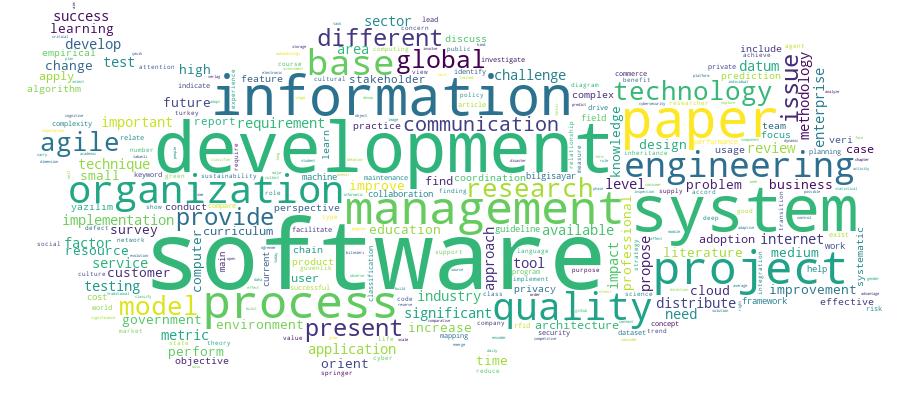
Competency Cloud
47 results
Scholarly Output Search Results
Now showing 1 - 10 of 47
Conference Object Citation - Scopus: 2Software Quality Management Improvement Through Mentoring: an Exploratory Study From Gsd Projects(2011) Colomo-Palacios,R.; Soto-Acosta,P.; Mishra,A.; García-Crespo,Á.Software Quality Management (SQM) is a set of processes and procedures designed to assure the quality of software artifacts along with their development process. In an environment in which software development is evolving to a globalization, SQM is seen as one of its challenges. Global Software Development is a way to develop software across nations, continents, cultures and time zones. The aim of this paper is to detect if mentoring, one of the lead personnel development tools, can improve SQM of projects developed under GSD. The results obtained in the study reveal that the influence of mentoring on SQM is just temperate. © 2011 Springer-Verlag.Book Part Citation - Scopus: 2Novel Covid-19 Recognition Framework Based on Conic Functions Classifier(Springer Science and Business Media Deutschland GmbH, 2022) Karim,A.M.; Mishra,A.The new coronavirus has been declared as a global emergency. The first case was officially declared in Wuhan, China, during the end of 2019. Since then, the virus has spread to nearly every continent, and case numbers continue to rise. The scientists and engineers immediately responded to the virus and presented techniques, devices and treatment approaches to fight back and eliminate the virus. Machine learning is a popular scientific tool and is applied to several medical image recognition problems, involving tumour recognition, cancer detection, organ transplantation and COVID-19 diagnosis. It is proved that machine learning presents robust, fast and accurate results in various medical image recognition problems. Generally, machine learning-based frameworks consist of two stages: feature extraction and classification. In the feature extraction, overwhelmingly unsupervised learning techniques are applied to reduce the input data’s size. This step extracts appropriate features by reducing the computational time and increasing the performance of the classifiers. A classifier is the second step that aims to categorise the input. Within the proposed step, the unsupervised part relies on the feature extraction by using local binary patterns (LBP), followed by feature selection relying on factor analysis technique. The LBP is a kind of visual descriptor, mainly applied for image recognition problem. The aim of using LBP is to analyse the input COVID-19 image and extract salient features. Furthermore, factor analysis is a statistical technique applied to define variability among observed variables in less unnoticed variables named factors. The factor analysis applied to the LBP wavelet aims to select sensitive features from input data (LBP output) and reduce the size input. In the last stage, conic functions classifier is applied to classify two sets of data, categorising the extracted features by using LBP and factor analysis as positive or negative COVID-19 cases. The proposed solution aims to diagnose COVID-19 by using LBP and factor analysis, based on conic functions classifier. The conic functions classifier presents remarkable results compared with these popular classifiers and state-of-the-art studies presented in the literature. © 2022, Springer Nature Switzerland AG.Conference Object Üniversite Yazilim Mühendisligi Programlari Müfredatinin Swebok Kilavuzu Kullanilarak Degerlendirme ve İyilestirilmesi: Türkiye'de Bir Vaka Çalismasi(CEUR-WS, 2015) Garousi,V.; Mishra,A.; Yazici,A.[No abstract available]Book Part E-mentoring in global software development teams: Success factors to develop a common culture(IGI Global, 2012) Colomo-Palacios,R.; Mishra,A.; Casado-Lumbreras,C.; Soto-Acosta,P.Global Software Development (GSD) teams face communication and coordination problems due to spatial, temporal, and cultural separation between team members. Cultural diversity and cross-cultural management are significant issues among GSD teams. In software development projects, mentoring dramatically reduces the learning curve for novice human resources. Due to the large amount of electronic communication instruments, a remarkable number of different e-Mentoring concepts have emerged, which provides opportunity for mentoring that would not otherwise be possible. This chapter presents key success factors to enable e-Mentoring as a tool to develop a common culture in GSD scenarios. These success factors enable the correct application of mentoring programmes and the use of this to build a common culture in organizations that perform GSD. © 2013, IGI Global.Conference Object Citation - Scopus: 1Crm System Implementation in a Multinational Enterprise(2009) Mishra,A.; Mishra,D.The concept of customer relationship management (CRM) resonates with managers in today's competitive economy. As more and more organizations realize the significance of becoming customer-centric in today's competitive era, they embrace CRM as a core business strategy. CRM an integration of information technology and relationship marketing provides the infrastructure that facilitates long-term relationship building with customers at an enterprise-wide level. Successful CRM implementation is a complex, expensive and rarely technical projects. This paper presents the successful implementation of CRM in a multinational organization. This study will facilitate in understanding transition, constraints and implementation of CRM in multinational enterprises. © Springer-Verlag 2009.Book Part E-mentoring in global software development teams: Success factors to develop a common culture(IGI Global, 2013) Colomo-Palacios,R.; Mishra,A.; Casado-Lumbreras,C.; Soto-Acosta,P.Global Software Development (GSD) teams face communication and coordination problems due to spatial, temporal, and cultural separation between team members. Cultural diversity and cross-cultural management are significant issues among GSD teams. In software development projects, mentoring dramatically reduces the learning curve for novice human resources. Due to the large amount of electronic communication instruments, a remarkable number of different e-Mentoring concepts have emerged, which provides opportunity for mentoring that would not otherwise be possible. This chapter presents key success factors to enable e-Mentoring as a tool to develop a common culture in GSD scenarios. These success factors enable the correct application of mentoring programmes and the use of this to build a common culture in organizations that perform GSD. © 2014, IGI Global.Book Part Citation - Scopus: 12Sustainable Software Engineering: Curriculum Development Based on Acm/Ieee Guidelines(Springer International Publishing, 2021) Mishra,A.; Mishra,D.Climate change risk and environmental degradation are the most critical issues of our society. Our technology-influenced daily lifestyle involves many types of software and apps which are used by society at large, and their use is increasing more than ever before. Sustainability is a significant topic for future professionals and more so for software engineers due to its impact on society. It is crucial to motivate and raise concern among students and faculty members regarding sustainability by including it in the Software Engineering (SE) curriculum. This chapter discusses how sustainability can be included in various courses of the SE curriculum by considering ACM/IEEE curriculum guidelines for the SE curriculum, literature review, and various viewpoints so that SE students can attain knowledge on sustainable software engineering. It also includes an assessment of key competences in sustainability for proposed units in the SE curriculum. © Springer Nature Switzerland AG 2021. All rights reserved.Book Part Citation - Scopus: 2A Study of Software Process Improvement in Small and Medium Organizations(IGI Global, 2008) Mishra,D.; Mishra,A.Presently, the majority of software development, including outsourcing, is carried out by small and medium size software development organizations all over the world. These organizations are not capable to bear the cost of implementing available software process improvement models like CMMI, SPICE, ISO, and so forth. Therefore, there is a need to address this problem. In this chapter, various software process assessment and software process improvement models for small and medium scale organizations are discussed and compared. This will lead towards development of standardized software process improvement model for small and medium sized software development organizations in the future. © 2008, IGI Global.Article Citation - Scopus: 15Software Quality Assurance Models in Small and Medium Organisations: a Comparison(Inderscience Publishers, 2006) Mishra,A.; Mishra,D.Presently, the majority of software development including outsourcing is carried out by small- and medium-sized software development organisations all over the world. These organisations are not capable of bearing the cost of implementing available software quality models like CMM, SPICE, ISO, etc. Therefore, there is a need to address this problem. In this paper, we have tried to compare the main characteristics, benefits, and limitations of the models for small and medium software development organisations. We believe that this effort will contribute towards the development of a standardised quality improvement model for small- and medium-sized software development organisations. Copyright © 2006 Inderscience Enterprises Ltd.Conference Object Citation - Scopus: 1Inventory System Transition Towards ERP(Institute of Electrical and Electronics Engineers Inc., 2019) Alansari,S.; Mishra,A.To do activities effectively and generate a value chain for organization competitiveness, it is required to run supply chain in best way by logistic services information system. Supply chains in the best way using logistic services information. Supply chain management has two purposes, first to deliver the product to the end users via multiple departments and, secondly, to deliver products to last customers because as it is beneficial to manage such product with coordination and monitoring everyday supply.To improve departments by equipping them with the best strategic information system, and to avoid all the associated risks its requires to have a specific system for inventory control. Therefore, the main goal of this paper is to illustrate the transition of the existing systems towards Enterprise Resource Planning (ERP). The study also proposes inception plans to develop the necessary software and search towards the best system by keeping in view many organizational constraints. To the end, a survey is carried out to measure the relationship between management models and organizational innovativeness in internal processes as part of the efforts towards adopting the new system planning. © 2019 IEEE.
