
Kılıç, Sadık Engin
Loading...
Profile URL
Name Variants
K.,Sadik Engin
Sadık Engin, Kılıç
Kılıç S.
S. E. Kılıç
Kılıç, Sadık Engin
S.E.Kılıç
Kiliç S.
S.,Kılıç
Kilic S.
K.,Sadık Engin
K., Sadik Engin
Kilic,S.E.
S. E. Kilic
K., Sadık Engin
Kılıç,S.E.
Sadik Engin, Kilic
Sadık Engin Kılıç
S., Kilic
Kilic, Sadik Engin
Kilic,Sadik Engin
S.E.Kilic
Kilic, S. Engin
Sadık Engin, Kılıç
Kılıç S.
S. E. Kılıç
Kılıç, Sadık Engin
S.E.Kılıç
Kiliç S.
S.,Kılıç
Kilic S.
K.,Sadık Engin
K., Sadik Engin
Kilic,S.E.
S. E. Kilic
K., Sadık Engin
Kılıç,S.E.
Sadik Engin, Kilic
Sadık Engin Kılıç
S., Kilic
Kilic, Sadik Engin
Kilic,Sadik Engin
S.E.Kilic
Kilic, S. Engin
Job Title
Profesör Doktor
Email Address
engin.kilic@atilim.edu.tr
Main Affiliation
Manufacturing Engineering
Status
ORCID ID
Scopus Author ID
Turkish CoHE Profile ID
Google Scholar ID
WoS Researcher ID
Sustainable Development Goals
 1
1NO POVERTY
0
Research Products
 2
2ZERO HUNGER
0
Research Products
 3
3GOOD HEALTH AND WELL-BEING
1
Research Products
 4
4QUALITY EDUCATION
0
Research Products
 5
5GENDER EQUALITY
0
Research Products
 6
6CLEAN WATER AND SANITATION
0
Research Products
 7
7AFFORDABLE AND CLEAN ENERGY
2
Research Products
 8
8DECENT WORK AND ECONOMIC GROWTH
0
Research Products
 9
9INDUSTRY, INNOVATION AND INFRASTRUCTURE
12
Research Products
 10
10REDUCED INEQUALITIES
0
Research Products
 11
11SUSTAINABLE CITIES AND COMMUNITIES
0
Research Products
 12
12RESPONSIBLE CONSUMPTION AND PRODUCTION
5
Research Products
 13
13CLIMATE ACTION
1
Research Products
 14
14LIFE BELOW WATER
0
Research Products
 15
15LIFE ON LAND
1
Research Products
 16
16PEACE, JUSTICE AND STRONG INSTITUTIONS
0
Research Products
 17
17PARTNERSHIPS FOR THE GOALS
0
Research Products

Documents
40
Citations
1080
h-index
18

Documents
29
Citations
616

Scholarly Output
34
Articles
19
Views / Downloads
77/105
Supervised MSc Theses
4
Supervised PhD Theses
2
WoS Citation Count
388
Scopus Citation Count
496
Patents
0
Projects
0
WoS Citations per Publication
11.41
Scopus Citations per Publication
14.59
Open Access Source
10
Supervised Theses
6
| Journal | Count |
|---|---|
| The International Journal of Advanced Manufacturing Technology | 4 |
| Machining Science and Technology | 3 |
| Procedia CIRP | 3 |
| Journal of Cleaner Production | 2 |
| International Journal of Computer Integrated Manufacturing | 2 |
Current Page: 1 / 4
Scopus Quartile Distribution
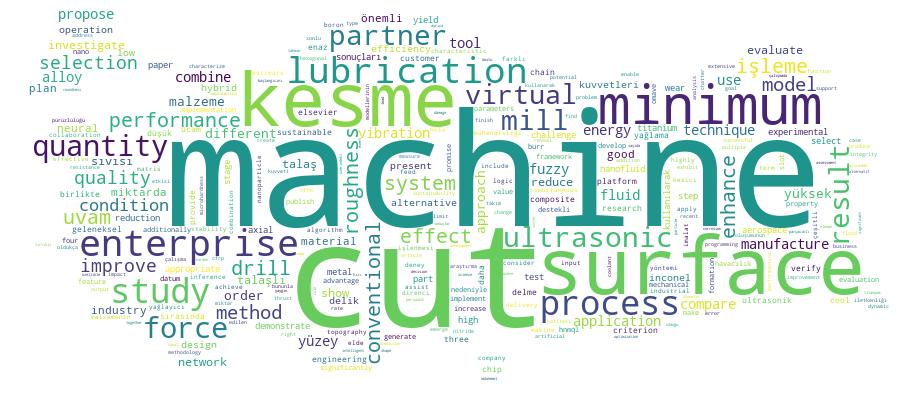
Competency Cloud
7 results
Scholarly Output Search Results
Now showing 1 - 7 of 7
Article Citation - WoS: 38Citation - Scopus: 45Slot milling of titanium alloy with hexagonal boron nitride and minimum quantity lubrication and multi-objective process optimization for energy efficiency(Elsevier Sci Ltd, 2020) Osman, Khaled Ali; Yilmaz, Volkan; Unver, Hakki Ozgur; Seker, Ulvi; Kilic, Sadik EnginThe implementation of sustainable manufacturing techniques to make machining processes more eco-friendly is a challenging topic that has attracted significant attention from the industrial sector for many years. As one of the dominant manufacturing processes, machining can have a considerable impact in terms of ecology, society, and economics. In certain areas, this impact is a result of using certain cutting fluids, especially during the machining of difficult-to-cut alloys such as titanium, where a large amount of cutting fluid is wasted to ease the cutting process. In such scenarios, identifying suitable machining conditions to supply cutting fluids using eco-friendly techniques is currently a major focus of academic and industrial sector research. In this study, effects of minimum quantity lubrication with different concentrations of hexagonal boron nitride nanoparticles on the surface roughness and cutting force of slot-milled titanium alloy is investigated using analysis of variance and response surface methodology. The results reveal that all responses are sensitive to changes in the feed per tooth, cutting depth, and cutting fluid flow rate. The regression functions generated were combined with particle swarm optimization in order to improve energy-efficiency, as well. Possible sectorial scenarios were generated for wider industrial adoption. With this study, it was proven that utilizing minimum quantity lubrication with hexagonal boron nitride nanoparticles can reduce both cutting force and surface roughness, which makes it to be a promising alternative as a nanoparticle augmented minimum quantity lubrication method for machining titanium alloys. (C) 2020 Elsevier Ltd. All rights reserved.Article Citation - WoS: 15Citation - Scopus: 20A Survey of Partner Selection Methodologies for Virtual Enterprises and Development of a Goal Programming-Based Approach(Springer London Ltd, 2016) Nikghadam, Shahrzad; Sadigh, Bahram Lotfi; Ozbayoglu, Ahmet Murat; Unver, Hakki Ozgur; Kilic, Sadik EnginA virtual enterprise (VE) is a platform that enables dynamic collaboration among manufacturers and service providers with complementary capabilities in order to enhance their market competitiveness. The performance of a VE as a system depends highly on the performance of its partner enterprises. Hence, choosing an appropriate methodology for evaluating and selecting partners is a crucial step toward creating a successful VE. In this paper, we begin by presenting an extensive review of articles that address the VE partner selection problem. To fill a significant research gap, we develop a new goal programming (GP)-based approach that can be applied in extreme bidding conditions such as tight delivery timelines for large demand volumes. In this technique, fuzzy analytic hierarchy process (F-AHP) is used to determine customer preferences for four main criteria: proposed unit price, on-time delivery reliability, enterprises' past performance, and service quality. These weights are then incorporated into the GP model to evaluate bidders based on customers' preferences and goals. We present a case study in which we implement the F-AHP-GP technique and verify the model's applicability, as it provides a more flexible platform for matching customers' preferences.Conference Object Citation - WoS: 5Citation - Scopus: 10Design of a Customer's Type Based Algorithm for Partner Selection Problem of Virtual Enterprise(Elsevier Science Bv, 2016) Nikghadam, Shahrzad; Ozbayoglu, Ahmet Murat; Unver, Hakki Ozgur; Kilic, Sadik EnginVirtual Enterprise (VE) is a temporary platform for individual enterprises to collaborate with each other, sharing their core competencies to fulfill a customer demand. In order to improve the customer satisfaction, the most successful VEs select their consortium's members based on customer's preferences. There is quite extensive literature in the field of partner selection in VE, each proposing a new approach to evaluate and select the most appropriate partners among pool of enterprises. However, none of the studies in literature recommend which partner selection methodology should be used in each project with a particular customer attitude. In this study an algorithm is proposed which classifies the customers into three categories; passive, standard and assertive. Three different approaches; Fuzzy Logic-FAHP TOPSIS and Goal programming are used for each customer type respectively. This classification is beneficial since the problem's characteristics; such as vagueness of data, change as the customer's attitude varies. The results certify that, adopting this algorithm not only helps the VE to select the most appropriate partners based on customer preferences, but also the model adapts itself to each customer's attitude. As a result, the overall system flexibility is significantly improved. (C) 2016 The Authors. Published by Elsevier B.V.Article Citation - WoS: 12Citation - Scopus: 19An Ontology-Based Multi-Agent Virtual Enterprise System (omave): Part 1: Domain Modelling and Rule Management(Taylor & Francis Ltd, 2017) Sadigh, Bahram Lotfi; Unver, Hakki Ozgur; Nikghadam, Shahrzad; Dogdu, Erdogan; Ozbayoglu, A. Murat; Kilic, S. EnginNew advancements in computers and information technologies have yielded novel ideas to create more effective virtual collaboration platforms for multiple enterprises. Virtual enterprise (VE) is a collaboration model between multiple independent business partners in a value chain and is particularly suited to small and medium-sized enterprises (SMEs). The most challenging problem in implementing VE systems is ineffcient and inFLexible data storage and management techniques for VE systems. In this research, an ontology-based multi-agent virtual enterprise (OMAVE) system is proposed to help SMEs shift from the classical trend of manufacturing part pieces to producing high-value-added, high-tech, innovative products. OMAVE targets improvement in the FLexibility of VE business processes in order to enhance integration with available enterprise resource planning (ERP) systems. The architecture of OMAVE supports the requisite FLexibility and enhances the reusability of the data and knowledge created in a VE system. In this article, a detailed description of system features along with the rule-based reasoning and decision support capabilities of OMAVE system are presented. To test and verify the functionality and operation of this system, a sample product was manufactured using OMAVE applications and tools with the contribution of three SMEs.Article Citation - WoS: 19Citation - Scopus: 20A Framework for Energy Reduction in Manufacturing Process Chains (e-Mpc) and a Case Study From the Turkish Household Appliance Industry(Elsevier Sci Ltd, 2016) Uluer, Muhtar Ural; Unver, Hakki Ozgur; Gok, Gozde; Fescioglu-Unver, Nilgun; Kilic, Sadik EnginEnergy is a major input in the manufacturing sector. Its security and efficiency are of supreme importance to a nation's industrial activities. Energy consumption also has serious environmental impacts in terms of Greenhouse Gas (GHG) emissions. In order to use energy more efficiently, simply designing parts and planning manufacturing processes with an energy-aware mindset is insufficient; it is also necessary to model and assess the energy efficiency of a process chain from a holistic point of view. In this work, we propose an integrated energy reduction framework and the internal methods to implement it. Our framework builds on three pillars. Creating an energy profile of a process chain is the first step in characterizing a manufacturing system in terms of energy demand. Energy-aware part designs and process plans are based on ISO/STEP 10303 AP224 standards in order to estimate the embodied energy of a mechanical part. Finally, using discrete event simulation methods, the energy consumption of a process chain is assessed and reduction scenarios are generated based on design or operational alternatives. A data collection and analytics system visualizing measures and key performance indicators (KPIs) also must be implemented in order to measure real consumption values and track improvement results over time. The energy reduction in manufacturing process chains (E-MPC) framework is unique in that it provides a structured method which enables the embodied energy of a part to be estimated during early design stages and further enables the evaluation of design impacts on process chains, thereby recognizing the dynamic nature of systems. A pilot case study of the framework was implemented at the largest household appliance manufacturer in Turkey, Arcelik A.S. In order to evaluate its usefulness and validity, we performed a detailed implementation on a fully automated crankshaft manufacturing line in Arcelilc's refrigerator compressor plant. The results reveal that design improvements estimated gains would reach 2%, whereas operational improvements yield up to 10% energy savings per produced part. (C) 2015 Elsevier Ltd. All rights reserved.Article Citation - WoS: 1Citation - Scopus: 1EFFECT OF THE MQL TECHNIQUE ON CUTTING FORCE AND SURFACE QUALITY DURING THE SLOT MILLING OF TITANIUM ALLOY(inst Za Kovinske Materiale I in Tehnologie, 2022) Osman, Khaled Ali; Yilmaz, Volkan; Unver, Hakki Ozgur; Seker, Ulvi; Kilic, S. EnginIn this study, the effects of four control parameters, i.e., the cutting speed (v(c)), feed per tooth (f), depth of cut (a(p)), and flow rate of the cutting fluid (Q), on the surface roughness (R-a) and cutting force (F-c) were investigated in the slot milling of titanium alloys (Ti-6A1-4V). The effects of the control parameters were determined by a statistical analysis. In addition, RSM models for R-a and F-c during machining under three cooling/lubrication conditions, i.e., dry, flood, and minimum quantity lubrication (MQL), were obtained. The results revealed that both R-a and F-c are sensitive to changes in f, a(p) and Q. It was found that the MQL condition generates lower values of R-a where the surface roughness value is 0.227 mu m. By contrast. F-c values under the MQL condition were close to those of the flood condition and at times even better. The machining performance at a cutting-fluid flow rate of 36 mL/h under the MQL condition was found to be the best under certain machining conditions. MQL was found to be an effective alternative technique for conventional conditions when machining Ti-6Al-4V.Article Citation - WoS: 8Citation - Scopus: 13An Ontology-Based Multi-Agent Virtual Enterprise System (omave): Part 2: Partner Selection(Taylor & Francis Ltd, 2017) Sadigh, Bahram Lotfi; Nikghadam, Shahrzad; Ozbayoglu, A. Murat; Unver, Hakki Ozgur; Dogdu, Erdogan; Kilic, S. EnginA virtual enterprise (VE) is a collaboration model between multiple business partners in a value chain. The VE model is particularly feasible and appropriate for small- and medium-sized enterprises (SMEs) and industrial parks containing multiple SMEs that have different vertical competencies. The VE consortium's success highly depends on its members. Therefore, it is crucial to select the most appropriate enterprises when forming a VE consortium. In this study, a new multi-agent hybrid partner selection algorithm is developed for application in the development of an ontology-based multi-agent virtual enterprise (OMAVE) system. In this platform, the agent's interactions are supported by agent ontology, which provides concepts, properties and all message formats for the agents. Different types of agents collaborate and compete with each other so that unqualified or inefficient enterprises are eliminated from the enterprise pool. Only the remaining enterprises would be allowed to enter the negotiation process and propose in the bidding. The agent-based auctioning platform is coupled with a fuzzy-AHP-TOPSIS algorithm to evaluate partners based on their proposals and background. Accordingly, the winning enterprise for each task is identified and the whole project can be accomplished by assigning tasks to the responsible partners. To test and verify the functionality of the developed OMAVE system, a sample module using OMAVE applications and tools was manufactured. The last section of this paper presents the results of this case study, which validate the applicability of the proposed technique.
