
Azad, Saeıd Kazemzadeh
Loading...

Profile URL
Name Variants
Azad, S. Kazemzadeh
Saeid Kazemzadeh, Azad
S.K.Azad
Azad, Saeid Kazemzadeh
S., Azad
Azad, Saeıd Kazemzadeh
A., Saeid Kazemzadeh
S.,Azad
Azad,S.K.
A.,Saeid Kazemzadeh
Saeıd Kazemzadeh, Azad
A.,Saeıd Kazemzadeh
Saeid Kazemzadeh, Azad
S.K.Azad
Azad, Saeid Kazemzadeh
S., Azad
Azad, Saeıd Kazemzadeh
A., Saeid Kazemzadeh
S.,Azad
Azad,S.K.
A.,Saeid Kazemzadeh
Saeıd Kazemzadeh, Azad
A.,Saeıd Kazemzadeh
Job Title
Doçent Doktor
Email Address
saeid.azad@atilim.edu.tr
Main Affiliation
Department of Civil Engineering
Status
Former Staff
Website
ORCID ID
Scopus Author ID
Turkish CoHE Profile ID
Google Scholar ID
WoS Researcher ID
Sustainable Development Goals
SDG data is not available

This researcher does not have a Scopus ID.

This researcher does not have a WoS ID.

Scholarly Output
23
Articles
21
Views / Downloads
23/41
Supervised MSc Theses
2
Supervised PhD Theses
0
WoS Citation Count
469
Scopus Citation Count
524
Patents
0
Projects
0
WoS Citations per Publication
20.39
Scopus Citations per Publication
22.78
Open Access Source
3
Supervised Theses
2
| Journal | Count |
|---|---|
| Structural and Multidisciplinary Optimization | 6 |
| Structures | 4 |
| Iranian Journal of Science and Technology, Transactions of Mechanical Engineering | 3 |
| Computers & Structures | 2 |
| Periodica Polytechnica Civil Engineering | 1 |
Current Page: 1 / 2
Scopus Quartile Distribution
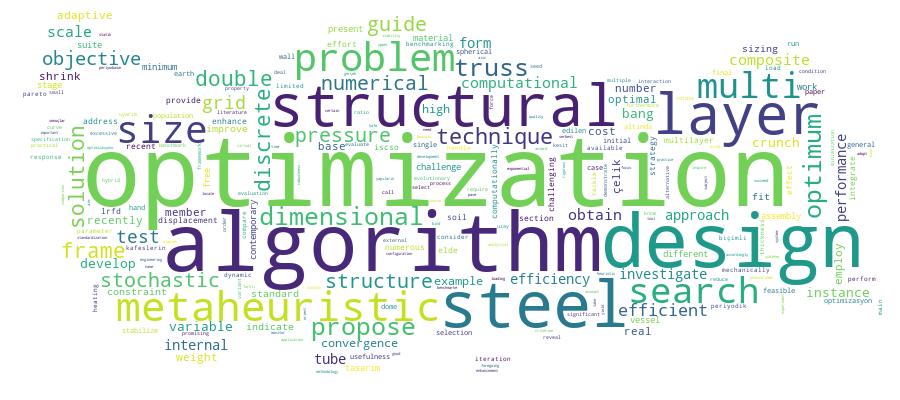
Competency Cloud
10 results
Scholarly Output Search Results
Now showing 1 - 10 of 10
Master Thesis Serbest Biçimli Çelık Çift Katmanlı Uzay Kafeslerin Optimizasyonu ve Standardizasyonu(2021) Shaban, Samer S S; Azad, Saeıd KazemzadehSon yıllarda düzensiz eğrili ancak estetik açıdan hoş görünen konfigürasyonlara sahip serbest biçimli yapıların kullanımına artan bir ilgi olmuştur. Normal çelik uzay kafeslerin tasarım optimizasyonu, yapısal optimizasyon literatüründe detaylı bir şekilde ele alınsa da, gerçek boyutlu serbest biçimli uzay kafes yapıların optimum tasarımında yapılan çalışmalar hala sınırlı düzeyde kalmıştır. Bir yandan, gerçek boyutlu serbest biçimli çelik kafeslerin optimizasyonunun önündeki ana engel, güncel evrimsel optimizasyon algoritmalarıyla ortaya çıkan aşırı hesaplama yüküdür. Öte yandan, algoritma tarafından nihai tasarımda farklı çelik kesit boyutlarının sayıca fazlalığını önlemek için gerekli kısıtlamalar uygulanmamışsa, geleneksel optimizasyon algoritmaları kullanılarak elde edilen nihai tasarımların uygulamada tercih edilmemesi muhtemeldir. Bu nedenle, tek bir optimum veya optimuma yakın tasarım sunmak yerine, tasarımcıya veya karar vericiye, hem minimum ağırlığı hem de mevcut ürün çeşitliliğini hesaba katan ve etkin tasarım alternatifleri setinden oluşan bir Pareto eğrisi sunmak daha arzu edilir olacaktır. Buna göre, bu çalışmada, gerçek boyutlu serbest biçimli çelik çift katmanlı uzay kafeslerin optimizasyonu ve standardizasyonu için hesaplama açısından verimli çok aşamalı rehberli stokastik arama algoritması önerilmiştir. İlk optimizasyon aşamasında, algoritmaya ticari olarak mevcut çelik profillerin eksiksiz bir setinin sunulduğu ve sonraki aşamalarda, kullanılmayan veya daha az kullanılan kesitleri eleyerek kesit listesinin kademeli olarak küçültüldüğü, bir tasarım odaklı kesit eleme yaklaşımı izlenmiştir. Serbest biçimli çelik çift katmanlı uzay kafeslerin sıra dışı kolay olmayan test örnekleri üzerinde önerilen tekniğin kullanışlılığını göstermek için algoritmanın iki farklı versiyonu kullanılmış ve elde edilen Pareto eğrisi, minimum ağırlık ve çelik kesit çeşitleri arasındaki dengeyi göstermek için çizilmiştir.Article Citation - WoS: 11Citation - Scopus: 12A Standard Benchmarking Suite for Structural Optimization Algorithms: Iscso 2016-2022(Elsevier Science inc, 2023) Azad, Saeid Kazemzadeh; Azad, Saeıd Kazemzadeh; Azad, Sina Kazemzadeh; Azad, Saeıd Kazemzadeh; Kazemzadeh Azad, Saeid; Department of Civil Engineering; Department of Civil EngineeringBenchmarking is an essential part of developing efficient structural optimization techniques. Despite the advent of numerous metaheuristic techniques for solving truss optimization problems, benchmarking new algorithms is often carried out using a selection of classic test examples which are indeed unchallenging for contemporary sophisticated optimization algorithms. Furthermore, the limited optimization results available in the literature on new test examples are usually not accurately comparable. This is typically due to the lack of infromation about the performance of the investigated algorithms and the inconsistencies between the studies in terms of adopted test examples for benchmarking, optimization problem formulation, maximum number of objective function evaluations and other similar issues. Accordingly, there exists a need for developing new standard test suites composed of easily reproducible challenging test examples with rigorous and comparable performance evaluation results of algorithms on these test suites. To this end, the present work aims to propose a new baseline for benchmarking structural optimization algorithms, using a set of challenging sizing and shape optimization problems of truss structures selected from the international student competition in structural optimization (ISCSO) instances. The most recent six structural optimization examples from the ISCSO are tackled using a representative metaheuristic structural optimization algorithm. The statistical results of all the optimization runs using the proposed benchmarking suite are provided to pave the way for more rigorous benchmarking of structural optimization algorithms.Article Citation - Scopus: 1An Enhanced Guided Stochastic Search With Repair Deceleration Mechanism for Very High-Dimensional Optimization Problems of Steel Double-Layer Grids(Springer, 2024) Azad, Saeid Kazemzadeh; Aminbakhsh, Saman; Gandomi, Amir H.Finding reasonably good solutions using a fewer number of objective function evaluations has long been recognized as a good attribute of an optimization algorithm. This becomes more important, especially when dealing with very high-dimensional optimization problems, since contemporary algorithms often need a high number of iterations to converge. Furthermore, the excessive computational effort required to handle the large number of design variables involved in the optimization of large-scale steel double-layer grids with complex configurations is perceived as the main challenge for contemporary structural optimization techniques. This paper aims to enhance the convergence properties of the standard guided stochastic search (GSS) algorithm to handle computationally expensive and very high-dimensional optimization problems of steel double-layer grids. To this end, a repair deceleration mechanism (RDM) is proposed, and its efficiency is evaluated through challenging test examples of steel double-layer grids. First, parameter tuning based on rigorous analyses of two preliminary test instances is performed. Next, the usefulness of the proposed RDM is further investigated through two very high-dimensional instances of steel double-layer grids, namely a 21,212-member free-form double-layer grid, and a 25,514-member double-layer multi-dome, with 21,212 and 25,514 design variables, respectively. The obtained numerical results indicate that the proposed RDM can significantly enhance the convergence rate of the GSS algorithm, rendering it an efficient tool to handle very high-dimensional sizing optimization problems.Article Citation - WoS: 25Citation - Scopus: 32High-Dimensional Optimization of Large-Scale Steel Truss Structures Using Guided Stochastic Search(Elsevier Science inc, 2021) Azad, Saeid Kazemzadeh; Aminbakhsh, Saman; Kazemzadeh Azad, SaeidDespite a plethora of truss optimization algorithms devised in the recent literature of structural optimization, still high-dimensional large-scale truss optimization problems have not been properly tackled basically due to the excessive computational effort required to handle the foregoing instances. In this study, application of a recently developed design-driven heuristic, namely guided stochastic search (GSS), is extended to a more challenging class of truss optimization problems having thousands of design variables. Two variants of the algorithm, namely GSSA and GSSB, have been employed for sizing optimization of four high-dimensional examples of steel trusses, i.e., a 2075-member single-layer onion dome, a 2688-member double-layer open dome, a 6000-member doublelayer scallop dome, and a 15048-member double-layer grid as per AISC-LRFD specification. The numerical results obtained indicate the efficiency of GSSA and GSSB in handling high-dimensional instances of large-scale steel trusses with up to 15048 discrete design variables.Article Citation - WoS: 11Citation - Scopus: 10Multi-Stage Guided Stochastic Search for Optimization and Standardization of Free-Form Steel Double-Layer Grids(Elsevier Science inc, 2021) Azad, Saeid Kazemzadeh; Aminbakhsh, Saman; Shaban, Samer S. S.; Kazemzadeh Azad, SaeidThere has been a growing interest in the use of free-form structures with irregularly curved yet aesthetically pleasing configurations in the recent decades. Although design optimization of regular steel grids has been well addressed in the literature of structural optimization, still limited work has been devoted to optimum design of real-size free-form grid structures. On the one hand, a main obstacle when dealing with real-size free-form steel grids is the excessive computational effort associated with contemporary evolutionary optimization algorithms. On the other hand, it is generally perceived that the obtained final designs using conventional optimization algorithms may not necessarily be favored in practice if certain provisions are not stipulated by the algorithm to preclude an abundance of distinct steel section sizes in the final design. Hence, instead of offering a single optimum or near optimum design, it would be more desirable to provide the designer or decision maker with a Pareto front set of non-dominated design alternatives taking into account both the minimum weight as well as the assortment of available steel section sizes in the final design. Accordingly, in this paper, a computationally efficient multi-stage guided stochastic search algorithm is proposed for optimization and standardization of realsize free-form steel double-layer grids. A gradual design-oriented section elimination approach is followed where in the first optimization stage, a complete set of commercially available steel sections is introduced to the algorithm and in the succeeding stages, the size of section list is reduced by eliminating the redundant sizes. Two variants of the algorithm are employed to demonstrate the usefulness of the proposed technique in challenging test examples of free-form steel double-layer grids, and the obtained Pareto fronts are plotted to illustrate the trade-off between minimum weight and assortment of steel section sizes in the final design.Article Citation - WoS: 1Citation - Scopus: 1Metaheuristic Optimization of Rotating Multilayer Composite Tubes Under Internal Heating and Pressure(Springer, 2022) Azad, Saeid Kazemzadeh; Akis, Tolga; Kazemzadeh Azad, SaeidAlthough analysis/design of multilayer assemblies has been always an active field of research, works on the optimal design of rotating multilayer composite tubes are very limited. This paper addresses the design optimization of rotating multilayer composite tubes under internal heating and pressure. For determining the structural responses, analytical solutions are provided based on different boundary conditions. The automated selection of optimal material as well as thickness optimization of pressurized multilayer assemblies is carried out under different angular speed and internal heating conditions using a metaheuristic algorithm. The corresponding optimum design for each angular speed as well as internal heating condition is sought, and the numerical results are discussed. The study provides general guidelines for conceptual design of rotating multilayer composite tubes subjected to internal heating and pressure.Article Citation - WoS: 13Citation - Scopus: 15E-Constraint Guided Stochastic Search With Successive Seeding for Multi-Objective Optimization of Large-Scale Steel Double-Layer Grids(Elsevier, 2022) Azad, Saeid Kazemzadeh; Aminbakhsh, Saman; Kazemzadeh Azad, SaeidThis paper proposes a design-driven structural optimization algorithm named e-constraint guided stochastic search (e-GSS) for multi-objective design optimization of large-scale steel double-layer grids having numerous discrete design variables. Based on the well-known e-constraint method, first, the multi-objective optimization problem is transformed into a set of single-objective optimization problems. Next, each single-objective optimization problem is tackled using an enhanced reformulation of the standard guided stochastic search algorithm proposed based on a stochastic maximum incremental/decremental step size approach. Moreover, a successive seeding strategy is employed in conjunction with the proposed e-GSS algorithm to improve its performance in multi-objective optimization of large-scale steel double-layer grids. The numerical results obtained through multi-objective optimization of three challenging test examples, namely a 1728-member double-layer compound barrel vault, a 2304-member double-layer scallop dome, and a 2400-member double-layer multi-radial dome, demonstrate the usefulness of the proposed e-GSS algorithm in generating Pareto fronts of the foregoing multi-objective structural optimization problems with up to 2400 distinct sizing variables.Article Citation - WoS: 3Cost Efficient Design of Mechanically Stabilized Earth Walls Using Adaptive Dimensional Search Algorithm(Turkish Chamber Civil Engineers, 2020) Azad, Saeid Kazemzadeh; Akış, Ebru; Kazemzadeh Azad, SaeidMechanically stabilized earth walls are among the most commonly used soil-retaining structural systems in the construction industry. This study addresses the optimum design problem of mechanically stabilized earth walls using a recently developed metaheuristic optimization algorithm, namely adaptive dimensional search. For a cost efficient design, different types of steel reinforcement as well as reinforced backfill soil are treated as discrete design variables. The performance of the adaptive dimensional search algorithm is investigated through cost optimization instances of mechanically stabilized earth walls under realistic design criteria specified by standard design codes. The numerical results demonstrate the efficiency and robustness of the adaptive dimensional search algorithm in minimum cost design of mechanically stabilized earth walls and further highlight the usefulness of design optimization in engineering practice.Article Citation - WoS: 1Citation - Scopus: 1MO-ISCSO: A Challenging Benchmark Test Suite for Large-Scale Multi-Objective Structural Optimization(Elsevier Science inc, 2025) Azad, Saeid Kazemzadeh; Azad, Sina Kazemzadeh; Kazemzadeh Azad, SaeidCurrent studies on the development of multi-objective algorithms for optimization of truss structures mainly depend on small-scale classic benchmark instances. This paper highlights the importance of establishing standard large-scale multi-objective structural optimization benchmarking suites for accurate validation of the proposed algorithms. A new benchmark test suite, called MO-ISCSO, is proposed for large-scale multi-objective structural optimization, based on the most recent optimization problems of the international student competition in structural optimization (ISCSO). Owing to the very small feasibility ratios of the MO-ISCSO instances, the effect of presence of feasible designs in the initial population of NSGA-II, GDE3, and AR-MOEA multi-objective optimization algorithms is investigated using the proposed test suite. The obtained numerical results indicate that seeding the initial population with feasible solutions helps the foregoing algorithms maintain a better balance between convergence and diversity. The statistical results form a baseline for future studies on developing efficient multi-objective structural optimization techniques.Article Citation - WoS: 24Citation - Scopus: 23Design Optimization of Real-Size Steel Frames Using Monitored Convergence Curve(Springer, 2021) Azad, Saeid Kazemzadeh; Azad, Saeıd Kazemzadeh; Azad, Saeıd Kazemzadeh; Department of Civil Engineering; Department of Civil EngineeringIt is an undeniable fact that there are main challenges in the use of metaheuristics for optimal design of real-size steel frames in practice. In general, steel frame optimization problems usually require an inordinate amount of processing time where the main portion of computational effort is devoted to myriad structural response computations during the optimization iterations. Moreover, the inherent complexity of steel frame optimization problems may result in poor performance of even contemporary or advanced metaheuristics. Beside the challenging nature of such problems, significant difference in geometrical properties of two adjacent steel sections in a list of available profiles can also mislead the optimization algorithm and may result in trapping the algorithm in a poor local optimum. Consequently, akin to other challenging engineering optimization instances, significant fluctuations could be observed in the final results of steel frame optimization problems over multiple runs even using contemporary metaheuristics. Accordingly, the main focus of this study is to improve the solution quality as well as the stability of results in metaheuristic optimization of real-size steel frames using a recently developed framework so-called monitored convergence curve (MCC). Two enhanced variants of the well-known big bang-big crunch algorithm are adopted as typical contemporary metaheuristic algorithms to evaluate the usefulness of the MCC framework in steel frame optimization problems. The numerical experiments using challenging test examples of real-size steel frames confirm the efficiency of the MCC integrated metaheuristics versus their standard counterparts.
