Yılmaz, Hakkı Hakan

Loading...
Profile Picture
Name Variants
Yilmaz, Hakki Hakan
H.H.Yilmaz
Hakki Hakan, Yilmaz
Y.,Hakki Hakan
Yılmaz,H.H.
Y.,Hakkı Hakan
H.H.Yılmaz
Yilmaz,H.H.
H., Yilmaz
Y., Hakki Hakan
Hakkı Hakan, Yılmaz
H.,Yılmaz
Yılmaz, Hakkı Hakan
Job Title
Profesör Doktor
Email Address
hakan.yilmaz@atilim.edu.tr
Main Affiliation
Public Finance
Status
Former Staff
Website
ORCID ID
Scopus Author ID
Turkish CoHE Profile ID
Google Scholar ID
WoS Researcher ID

Sustainable Development Goals

NO POVERTY1
NO POVERTY
1
Research Products
ZERO HUNGER2
ZERO HUNGER
0
Research Products
GOOD HEALTH AND WELL-BEING3
GOOD HEALTH AND WELL-BEING
0
Research Products
QUALITY EDUCATION4
QUALITY EDUCATION
0
Research Products
GENDER EQUALITY5
GENDER EQUALITY
0
Research Products
CLEAN WATER AND SANITATION6
CLEAN WATER AND SANITATION
0
Research Products
AFFORDABLE AND CLEAN ENERGY7
AFFORDABLE AND CLEAN ENERGY
0
Research Products
DECENT WORK AND ECONOMIC GROWTH8
DECENT WORK AND ECONOMIC GROWTH
2
Research Products
INDUSTRY, INNOVATION AND INFRASTRUCTURE9
INDUSTRY, INNOVATION AND INFRASTRUCTURE
0
Research Products
REDUCED INEQUALITIES10
REDUCED INEQUALITIES
1
Research Products
SUSTAINABLE CITIES AND COMMUNITIES11
SUSTAINABLE CITIES AND COMMUNITIES
1
Research Products
RESPONSIBLE CONSUMPTION AND PRODUCTION12
RESPONSIBLE CONSUMPTION AND PRODUCTION
1
Research Products
CLIMATE ACTION13
CLIMATE ACTION
0
Research Products
LIFE BELOW WATER14
LIFE BELOW WATER
0
Research Products
LIFE ON LAND15
LIFE ON LAND
0
Research Products
PEACE, JUSTICE AND STRONG INSTITUTIONS16
PEACE, JUSTICE AND STRONG INSTITUTIONS
0
Research Products
PARTNERSHIPS FOR THE GOALS17
PARTNERSHIPS FOR THE GOALS
1
Research Products
This researcher does not have a Scopus ID.
This researcher does not have a WoS ID.
Scholarly Output

3

Articles

2

Views / Downloads

11/24

Supervised MSc Theses

1

Supervised PhD Theses

0

WoS Citation Count

3

Scopus Citation Count

5

Patents

0

Projects

0

WoS Citations per Publication

1.00

Scopus Citations per Publication

1.67

Open Access Source

1

Supervised Theses

1

JournalCount
Applied Economics1
Sustainability1
Current Page: 1 / 1

Scopus Quartile Distribution

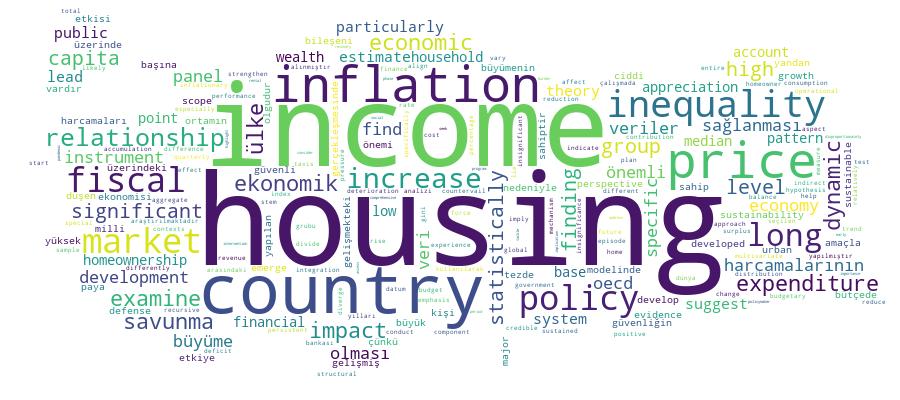
Competency Cloud

GCRIS Competency Cloud

Scholarly Output Search Results

Now showing 1 - 3 of 3
  • Article
    Fiscal Policy and Long-Run Inflation Dynamics: Evidence From a Major Emerging Market Economy
    (Routledge Journals, Taylor & Francis Ltd, 2025) Ekinci, Mehmet Fatih; Saygili, Huelya; Yilmaz, Hakki Hakan
    This study examines the long-run aspects of fiscal policy on inflation in T & uuml;rkiye, using a multivariate co-integration approach with quarterly data from 2006Q1 to 2024Q2. A key contribution of the study lies in its emphasis on the long-run dynamics between various budgetary policy instruments and inflation. We find no significant long-run relationship between inflation and fiscal policy measured at the aggregate level such as budget balance, total expenditures, and revenues. However, examining the specific components, we find statistically significant long-run positive relationships between inflation and indirect taxes - particularly the special consumption tax - and operational government expenditures. Recursive estimates suggest that the relationship between inflation and fiscal instruments has strengthened since 2021 when T & uuml;rkiye started to experience a high inflation episode diverging from global inflation trends with a deterioration in public finance performance. These findings align with the fiscal theory of price level, as the theory implies that persistent fiscal deficits without credible plans for future surpluses can lead to sustained inflationary pressures.
  • Master Thesis
    Gelişmiş ve Gelişmekte Olan Ülkeler Kapsamında Savunma Harcamalarının Ekonomik Büyüme Üzerine Etkisi
    (2023) Aydoğdu, Selvi; Yılmaz, Hakkı Hakan
    Milli güvenliğin sağlanması ve bu amaçla yapılan savunma harcamalarının ülke ekonomisi için de büyük önemi vardır. Çünkü güvenli bir ortamın sağlanması ekonomik büyümenin gerçekleşmesinde önemli bir olgudur. Öte yandan, savunma harcamaları bütçede yüksek bir paya sahip olması ve GSYİH'nın önemli bir bileşeni olması nedeniyle ekonomik büyüme üzerinde ciddi bir etkiye sahiptir. Bu tezde, gelişmiş ve gelişmekteki ülke için GSYİH, kişi başına düşen GSYİH ve savunma harcamalarının ekonomik büyüme üzerindeki etkisi panel veri modelinde araştırılmaktadır. Veriler Dünya Bankası, OECD ve SIPRI'den alınmıştır. Çalışmada seçilen ülke grubu için 1992-2022 yılları arasındaki veriler kullanılarak panel veri analizi yapılmıştır
  • Article
    Citation - WoS: 3
    Citation - Scopus: 5
    The Impact of Increases in Housing Prices on Income Inequality: a Perspective on Sustainable Urban Development
    (Mdpi, 2025) Unalan, Gokhan; Camalan, Ozge; Yilmaz, Hakki Hakan
    This study examines the impact of housing price increases on income inequality using the dynamic system GMM for OECD countries (2010-2021). We test the hypothesis that housing price appreciation affects income distribution differently based on economic development levels and homeownership patterns. The analysis is conducted both for the entire sample and by dividing countries into two groups based on per capita income, Group 1 (16 countries) with below-median per capita GDP and Group 2 (17 countries) with above-median per capita GDP, to account to account for structural differences in housing markets, financial systems, and wealth accumulation mechanisms. The findings show that rising housing prices help reduce income inequality, especially in countries that are relatively low-income and where more low-income households own their homes. Specifically, our estimates indicate that a one-point increase in the housing price index leads to a statistically significant (p < 0.05) 0.21 percentage point reduction in the Gini change rate in lower-income countries. However, in higher-income countries, the effect of housing prices on inequality is statistically insignificant, suggesting that the relationship between housing markets and income inequality varies across different economic contexts. This insignificance likely stems from countervailing forces: while housing appreciation increases wealth for homeowners, higher housing costs may disproportionately burden lower-income households through rental markets in these economies. The findings highlight the importance of country-specific housing programs that consider homeownership patterns and financial market access in tackling inequality, along with comprehensive public social policies. Our study has implications for policymakers seeking to address inequality through housing market interventions, particularly during the post-2008 recovery period and into the early pandemic phase.