
Kaftanoğlu, Bilgin
Loading...
Profile URL
Name Variants
Bilgin, Kaftanoğlu
Kaftanoglu, Bilgin
Bilgin Kaftanoğlu
K., Bilgin
Kaftanoğlu,B.
Kaftanoğlu, Bilgin
K.,Bilgin
B.,Kaftanoglu
KAFTANOGLU B.
Kaftanoğlu B.
B.,Kaftanoğlu
Kaftanoglu,B.
Bilgin, Kaftanoglu
Kaftanoglu B.
Kaftanoglu,Bilgin
B., Kaftanoğlu
B., Kaftanoglu
Kaftanoglu, B.
Kaftanoglu, Bilgin
Bilgin Kaftanoğlu
K., Bilgin
Kaftanoğlu,B.
Kaftanoğlu, Bilgin
K.,Bilgin
B.,Kaftanoglu
KAFTANOGLU B.
Kaftanoğlu B.
B.,Kaftanoğlu
Kaftanoglu,B.
Bilgin, Kaftanoglu
Kaftanoglu B.
Kaftanoglu,Bilgin
B., Kaftanoğlu
B., Kaftanoglu
Kaftanoglu, B.
Job Title
Profesör Doktor
Email Address
bilgin.kaftanoglu@atilim.edu.tr
Main Affiliation
Manufacturing Engineering
Status
Website
ORCID ID
Scopus Author ID
Turkish CoHE Profile ID
Google Scholar ID
WoS Researcher ID
Sustainable Development Goals
 1
1NO POVERTY
0
Research Products
 2
2ZERO HUNGER
0
Research Products
 3
3GOOD HEALTH AND WELL-BEING
1
Research Products
 4
4QUALITY EDUCATION
0
Research Products
 5
5GENDER EQUALITY
0
Research Products
 6
6CLEAN WATER AND SANITATION
0
Research Products
 7
7AFFORDABLE AND CLEAN ENERGY
2
Research Products
 8
8DECENT WORK AND ECONOMIC GROWTH
0
Research Products
 9
9INDUSTRY, INNOVATION AND INFRASTRUCTURE
4
Research Products
 10
10REDUCED INEQUALITIES
0
Research Products
 11
11SUSTAINABLE CITIES AND COMMUNITIES
1
Research Products
 12
12RESPONSIBLE CONSUMPTION AND PRODUCTION
0
Research Products
 13
13CLIMATE ACTION
0
Research Products
 14
14LIFE BELOW WATER
0
Research Products
 15
15LIFE ON LAND
0
Research Products
 16
16PEACE, JUSTICE AND STRONG INSTITUTIONS
0
Research Products
 17
17PARTNERSHIPS FOR THE GOALS
0
Research Products

This researcher does not have a Scopus ID.

This researcher does not have a WoS ID.

Scholarly Output
49
Articles
25
Views / Downloads
280/2936
Supervised MSc Theses
10
Supervised PhD Theses
5
WoS Citation Count
753
Scopus Citation Count
839
Patents
0
Projects
0
WoS Citations per Publication
15.37
Scopus Citations per Publication
17.12
Open Access Source
9
Supervised Theses
15
| Journal | Count |
|---|---|
| Makina Tasarım ve Imalat Dergisi | 3 |
| International Journal of Thermodynamics | 2 |
| CIRP Annals | 2 |
| Applied Energy | 2 |
| International Journal of Refrigeration | 2 |
Current Page: 1 / 5
Scopus Quartile Distribution
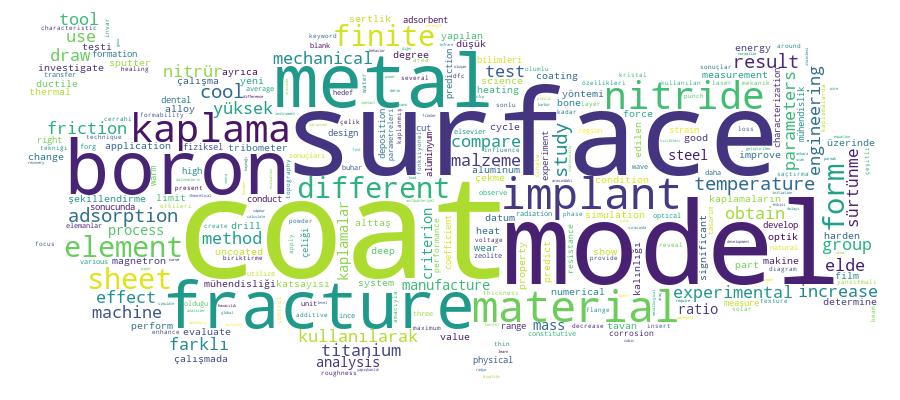
Competency Cloud
33 results
Scholarly Output Search Results
Now showing 1 - 10 of 33
Article Havada Görevlendirilebilen Tekerleksiz Araç Tasarımı – Kişisel Hava Aracı(2022) Küçüköztaş, Korcan; Taşcı, Furkan; Varlı, Hüseyin; Gök, Eren; Kaftanoğlu, Bilgin; Baytaroğlu, ŞakirBu çalışmada, asgari 100kg yük taşıma kapasitesi olan, hafif ve fonksiyonel bir araç tasarımı yapılmıştır. Bu araç, sahip olduğu sekiz pervane sayesinde havada görev görebilirken aynı zamanda yere ve suya dikey iniş de gerçekleştirebilme özelliğine sahiptir. Bu tasarım, kurtarma ekiplerinin ulaşımı, kargo taşımacılığı ve kısa mesafeler içinde, insanların özel ulaşım ihtiyaçlarını karşılayabilmeleri amacı ile tasarlanmıştır. Her pervane motoru tek başına 94kg taşıyabilmekle beraber, aracın toplam taşıyabileceği yük kendi ağırlığıyla birlikte 752kg olmuştur. Proje sürecinde, ön tasarım ve detaylı tasarım süreçleri yürütülmüştür. Tasarımlar, sonlu elemanlar analizleri ve hesaplamalı akışkanlar dinamiği simülasyonlarının sonuçları göz önünde tutularak yapılmıştır. Pervanelerin testi için deneysel iki düzenek tasarlanmıştır. İlk düzenek mekanik bir düzenek olmakla beraber iki taraftan oluşmaktadır. İlk tarafta bir yük hücresi kullanılarak pervanenin itiş gücünün ölçülmesi hedeflenmiştir. İkinci tarafta ise pervanenin dakikada kaç tur attığını ölçmek için bir fotodedektör veya Hall etkisi sensörü kullanılmıştır. İkinci düzenekte bir elektronik hız kontrolcüsü, motoru kontrol etmek için kullanılmıştır. Son olarak, kullanılan yük hücresinin ölçümlemesi için deneysel düzenekler tasarlanmıştır.Letter Theoretical Modelling of Magnetron Sputtering of Boron Nitride Coating(Springer Heidelberg, 2023) Rake, Nakka; Kaftanoglu, Bilgin; Hacaloglu, Tugce; Aydogan, AsudeThe fundamentals of the magnetron sputtering (MS) technique are simple. However, the complex interplay of various physical and chemical sub-processes lies in its simplicity. The direct simulation Monte Carlo (DSMC) method is used to model the MS of the Boron Nitride (BN) coating. The Lorentz force, which is created by an electric field, magnetic field and particle collision, is utilised to model the BN coating. Three distinct bias voltages are used to generate three different BN-coating models under the same conditions. The modelling of BN coatings reveals that the deposition rate decreases as the substrate voltage increases.Article Citation - WoS: 58Citation - Scopus: 66Experimental Investigation of a Natural Zeolite-Water Adsorption Cooling Unit(Elsevier Sci Ltd, 2011) Solmus, Ismail; Kaftanoglu, Bilgin; Yamali, Cemil; Baker, DerekIn this study, a thermally driven adsorption cooling unit using natural zeolite-water as the adsorbent-refrigerant pair has been built and its performance investigated experimentally at various evaporator temperatures. The primary components of the cooling unit are a shell and tube adsorbent bed, an evaporator, a condenser, heating and cooling baths, measurement instruments and supplementary system components. The adsorbent bed is considered to enhance the bed's heat and mass transfer characteristics; the bed consists of an inner vacuum tube filled with zeolite (zeolite tube) inserted into a larger tubular shell. Under the experimental conditions of 45 degrees C adsorption, 150 degrees C desorption, 30 degrees C condenser and 22.5 degrees C, 15 degrees C and 10 degrees C evaporator temperatures, the COP of the adsorption cooling unit is approximately 0.25 and the maximum average volumetric cooling power density (SCR,) and mass specific cooling power density per kg adsorbent (SCP) of the cooling unit are 5.2 kW/m(3) and 7 W/kg, respectively. (C) 2011 Elsevier Ltd. All rights reserved.Conference Object A Study on the Constitutive Equation Effects in the Fracture Initiation of Aa5450 Sheets(Pleiades journals, 2019) Dizaji,S.A.; Darendeliler,H.; Kaftanoğlu,B.Determination of the fracture initiation in the sheet metal forming applications can be achieved successfully using ductile fracture criteria (DFCs) and finite element codes together. In this study three different uncoupled, energy based ductile fracture criteria have been employed to predict the onset of the fracture in the AA5450 aluminum alloy sheets. Also, two different constitutive models namely, isotropic von-Mises and anisotropic Hill, have been implemented to the finite element code ABAQUS through VUMAT subroutine to investigate the effect of constitutive equations on the applicability of the utilized DFCs. It was shown that the constitutive model has significant influence on the estimation of the time and place of the fracture initiation in the sheets. © Springer Nature Singapore Pte Ltd. 2019.Conference Object Antibacterial Activity of Cubic Boron Nitride (cbn) Coatings on Stainless Steel Grade 316 (316l)(Amer Chemical Soc, 2010) Uzunoglu, Emel; Sengonul, Merih; Derici, Kursat; Biriken, Derya; Kaftanoglu, Bilgin; Sengonul, Merih[No Abstract Available]Article Citation - WoS: 13Citation - Scopus: 13Analysis of Non-Isothermal Warm Deep Drawing of Dual-Phase Dp600 Steel(Springer France, 2019) Pepelnjak, T.; Kayhan, E.; Kaftanoglu, B.Improving the formability of the material is a key issue in the deep drawing process. Heating the material above its recrystallization temperature drastically increases formability, but in the case of dual phase (DP) steels, it results in a loss of their mechanical properties. To improve the drawing ratio, only the heating of the flange region in the warm temperature range up to 573K was studied on DP600 sheet steel by numerical simulation. A thermo-elastic-plastic finite element method (FEM) analysis of deep drawing at several drawing ratios was performed and compared with experimental results. During the experiments, the flange area of the blank was heated by induction heating, and the central part over the punch was cooled with spray water. Experimental results showed that limiting drawing ratio could be increased by 25.58%. The microstructure of the DP 600 steel was analyzed before and after the warm forming process. No significant changes were observed, and the high strength properties of the DP 600 steel remained intact. There was good agreement between numerical and experimental results.Article Havacılık Endüstrisinde Kullanılmak Üzere Alüminyum Malzemelerin Korozyon Direncinin Arttırılması Amacıyla Yüzey Kaplaması Geliştirilmesi(2021) Ceylan, Çağlar; Duran, Bahtiyar; Koçyiğit, Osman; Koçer, Cem; Doğan, Berkay; Hacaloğlu, Tuğçe; Kaftanoğlu, Bilgin; Sengonul, MerihHavacılık endüstrisinde yüksek oranda kullanılan alüminyum alaşımlarını korozyona karşı korumak üzere genellikle kromat (krom VI bazlı) dönüşümlü kaplama (CCC) yöntemleri kullanılmaktadır. Ancak altı değerlikli kromun doğada oluşturduğu zararlı etkilerden dolayı, AB’nin REACH düzenlemeleri ile kullanımı kısıtlanmıştır. Bu çalışma ile krom +6 dönüşümlü kaplamalara alternatif olarak PVD,anodizasyon gibi yöntemlerin de olduğu kaplama çeşitleri araştırılmış ve kaplamaların korozyon dayanımıyla mekanik performansları incelenmiştir.Conference Object Citation - WoS: 7Citation - Scopus: 7Effect of Hardening Models on Different Ductile Fracture Criteria in Sheet Metal Forming(Springer France, 2016) Dizaji, Shahram Abbasnejad; Darendeliler, Haluk; Kaftanoglu, Bilgin; Abbasnejad Dizaji, ShahramPrediction of the fracture is one of the challenging issues which gains attention in sheet metal forming as numerical analyses are being extensively used to simulate the process. To have better results in predicting the sheet metal fracture, appropriate ductile fracture criterion (DFC), yield criterion and hardening rule should be chosen. In this study, the effects of different hardening models namely isotropic, kinematic and combined hardening rules on the various uncoupled ductile fracture criteria are investigated using experimental and numerical methods. Five different ductile fracture criteria are implemented to a finite element code by the user subroutines. The criterion constants of DFCs are obtained by the related experimental tests. The in-plane principle strains obtained by the finite element analyses for different DFCs are compared with the experimental results. Also, the experimental results are used to evaluate the principle strain values calculated by the finite element analysis for different combinations of DFCs and hardening rules. It is shown that some DFCs give better predictions if the appropriate hardening model is employed.Article Citation - WoS: 39Citation - Scopus: 49Focus Variation Measurement and Prediction of Surface Texture Parameters Using Machine Learning in Laser Powder Bed Fusion(Asme, 2020) Ozel, Tugrul; Altay, Ayca; Kaftanoglu, Bilgin; Leach, Richard; Senin, Nicola; Donmez, AlkanThe powder bed fusion-based additive manufacturing process uses a laser to melt and fuse powder metal material together and creates parts with intricate surface topography that are often influenced by laser path, layer-to-layer scanning strategies, and energy density. Surface topography investigations of as-built, nickel alloy (625) surfaces were performed by obtaining areal height maps using focus variation microscopy for samples produced at various energy density settings and two different scan strategies. Surface areal height maps and measured surface texture parameters revealed the highly irregular nature of surface topography created by laser powder bed fusion (LPBF). Effects of process parameters and energy density on the areal surface texture have been identified. Machine learning methods were applied to measured data to establish input and output relationships between process parameters and measured surface texture parameters with predictive capabilities. The advantages of utilizing such predictive models for process planning purposes are highlighted.Article Citation - WoS: 113Citation - Scopus: 147Experiments and Finite Element Simulations on Micro-Milling of Ti-6al Alloy With Uncoated and Cbn Coated Micro-Tools(Elsevier, 2011) Oezel, T.; Thepsonthi, T.; Ulutan, D.; Kaftanoglu, B.; Ozel, T.; Kaftanolu, B.This paper presents experimental investigations and finite element simulations on micro-milling of Ti-6Al-4V alloy with fine grain uncoated and cBN coated micro-end mills. Micro-milling of Ti-6Al-4V using uncoated and cBN coated tungsten carbide micro-end mills are conducted; surface roughness, burr formation and tool wear are measured. Effects of machining parameters on surface roughness, burr formation, and tool wear for uncoated and cBN coated micro-tools are investigated. Finite element modelling is utilized to predict forces, temperatures, and wear rate for uncoated and cBN coated micro-tools. Predicted temperature and tool wear contours for uncoated and cBN coated micro-tool edges reveal advantages of cBN coatings. Optimization studies on the experimental results are also conducted to identify the optimum process parameters which minimize both surface roughness and burr formation concurrently. (C) 2011 CIRP.
