
Aminbakhsh, Saman
Loading...
Profile URL
Name Variants
Saman, Aminbakhsh
S., Aminbakhsh
A., Saman
Saman Aminbakhsh
S.,Aminbakhsh
Aminbakhsh,Saman
A.,Saman
Aminbakhsh, Saman
Aminbakhsh,S.
S., Aminbakhsh
A., Saman
Saman Aminbakhsh
S.,Aminbakhsh
Aminbakhsh,Saman
A.,Saman
Aminbakhsh, Saman
Aminbakhsh,S.
Job Title
Doktor Öğretim Üyesi
Email Address
saman.aminbakhsh@atilim.edu.tr
Main Affiliation
Civil Engineering
Status
Website
ORCID ID
Scopus Author ID
Turkish CoHE Profile ID
Google Scholar ID
WoS Researcher ID
Sustainable Development Goals
 1
1NO POVERTY
0
Research Products
 2
2ZERO HUNGER
0
Research Products
 3
3GOOD HEALTH AND WELL-BEING
0
Research Products
 4
4QUALITY EDUCATION
0
Research Products
 5
5GENDER EQUALITY
0
Research Products
 6
6CLEAN WATER AND SANITATION
0
Research Products
 7
7AFFORDABLE AND CLEAN ENERGY
1
Research Products
 8
8DECENT WORK AND ECONOMIC GROWTH
0
Research Products
 9
9INDUSTRY, INNOVATION AND INFRASTRUCTURE
1
Research Products
 10
10REDUCED INEQUALITIES
0
Research Products
 11
11SUSTAINABLE CITIES AND COMMUNITIES
0
Research Products
 12
12RESPONSIBLE CONSUMPTION AND PRODUCTION
0
Research Products
 13
13CLIMATE ACTION
0
Research Products
 14
14LIFE BELOW WATER
1
Research Products
 15
15LIFE ON LAND
0
Research Products
 16
16PEACE, JUSTICE AND STRONG INSTITUTIONS
0
Research Products
 17
17PARTNERSHIPS FOR THE GOALS
0
Research Products

Documents
15
Citations
632
h-index
8

Documents
16
Citations
532

Scholarly Output
16
Articles
12
Views / Downloads
43/0
Supervised MSc Theses
2
Supervised PhD Theses
0
WoS Citation Count
118
Scopus Citation Count
109
Patents
0
Projects
0
WoS Citations per Publication
7.38
Scopus Citations per Publication
6.81
Open Access Source
5
Supervised Theses
2
| Journal | Count |
|---|---|
| Journal of Construction Engineering, Management & Innovation | 2 |
| Structures | 2 |
| European Journal of Operational Research | 1 |
| Journal of Building Engineering | 1 |
| Journal of Construction Engineering and Management | 1 |
Current Page: 1 / 3
Scopus Quartile Distribution
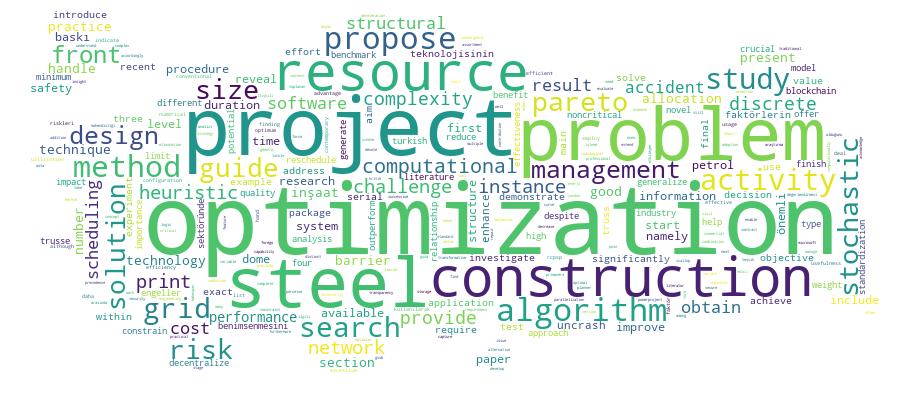
Competency Cloud
16 results
Scholarly Output Search Results
Now showing 1 - 10 of 16
Master Thesis Irak'ta Petrol ve Gaz İşleme Tesisleri için İnşaat Projelerinin Risk Değerlendirmesi(2021) Dawood, Muhanned Samır Dawood; Aminbakhsh, SamanPetrol ve gaz, en önemli ekonomik kaynaklardan biridir ve Irak'taki doğal rezervlerin ana arteri olarak kabul edilmektedir. Bu tür rezervlerle ilişkili işleme tesislerinin inşasında yer alan şirketler ve kurumlar, küresel ekonomide çok önemli bir role sahiptir. Öte yandan, Irak'ın sermaye bütçesi büyük ölçüde petrolun gelirlerinin oranına bağlıdır. Bu bağlamda, birçok araştırmacı, petrol ve gaz işleme tesisleri ile ilgili olan inşaat projeleri ile ilgili riskleri belirlemeye ve analiz etmeye çalışmış zaman, maliyet ve kalite gibi kritik başarı faktörleri üzerindeki etkilerin ortadan kaldirmal için çeşitli yöntemler ve pratik planlar önermişlerdir. Bu çalışmanın amacı, Irak'ın petrol ve gaz sektöründeki inşaat projelerinin ana hedefleri arasında istenen dengeyi tehdit eden risklerin benzer şekilde belirlenmesidir. Bu amaç için, literatür taramasının bulguları, akademik çevrelerden, profesyonellerden ve karar alma otoritelerinden ampirik veriler toplamak için bilimsel alanda yaygın olarak atıfta bulunulan 70 risk öğesini içeren çevrimiçi bir anket geliştirmek için kullanılır. Katılımcılar, Irak'ın Petrol Bakanlığı, Kuveyt Enerji, Bağdat Üniversitesi, Kerbala ve Al-Dorra rafinerileri gibi farklı devletin kurumları ve sivil toplumun kuruluşları ve / veya şirketlerinden seçilir. 143 uzman ve risk derecelendirmelerine ilişkin genel bilgiler beşli Likert ölçeği kullanılarak derlenmiştir. Sekiz risk kategorisi altında gruplandırılarak, risk faktörlerinin her biri için olasılık düzeyi ve etki belirlenir. Yanıt verenlerden toplanan verilere dayanarak, tanımlanan riskleri değerlendirmek ve sıralamak için risk matrisleri geliştirilir; bununla birlikte, ilişkili risk yanıtları burada en yüksek on faktör için önerilmektedir. Toplanan yanıtların istatistiksel analizi için SPSS ve Microsoft Excel programları kullanılmış ve verilerin tutarlılığı Cronbach's Alpha güvenirlik katsayısı kullanılarak doğrulanmıştır. Sonuçlar, projelerin başarısını dolaylı olarak etkileyebilecek en önemli risk unsurlarının, 'Küresel petrol ve gaz fiyatlarında istikrarsızlık' ve 'işgücüne yapılan ödemelerde gecikme' olduğuna işaret ediyor.Master Thesis Türk İnşaat Sektöründe 3B Baski Teknolojisinin Benimsenmesini Etkileyen Ana Etkenler ve Engeller(2025) Latifiilkhechi, Leva; Aminbakhsh, Saman; Akçay, Emre CanerBu çalışmada, Türk inşaat sektöründe 3B baskı teknolojisinin benimsenmesini etkileyen temel faktörler incelenmiştir. Bu doğrultuda, kapsamlı bir literatür taraması sonucunda 27 teşvik edici ve 19 engelleyici faktör belirlenmiş olup, bu faktörlerin değerlendirmesi 106 uzmandan oluşan bir anket çalışması ile yapılmıştır. Bu faktörlerin önemi, Göreceli Önem İndeksi (GÖİ) kullanılarak değerlendirilmiş ve ardından Analitik Hiyerarşi Prosesi (AHP) ile faktörlerin önem düzeyleri belirlenmiştir. 3B baskı teknolojisinin daha hızlı inşaat, iş kazalarının azalması, enerji verimliliğinin artması ve karmaşık tasarımların daha kolay uygulanması gibi avantajlar sunduğu görülse de, bu teknolojinin benimsenmesini engelleyen başlıca zorluklar arasında 3B Beton Baskı için yeterli düzenlemelerin ve yapı kodlarının eksikliği, büyük ölçekli uygulamalar konusunda sınırlı bilgi ve yalıtım malzemelerinin yetersizliği yer almaktadır. Araştırma sonuçları, malzeme israfını azaltma ve daha fazla özelleştirme imkânı sağlama gibi faktörlerin 3B baskının inşaat sektöründe benimsenmesinde en önemli etmen olduğunu, gözetim maliyetlerinin azaltılmasının ise en az önemli teşvik edici faktör olduğunu ortaya koymuştur. Diğer yandan, siber güvenlik riskleri, potansiyel iş kayıpları ve basılı yapıların katmanlı ve pürüzlü yüzeyleri, en kritik engeller olarak belirlenmiştir. Bu araştırma, 3B baskı teknolojisinin inşaat sektörüne entegrasyonunun artırılması için bu etmenlerin ve engellerin hedefe yönelik stratejilerle ele alınması gerektiğini vurgulamaktadır.Article Effects of Topological Structure of Project Network on Computational Cost(Golden Light Publ, 2024) Aminbakhsh, SamanUnderstanding how network complexity affects optimization algorithms is crucial for improving computational efficiency. This study investigates how variations in network complexity impact the performance of optimization algorithms. By examining networks with different serial/parallel indicator (I2) values, the research uncovers several key insights into how topology influences computational requirements. The experiments show that higher I2 values, which are closer to serial configurations, heighten the problem's complexity. This study reveals that networks with lower I2 values, which exhibit steeper time-cost curves with fewer solutions over their efficient frontiers, require significantly more CPU time, indicating that project complexity does not necessarily scale with the extend of the Pareto fronts. This contradicts the expectation that more Pareto front solutions would inherently demand greater computational resources. Lastly, the study highlights that while the number of time-cost realizations is often used to gauge project complexity, it may not be conclusive on its own and that one complexity measure can outperform another. Although it can be an effective indicator, it does not fully capture the computational challenges posed by different network topologies. This study further acknowledges the difficulty in establishing a clear link between project performance and complexity due to the multifaceted nature of the problem. The findings suggest that exploring similar problems in other contexts could provide valuable insights into understanding and managing computational complexity.Article Citation - WoS: 25Citation - Scopus: 32High-Dimensional Optimization of Large-Scale Steel Truss Structures Using Guided Stochastic Search(Elsevier Science inc, 2021) Azad, Saeid Kazemzadeh; Aminbakhsh, Saman; Kazemzadeh Azad, SaeidDespite a plethora of truss optimization algorithms devised in the recent literature of structural optimization, still high-dimensional large-scale truss optimization problems have not been properly tackled basically due to the excessive computational effort required to handle the foregoing instances. In this study, application of a recently developed design-driven heuristic, namely guided stochastic search (GSS), is extended to a more challenging class of truss optimization problems having thousands of design variables. Two variants of the algorithm, namely GSSA and GSSB, have been employed for sizing optimization of four high-dimensional examples of steel trusses, i.e., a 2075-member single-layer onion dome, a 2688-member double-layer open dome, a 6000-member doublelayer scallop dome, and a 15048-member double-layer grid as per AISC-LRFD specification. The numerical results obtained indicate the efficiency of GSSA and GSSB in handling high-dimensional instances of large-scale steel trusses with up to 15048 discrete design variables.Conference Object Drivers for Adopting 3D Printing Technology in Turkiye(European Council on Computing in Construction (EC3), 2025) Latifiilkhechi, L.; Aminbakhsh, S.; Akcay, E.C.This study investigates the factors driving the adoption of 3D printing technology in construction industry, focusing on Turkiye and developing EU countries. A comprehensive literature review identified 27 key drivers, which were evaluated through a survey of 106 professionals using Relative Importance Index (RII). Results reveal that faster construction, lower rate of site accidents and fatalities, and reduction in material waste are the most significant drivers, while freedom in design due to less strict standards was found to be the least important. The research emphasizes the need for targeted initiatives to enhance the integration of 3D printing in construction projects. © 2025, European Council on Computing in Construction (EC3). All rights reserved.Article Citation - WoS: 5Resource Allocation Capabilities of Commercial Project Management Software Packages for Resource Leveling and Resource Constrained Project Scheduling Problems: a Comparative Study(Golden Light Publ, 2023) Albayati, Noor Hussein Farooq; Aminbakhsh, SamanIn construction project management the critical path method (CPM) is the most used technique for project scheduling. Although this technique provides many advantages for project managers, it cannot efficiently deal with the allocation of the resources. Therefore, alternative techniques have been introduced to address resource allocation requirements of the projects. Of these techniques, Resource Leveling (RLP) aims to minimize the fluctuation in resource usage histograms while maintaining the duration obtained by CPM. Resource Constrained Project Scheduling Problem (RCPSP), on the other hand, aims to secure the shortest CPM duration without violating the resource constraints. RLP and RCPSP are vital for effective utilization of project resources (e.g., manpower, machinery, and equipment) as they help precluding intermittent usage or over-allocation of the resources. Keeping the resource usage at a relatively constant level through RLP would result in a decrease in the overall project cost as the additional costs required to demobilize and remobilize the resources will be minimized. Shortening the makespan while meeting the resource constraints through RCPSP would lead to improved resource utilization and cost savings as well. The main objective of this study is, therefore, to analyze effectiveness and efficiency of the most widely used commercial project management software packages in solving resource allocation problems. To this end, the most recent versions - as per the date of this study - of three software packages, namely, Microsoft Project Professional 2019, Primavera P6 Professional 2019, and Asta Powerproject version 15.0.01.489 are examined. The performance of the practiced software is evaluated based on thirteen different priority rules over a set of problem instances available in the literature. The practiced problems include 640 instances providing a diverse combination of network complexity, activity number, and resource type number. Results obtained by the software for RCPSP are also compared with the solutions provided by the Serial Scheduling Scheme - a heuristic method. The findings of this study reveal that whilst all the three software packages manage to provide comparable results, Asta PowerProject transpire to be the all-round best performing method while Primavera sports the fastest leveling module. This study also sheds light on the challenges and practical hurdles to utilization of the aforementioned software for resource allocation purposes.Article Citation - WoS: 3Citation - Scopus: 7Optimization-Based Scheduling of Construction Projects With Generalized Precedence Relationships: a Real-Life Case Study(Sharif University of Technology, 2024) Aminbakhsha, S.; Ahmed, A.; Aminbakhsh, SamanConcomitant reduction of cost and duration is recognized as one of the main aspects of construction planning. Expedition of project schedule naturally incurs extra costs due to implementation of more productive and/or high-price construction techniques. Meanwhile, a reduction in time is usually plausible only down to a certain limit, below which renders expeditions either technically or nancially unviable. Thus, striking a reasonable balance between project cost and duration remains a desirable yet challenging task for which there has been a myriad of advancements and literature. Despite the many studies associated with this problem-referred to as Time-Cost Trade-off Problem (TCTP) it is observed that only a few exercise TCTPs with the generalized logical relationships. This observation holds despite the fact that generalized precedence relationships are imperative to introduce parallelism and to secure a realistic overlap among the activities. In this regard, a Simulated Annealing-based (SA-based) Genetic Algorithm (GA) as proposed herein, is specically designed to provide the capability of exerting TCTPs with properly overlapped activities. Eciency of this algorithm is tested over a range of problems and its performance is validated over a large-scale real-case construction project. Results of the hybridized GA indicate fast and robust convergence to high-quality solutions. © 2024, Sharif University of Technology. All rights reserved.Article Citation - WoS: 32Citation - Scopus: 40A Transformative Solution for Construction Safety: Blockchain-Based System for Accident Information Management(Elsevier, 2023) Ahmadisheykhsarmast, Salar; Aminbakhsh, Saman; Sonmez, Rifat; Uysal, FurkanEffective management of accident information is a crucial component of safety management within the construction industry, as it reflects the safety performance of the company and allows them to identify the root causes of accidents and prevent similar accidents in the future. However, existing safety information systems provide self-owned, isolated, and centralized environments and fail to present a secure, transparent, and trustworthy platform for monitoring and management of accident information. To address these issues, this paper presents a novel decentralized blockchain-based system for accident/incident information management of construction projects. The proposed system leverages the benefits and advantages of blockchain, smart contracts, and decentralized IPFS storage to address the security transparency, tampering, and trustworthiness issues of the conventional approaches. The proposed system is simulated by using real-world construction accident data to demonstrate how blockchain technology can provide a novel solution to assure security, transparency, authenticity, availability, and immutability of the accident/incident data for improving safety management.Article Citation - WoS: 11Citation - Scopus: 10Multi-Stage Guided Stochastic Search for Optimization and Standardization of Free-Form Steel Double-Layer Grids(Elsevier Science inc, 2021) Azad, Saeid Kazemzadeh; Aminbakhsh, Saman; Shaban, Samer S. S.; Kazemzadeh Azad, SaeidThere has been a growing interest in the use of free-form structures with irregularly curved yet aesthetically pleasing configurations in the recent decades. Although design optimization of regular steel grids has been well addressed in the literature of structural optimization, still limited work has been devoted to optimum design of real-size free-form grid structures. On the one hand, a main obstacle when dealing with real-size free-form steel grids is the excessive computational effort associated with contemporary evolutionary optimization algorithms. On the other hand, it is generally perceived that the obtained final designs using conventional optimization algorithms may not necessarily be favored in practice if certain provisions are not stipulated by the algorithm to preclude an abundance of distinct steel section sizes in the final design. Hence, instead of offering a single optimum or near optimum design, it would be more desirable to provide the designer or decision maker with a Pareto front set of non-dominated design alternatives taking into account both the minimum weight as well as the assortment of available steel section sizes in the final design. Accordingly, in this paper, a computationally efficient multi-stage guided stochastic search algorithm is proposed for optimization and standardization of realsize free-form steel double-layer grids. A gradual design-oriented section elimination approach is followed where in the first optimization stage, a complete set of commercially available steel sections is introduced to the algorithm and in the succeeding stages, the size of section list is reduced by eliminating the redundant sizes. Two variants of the algorithm are employed to demonstrate the usefulness of the proposed technique in challenging test examples of free-form steel double-layer grids, and the obtained Pareto fronts are plotted to illustrate the trade-off between minimum weight and assortment of steel section sizes in the final design.Article Citation - WoS: 24Activity Uncrashing Heuristic With Noncritical Activity Rescheduling Method for the Discrete Time-Cost Trade-Off Problem(Asce-amer Soc Civil Engineers, 2020) Sonmez, Rifat; Aminbakhsh, Saman; Atan, TankutDespite intensive research efforts that have been devoted to discrete time-cost optimization of construction projects, the current methods have very limited capabilities for solving the problem for real-life-sized projects. This study presents a new activity uncrashing heuristic with noncritical activity rescheduling method to narrow the gap between the research and practice for time-cost optimization. The uncrashing heuristic searches for new solutions by uncrashing the critical activities with the highest cost-slope. This novel feature of the proposed heuristic enables identification and elimination of the dominated solutions during the search procedure. Hence, the heuristic can determine new high-quality solutions based on the nondominated solutions. Furthermore, the proposed noncritical activity rescheduling method of the heuristic decreases the amount of scheduling calculations, and high-quality solutions are achieved within a short CPU time. Results of the computational experiments reveal that the new heuristic outperforms state-of-the-art methods significantly for large-scale single-objective cost minimization and Pareto front optimization problems. Hence, the primary contribution of the paper is a new heuristic method that can successfully achieve high-quality solutions for large-scale discrete time-cost optimization problems.
