
Tunç, Gökhan
Loading...
Profile URL
Name Variants
Tunç, Gökhan
G.,Tunç
G., Tunç
Tunc, Gokhan
Tunc,Gokhan
Tunç,G.
Gokhan, Tunc
Tunc,G.
T.,Gökhan
G., Tunc
Gökhan Tunç
T., Gokhan
Tunç G.
Gökhan, Tunç
T., Gökhan
G.,Tunc
T.,Gokhan
G.,Tunç
G., Tunç
Tunc, Gokhan
Tunc,Gokhan
Tunç,G.
Gokhan, Tunc
Tunc,G.
T.,Gökhan
G., Tunc
Gökhan Tunç
T., Gokhan
Tunç G.
Gökhan, Tunç
T., Gökhan
G.,Tunc
T.,Gokhan
Job Title
Doktor Öğretim Üyesi
Email Address
gokhan.tunc@atilim.edu.tr
Main Affiliation
Civil Engineering
Status
ORCID ID
Scopus Author ID
Turkish CoHE Profile ID
Google Scholar ID
WoS Researcher ID
Sustainable Development Goals
 1
1NO POVERTY
1
Research Products
 2
2ZERO HUNGER
0
Research Products
 3
3GOOD HEALTH AND WELL-BEING
0
Research Products
 4
4QUALITY EDUCATION
0
Research Products
 5
5GENDER EQUALITY
0
Research Products
 6
6CLEAN WATER AND SANITATION
0
Research Products
 7
7AFFORDABLE AND CLEAN ENERGY
0
Research Products
 8
8DECENT WORK AND ECONOMIC GROWTH
0
Research Products
 9
9INDUSTRY, INNOVATION AND INFRASTRUCTURE
3
Research Products
 10
10REDUCED INEQUALITIES
0
Research Products
 11
11SUSTAINABLE CITIES AND COMMUNITIES
20
Research Products
 12
12RESPONSIBLE CONSUMPTION AND PRODUCTION
1
Research Products
 13
13CLIMATE ACTION
0
Research Products
 14
14LIFE BELOW WATER
0
Research Products
 15
15LIFE ON LAND
0
Research Products
 16
16PEACE, JUSTICE AND STRONG INSTITUTIONS
0
Research Products
 17
17PARTNERSHIPS FOR THE GOALS
1
Research Products

Documents
20
Citations
226
h-index
8

Documents
21
Citations
189

Scholarly Output
42
Articles
30
Views / Downloads
124/211
Supervised MSc Theses
11
Supervised PhD Theses
0
WoS Citation Count
144
Scopus Citation Count
172
Patents
0
Projects
0
WoS Citations per Publication
3.43
Scopus Citations per Publication
4.10
Open Access Source
13
Supervised Theses
11
| Journal | Count |
|---|---|
| Buildings | 4 |
| Journal of the Croatian Association of Civil Engineers | 2 |
| Challenge Journal of Structural Mechanics | 1 |
| Endeavour | 1 |
| Engineering Studies | 1 |
Current Page: 1 / 4
Scopus Quartile Distribution
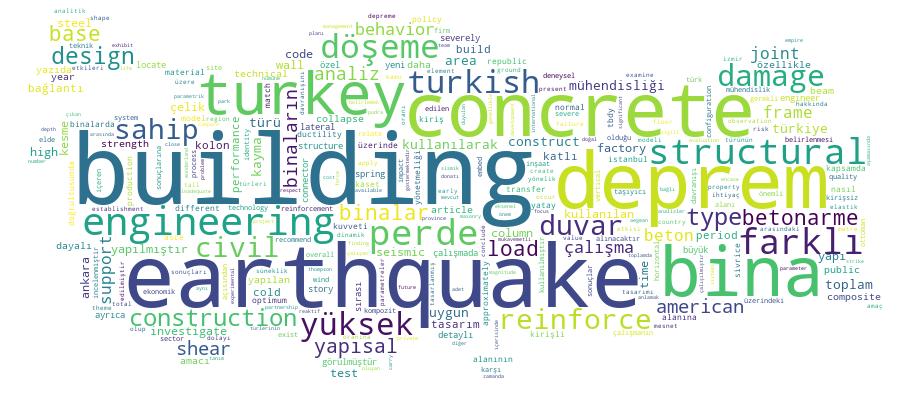
Competency Cloud
42 results
Scholarly Output Search Results
Now showing 1 - 10 of 42
Master Thesis Kompozit Kolon-betonarme Kiriş Birleşim Bölgelerinin Deneysel Analizle Davranışının Belirlenmesi(2020) Dakhıl, Abdulrrahman A.; Tunç, Gökhan; Mertol, Halit CenanBu tezde, yüksek ve sınırlı süneklik düzeylerine sahip çelik-betonarme kompozit çerçevelerin deprem performansları deneysel olarak incelenmiştir. Yapılan deneysel çalışma ile SRC kolon ve betonarme kiriş kompozit birleşim bölgelerinin depreme karşı davranış ve hasar görebilirlik özelliği ile bu birleşim bölgelerinin deprem enerjisini elastik olmayan deplasmanlar yardımı ile soğurabilme yeteneği araştırılmış ve konu detaylı olarak irdelenmiştir. Bu kapsamda, akademik kaynak taraması yapılarak kolon-kiriş bağlantısının tasarımı ve davranışı için yeni bir bakış açısı elde edilmeye çalışılmıştır. Tez çalışmasında verimlilik esasına dayalı deprem mühendisliği kavramı çerçevesinde kullanılan temel tasarım parametresi ise sünekliktir. Bu çalışma ile yürürlükteki Türkiye Bina Deprem Yönetmeliği (TBDY 2018) uyarınca detayları elde edilen kompozit kolon-kiriş bağlantılarının tasarım gereği ihtiyaç duyulan değişken süneklik taleplerine göre davranışının belirlenmesi hedeflenmiştir. Kolon-kiriş bağlantılarındaki eksikliklerin ve enerji soğurma kapasitelerinin belirlenmesini müteakip, ½ ölçek oranındaki çerçeveler belirlenen süneklik hedeflerine uygun olarak tasarlanmış, deneysel ölçüm cihazları yerleştirilerek, testleri ve analizleri gerçekleştirilmiştir. Deneylerde, bağlantı noktalarına deplasman kontrollü yatay tersinir çekme ve basınç kuvvetleri ile sabit eksenel yük uygulanmıştır. Deneysel çalışmalarda kullanılan parametreler ise şunlardır: kolon donatı oranı, bağlantı ebat oranı, eksenel yük ve yatay tersinir yükler. Yapılan deneyler neticesinde SRC kolon-betonarme kirişlerden oluşan çerçevelerde ilave kolon donatı miktarlarının deprem davranışını olumlu yönde etkilediği görülmüştür.Conference Object Structural Analyses of Rc Buildings With Various Support Types(Springer Science and Business Media Deutschland GmbH, 2024) Tunc,G.; Tanfener,T.; Khayyat,Z.K.The seismic design of buildings is performed based on dynamic analyses by considering fixed-base supports. The effect of soil’s elastic behavior is usually ignored during the analysis and design phases of buildings. Due to differences in the seismic responses of rigidly and elastically supported buildings, it is essential to study the impact of the elastic behavior of soil on overall building design. In this study, the structural behavior of rigid basement walls with various support conditions will be investigated. For this purpose, a parametric study will be conducted on a total of 60 reinforced concrete buildings with two different layouts. For this purpose, five support types will be studied. These supports types in their correct order are as follows: (1) vertical area springs at the base coupled with horizontal area springs all around the basement walls, (2) fixity at the base coupled with horizontal joint springs only at the ground floor level, (3) vertical joint springs at the base, (4) only fixity at the base with no joint or area springs, and (5) vertical joint springs at the base coupled with horizontal joint springs only at the ground floor level. The results revealed that the buildings with support type 2 exhibited the most rigid behavior, while the buildings with support types 1 and 3 exhibited the most flexible behavior. The fundamental periods from support type 5 were always smaller than those from support type 1, pronouncing the significance of the presence of horizontal springs. Based on the results, it was also concluded that the choice of support type had almost no impact on the design of a mat foundation. © The Author(s), under exclusive license to Springer Nature Singapore Pte Ltd. 2024.Article Citation - WoS: 6Citation - Scopus: 10Lessons Learned From Four Recent Turkish Earthquakes: Sivrice-Elazığ, Aegean Sea, and Dual Kahramanmaraş(Springer, 2024) Tunc, Goekhan; Mertol, Halit Cenan; Akis, TolgaT & uuml;rkiye is located in an earthquake-prone region where almost all of its population resides in risky areas. In the past 100 years, there has been a strong earthquake every two years and a major one every 3 years. This study investigates the impact of four recent earthquakes, that occurred between 2020 and 2023, on reinforced concrete (RC) buildings. The first, Sivrice-Elaz & imath;& gbreve;, struck the eastern part of T & uuml;rkiye on January 24, 2020, with a moment magnitude of Mw = 6.8. The second, the Aegean Sea, hit the western part of the country on October 30, 2020, with an Mw of 6.6. The third and fourth are the February 6, 2023 dual Kahramanmara & scedil; earthquakes with Mws of 7.7 and 7.6, which struck the eastern part of T & uuml;rkiye approximately 9 h apart. Immediately following these earthquakes, a technical team investigated each of the damaged areas. This study summarizes their findings on RC buildings. It was discovered that the majority of the collapsed or severely damaged RC buildings were constructed before 2000. The main reasons for this included technological limitations, specifically on producing high-quality concrete, as well as a lack of public policies and enforced laws in the construction sector to maintain an acceptable international standard. Furthermore, the damage patterns of buildings from these four earthquakes indicated poor workmanship, low material quality, improper structural framing, a common appearance of soft and weak stories, the inadequate use of shear walls, and defective reinforcement configuration. The significance of soil studies and the enforcement of building inspections are also discussed, along with the earthquake codes. The study concludes that the maximum peak ground accelerations from the dual Kahramanmara & scedil; earthquakes were almost triple the code-prescribed values. Therefore, it is recommended that the current mapped spectral acceleration values be revised and that buildings constructed before 2000 should be prioritized while determining their structural performances.Article TÜRKİYE’DEKİ KAMU ÖZEL İŞBİRLİĞİ MODELİNİN İYİLEŞTİRİLMESİNE AİT ÖNERİLER(2015) Tunç, Gökhan; Özsaraç, EmrahBu makale, kamu özel işbirliği (KÖİ) modeli kullanılarak Türkiye'de inşa edilen projeler üzerine yapılan çalışmanın sonuçlarını içermektedir. KÖİ modelinin uygulandığı ülkelere özgü olarak özel sorunlar içerdiği bilinen bir gerçek olup, bu sorunların Türkiye'deki gelişimine ve farklılaşmasına yazıda değinilecektir. KÖİ modeline ait konular önce mühendislik sonra da hukuki yönlerini içerecek şekilde iki ayrı kategoride ele alınacaktır. Modelin mühendislik yönü, sözleşme ve inşaat yönetimi perspektiflerinden araştırılarak incelenecektir. Çalışmanın hukuki konuları içeren kısmında ise Türkiye'ye özgü yaşanılan sorunlar ele alınacaktır. Bu kapsamda, kamu ve özel sektörü çevreleyen belirsizlikler ve sorunları vurgulamak amacıyla güncel mevzuat ve yasalar ile yönetmelikler incelenip değerlendirilecektir. Böylelikle, KÖİ modelinin Türkiye'deki gelişim süreci mercek altına alınmış olacaktır. Finansman durumu ile sözleşme ve ruhsat projeleri de KÖİ modelini oluşturan anahtar nitelikteki risk parametreleri olarak bu yazıda ele alınacaktır. Modelin, Türkiye’ye adaptasyon sürecinde yaşanan zorluklar da incelenerek tarihsel gelişimine dair bilgiler aktarılacaktır. Özellikle son yıllarda yaygın olarak kullanılan Kentsel Dönüşüm Projeleri ile KÖİ modeli arasındaki ilişkiden de bahsedilecek ve modelin Türkiye’ye adaptasyon sürecinde yaşanılanlar tartışılacaktır.Article Citation - WoS: 4Citation - Scopus: 4A Site Survey of Damaged Rc Buildings in Izmir After the Aegean Sea Earthquake on October 30, 2020(Croatian Soc Civil Engineers-hsgi, 2023) Mertol, Halit Cenan; Tunc, Gokhan; Akis, TolgaAn earthquake with a magnitude of Mw = 6.6 and a depth of approximately 16.5 km occurred on 30 October 2020 off the cost of Samos, a Greek island 35 km southwest of Seferihisar, a town in Izmir. The earthquake caused several collapses and severe structural damage in approximately 6,000 buildings, specifically in the Bayrakli District in Izmir Bay. This paper presents the observations and findings of a technical team that visited the earthquake -affected areas immediately after the earthquake. Eleven partially or fully collapsed and several severely damaged reinforced concrete buildings were investigated. Based on the site investigations, we observed that almost all of the collapsed or severely damaged reinforced concrete buildings in the region were built between 1975 and 2000. Site observations also confirmed that the construction of these collapsed or damaged buildings did not conform to the requirements outlined in the Turkish Earthquake Codes used at the time. The failures and severe damage to buildings in earthquake-affected areas are primarily related to inadequate reinforcement configuration, poor material quality, the absence of geotechnical studies, and framing problems related to their lateral load-carrying systems. Therefore, it is recommended that all the buildings located in and around Izmir Bay, particularly those built between 1975 and 2000, be structurally evaluated to prevent any further loss of life and property during future earthquakes.Article Citation - WoS: 3Citation - Scopus: 6Experimental Analysis of the Behavior of Composite Column-Reinforced Concrete Beam Joints(Springer Heidelberg, 2021) Tunc, Gokhan; Dakhil, Abdulrrahman; Mertol, Halit CenanThis study assesses the seismic performance of steel-reinforced concrete (SRC) composite columns connected to reinforced concrete (RC) beam joints, and their ability to dissipate seismic energy through inelastic deformations. In this article, experimental aspects regarding the seismic performance of high-ductility and low-ductility steel-concrete composite frame were investigated. The principle design parameter in this study was ductility, which is considered a conceptual framework in Efficiency-Based Seismic Engineering. Thus, attention was focused on assuring various ductility ranges of joints obtained through a detailed study of the Turkish Earthquake Code (TEC 18) [Ministry of Public Works and Housing.: Turkiye Bina Deprem Yonetmeligi (Turkey's Earthquake Code for Buildings). Official Gazette (2018) (in Turkish).]. After identifying deficiencies and the energy dissipation capacity in the newly proposed joints, two half-scaled frames with specific ductility-related designs were constructed, instrumented, tested, and analyzed. The specimens were tested under displacement-controlled lateral cyclic loading that incorporated constant axial loading to create cyclic tension and compression facets across the joint areas. The test results proved that the SRC column-RC beam frames employing an extra column reinforcement ratio exhibit slightly better seismic performance. Due to the presence of structural steel, the shear failure of the joint was effectively prevented, even after the formation of the plastic hinge on the interface of the beam. During the testing, the column rebars, to some extent, made a minor contribution to the joint strength of the specimen compared to the structural steel that absorbed almost all of the load applied to the frame.Master Thesis Betonarme Binalarda Optimum Perde Duvar Alanının Kat Planı Alanına Oranının Belirlenmesi(2019) Al-ageedı, Mustafa Khalıd Abdullah; Tunç, GökhanDepremlerin sayıca fazla olması nedeniyle, binalar için sismik analiz ve tasarımın incelenmesi önemli bir ihtiyaç haline gelmektedir. Bu tez çalışmasında, betonarme binalarda en uygun perde duvar alanının kat planı alanına olan oranını belirlemek için yapısal analizler yapılmıştır. Bu amaçla farklı bina ve duvar ölçülerinde toplam 20 bina modeli paket program kullanılarak üretilmiş. Farklı bina yüksekliklerinin yapısal davranışlarına etkisini anlamak için sırası ile yirmi ve otuz katlı iki tür bina seçilmiştir. Perde duvarlar üzerinde farklı perde duvar alanının kat alanına olan oranları değiştirilerek parametrik bir çalışma yapılmıştır. Bu amaç doğrultusunda, bina modelleri perde duvar içeren ve içermeyen binalar olmak üzere hazırlanmıştır. Perde duvar içeren modellerde hem x hem de y yönlerinde sırası ile % 0.5, % 1 ve % 1.5 oranlarına sahip perde duvar kullanımı sağlanmıştır. Bu modellerin her biri, Türkiye Bina Deprem Yönetmeliği 2019 (TBDY 19) ve Amerikan Bina Yönetmeliği 2016 (ASCE 7-16) yönetmeliklerine göre belirlenen kuvvetler kullanılarak mod birleştirme yöntemine (response spectrum method) deprem analizine tabi tutulmuştur. Binaların, deprem tehlikesi en yoğun olan Avcılar, İstanbul'da konumlandırıldığı ve tamamının ofis türü bina olduğu varsayılmıştır. Toplam yüksekliği nedeniyle otuz katlı olan bina, TBDY 19'daki koşullara göre yüksek bina olarak tasarlanmış ve analizi yapılmıştır. Böylelikle, yüksek binaların optimum perde duvar alanı oranına olan etkisi yapılan analizlerle anlaşılmaya çalışılmıştır. Bu kapsam dahilinde optimum perde duvar alanının toplam kat alanına oranı belirlenirken şu parametreler detaylı olarak incelenmiştir: (a) bina periyotları, (b) taban kesme kuvveti ve perde duvarların karşı koyduğu kesme kuvveti miktarı ve (c) yatay deplasmanlar ile kat öteleme miktarları. Sonuç olarak, perde duvar alanının kat alanına olan oranı şayet % 1.5'a eşit ise yapısal açıdan optimum çözümün üretildiği görülmüştür.Article Citation - WoS: 7Citation - Scopus: 8Finite Element Analysis of Frames With Reinforced Concrete Encased Steel Composite Columns(Mdpi, 2022) Tunc, Gokhan; Othman, Mohammed Moatasem; Mertol, Halit CenanStructural frame systems that consists of concrete-encased-steel-embedded composite columns and reinforced concrete beams are typically used in mid-rise to tall buildings. In order to understand their overall structural behavior, a total of 12 frame models with high and low ductility features were constructed and analyzed using LS-DYNA software. Two of these models were validated using the results of previously tested frames. The remaining 10 models were studied to predict the behavior of frames with varying concrete strengths, reinforcement configurations, and structural steel sections under vertical and lateral loads. The results were investigated in terms of cracks and failure patterns, load-deflection relationships, energy dissipation, and stiffness degradation. The analytical results indicated that the high ductile frame models showed slightly better lateral load carrying performances compared to low ductility frame models. Moreover, the analytical studies demonstrated that the existence of structural steel in a column, regardless of its cross-sectional shape, was the most important parameter in improving the lateral load carrying capacity of a frame.Master Thesis Betonarme Kirişler için Irak'taki Güçlendirme ve Onarım Yöntemleri(2015) Mohammed, Anas Malık; Tunç, GökhanDarbe yüklemesi dolayısıyla kirişlerde kayma veya eğilme kayıpları, yahut her ikisi de ortaya çıkabilir. Bu araştırma kapsamında, yerelde Irak'ta bulunan ham maddeler kullanılarak yapısal elemanların nasıl tamir edileceğinin metodolojisi analitik ve sonlu eleman yöntemleriyle sunulmaktadır. Irak genelinde hasar görmüş yapısal elemanların rehabilitasyonunda ve tamiratında mevcut durumda fiber destekli polimer (FRP) bileşimli malzemeler kullanılmaktadır. Bu çalışma içerisinde Irak'ta yerel olarak özellikle kirişler için kullanılan malzemelere dayalı çok sayıda yöntem araştırılmakta ve açıklanmaktadır. Özellikle, patlamadan dolayı hasar görmüş kirişlerin tamir ve rehabilitasyonunda etkili çözüm önerisi sunan FRP'ler incelenmektedir. Bu çalışmada, patlamadan dolayı oluşan hasarın etkilerini anlamak ve güçlendirme metotlarının etkinliği belirlemek amacı ile FRP'li ve FRP'siz toplam dokuz adet betonarme kiriş ACI-318-2011'e ve ACI-440-2R'ye göre inecelenmektedir. Bu kirişler aynı zamanda ANSYS yazılımı kullanılarak sonlu elemanlar yöntemine göre de modellemeleri yapılmıştır. Sonuçlar, FRP'nin toplam sapmayı azalttığını, kapasite ve kayma direncini artırdığını göstermektedir. ANSYS sonuçlarının doğruluğunu kontrol etmek amacı ile kayma ve eğilme açısından kiriş kapasitesinin gerçek değerlerinin hesaplanması amacı ile ACI-318-2011 ve ACI440-2R-2008'e göre FRP tasarımları kullanılarak bir Visual Basic programı geliştirilmiştir. Visual Basic programından elde edilen sonuçlar ANSYS'den elde edilenlerle karşılaştırılmıştır.Article İNŞAAT MÜHENDİSLİĞİ EĞİTİMİ VE ÖNERİLER(Bilim ve Teknoloji, 2015) Tunç, GökhanBu yazıda, İnşaat Mühendisliği eğitiminden ve öğrencilerin gerçek hayata dönük uyumlarının sağlıklı hale getirilmesine engel olan problemlerden bahsedilecektir. Konunun pek çok popüler dergi, gazete ve makalelerde detaylı olarak incelendiği düşünülürse, bu yazıda önerilere ait nispeten genel bir çerçeve çizilecek ve bu çerçeve içerisinde kalınarak gerekli görülen bilgiler kısa özetler halinde okuyucuya aktarılacaktır.
