Mertol, Halit Cenan

Loading...
Profile Picture
Name Variants
Mertol, Halit Cenan
Halit Cenan Mertol
M., Halit Cenan
H. C. Mertol
H.,Mertol
M.,Halit Cenan
H., Mertol
Mertol,H.C.
Mertol,Halit Cenan
H.C.Mertol
Mertol H.
Halit Cenan, Mertol
Cenan Mertol H.
Mertol, Halit
Job Title
Doktor Öğretim Üyesi
Email Address
cenan.mertol@atilim.edu.tr
Main Affiliation
Civil Engineering
Status
Scopus Author ID
Turkish CoHE Profile ID
Google Scholar ID
WoS Researcher ID

Sustainable Development Goals

5

GENDER EQUALITY
GENDER EQUALITY Logo

0

Research Products

14

LIFE BELOW WATER
LIFE BELOW WATER Logo

0

Research Products

10

REDUCED INEQUALITIES
REDUCED INEQUALITIES Logo

0

Research Products

3

GOOD HEALTH AND WELL-BEING
GOOD HEALTH AND WELL-BEING Logo

0

Research Products

2

ZERO HUNGER
ZERO HUNGER Logo

0

Research Products

9

INDUSTRY, INNOVATION AND INFRASTRUCTURE
INDUSTRY, INNOVATION AND INFRASTRUCTURE Logo

0

Research Products

16

PEACE, JUSTICE AND STRONG INSTITUTIONS
PEACE, JUSTICE AND STRONG INSTITUTIONS Logo

0

Research Products

11

SUSTAINABLE CITIES AND COMMUNITIES
SUSTAINABLE CITIES AND COMMUNITIES Logo

12

Research Products

8

DECENT WORK AND ECONOMIC GROWTH
DECENT WORK AND ECONOMIC GROWTH Logo

1

Research Products

13

CLIMATE ACTION
CLIMATE ACTION Logo

0

Research Products

4

QUALITY EDUCATION
QUALITY EDUCATION Logo

1

Research Products

6

CLEAN WATER AND SANITATION
CLEAN WATER AND SANITATION Logo

0

Research Products

1

NO POVERTY
NO POVERTY Logo

0

Research Products

15

LIFE ON LAND
LIFE ON LAND Logo

0

Research Products

17

PARTNERSHIPS FOR THE GOALS
PARTNERSHIPS FOR THE GOALS Logo

0

Research Products

7

AFFORDABLE AND CLEAN ENERGY
AFFORDABLE AND CLEAN ENERGY Logo

0

Research Products

12

RESPONSIBLE CONSUMPTION AND PRODUCTION
RESPONSIBLE CONSUMPTION AND PRODUCTION Logo

1

Research Products
Documents

18

Citations

365

h-index

10

Documents

14

Citations

310

Scholarly Output

34

Articles

18

Views / Downloads

36/0

Supervised MSc Theses

14

Supervised PhD Theses

1

WoS Citation Count

272

Scopus Citation Count

306

WoS h-index

7

Scopus h-index

8

Patents

0

Projects

1

WoS Citations per Publication

8.00

Scopus Citations per Publication

9.00

Open Access Source

8

Supervised Theses

15

Google Analytics Visitor Traffic

JournalCount
PCI Journal2
Buildings2
Journal of the Croatian Association of Civil Engineers2
Journal of Performance of Constructed Facilities2
Journal of Reinforced Plastics and Composites1
Current Page: 1 / 3

Scopus Quartile Distribution

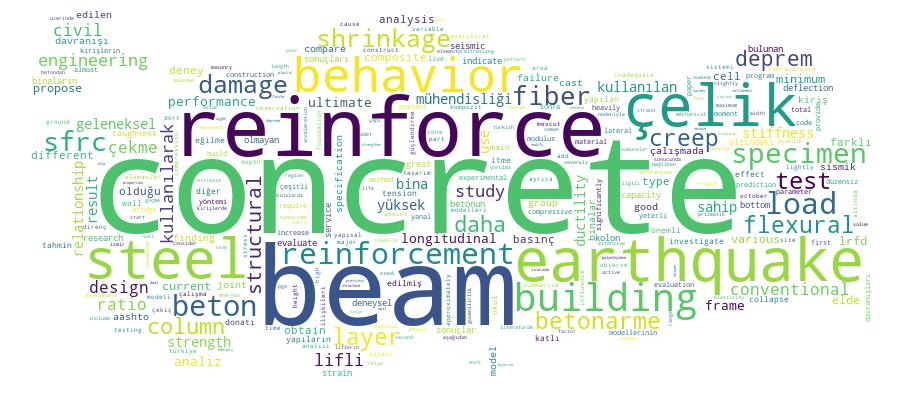
Competency Cloud

GCRIS Competency Cloud

Scholarly Output Search Results

Now showing 1 - 6 of 6
  • Article
    Citation - WoS: 4
    Citation - Scopus: 4
    A Site Survey of Damaged Rc Buildings in Izmir After the Aegean Sea Earthquake on October 30, 2020
    (Croatian Soc Civil Engineers-hsgi, 2023) Mertol, Halit Cenan; Tunc, Gokhan; Akis, Tolga
    An earthquake with a magnitude of Mw = 6.6 and a depth of approximately 16.5 km occurred on 30 October 2020 off the cost of Samos, a Greek island 35 km southwest of Seferihisar, a town in Izmir. The earthquake caused several collapses and severe structural damage in approximately 6,000 buildings, specifically in the Bayrakli District in Izmir Bay. This paper presents the observations and findings of a technical team that visited the earthquake -affected areas immediately after the earthquake. Eleven partially or fully collapsed and several severely damaged reinforced concrete buildings were investigated. Based on the site investigations, we observed that almost all of the collapsed or severely damaged reinforced concrete buildings in the region were built between 1975 and 2000. Site observations also confirmed that the construction of these collapsed or damaged buildings did not conform to the requirements outlined in the Turkish Earthquake Codes used at the time. The failures and severe damage to buildings in earthquake-affected areas are primarily related to inadequate reinforcement configuration, poor material quality, the absence of geotechnical studies, and framing problems related to their lateral load-carrying systems. Therefore, it is recommended that all the buildings located in and around Izmir Bay, particularly those built between 1975 and 2000, be structurally evaluated to prevent any further loss of life and property during future earthquakes.
  • Article
    Citation - WoS: 3
    Citation - Scopus: 6
    Experimental Analysis of the Behavior of Composite Column-Reinforced Concrete Beam Joints
    (Springer Heidelberg, 2021) Tunc, Gokhan; Dakhil, Abdulrrahman; Mertol, Halit Cenan
    This study assesses the seismic performance of steel-reinforced concrete (SRC) composite columns connected to reinforced concrete (RC) beam joints, and their ability to dissipate seismic energy through inelastic deformations. In this article, experimental aspects regarding the seismic performance of high-ductility and low-ductility steel-concrete composite frame were investigated. The principle design parameter in this study was ductility, which is considered a conceptual framework in Efficiency-Based Seismic Engineering. Thus, attention was focused on assuring various ductility ranges of joints obtained through a detailed study of the Turkish Earthquake Code (TEC 18) [Ministry of Public Works and Housing.: Turkiye Bina Deprem Yonetmeligi (Turkey's Earthquake Code for Buildings). Official Gazette (2018) (in Turkish).]. After identifying deficiencies and the energy dissipation capacity in the newly proposed joints, two half-scaled frames with specific ductility-related designs were constructed, instrumented, tested, and analyzed. The specimens were tested under displacement-controlled lateral cyclic loading that incorporated constant axial loading to create cyclic tension and compression facets across the joint areas. The test results proved that the SRC column-RC beam frames employing an extra column reinforcement ratio exhibit slightly better seismic performance. Due to the presence of structural steel, the shear failure of the joint was effectively prevented, even after the formation of the plastic hinge on the interface of the beam. During the testing, the column rebars, to some extent, made a minor contribution to the joint strength of the specimen compared to the structural steel that absorbed almost all of the load applied to the frame.
  • Article
    Citation - WoS: 7
    Citation - Scopus: 7
    Finite Element Analysis of Frames With Reinforced Concrete Encased Steel Composite Columns
    (Mdpi, 2022) Tunc, Gokhan; Othman, Mohammed Moatasem; Mertol, Halit Cenan
    Structural frame systems that consists of concrete-encased-steel-embedded composite columns and reinforced concrete beams are typically used in mid-rise to tall buildings. In order to understand their overall structural behavior, a total of 12 frame models with high and low ductility features were constructed and analyzed using LS-DYNA software. Two of these models were validated using the results of previously tested frames. The remaining 10 models were studied to predict the behavior of frames with varying concrete strengths, reinforcement configurations, and structural steel sections under vertical and lateral loads. The results were investigated in terms of cracks and failure patterns, load-deflection relationships, energy dissipation, and stiffness degradation. The analytical results indicated that the high ductile frame models showed slightly better lateral load carrying performances compared to low ductility frame models. Moreover, the analytical studies demonstrated that the existence of structural steel in a column, regardless of its cross-sectional shape, was the most important parameter in improving the lateral load carrying capacity of a frame.
  • Article
    Citation - WoS: 15
    Citation - Scopus: 16
    Damage Observation of Reinforced Concrete Buildings After 2020 Sivrice (elazig) Earthquake, Turkey
    (Asce-amer Soc Civil Engineers, 2021) Cenan Mertol, Halit; Tunc, Gokhan; Akis, Tolga
    An earthquake with a magnitude of M-w = 6.8 and a depth of approximately 8.06 km occurred on January 24, 2020, with the epicenter near the town of Sivrice in Elazig province, Turkey. The earthquake resulted in numerous collapses and severe structural damage to the buildings located in the downtowns and villages of Elazig and Malatya provinces. A technical team investigated the earthquake-affected areas, and this study presents their observations and findings with respect to reinforced concrete buildings. It was concluded that almost all of the collapsed or severely-damaged reinforced concrete buildings were constructed between 1975 and 1998. The design and construction of these buildings did not comply with the specifications of the Turkish earthquake codes valid at that time. The failures and severe damage of the buildings are associated with poor material quality, inadequate reinforcement configuration, and framing problems related to their lateral load-carrying systems. Therefore, it is recommended that buildings constructed between 1975 and 1998 in the region be structurally re-evaluated to avoid additional loss of life and property in future earthquakes. (C) 2021 American Society of Civil Engineers.
  • Article
    Citation - WoS: 10
    Citation - Scopus: 10
    Evaluation of Masonry Buildings and Mosques After Sivrice Earthquake
    (Croatian Soc Civil Engineers-hsgi, 2021) Mertol, Halit Cenan; Tunc, Gokhan; Akis, Tolga
    The evaluation of masonry and mosque type structures after the Sivrice Earthquake is presented in this study. Stone masonry buildings exhibited damage such as vertical cracks and splitting at corners, wedge shaped corner failures, diagonal cracking on walls, out-of-plane splitting of walls, and separation of walls from flooring/roofing systems. On the other hand, the separation of flags and caps of minarets was a common example of damage in mosques. Future earthquake damage can be prevented by following design codes and providing adequate supervision for new structures, while strengthening measures are recommended for the existing buildings.
  • Article
    Citation - WoS: 59
    Citation - Scopus: 67
    Investigation of Rc Buildings After 6 February 2023, Kahramanmaras, Turkiye Earthquakes
    (Mdpi, 2023) Mertol, Halit Cenan; Tunc, Gokhan; Akis, Tolga; Kantekin, Yunus; Aydin, Ishak Can
    Two major earthquakes struck Pazarcik and Elbistan, towns in Kahramanmaras, Turkiye, on 6 February 2023, approximately 9 h apart. The first earthquake, recorded at 04:17 local time, had a M-w = 7.7, with a focal depth of 8.6 km. At 13:24 local time, a second earthquake occurred with M-w = 7.6 at a focal depth of 7 km, approximately 90 km north of the first one. A total of 11 provinces were severely affected by these earthquakes. As of 15 April 2023, they caused close to 51,000 deaths and almost 215,000 completely destroyed/severely damaged buildings. At some locations, the largest horizontal peak ground acceleration (PGA) values of the first and second earthquakes exceeded the code-generated PGAs by almost 3 and 1.75 times, respectively. A technical team visited these areas within 15 h of the first earthquake. The purpose of this article is to present their observations, findings, and the characteristics of the two earthquakes, with comprehensive site survey results supported by photographs. This study concludes that most of the collapsed and severely/moderately damaged buildings in the region were built between 1975 and 2000, when site inspections were rare or non-existent. In addition to the high PGAs recorded in these earthquakes, it was verified that the design and construction of these buildings did not fully comply with the earthquake codes valid at the time. The collapsed buildings and their damage patterns confirm inadequate development length, violation of bending stirrup ends at 135 & DEG;, deficiencies in construction materials and reinforcement configuration, noncompliance with confinement zones, violation of the strong beam-stronger column analogy, and issues related to building inspection. Based on the extent of the damage, it is strongly recommended that the structural performance inspection of all other buildings located near major fault lines, specifically those constructed between 1975 and 2000, should be completed. Since these earthquakes generated much higher PGAs, which is believed to be one of the main reasons for the extensive damage, a re-evaluation of all other PGAs along major fault lines is also recommended.