Mertol, Halit Cenan

Loading...
Profile Picture
Name Variants
Mertol, Halit Cenan
Halit Cenan Mertol
M., Halit Cenan
H. C. Mertol
H.,Mertol
M.,Halit Cenan
H., Mertol
Mertol,H.C.
Mertol,Halit Cenan
H.C.Mertol
Mertol H.
Halit Cenan, Mertol
Cenan Mertol H.
Mertol, Halit
Job Title
Doktor Öğretim Üyesi
Email Address
cenan.mertol@atilim.edu.tr
Main Affiliation
Civil Engineering
Status
Scopus Author ID
Turkish CoHE Profile ID
Google Scholar ID
WoS Researcher ID

Sustainable Development Goals

5

GENDER EQUALITY
GENDER EQUALITY Logo

0

Research Products

14

LIFE BELOW WATER
LIFE BELOW WATER Logo

0

Research Products

10

REDUCED INEQUALITIES
REDUCED INEQUALITIES Logo

0

Research Products

3

GOOD HEALTH AND WELL-BEING
GOOD HEALTH AND WELL-BEING Logo

0

Research Products

2

ZERO HUNGER
ZERO HUNGER Logo

0

Research Products

9

INDUSTRY, INNOVATION AND INFRASTRUCTURE
INDUSTRY, INNOVATION AND INFRASTRUCTURE Logo

0

Research Products

16

PEACE, JUSTICE AND STRONG INSTITUTIONS
PEACE, JUSTICE AND STRONG INSTITUTIONS Logo

0

Research Products

11

SUSTAINABLE CITIES AND COMMUNITIES
SUSTAINABLE CITIES AND COMMUNITIES Logo

12

Research Products

8

DECENT WORK AND ECONOMIC GROWTH
DECENT WORK AND ECONOMIC GROWTH Logo

1

Research Products

13

CLIMATE ACTION
CLIMATE ACTION Logo

0

Research Products

4

QUALITY EDUCATION
QUALITY EDUCATION Logo

1

Research Products

6

CLEAN WATER AND SANITATION
CLEAN WATER AND SANITATION Logo

0

Research Products

1

NO POVERTY
NO POVERTY Logo

0

Research Products

15

LIFE ON LAND
LIFE ON LAND Logo

0

Research Products

17

PARTNERSHIPS FOR THE GOALS
PARTNERSHIPS FOR THE GOALS Logo

0

Research Products

7

AFFORDABLE AND CLEAN ENERGY
AFFORDABLE AND CLEAN ENERGY Logo

0

Research Products

12

RESPONSIBLE CONSUMPTION AND PRODUCTION
RESPONSIBLE CONSUMPTION AND PRODUCTION Logo

1

Research Products
Documents

18

Citations

365

h-index

10

Documents

14

Citations

310

Scholarly Output

34

Articles

18

Views / Downloads

36/0

Supervised MSc Theses

14

Supervised PhD Theses

1

WoS Citation Count

272

Scopus Citation Count

306

WoS h-index

7

Scopus h-index

8

Patents

0

Projects

1

WoS Citations per Publication

8.00

Scopus Citations per Publication

9.00

Open Access Source

8

Supervised Theses

15

Google Analytics Visitor Traffic

JournalCount
PCI Journal2
Buildings2
Journal of the Croatian Association of Civil Engineers2
Journal of Performance of Constructed Facilities2
Journal of Reinforced Plastics and Composites1
Current Page: 1 / 3

Scopus Quartile Distribution

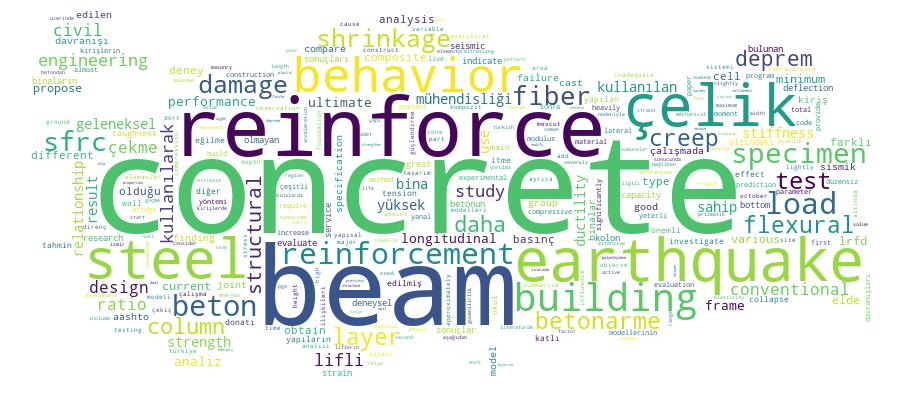
Competency Cloud

GCRIS Competency Cloud

Scholarly Output Search Results

Now showing 1 - 2 of 2
  • Article
    Citation - WoS: 6
    Citation - Scopus: 10
    Lessons Learned From Four Recent Turkish Earthquakes: Sivrice-Elazığ, Aegean Sea, and Dual Kahramanmaraş
    (Springer, 2024) Tunc, Goekhan; Mertol, Halit Cenan; Akis, Tolga
    T & uuml;rkiye is located in an earthquake-prone region where almost all of its population resides in risky areas. In the past 100 years, there has been a strong earthquake every two years and a major one every 3 years. This study investigates the impact of four recent earthquakes, that occurred between 2020 and 2023, on reinforced concrete (RC) buildings. The first, Sivrice-Elaz & imath;& gbreve;, struck the eastern part of T & uuml;rkiye on January 24, 2020, with a moment magnitude of Mw = 6.8. The second, the Aegean Sea, hit the western part of the country on October 30, 2020, with an Mw of 6.6. The third and fourth are the February 6, 2023 dual Kahramanmara & scedil; earthquakes with Mws of 7.7 and 7.6, which struck the eastern part of T & uuml;rkiye approximately 9 h apart. Immediately following these earthquakes, a technical team investigated each of the damaged areas. This study summarizes their findings on RC buildings. It was discovered that the majority of the collapsed or severely damaged RC buildings were constructed before 2000. The main reasons for this included technological limitations, specifically on producing high-quality concrete, as well as a lack of public policies and enforced laws in the construction sector to maintain an acceptable international standard. Furthermore, the damage patterns of buildings from these four earthquakes indicated poor workmanship, low material quality, improper structural framing, a common appearance of soft and weak stories, the inadequate use of shear walls, and defective reinforcement configuration. The significance of soil studies and the enforcement of building inspections are also discussed, along with the earthquake codes. The study concludes that the maximum peak ground accelerations from the dual Kahramanmara & scedil; earthquakes were almost triple the code-prescribed values. Therefore, it is recommended that the current mapped spectral acceleration values be revised and that buildings constructed before 2000 should be prioritized while determining their structural performances.
  • Article
    Citation - WoS: 15
    Citation - Scopus: 16
    Damage Observation of Reinforced Concrete Buildings After 2020 Sivrice (elazig) Earthquake, Turkey
    (Asce-amer Soc Civil Engineers, 2021) Cenan Mertol, Halit; Tunc, Gokhan; Akis, Tolga
    An earthquake with a magnitude of M-w = 6.8 and a depth of approximately 8.06 km occurred on January 24, 2020, with the epicenter near the town of Sivrice in Elazig province, Turkey. The earthquake resulted in numerous collapses and severe structural damage to the buildings located in the downtowns and villages of Elazig and Malatya provinces. A technical team investigated the earthquake-affected areas, and this study presents their observations and findings with respect to reinforced concrete buildings. It was concluded that almost all of the collapsed or severely-damaged reinforced concrete buildings were constructed between 1975 and 1998. The design and construction of these buildings did not comply with the specifications of the Turkish earthquake codes valid at that time. The failures and severe damage of the buildings are associated with poor material quality, inadequate reinforcement configuration, and framing problems related to their lateral load-carrying systems. Therefore, it is recommended that buildings constructed between 1975 and 1998 in the region be structurally re-evaluated to avoid additional loss of life and property in future earthquakes. (C) 2021 American Society of Civil Engineers.