
Arıkan, Kutluk Bilge
Loading...

Profile URL
Name Variants
K.B.Arikan
Kutluk Bilge, Arıkan
K., Arikan
Arıkan,K.B.
Arıkan, Kutluk Bilge
K.B.Arıkan
Kutluk Bilge, Arikan
Arikan, Kutluk Bilge
K.,Arıkan
A., Kutluk Bilge
Arikan,K.B.
A.,Kutluk Bilge
Arikan, K. B.
Kutluk Bilge, Arıkan
K., Arikan
Arıkan,K.B.
Arıkan, Kutluk Bilge
K.B.Arıkan
Kutluk Bilge, Arikan
Arikan, Kutluk Bilge
K.,Arıkan
A., Kutluk Bilge
Arikan,K.B.
A.,Kutluk Bilge
Arikan, K. B.
Job Title
Doktor Öğretim Üyesi
Email Address
kutluk.arikan@atilim.edu.tr
Main Affiliation
Department of Mechatronics Engineering
Status
Former Staff
Website
ORCID ID
Scopus Author ID
Turkish CoHE Profile ID
Google Scholar ID
WoS Researcher ID
Sustainable Development Goals
 1
1NO POVERTY
1
Research Products
 2
2ZERO HUNGER
0
Research Products
 3
3GOOD HEALTH AND WELL-BEING
1
Research Products
 4
4QUALITY EDUCATION
0
Research Products
 5
5GENDER EQUALITY
0
Research Products
 6
6CLEAN WATER AND SANITATION
0
Research Products
 7
7AFFORDABLE AND CLEAN ENERGY
0
Research Products
 8
8DECENT WORK AND ECONOMIC GROWTH
0
Research Products
 9
9INDUSTRY, INNOVATION AND INFRASTRUCTURE
1
Research Products
 10
10REDUCED INEQUALITIES
0
Research Products
 11
11SUSTAINABLE CITIES AND COMMUNITIES
1
Research Products
 12
12RESPONSIBLE CONSUMPTION AND PRODUCTION
0
Research Products
 13
13CLIMATE ACTION
0
Research Products
 14
14LIFE BELOW WATER
0
Research Products
 15
15LIFE ON LAND
0
Research Products
 16
16PEACE, JUSTICE AND STRONG INSTITUTIONS
0
Research Products
 17
17PARTNERSHIPS FOR THE GOALS
0
Research Products

This researcher does not have a Scopus ID.

This researcher does not have a WoS ID.

Scholarly Output
38
Articles
11
Views / Downloads
226/2888
Supervised MSc Theses
14
Supervised PhD Theses
7
WoS Citation Count
158
Scopus Citation Count
206
Patents
0
Projects
0
WoS Citations per Publication
4.16
Scopus Citations per Publication
5.42
Open Access Source
3
Supervised Theses
21
| Journal | Count |
|---|---|
| Journal of Petroleum Science and Engineering | 2 |
| 20th Annual International Conference on Mechatronics and Machine Vision in Practice, M2VIP 2013 -- 20th Annual International Conference on Mechatronics and Machine Vision in Practice, M2VIP 2013 -- 20 September 2013 through 20 September 2013 -- Ankara -- 102276 | 2 |
| Adaptive Behavior | 1 |
| AIAA Modeling and Simulation Technologies Conference, 2016 -- AIAA Modeling and Simulation Technologies Conference, 2016 -- 13 June 2016 through 17 June 2016 -- Washington -- 176499 | 1 |
| AIAA SciTech Forum - 55th AIAA Aerospace Sciences Meeting -- 55th AIAA Aerospace Sciences Meeting -- 9 January 2017 through 13 January 2017 -- Grapevine -- 126423 | 1 |
Current Page: 1 / 3
Scopus Quartile Distribution
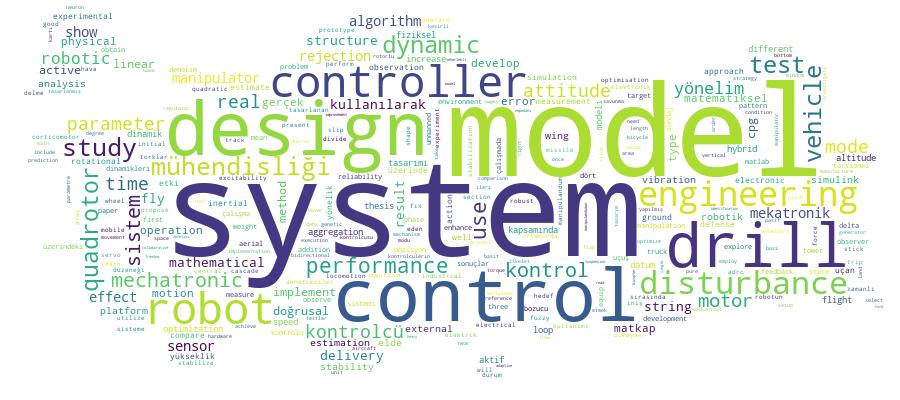
Competency Cloud
14 results
Scholarly Output Search Results
Now showing 1 - 10 of 14
Conference Object Citation - WoS: 12Design of a Robotic Bicopter(Ieee, 2019) Albayrak, Ozge Beyza; Ersan, Yagmur; Bagbasi, Aysen Suheyla; Basaranoglu, Ahmet Turgut; Arikan, Kutluk BilgeThis article presents a Bicopter type of a flying robot with two rotary-wing units which are placed in a tandem form on the chassis. The rotors are tilted by the aid of the tilt mechanism. Cascaded type of PID controllers are designed on the dynamical models for the attitude and altitude dynamics. The simulated control systems are implemented and tuned on the Naze32 flight controller which is connected to a Raspberry Pi single board computer for real-time applications. The real-time performance is monitored and evaluated during the tests and it is seen that the system is suitable for indoor type of robotic applications.Article Citation - WoS: 7Citation - Scopus: 8Robust and Adaptive Control Design of a Drilling Rig During the Operating Modes(Sage Publications Ltd, 2019) Sadeghi, Amir Nobahar; Arikan, Kutluk Bilge; Ozbek, Mehmet Efe; Baranoglu, Besim; Nobahar Sadeghi, AmirOil well drilling towers have different operating modes during a real operation, like drilling, tripping, and reaming. Each mode involves certain external disturbances and uncertainties. In this study, using the nonlinear model for the modes of the operation, robust and/or adaptive control systems are designed based on the models. These control strategies include five types of controllers: cascaded proportional-integral-derivative, active disturbance rejection controller, loop shaping, feedback error learning, and sliding mode controller. The study presents the design process of these controllers and evaluates the performances of the proposed control systems to track the reference signal and reject the uncertain forces including the parametric uncertainties and the external disturbances. This comparison is based on the mathematical performance measures and energy consumption. In addition, three architectures are presented to control the weight on bit during drilling process, and also to maintain a preset constant weight on bit, two control approaches are designed and presented.Article Araç Dinamiğinin Tek İzli Araç Modeli Yardımıyla Tanılanması(2004) Arıkan, Kutluk Bilge; Ünlüsoy, Y. SamimTek izli araç modeli yapısı kullanılarak, aracın dönüş dinamiğini anlatan matematiksel modeller tanılanmıştır. ARMAX ve durum uzayı modelleri parametre kestirimlerinde kullanılmıştır. Öngörü hatası kestir imi yöntemi uygulanmıştır. Kestirilen modellerden tek izli araç modelini oluşturan fiziksel parametreler de hesaplanmıştır.Article Citation - WoS: 20Citation - Scopus: 28Modelling and Optimisation of an 8 X 8 Heavy Duty Vehicle's Hydro-Pneumatic Suspension System(inderscience Enterprises Ltd, 2016) Kucuk, Kahraman; Yurt, Hunkar Kemal; Arikan, Kutluk Bilge; Mrek, Huseyin; Imrek, HüseyinIn this paper, modelling of the hydro-pneumatic suspension (HPS) system of a heavy duty vehicle that has all-wheel steering and driving capability is studied. The prototype vehicle of concern is a mobile telescopic crane. The spring and damper effects of the HPS, which is used generally in heavy commercial vehicles and in military vehicles, have been modelled separately. First, HPS dynamics is studied on 1/8 vehicle model and then vehicle dynamics is examined on the MSC ADAMS/Car model. HPS of the prototype vehicle is assessed by some objective functions. In addition, simulation-based optimisation is performed using a 1/8 vehicle model. Various designs are obtained and their performances are compared with that of the prototype vehicle's HPS by the ADAMS/Car model simulations. Modelling and optimisation studies reveal a sound background to improve the prototype vehicle and to design active HPS system.Conference Object Citation - Scopus: 14Attitude and Altitude Stabilization of a Fixed Wing Vtol Unmanned Air Vehicle(American Institute of Aeronautics and Astronautics Inc, AIAA, 2016) Güçlü,A.; Arıkan,K.B.; Kurtuluş,D.F.The aim of the current study is to introduce an overview about the design, manufacturing and testing of a Hybrid Air Vehicle (HAV). The designed vehicle will have the ability to vertically takeoff and landing in addition to fly horizontally as a fixed wing aircraft. A remotely piloted model aircraft (E-Flite Apprentice Model Plane) is selected for the initial tests and it is modified for the current purpose. A thrust measurement setup is used to obtain the thrust characteristics of the motors which are used in the model aircraft for system identification. Another test stand is also designed and manufactured to test the servo motor responses at the control surfaces of the HAV. Inertia tensor of the HAV is obtained experimentally by means of bifilar pendulum test method. The wing of the aircraft will be tested in the 1m x 1mtest section wind tunnel of Aerospace Engineering Department of METU to obtain aerodynamic characteristics. By means of experimentally identified system parameters, the HAV is modeled in Matlab/Simulink environment mathematically. The HAV has three main operating modes such as vertical takeoff and landing, transition to fixed wing flight or vice versa, and fixed wing flight. Combinations of a Linear Active Disturbance Rejection Controller (LADRC) and a Proportional Integral Derivative (PID) based control topologies will be designed for operating modes. To observe performance and enhance the developed system models and controllers, hardware in the loop tests will be done by means of a Flight Motion Simulator (FMS) of ROKETSAN Missile Inc. © 2016 by the American Institute of Aeronautics and Astronautics, Inc. All rights reserved.Conference Object Disturbance Rejection Control of a Quadrotor Equipped With a 2 Dof Manupilator(2013) Aydemir,M.; Arikan,K.B.; Irfanoǧlu,B.In this study Active Disturbance Rejection Control (ADRC) is implemented for the attitude dynamics of the quadrotor flying platform. Quadrotor model with a 2 DOF manipulator is constructed. External disturbances, manipulator dynamics and internal plant dynamics are treated as total disturbance which are estimated and rejected in simulation environment.Book Part Citation - Scopus: 3Disturbance Rejection Control of a Quadrotor Equipped With a 2 DOF Manipulator(Springer Berlin Heidelberg, 2015) Aydemir, Mete; Arikan, Kutluk Bilge; Irfanoğlu, BülentIn this study Active Disturbance Rejection Control (ADRC) is implemented for the attitude dynamics of the quadrotor flying platform. Quadrotor model with a 2 DOF manipulator is constructed. External disturbances, manipulator dynamics and internal plant dynamics are treated as total disturbance which are estimated and rejected in simulation environment. © 2025 Elsevier B.V., All rights reserved.Article Citation - WoS: 8Citation - Scopus: 15Identification of Linear Handling Models for Road Vehicles(Taylor & Francis Ltd, 2008) Arikan, K. B.; Unlusoy, Y. S.; Korkmaz, I.; Celebi, A. O.This study reports the identification of linear handling models for road vehicles starting from structural identifiability analysis, continuing with the experiments to acquire data on a vehicle equipped with a sensor set and data acquisition system, and ending with the estimation of parameters using the collected data. The model structure originates from the well-known linear bicycle model that is frequently used in handling analysis of road vehicles. Physical parameters of the bicycle model structure are selected as the unknown parameter set that is to be identified. Global identifiability of the model structure is analysed, in detail, and concluded according to various available sensor sets. Physical parameters of the bicycle model structure are estimated using prediction error estimation method. Genetic algorithms are used in the optimisation phase of the identification algorithm to overcome the difficulty in the selection of initial values for parameter estimates. Validation analysis of the identified model is also presented. The identified model is shown to track the system response successfully.Article Citation - WoS: 1Citation - Scopus: 1Evaluation and Optimization of Nonlinear Central Pattern Generators for Robotic Locomotion(Romanian Soc Control Tech informatics, 2018) Elbori, Abdalftah; Turan, Mehmet; Arikan, Kutluk Bilge; Department of Mechatronics Engineering; MathematicsWith regard to the optimization of Central Pattern Generators (CPGs) for bipedal locomotion in robots, this paper investigates how the different cases of CPGs such as uncoupled, unidirectional, bidirectional two CPGs are used to produce rhythmic patterns for one leg with two degrees of freedom (DOF). This paper also discusses the stability analysis of CPGs and attempts to utilize genetic algorithms with the hybrid function and adapts the CPGs to robotic systems that perform one-leg movement, by utilizing the bidirectional two CPGs. The results show far greater improvement than in the other cases. CPGs not only enhance movement but also control locomotion without any sensory feedback.Conference Object Citation - Scopus: 2Experimental and Numerical Results of a Flapping Wing Four Bar Mechanism(American Institute of Aeronautics and Astronautics Inc., 2017) Senol,M.G.; Arikan,K.B.; Kurtulus,D.F.This paper explores the design and testing of a flapping wing four-bar mechanism. A four-bar linkage system kinematic analysis is introduced for flapping wing motion. Four-bar mechanism is activated by a servo motor which is driven by microcontroller. The wing undergoes a pure flapping motion at a fixed pitch angle. Force measurements are performed for hover mode by using a force transducer. In addition, 3D numerical analyses are performed and the results are compared with the experimental measurements. Overall, CFD results show good agreement with the experimental data. © 2017 by the American Institute of Aeronautics and Astronautics, Inc. All rights reserved.
