
Akçay, Emre Caner
Loading...
Profile URL
Name Variants
E. C. Akçay
Emre Caner, Akcay
E.C.Akçay
Akçay,E.C.
E., Akcay
A., Emre Caner
Emre Caner, Akçay
Akcay, Emre Caner
Akcay,Emre Caner
E.,Akçay
Akcay,E.C.
E.C.Akcay
Emre Caner Akçay
A.,Emre Caner
Akçay, Emre Caner
E. C. Akcay
Emre Caner, Akcay
E.C.Akçay
Akçay,E.C.
E., Akcay
A., Emre Caner
Emre Caner, Akçay
Akcay, Emre Caner
Akcay,Emre Caner
E.,Akçay
Akcay,E.C.
E.C.Akcay
Emre Caner Akçay
A.,Emre Caner
Akçay, Emre Caner
E. C. Akcay
Job Title
Doçent Doktor
Email Address
caner.akcay@atilim.edu.tr
Main Affiliation
Civil Engineering
Status
Website
ORCID ID
Scopus Author ID
Turkish CoHE Profile ID
Google Scholar ID
WoS Researcher ID
Sustainable Development Goals
5
GENDER EQUALITY

0
Research Products
14
LIFE BELOW WATER

0
Research Products
10
REDUCED INEQUALITIES

0
Research Products
3
GOOD HEALTH AND WELL-BEING

0
Research Products
2
ZERO HUNGER

0
Research Products
9
INDUSTRY, INNOVATION AND INFRASTRUCTURE

5
Research Products
16
PEACE, JUSTICE AND STRONG INSTITUTIONS

0
Research Products
11
SUSTAINABLE CITIES AND COMMUNITIES

0
Research Products
8
DECENT WORK AND ECONOMIC GROWTH

2
Research Products
13
CLIMATE ACTION

2
Research Products
4
QUALITY EDUCATION

0
Research Products
6
CLEAN WATER AND SANITATION

0
Research Products
1
NO POVERTY

1
Research Products
15
LIFE ON LAND

0
Research Products
17
PARTNERSHIPS FOR THE GOALS

4
Research Products
7
AFFORDABLE AND CLEAN ENERGY

8
Research Products
12
RESPONSIBLE CONSUMPTION AND PRODUCTION

5
Research Products

Documents
18
Citations
122
h-index
6

Documents
9
Citations
49

Scholarly Output
18
Articles
10
Views / Downloads
39/0
Supervised MSc Theses
4
Supervised PhD Theses
0
WoS Citation Count
49
Scopus Citation Count
69
WoS h-index
4
Scopus h-index
5
Patents
0
Projects
0
WoS Citations per Publication
2.72
Scopus Citations per Publication
3.83
Open Access Source
8
Supervised Theses
4
Google Analytics Visitor Traffic
| Journal | Count |
|---|---|
| Buildings | 3 |
| Engineering, Construction and Architectural Management | 2 |
| Dicle Üniversitesi Mühendislik Fakültesi Mühendislik Dergisi | 1 |
| International Conference on Construction in the 21st Century -- 14th International Conference on Construction in the 21st Century, CITC 2024 -- 2 September 2024 through 5 September 2024 -- Rio de Janeiro -- 208601 | 1 |
| JOURNAL OF CIVIL ENGINEERING AND MANAGEMENT | 1 |
Current Page: 1 / 3
Scopus Quartile Distribution
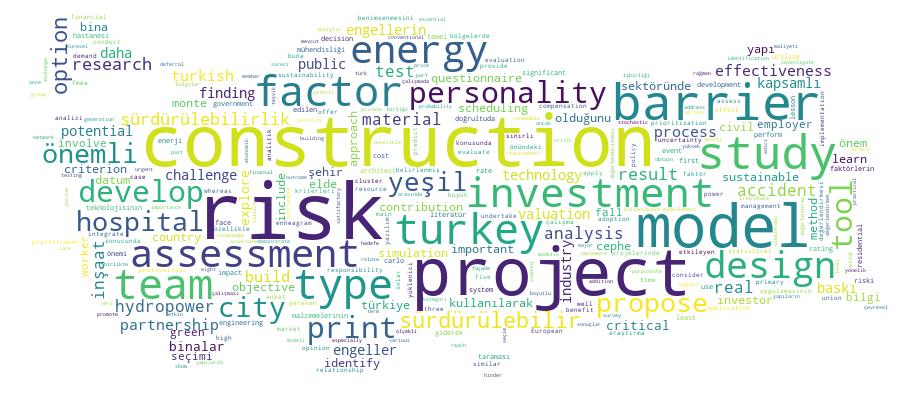
Competency Cloud
18 results
Scholarly Output Search Results
Now showing 1 - 10 of 18
Article Design Team Effectiveness and Architects' Personality Types(Emerald Group Publishing Ltd, 2025) Alan, Ece; Arditi, David; Gunaydin, Husnu Murat; Akcay, Emre CanerPurposeThe personalities of the design team members constitute one of the factors that influence team effectiveness. In this study, 223 members of the "American Institute of Architects" who are employed by the largest architectural design firms in the United States of America were categorized according to their personality types by using "The Enneagram Personality Type Model." Also, the respondents' opinions about eight team effectiveness outcomes were recorded in order to explore the relationship between team members' personality types and team effectiveness outcomes.Design/methodology/approachThe information was collected by a questionnaire where the first part included 144 pairs of statements that were used to identify respondents' personality types. The second part sought designers' opinions about the importance of eight team effectiveness outcomes rated on a Likert scale ranging from 1 to 5. The results were assessed by performing the Kruskal-Wallis test first and Dunn's post-hoc test with Bonferroni adjustment subsequently.FindingsThe findings highlight the significance of personality types in effective design teams. While Type 6 (loyalist and skeptic) and Type 3 (achiever and performer) architects prioritize team effectiveness the most, Type 7 architects (enthusiasts and epicureans) assign the lowest importance. However, the presence of Type 1 (reformist and perfectionist) and Type 8 (challenger and protector) architects within the same design team may involve challenges or conflicts.Originality/valueThe primary contribution of this study is that it is the first study in the construction management literature that utilizes The Enneagram of Personality Test to understand the relationship between team members' personality types and team effectiveness outcomes. This study is of direct relevance to practitioners and could be utilized in design team-building activities.Master Thesis Türk İnşaat Sektöründe 3B Baski Teknolojisinin Benimsenmesini Etkileyen Ana Etkenler ve Engeller(2025) Latifiilkhechi, Leva; Aminbakhsh, Saman; Akçay, Emre CanerBu çalışmada, Türk inşaat sektöründe 3B baskı teknolojisinin benimsenmesini etkileyen temel faktörler incelenmiştir. Bu doğrultuda, kapsamlı bir literatür taraması sonucunda 27 teşvik edici ve 19 engelleyici faktör belirlenmiş olup, bu faktörlerin değerlendirmesi 106 uzmandan oluşan bir anket çalışması ile yapılmıştır. Bu faktörlerin önemi, Göreceli Önem İndeksi (GÖİ) kullanılarak değerlendirilmiş ve ardından Analitik Hiyerarşi Prosesi (AHP) ile faktörlerin önem düzeyleri belirlenmiştir. 3B baskı teknolojisinin daha hızlı inşaat, iş kazalarının azalması, enerji verimliliğinin artması ve karmaşık tasarımların daha kolay uygulanması gibi avantajlar sunduğu görülse de, bu teknolojinin benimsenmesini engelleyen başlıca zorluklar arasında 3B Beton Baskı için yeterli düzenlemelerin ve yapı kodlarının eksikliği, büyük ölçekli uygulamalar konusunda sınırlı bilgi ve yalıtım malzemelerinin yetersizliği yer almaktadır. Araştırma sonuçları, malzeme israfını azaltma ve daha fazla özelleştirme imkânı sağlama gibi faktörlerin 3B baskının inşaat sektöründe benimsenmesinde en önemli etmen olduğunu, gözetim maliyetlerinin azaltılmasının ise en az önemli teşvik edici faktör olduğunu ortaya koymuştur. Diğer yandan, siber güvenlik riskleri, potansiyel iş kayıpları ve basılı yapıların katmanlı ve pürüzlü yüzeyleri, en kritik engeller olarak belirlenmiştir. Bu araştırma, 3B baskı teknolojisinin inşaat sektörüne entegrasyonunun artırılması için bu etmenlerin ve engellerin hedefe yönelik stratejilerle ele alınması gerektiğini vurgulamaktadır.Article Citation - WoS: 13Citation - Scopus: 17An Analytic Network Process Based Risk Assessment Model for Ppp Hydropower Investments(Vilnius Gediminas Tech Univ, 2021) Akcay, Emre CanerThe number of public-private partnership (PPP) projects has gone up especially in developing countries. The risk assessment of PPP projects is essential in ensuring project success. The objective of this study is to develop an Analytic Network Process (ANP) based risk assessment model for hydropower investments, and a tool to facilitate quantification of risk ratings based on this model. The results show that the three most important risk factors that affect the overall risk rating of a PPP hydropower investment are legal risks, contractor/subcontractor risks, and operator risks. In addition, the three most important risk clusters were identified as stakeholders, government requirements, and resources, whereas market was the least important cluster. The tool that measures the risk rating of a PPP of hydropower project was tested on ten real cases, and satisfactory results were obtained in terms of its predictive capability. The contributions of this research include (1) identification of the risk factors and clusters of factors associated with PPP hydropower investments; (2) determination of the priority of each risk factor and cluster; (3) development a tool that guides the investors through the risk assessment of PPP hydropower investments.Article Citation - WoS: 2Citation - Scopus: 2A Comparative Analysis of the Criteria for Choosing Sustainable Materials for Façades in Turkey and the European Union(Mdpi, 2024) Daskin, Haney Basak; Barbulescu, Alina; Muntean, Radu; Akcay, Emre CanerOne of the primary contributors to energy consumption is the construction industry. To address the urgent demand for eco-friendly approaches in this field, this study conducted an investigation on Scopus and Web of Science databases to identify the criteria for selecting sustainable materials for facades. Three groups of criteria were derived after a systematic review: Environmental, Social/economic and Technical. The main goal of the research was to answer the question of whether there are differences in these materials' selection between Turkey and European Union countries. After applying statistical tests, it was found that there are significant differences in selecting eco-friendly material only from the social/economic perspective. The most important sub-criterion is the economic cost. Comparisons with results from China and US confirm this finding.Article Citation - Scopus: 1An Activity-Based Lessons Learned Model To Support Scheduling Decisions in Construction(Emerald Group Publishing Ltd, 2025) Yilmaz, Anil; Akcay, Emre Caner; Dikmen, Irem; Birgonul, M. TalatPurposeThe aim of this study is to develop an activity-based lessons-learned model that allows construction companies to capture, store, classify and reuse activity-related lessons learned (LL) from previous projects, thereby increasing the reliability of time estimates in scheduling.Design/methodology/approachScheduling is a knowledge-intensive process that requires the utilization of data and expert opinion elicitation from various levels of an organization in construction projects. This research consists of five successive steps: performing a needs analysis, proposing an activity-based lessons-learned process model, validating the proposed process model, developing a tool to apply the proposed model in a computer environment and testing the applicability of the tool. To implement the proposed model in practice, a web-based tool, namely the Construction Industry Scheduling with Activity-Based Lessons Learned Tool (ConSALL Tool), was developed. Its functionality was evaluated using black-box testing. The tool was then applied in a real construction project.FindingsResults show that ConSALL has the potential to improve scheduling decisions in construction projects by incorporating data and experience from previous projects. Findings from this research can be used to develop similar models and AI tools to foster activity-based learning in other project-based industries as well as the construction industry.Originality/valueThis paper presents an innovative approach to enhancing construction project scheduling by leveraging LL from past projects. The development and application of the ConSALL Tool demonstrate a practical implementation of the proposed model, providing a framework that can be adapted to other industries to improve project planning and execution.Conference Object Drivers for Adopting 3D Printing Technology in Turkiye(European Council on Computing in Construction (EC3), 2025) Latifiilkhechi, L.; Aminbakhsh, S.; Akcay, E.C.This study investigates the factors driving the adoption of 3D printing technology in construction industry, focusing on Turkiye and developing EU countries. A comprehensive literature review identified 27 key drivers, which were evaluated through a survey of 106 professionals using Relative Importance Index (RII). Results reveal that faster construction, lower rate of site accidents and fatalities, and reduction in material waste are the most significant drivers, while freedom in design due to less strict standards was found to be the least important. The research emphasizes the need for targeted initiatives to enhance the integration of 3D printing in construction projects. © 2025, European Council on Computing in Construction (EC3). All rights reserved.Article Yeşil Binalar için Analitik Ağ Süreci (aas) Kullanılarak Yüklenici Seçimi(2020) Akçay, Emre CanerBinalar, dünyadaki tükenebilen kaynakların azalmasında ve enerji tüketiminde önemli bir paya sahiptir. Buçevresel etkileri en aza indirmek için yeşil binalar dünyada giderek önem kazanmaya başlamıştır. Yeşil binalarıngiderek önem kazandığı ve sayısının her geçen gün arttığı ülkelerden birisi de Türkiye’dir. Yeşil bina yaptırmakisteyen yatırımcıların en önemli sorunlarından biri, yeşil bina inşaatını yapacak olan yüklenici firmanın seçimidir.Bu çalışmada çok kriterli seçim yöntemlerinden biri olan Analitik Ağ Süreci (AAS) kullanılarak yeşil binalar içinyüklenici seçim modeli oluşturulması hedeflenmiştir. Buna göre, önce kavramsal bir model geliştirilmiş dahasonra AAS kullanılarak önerilen modelin pratikte nasıl uygulanabileceği Ankara’da gerçekleştirilmesi planlananbir yeşil bina projesinde gösterilmiştir. Oluşturulan bu modelin yeşil binalar için yüklenici seçimi yapanyatırımcılara yardımcı olacağı düşünülmektedir.Master Thesis Türkiye'de Kamu-özel İşbirliği (köi) Modeli ile Yürütülen Şehir Hastanesi Projeleri için Risk Değerlendirilmesi(2022) Doğan, Tuğba; Akçay, Emre CanerDevletler, sınırlı kaynaklarıyla topluma sunmaları gereken hizmetleri gerçekleştirmekte güçlük çekmektedirler. Söz konusu durum, alternatif bir finansman modeli olan Kamu-Özel İşbirliği (KÖİ) modelinin kullanımının giderek artmasına yol açmıştır. KÖİ, kamu hizmetlerini yerine getirmek için özel sektör ve kamu sektörünün birlikte yürüttüğü uzun soluklu bir işbirliği yapısına sahiptir. Türkiye, yeterli kaynağa sahip olmayan ve ivedi toplum ihtiyaçlarını karşılamak için KÖİ modelini uygulayan gelişmekte olan ülkelerden biridir. Son 10 yıldır, Türkiye Hükûmeti özellikle şehir hastanesi projelerinin gerçekleştirilmesinde KÖİ modelini yaygın olarak kullanmaktadır. Ancak, yatırımcılar çeşitli risk faktörleri nedeniyle projelerin uygulanmasında birtakım zorluklarla karşılaşmışlardır. Bu doğrultuda, bu tezin temel amacı Türkiye'deki KÖİ şehir hastanesi projeleri için risk değerlendirmesi yapmaktır. Bu kapsamda, KÖİ projelerinde karşılaşılabilecek olası risk faktörlerinin listesi kapsamlı bir literatür taraması yapılarak elde edilmiştir. Risk faktörlerinin meydana gelme olasılığı ve etkisinin şiddeti, bir anket çalışması aracılığıyla incelenmiştir. Risklerin önceliğinin belirlenmesi için anketten elde edilen veriler analiz edilmiştir. Sonuçlar ise, Türkiye'deki KÖİ şehir hastanesi projelerindeki en önemli beş risk faktörünün döviz kuru dalgalanmaları riski, enflasyon oranı oynaklığı riski, yüksek finansman maliyeti riski, mali risk ve ekonomik kriz riski olduğunu, buna karşın ekipmanın düşük verimliliği riskinin en az önemli risk faktörü olduğunu ortaya koymuştur. Bu tezden elde edilen sonuçların, Türkiye'de KÖİ şehir hastanesi projelerine yatırım yapmayı düşünen yatırımcılara yol gösterebileceği düşünülmektedir.Article Citation - WoS: 5Citation - Scopus: 5Exploring the Critical Risk Factors of Public-Private Partnership City Hospital Projects in Turkey(Mdpi, 2024) Dogan Erdem, Tugba; Birgonul, Zeynep; Bilgin, Gozde; Akcay, Emre CanerGovernments face challenges in delivering essential public services due to their limited funds. This has led to an increasing reliance on the Public-Private Partnership (PPP) model, an alternative financing model involving a long-term collaboration between the private and public sectors to provide public services. Turkey, as a developing country facing financial limitations, has embraced the PPP model to address urgent public needs. Over the past decade, the Turkish Government has extensively utilized the PPP model, particularly in executing city hospital projects. However, investors have faced challenges in project execution due to various risk factors. Therefore, the main objective of this study is to explore the critical risk factors associated with PPP city hospital projects in Turkey. In this context, a comprehensive literature review was conducted to identify potential risks related to PPP city hospital projects. A questionnaire survey was implemented to assess the probability of occurrence and the severity of the impact of these risk factors. The collected data underwent analysis to determine the priority of these risk factors. The findings revealed that the top five most critical risk factors in PPP city hospital projects in Turkey are "foreign exchange rate fluctuations", "inflation rate volatility", "high finance costs", "fiscal issues", and "economic crises". Conversely, "unavailability of equipment" was identified as the least significant risk factor. The insights gained from this research can offer valuable guidance for prospective investors interested in participating in PPP city hospital projects in Turkey and other developing countries with similar conditions.Conference Object Investigating the Barriers To the Adoption of 3d Printing Technology in the Turkish Construction Industry(Springer International Publishing Ag, 2025) Latifiilkhechi, Leva; Aminbakhsh, Saman; Akcay, Emre CanerIn recent years, 3D printing has emerged as a transformative force in construction technology. This innovative technology has found applications in many construction and bridge-building projects, starting a new era of automation and efficiency. Notably, the impact of 3D printing on the construction industry has been profound, yielding benefits such as reduced labor requirements, minimized material waste, accelerated project timelines, and a significant reduction in hazardous tasks for human workers. In contrast to conventional construction approaches, 3D printing stands out for its environmentally friendly characteristics, challenging traditional notions of geometric complexities and constraints in construction processes. While 3D printing technology undeniably offers a multitude of advantages over traditional methodologies, it is crucial to acknowledge that it also introduces its own set of unique challenges and risks. The main aim of this study is to investigate the barriers that hinder the adoption of 3D printing technology in the Turkish construction industry. Towards this, first, the list of potential barriers was extracted from multiple reputable sources, including Scopus, ScienceDirect and Web of Science databases. Based on this list, an online questionnaire was prepared to assess the impact of 19 potential barriers on the implementation of 3D printing technology in the Turkish construction industry. The findings and research directions articulated in this study create fresh pathways for further inquiry and substantial contributions to the evolving field of 3D printing in the construction industry.
