Çiğdemoğlu, Ceyhan

Loading...
Profile Picture
Name Variants
Ceyhan, Çiğdemoğlu
Çiğdemoğlu C.
C.,Ceyhan
Çiğdemoğlu,C.
Çiğdemoğlu, Ceyhan
Cigdemoglu, Ceyhan
C., Ceyhan
C.,Çiğdemoğlu
C.,Cigdemoglu
Ceyhan, Cigdemoglu
Ç.,Ceyhan
Cigdemoglu C.
C., Cigdemoglu
Ç., Ceyhan
C., Çiğdemoğlu
Cigdemoglu,C.
Çığdemoğlu, Ceyhan
Cigdemoglu, C.
Job Title
Doçent Doktor
Email Address
ceyhan.cigdemoglu@atilim.edu.tr
Main Affiliation
Public Relations and Advertising
Status
Website
ORCID ID
Scopus Author ID
Turkish CoHE Profile ID
Google Scholar ID
WoS Researcher ID

Sustainable Development Goals

NO POVERTY1
NO POVERTY
0
Research Products
ZERO HUNGER2
ZERO HUNGER
0
Research Products
GOOD HEALTH AND WELL-BEING3
GOOD HEALTH AND WELL-BEING
1
Research Products
QUALITY EDUCATION4
QUALITY EDUCATION
5
Research Products
GENDER EQUALITY5
GENDER EQUALITY
0
Research Products
CLEAN WATER AND SANITATION6
CLEAN WATER AND SANITATION
0
Research Products
AFFORDABLE AND CLEAN ENERGY7
AFFORDABLE AND CLEAN ENERGY
0
Research Products
DECENT WORK AND ECONOMIC GROWTH8
DECENT WORK AND ECONOMIC GROWTH
2
Research Products
INDUSTRY, INNOVATION AND INFRASTRUCTURE9
INDUSTRY, INNOVATION AND INFRASTRUCTURE
0
Research Products
REDUCED INEQUALITIES10
REDUCED INEQUALITIES
0
Research Products
SUSTAINABLE CITIES AND COMMUNITIES11
SUSTAINABLE CITIES AND COMMUNITIES
0
Research Products
RESPONSIBLE CONSUMPTION AND PRODUCTION12
RESPONSIBLE CONSUMPTION AND PRODUCTION
3
Research Products
CLIMATE ACTION13
CLIMATE ACTION
3
Research Products
LIFE BELOW WATER14
LIFE BELOW WATER
0
Research Products
LIFE ON LAND15
LIFE ON LAND
0
Research Products
PEACE, JUSTICE AND STRONG INSTITUTIONS16
PEACE, JUSTICE AND STRONG INSTITUTIONS
0
Research Products
PARTNERSHIPS FOR THE GOALS17
PARTNERSHIPS FOR THE GOALS
1
Research Products
Documents

16

Citations

458

h-index

9

Documents

10

Citations

187

Scholarly Output

52

Articles

30

Views / Downloads

223/1610

Supervised MSc Theses

17

Supervised PhD Theses

0

WoS Citation Count

275

Scopus Citation Count

458

Patents

0

Projects

0

WoS Citations per Publication

5.29

Scopus Citations per Publication

8.81

Open Access Source

13

Supervised Theses

17

JournalCount
Chemistry Education Research and Practice3
World Conference on Educational Technology Researches (WCETR) -- JUL 05-09, 2011 -- East Univ, Nicosia, CYPRUS2
İşletme Araştırmaları Dergisi2
Science & Education2
Science Education International2
Current Page: 1 / 4

Scopus Quartile Distribution

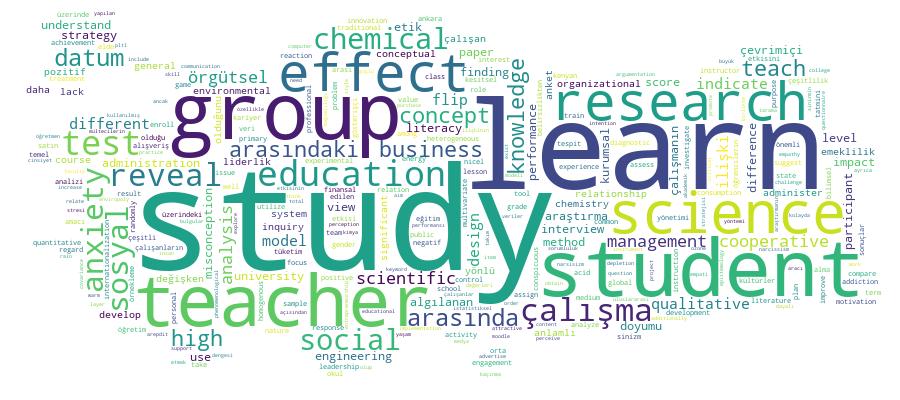
Competency Cloud

GCRIS Competency Cloud

Scholarly Output Search Results

Now showing 1 - 5 of 5
  • Conference Object
    Citation - WoS: 15
    Citation - Scopus: 21
    Taking Attention on Environmental Issues by an Attractive Educational Game: Enviropoly
    (Elsevier Science Bv, 2011) Arslan, Harika Ozge; Moseley, Christine; Cigdemoglu, Ceyhan
    Researches in interdisciplinary teaching methodologies on environmental education and in assessing their impact were recommended in Thessaloniki Declaration (UNESCO, 1997). Therefore, the purpose of this qualitative study was to develop and field test an educational game, EnviroPoly, to promote environmental literacy. The game was piloted with 44 elementary/mid-level pre-service teachers. Afterwards five pre-service teachers met in a focus group to discuss the game and its procedures. The discussions and observations of the large group of teachers during play and the smaller focus group indicated that EnviroPoly is attractive, motivating, enjoyable and useful. Additionally the game was found to be applicable for different grade levels by adapting reading and question cards. (C) 2011 Published by Elsevier Ltd.
  • Conference Object
    Determinants of General Chemistry Success of Engineering Students in Pltl and Traditional Classroom: State Anxiety and Test Anxiety
    (E D P Sciences, 2018) Eren-Sisman, Ece N.; Cigdemoglu, Ceyhan; Geban, Omer
    The purpose is to find out whether state and test anxiety can predict general chemistry grade in peer-led team learning group (PLTL) and non-PLTL groups and to explore their predictability of the grade after controlling the influence of trait anxiety. The sample consisted of a total 128 freshman engineering students attending general chemistry in a private university. STAI and RTT instruments and exams were used to generate data which were analyzed by using standard and hierarchical multiple regression. The findings revealed that in both groups the combination of predictors is significantly related to general chemistry grade, having the strongest unique contribution of test anxiety; however, it was only statistically significant for PLTL group. After controlling the effect of trait anxiety, test anxiety still makes a unique significant contribution for PLTL group. Accordingly, test anxiety can be used to predict the general chemistry grade of PLTL students.
  • Conference Object
    Use of Ict Tools and Their Effect on Teaching and Learning; Students' and Instructor's Views
    (Iated-int Assoc Technology Education & development, 2016) Cigdemoglu, Ceyhan; Akay, Hasan U.
    This study aims to reveal how instructors use ICT tools in their courses and determine what ICT tools they utilize as well as assessing the contribution of ICT to learning and teaching from both students' and instructors' perspectives. As a qualitative case study research, semi-structured interviews with instructors and focus group interviews with students were conducted. Both students' and instructors' responses indicated that there is a common belief that when these tools are employed, students' success will increase. Students verified that the use of educational technologies makes them to feel more successful. Instructors stated that such tools create more organized learning and alert instructor to search for best tools for students, and let course materials accessible whenever students need. Instructors stated that although there are number of factors impeding the whole utilization of ICT tools, they agree that traditional teaching is old fashioned and ineffective in these days. Based on the responses obtained, we can state that instructors lack in explaining and evaluating carefully the impact of ICT tools that may enhance or support students' in-depth learning. Their statements are generally anecdotal rather than data driven. Also, lack of motivation among faculty members due to time restrictions was perceived as obstacle to adopting ICT fully.
  • Conference Object
    Citation - WoS: 4
    Citation - Scopus: 16
    A Phenomenological Study of Instructors' Experiences on an Open Source Learning Management System
    (Elsevier Science Bv, 2011) Cigdemoglu, Ceyhan; Arslan, Harika Ozge; Akay, Hasan
    This paper focuses on instructors' experiences on usage of an open-source Learning Management System (LMS), Moodle in their courses. The study was conducted in a private university in Ankara, Turkey where the widespread use of the Moodle has only recently started. The phenomenological design has been utilized as qualitative research method for this paper. The Participants comprised in structures from different faculties who are new users of the Moodle. Open-ended interviews were carried out, and the data was transcribed into codes and themes. The research findings indicate that instructors have different impressions from the system in terms of their effort and expectation. (C) 2011 Published by Elsevier Ltd.
  • Conference Object
    INSTRUCTOR'S VIEWS ON DIGITALIZATION OF CAMPUS; ROLES AND RECOMMENDATIONS
    (Iated-int Assoc Technology Education A& development, 2016) Cigdemoglu, Ceyhan; Akay, Hasan U.; Tekin, Yucel
    This study delve into determine the faculty members' opinions on digitalization and their views on roles and recommendations to create a digital campus. An open-ended questionnaire was answered by eleven participants, and then semi-structured interviews are conducted with volunteers. In this qualitative research, the participants were purposively selected. All interview sessions were type recorded and the data was transcribed verbatim. Lack of a comprehensive project with its budgets and action plans, job descriptions are perceived as an obstacle to create a digital campus. Lack of motivation is perceived as another obstacle to design digital course contents. The respondents consider that lessons should be designed in more attractive ways through innovative teaching methods through online tools. Faculty members using more digital tools could suggest more accountable action plans for digitalization.