Çiğdemoğlu, Ceyhan

Loading...
Profile Picture
Name Variants
Ceyhan, Çiğdemoğlu
Çiğdemoğlu C.
C.,Ceyhan
Çiğdemoğlu,C.
Çiğdemoğlu, Ceyhan
Cigdemoglu, Ceyhan
C., Ceyhan
C.,Çiğdemoğlu
C.,Cigdemoglu
Ceyhan, Cigdemoglu
Ç.,Ceyhan
Cigdemoglu C.
C., Cigdemoglu
Ç., Ceyhan
C., Çiğdemoğlu
Cigdemoglu,C.
Çığdemoğlu, Ceyhan
Cigdemoglu, C.
Job Title
Doçent Doktor
Email Address
ceyhan.cigdemoglu@atilim.edu.tr
Main Affiliation
Public Relations and Advertising
Status
Website
ORCID ID
Scopus Author ID
Turkish CoHE Profile ID
Google Scholar ID
WoS Researcher ID

Sustainable Development Goals

NO POVERTY1
NO POVERTY
0
Research Products
ZERO HUNGER2
ZERO HUNGER
0
Research Products
GOOD HEALTH AND WELL-BEING3
GOOD HEALTH AND WELL-BEING
1
Research Products
QUALITY EDUCATION4
QUALITY EDUCATION
5
Research Products
GENDER EQUALITY5
GENDER EQUALITY
0
Research Products
CLEAN WATER AND SANITATION6
CLEAN WATER AND SANITATION
0
Research Products
AFFORDABLE AND CLEAN ENERGY7
AFFORDABLE AND CLEAN ENERGY
0
Research Products
DECENT WORK AND ECONOMIC GROWTH8
DECENT WORK AND ECONOMIC GROWTH
2
Research Products
INDUSTRY, INNOVATION AND INFRASTRUCTURE9
INDUSTRY, INNOVATION AND INFRASTRUCTURE
0
Research Products
REDUCED INEQUALITIES10
REDUCED INEQUALITIES
0
Research Products
SUSTAINABLE CITIES AND COMMUNITIES11
SUSTAINABLE CITIES AND COMMUNITIES
0
Research Products
RESPONSIBLE CONSUMPTION AND PRODUCTION12
RESPONSIBLE CONSUMPTION AND PRODUCTION
3
Research Products
CLIMATE ACTION13
CLIMATE ACTION
3
Research Products
LIFE BELOW WATER14
LIFE BELOW WATER
0
Research Products
LIFE ON LAND15
LIFE ON LAND
0
Research Products
PEACE, JUSTICE AND STRONG INSTITUTIONS16
PEACE, JUSTICE AND STRONG INSTITUTIONS
0
Research Products
PARTNERSHIPS FOR THE GOALS17
PARTNERSHIPS FOR THE GOALS
1
Research Products
Documents

16

Citations

458

h-index

9

Documents

10

Citations

187

Scholarly Output

52

Articles

30

Views / Downloads

223/1610

Supervised MSc Theses

17

Supervised PhD Theses

0

WoS Citation Count

275

Scopus Citation Count

458

Patents

0

Projects

0

WoS Citations per Publication

5.29

Scopus Citations per Publication

8.81

Open Access Source

13

Supervised Theses

17

JournalCount
Chemistry Education Research and Practice3
World Conference on Educational Technology Researches (WCETR) -- JUL 05-09, 2011 -- East Univ, Nicosia, CYPRUS2
İşletme Araştırmaları Dergisi2
Science & Education2
Science Education International2
Current Page: 1 / 4

Scopus Quartile Distribution

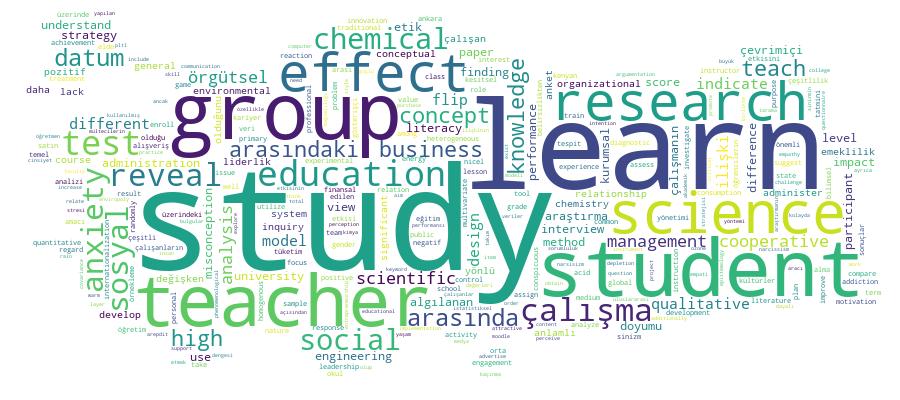
Competency Cloud

GCRIS Competency Cloud

Scholarly Output Search Results

Now showing 1 - 4 of 4
  • Article
    A Three-Tier Diagnostic Test To Assess Pre-Service Teachers’ Misconceptions About Global Warming, Greenhouse Effect, Ozone Layer Depletion, and Acid Rain
    (International Journal of Science Education, 2012) Arslan, Harika Özge; Çiğdemoğlu, Ceyhan; Moseley, Christine
    This study describes the development and validation of a three-tier multiple-choice diagnostic test, the atmosphere-related environmental problems diagnostic test (AREPDiT), to reveal common misconceptions of global warming (GW), greenhouse effect (GE), ozone layer depletion (OLD), and acid rain (AR). The development of a two-tier diagnostic test procedure as described by Treagust constitutes the framework for this study. To differentiate a lack of knowledge from a misconception, a certainty response index is added as a third tier to each item. Based on propositional knowledge statements, related literature, and the identified misconceptions gathered initially from 157 pre-service teachers, the AREPDiT was constructed and administered to 256 pre-service teachers. The Cronbach alpha reliability coefficient of the pre-service teachers’ scores was estimated to be 0.74. Content and face validations were established by senior experts. A moderate positive correlation between the participants’ both-tiers scores and their certainty scores indicated evidence for construct validity. Therefore, the AREPDiT is a reliable and valid instrument not only to identify pre-service teachers’ misconceptions about GW, GE, OLD, and AR but also to differentiate these misconceptions from lack of knowledge. The results also reveal that a majority of the respondents demonstrated limited understandings about atmosphere related environmental problems and held six common misconceptions. Future studies could test the AREPDiT as a tool for assessing the misconceptions held by pre-service teachers from different programs as well as in-service teachers and high school students.
  • Article
    Taking Attention on Environmental Issues by an Attractive Educational Game: Enviropoly
    (Procedia - Social and Behavioral Sciences, 2011) Arslan, Harika Özge; Moseley, Christine; Çiğdemoğlu, Ceyhan
    Researches in interdisciplinary teaching methodologies on environmental education and in assessing their impact were recommended in Thessaloniki Declaration (UNESCO, 1997). Therefore, the purpose of this qualitative study was to develop and field test an educational game, EnviroPoly, to promote environmental literacy. The game was piloted with 44 elementary/mid level pre-service teachers. Afterwards five pre-service teachers met in a focus group to discuss the game and its procedures. The discussions and observations of the large group of teachers during play and the smaller focus group indicated that EnviroPoly is attractive, motivating, enjoyable and useful. Additionally the game was found to be applicable for different grade levels by adapting reading and question cards.
  • Article
    Citation - WoS: 110
    Citation - Scopus: 187
    A Three-Tier Diagnostic Test To Assess Pre-Service Teachers' Misconceptions About Global Warming, Greenhouse Effect, Ozone Layer Depletion, and Acid Rain
    (Routledge Journals, Taylor & Francis Ltd, 2012) Arslan, Harika Ozge; Cigdemoglu, Ceyhan; Moseley, Christine
    This study describes the development and validation of a three-tier multiple-choice diagnostic test, the atmosphere-related environmental problems diagnostic test (AREPDiT), to reveal common misconceptions of global warming (GW), greenhouse effect (GE), ozone layer depletion (OLD), and acid rain (AR). The development of a two-tier diagnostic test procedure as described by Treagust constitutes the framework for this study. To differentiate a lack of knowledge from a misconception, a certainty response index is added as a third tier to each item. Based on propositional knowledge statements, related literature, and the identified misconceptions gathered initially from 157 pre-service teachers, the AREPDiT was constructed and administered to 256 pre-service teachers. The Cronbach alpha reliability coefficient of the pre-service teachers' scores was estimated to be 0.74. Content and face validations were established by senior experts. A moderate positive correlation between the participants' both-tiers scores and their certainty scores indicated evidence for construct validity. Therefore, the AREPDiT is a reliable and valid instrument not only to identify pre-service teachers' misconceptions about GW, GE, OLD, and AR but also to differentiate these misconceptions from lack of knowledge. The results also reveal that a majority of the respondents demonstrated limited understandings about atmosphere-related environmental problems and held six common misconceptions. Future studies could test the AREPDiT as a tool for assessing the misconceptions held by pre-service teachers from different programs as well as in-service teachers and high school students.
  • Conference Object
    Citation - WoS: 15
    Citation - Scopus: 21
    Taking Attention on Environmental Issues by an Attractive Educational Game: Enviropoly
    (Elsevier Science Bv, 2011) Arslan, Harika Ozge; Moseley, Christine; Cigdemoglu, Ceyhan
    Researches in interdisciplinary teaching methodologies on environmental education and in assessing their impact were recommended in Thessaloniki Declaration (UNESCO, 1997). Therefore, the purpose of this qualitative study was to develop and field test an educational game, EnviroPoly, to promote environmental literacy. The game was piloted with 44 elementary/mid-level pre-service teachers. Afterwards five pre-service teachers met in a focus group to discuss the game and its procedures. The discussions and observations of the large group of teachers during play and the smaller focus group indicated that EnviroPoly is attractive, motivating, enjoyable and useful. Additionally the game was found to be applicable for different grade levels by adapting reading and question cards. (C) 2011 Published by Elsevier Ltd.