
Şengül, Gökhan
Loading...
Profile URL
Name Variants
Gokhan, Sengul
Sengul, Gokhan
Sengul,G.
Gökhan, Şengül
Engul G.
Şengül G.
Şengül, Gökhan
G.,Sengul
Sengul, G.
S.,Gokhan
Sengul G.
Ş., Gökhan
G.,Şengül
G., Sengul
Şengül,G.
G., Şengül
S., Gokhan
Ş.,Gökhan
Sengul, Gokhan
Sengul,G.
Gökhan, Şengül
Engul G.
Şengül G.
Şengül, Gökhan
G.,Sengul
Sengul, G.
S.,Gokhan
Sengul G.
Ş., Gökhan
G.,Şengül
G., Sengul
Şengül,G.
G., Şengül
S., Gokhan
Ş.,Gökhan
Job Title
Profesor Doktor
Email Address
gokhan.sengul@atilim.edu.tr
Main Affiliation
Computer Engineering
Status
Website
ORCID ID
Scopus Author ID
Turkish CoHE Profile ID
Google Scholar ID
WoS Researcher ID
Sustainable Development Goals
 1
1NO POVERTY
0
Research Products
 2
2ZERO HUNGER
0
Research Products
 3
3GOOD HEALTH AND WELL-BEING
4
Research Products
 4
4QUALITY EDUCATION
1
Research Products
 5
5GENDER EQUALITY
1
Research Products
 6
6CLEAN WATER AND SANITATION
0
Research Products
 7
7AFFORDABLE AND CLEAN ENERGY
1
Research Products
 8
8DECENT WORK AND ECONOMIC GROWTH
0
Research Products
 9
9INDUSTRY, INNOVATION AND INFRASTRUCTURE
2
Research Products
 10
10REDUCED INEQUALITIES
0
Research Products
 11
11SUSTAINABLE CITIES AND COMMUNITIES
1
Research Products
 12
12RESPONSIBLE CONSUMPTION AND PRODUCTION
0
Research Products
 13
13CLIMATE ACTION
0
Research Products
 14
14LIFE BELOW WATER
1
Research Products
 15
15LIFE ON LAND
0
Research Products
 16
16PEACE, JUSTICE AND STRONG INSTITUTIONS
1
Research Products
 17
17PARTNERSHIPS FOR THE GOALS
0
Research Products

Documents
40
Citations
343
h-index
12

Documents
17
Citations
105

Scholarly Output
83
Articles
49
Views / Downloads
104/171
Supervised MSc Theses
9
Supervised PhD Theses
3
WoS Citation Count
216
Scopus Citation Count
331
Patents
0
Projects
0
WoS Citations per Publication
2.60
Scopus Citations per Publication
3.99
Open Access Source
18
Supervised Theses
12
| Journal | Count |
|---|---|
| Biomedical Research (India) | 5 |
| UBMK 2018 - 3rd International Conference on Computer Science and Engineering -- 3rd International Conference on Computer Science and Engineering, UBMK 2018 -- 20 September 2018 through 23 September 2018 -- Sarajevo -- 143560 | 4 |
| 3rd International Conference on Computer Science and Engineering (UBMK) -- SEP 20-23, 2018 -- Sarajevo, BOSNIA & HERCEG | 2 |
| 2016 24th Signal Processing and Communication Application Conference, SIU 2016 - Proceedings -- 24th Signal Processing and Communication Application Conference, SIU 2016 -- 16 May 2016 through 19 May 2016 -- Zonguldak -- 122605 | 2 |
| International Journal of Engineering Education | 2 |
Current Page: 1 / 9
Scopus Quartile Distribution
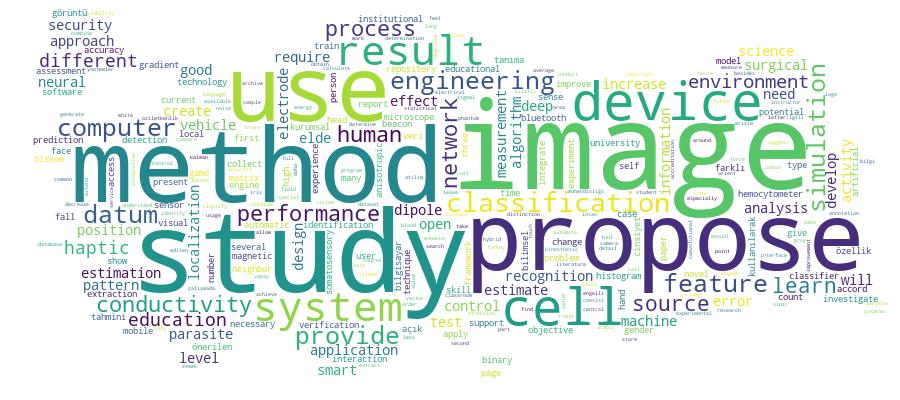
Competency Cloud
49 results
Scholarly Output Search Results
Now showing 1 - 10 of 49
Article Citation - WoS: 11Citation - Scopus: 12A Comprehensive Assessment Plan for Accreditation in Engineering Education: A Case Study in Turkey(International Journal of Engineering Education, 2015) Turhan, Çiğdem; Şengül, Gökhan; Koyuncu, MuratThis paper describes the procedure followed by Computer Engineering and Software Engineering programs at Atilim University, Ankara, Turkey, which led to the granting of five years of accreditation by MUDEK, the local accreditation body authorized by The European Network for Accreditation of Engineering Education (ENAEE) to award the EUR ACE label, and a full member signatory ofWashington Accord of International Engineering Alliance (IEA). It explains the organizational structure established for preparation, determination and measurement of the educational objectives, program outcomes, course outcomes, and the continuous improvement cycle carried out during the preparation period. The aim of the paper is to share methods and experiences which may be beneficial for the other programs that are intended for accreditation.Article Citation - WoS: 6Citation - Scopus: 12Classification of Parasite Egg Cells Using Gray Level Cooccurence Matrix and Knn(Scientific Publishers india, 2016) Sengul, GokhanParasite eggs are around 20 to 80 mu m dimensions, and they can be seen under microscopes only and their detection requires visual analyses of microscopic images, which requires human expertise and long analysis time. Besides visual analysis is very error prone to human procedures. In order to automatize this process, a number of studies are proposed in the literature. But there is still a gap between the preferred performance and the reported ones and it is necessary to increase the performance of the automatic parasite egg classification approaches. In this study a learning based statistical pattern recognition approach for parasite egg classification is proposed that will both decrease the time required for the manual classification by an expert and increase the performance of the previously suggested automated parasite egg classification approaches. The proposed method uses Gray-Level Co-occurrence Matrix as the feature extractor, which is a texture based statistical method that can differentiate the parasite egg cells based on their textures, and the k-Nearest Neighbourhood (kNN) classifier for the classification. The proposed method is tested on 14 parasite egg types commonly seen in humans. The results show that proposed method can classify the parasite egg cells with a performance rate of 99%.Article Determination of Measurement Noise, Conductivity Errors and Electrode Mislocalization Effects To Somatosensory Dipole Localization(Biomedical Research, 2012) Şengül, Gökhan; Baysal, UğurCalculating the spatial locations, directions and magnitudes of electrically active sources of human brain by using the measured scalp potentials is known as source localization. An accu rate source localization method requires not only EEG data but also the 3-D positions and number of measurement electrodes, the numerical head model of the patient/subject and the conductivities of the layers used in the head model. In this study we computationally deter mined the effect of noise, conductivity errors and electrode mislocalizations for electrical sources located in somatosensory cortex. We first randomly selected 1000 electric sources in somatosensory cortex, and for these sources we simulated the surface potentials by using av erage conductivities given in the literature and 3-D positions of the electrodes. We then added random noise to measurements and by using noisy data; we tried to calculate the positions of the dipoles by using different electrode positions or different conductivity values. The esti mated electrical sources and original ones are compared and by this way the effect of meas urement noise, electrode mislocalizations and conductivity errors to somatosensory dipole lo calization is investigated. We conclude that for an accurate somatosensory source localization method, we need noiseless measurements, accurate conductivity values of scalp and skull lay ers and the accurate knowledge of 3-D positions of measurement sensors.Article Single Camera Photogrammetry System for Eeg Electrode Identification and Localization(Annals of Biomedical Engineering, 2010) Baysal, Uğur; Şengül, GökhanIn this study, photogrammetric coordinate measurement and color-based identification of EEG electrode positions on the human head are simultaneously implemented. A rotating, 2MP digital camera about 20 cm above the subject’s head is used and the images are acquired at predefined stop points separated azimuthally at equal angular displacements. In order to realize full automation, the electrodes have been labeled by colored circular markers and an electrode recognition algorithm has been developed. The proposed method has been tested by using a plastic head phantom carrying 25 electrode markers. Electrode locations have been determined while incorporating three different methods: (i) the proposed photogrammetric method, (ii) conventional 3D radiofrequency (RF) digitizer, and (iii) coordinate measurement machine having about 6.5 lm accuracy. It is found that the proposed system automatically identifies electrodes and localizes them with a maximum error of 0.77 mm. It is suggested that this method may be used in EEG source localization applications in the human brain.Article Classification of Parasite Egg Cells Using Gray Level Cooccurence Matrix and Knn.(Biomedical Research, 2016) Şengül, GökhanParasite eggs are around 20 to 80 μm dimensions, and they can be seen under microscopes only and their detection requires visual analyses of microscopic images, which requires human expertise and long analysis time. Besides visual analysis is very error prone to human procedures. In order to automatize this process, a number of studies are proposed in the literature. But there is still a gap between the preferred performance and the reported ones and it is necessary to increase the performance of the automatic parasite egg classification approaches. In this study a learning based statistical pattern recognition approach for parasite egg classification is proposed that will both decrease the time required for the manual classification by an expert and increase the performance of the previously suggested automated parasite egg classification approaches. The proposed method uses Gray-Level Co-occurrence Matrix as the feature extractor, which is a texture based statistical method that can differentiate the parasite egg cells based on their textures, and the k-Nearest Neighbourhood (kNN) classifier for the classification. The proposed method is tested on 14 parasite egg types commonly seen in humans. The results show that proposed method can classify the parasite egg cells with a performance rate of 99%.Article Bilimsel İletişimde Yeşil ve Altın Yollarda Yakınsama ve Türkiye’deki Yansımaları(Bilgi Dünyası, 2011) Ertürk, Korhan Levent; Şengül, GökhanSon yıllarda özellikle sosyal ağlarda bilgi dolaşımının artması, gelişmiş mobil iletişim cihazlarının yoğun kullanımı kısıtsız ve farklı ortamlarda bilgi erişim ve paylaşımını gerektirmektedir. Bu bağlamda bilimsel bulguların yer aldığı makalelerin geniş kitlelere ve diğer bilim insanlarının erişimine açılması; hem bilimsel eserin doğruluk ve güvenirliğini artırmaya yardımcı olmakta, hem de bilimsel verinin paylaşılmasını ve dolayısı ile de bilimsel gelişimi olumlu yönde etkilemektedir. Yaklaşık on yıldır bu amaca açık erişim insiyatifi katkı sağlamaktadır. Bu amaçla kendi kendine arşivleme (yeşil yol) ve açık erişim dergisi (altın yol) bilimsel çalışmaların bilim topluluğuna sunulmasında yeni yöntemler olarak takdim edilmiştir Bu çalışmada; uluslararası alanda yeşil ve altın yollar üzerinde ortaya konan kurallar irdelenmiş, yazar ve yayıncılarının oluşan iklime uyumluluğu sorgulanmış ve Türkiye adresli kurumsal arşiv ve dergilerin ortaya çıkan durum karşısında konumları üzerine bir değerlendirme yapılmıştır. Çalışma esnasında Ulrich Süreli Yayın Rehberi, Thomson Reuters (ISI) Bilimsel Web (Web of Science - WoS) ve Elsevier Scopus uluslararası ticari atıf veri tabanları, RoMEO, Juliet, ve ROARMAP telif politikası rehberleri, OpenDOAR, ROAR kurumsal arşiv rehberleri ve DOAJ açık erişim dergisi rehberi ile ULAKBİM ulusal veri tabanları incelenmiştir.Article Biometric Verification on E-Id Secure Access Devices: a Case Study on Turkish National E-Id Card Secure Access Device Specifications(International Journal of Information Security Science, 2017) Bostan, Atila; Şengül, Gökhan; Karakaya, MuratBiometric verification on e-ID cards requires clear procedures and standards be defined, especially when the access devices are anticipated to be produced commercial companies. Turkish national e-ID card project has reached the dissemination step. Now the commercial companies are expected to produce and market e-ID card access devices which will conduct secure electronic identity verification functions. However, published standards specifying e-ID card-access-device requirements are ambiguous on biometric verification procedures. In this study, we intended to attract scientific interest to the problems identified in the current design of biometric verification on Turkish national e-ID cards and proposed several verification alternatives which enables the production of e-ID card access devices in a commercial-competition environment.Article Citation - WoS: 2Citation - Scopus: 3A Hybrid Approach for Semantic Image Annotation(Ieee-inst Electrical Electronics Engineers inc, 2021) Sezen, Arda; Turhan, Cigdem; Sengul, GokhanIn this study, a framework that generates natural language descriptions of images within a controlled environment is proposed. Previous work on neural networks mostly focused on choosing the right labels and/or increasing the number of related labels to depict an image. However, creating a textual description of an image is a completely different phenomenon, structurally, syntactically, and semantically. The proposed semantic image annotation framework presents a novel combination of deep learning models and aligned annotation results derived from the instances of the ontology classes to generate sentential descriptions of images. Our hybrid approach benefits from the unique combination of deep learning and semantic web technologies. We detect objects from unlabeled sports images using a deep learning model based on a residual network and a feature pyramid network, with the focal loss technique to obtain predictions with high probability. The proposed framework not only produces probabilistically labeled images, but also the contextual results obtained from a knowledge base exploiting the relationship between the objects. The framework's object detection and prediction performances are tested with two datasets where the first one includes individual instances of images containing everyday scenes of common objects and the second custom dataset contains sports images collected from the web. Moreover, a sample image set is created to obtain annotation result data by applying all framework layers. Experimental results show that the framework is effective in this controlled environment and can be used with other applications via web services within the supported sports domain.Article Türkiye’de Engelli Farkındalığı ve Engelli Bireylerin Adalete Web Erişilebilirlikleri Üzerine Bir Değerlendirme(Bilgi Dünyası, 2014) Ertürk, Korhan Levent; Şimşek, A. Aslı; Songür, Damla Gülseren; Şengül, GökhanFiziksel veya zihinsel nedenlerle bazı hareketleri, duyuları veya işlevleri kısıtlı olan bireyler toplumun bir grubunu oluşturmaktadır. türkiye’de bu bireyler ve/veya çevreleri toplumda doğrudan ya da dolaylı olarak çeşitli sorunlarla karşı karşıya kalmaktadırlar. Günümüzde eğitim, sağlık, adalet, sosyal güvenlik gibi alanlarda bu durum sıklıkla görülebilmektedir. Söz konusu bireyler sorunlarıyla ilgilenilmesini ve çözüme kavuşturulmasını istemektedirler. Bir ülkenin gelişmişlik düzeyi anılan sorunların çözümüne yönelik çalışmalar ile doğrudan ilişkilidir. Çalışmamız, bazı hareketleri, duyuları veya işlevleri kısıtlı olan bireylerin ortak bir terimle ifade edilmesi, engelli birey farkındalığının ortaya konulması ve bu bağlamda ilgili bazı web sitelerinin bu bireyler açısından yeterliliğinin sorgulanmasına yöneliktir. Web sitelerinin olabildiğince erişilebilir yapılması engelli kullanıcılara diğer bireyler ile eşit hakların sağlanmasına katkı sağlayabilecek, bilgi ve iletişim kaynaklarını çeşitlendirebilecektir.Article Citation - WoS: 9Citation - Scopus: 9Benchmarking Classification Models for Cell Viability on Novel Cancer Image Datasets(Bentham Science Publ Ltd, 2019) Ozkan, Akin; Isgor, Sultan Belgin; Sengul, Gokhan; Isgor, Yasemin GulgunBackground: Dye-exclusion based cell viability analysis has been broadly used in cell biology including anticancer drug discovery studies. Viability analysis refers to the whole decision making process for the distinction of dead cells from live ones. Basically, cell culture samples are dyed with a special stain called trypan blue, so that the dead cells are selectively colored to darkish. This distinction provides critical information that may be used to expose influences of the studied drug on considering cell culture including cancer. Examiner's experience and tiredness substantially affect the consistency throughout the manual observation of cell viability. The unsteady results of cell viability may end up with biased experimental results accordingly. Therefore, a machine learning based automated decision-making procedure is inevitably needed to improve consistency of the cell viability analysis. Objective: In this study, we investigate various combinations of classifiers and feature extractors (i.e. classification models) to maximize the performance of computer vision-based viability analysis. Method: The classification models are tested on novel hemocytometer image datasets which contain two types of cancer cell images, namely, caucasian promyelocytic leukemia (HL60), and chronic myelogenous leukemia (K562). Results: From the experimental results, k-Nearest Neighbor (KNN) and Random Forest (RF) by combining Local Phase Quantization (LPQ) achieve the lowest misclassification rates that are 0.031 and 0.082, respectively. Conclusion: The experimental results show that KNN and RF with LPQ can be powerful alternatives to the conventional manual cell viability analysis. Also, the collected datasets are released from the "biochem.atilim.edu.tr/datasets/ " web address publically to academic studies.
