
Şengül, Gökhan
Loading...
Profile URL
Name Variants
Gokhan, Sengul
Sengul, Gokhan
Sengul,G.
Gökhan, Şengül
Engul G.
Şengül G.
Şengül, Gökhan
G.,Sengul
Sengul, G.
S.,Gokhan
Sengul G.
Ş., Gökhan
G.,Şengül
G., Sengul
Şengül,G.
G., Şengül
S., Gokhan
Ş.,Gökhan
Sengul, Gokhan
Sengul,G.
Gökhan, Şengül
Engul G.
Şengül G.
Şengül, Gökhan
G.,Sengul
Sengul, G.
S.,Gokhan
Sengul G.
Ş., Gökhan
G.,Şengül
G., Sengul
Şengül,G.
G., Şengül
S., Gokhan
Ş.,Gökhan
Job Title
Profesor Doktor
Email Address
gokhan.sengul@atilim.edu.tr
Main Affiliation
Computer Engineering
Status
Website
ORCID ID
Scopus Author ID
Turkish CoHE Profile ID
Google Scholar ID
WoS Researcher ID
Sustainable Development Goals
 1
1NO POVERTY
0
Research Products
 2
2ZERO HUNGER
0
Research Products
 3
3GOOD HEALTH AND WELL-BEING
4
Research Products
 4
4QUALITY EDUCATION
1
Research Products
 5
5GENDER EQUALITY
1
Research Products
 6
6CLEAN WATER AND SANITATION
0
Research Products
 7
7AFFORDABLE AND CLEAN ENERGY
1
Research Products
 8
8DECENT WORK AND ECONOMIC GROWTH
0
Research Products
 9
9INDUSTRY, INNOVATION AND INFRASTRUCTURE
2
Research Products
 10
10REDUCED INEQUALITIES
0
Research Products
 11
11SUSTAINABLE CITIES AND COMMUNITIES
1
Research Products
 12
12RESPONSIBLE CONSUMPTION AND PRODUCTION
0
Research Products
 13
13CLIMATE ACTION
0
Research Products
 14
14LIFE BELOW WATER
1
Research Products
 15
15LIFE ON LAND
0
Research Products
 16
16PEACE, JUSTICE AND STRONG INSTITUTIONS
1
Research Products
 17
17PARTNERSHIPS FOR THE GOALS
0
Research Products

Documents
40
Citations
343
h-index
12

Documents
17
Citations
106

Scholarly Output
83
Articles
49
Views / Downloads
104/187
Supervised MSc Theses
9
Supervised PhD Theses
3
WoS Citation Count
217
Scopus Citation Count
331
Patents
0
Projects
0
WoS Citations per Publication
2.61
Scopus Citations per Publication
3.99
Open Access Source
18
Supervised Theses
12
| Journal | Count |
|---|---|
| Biomedical Research (India) | 5 |
| UBMK 2018 - 3rd International Conference on Computer Science and Engineering -- 3rd International Conference on Computer Science and Engineering, UBMK 2018 -- 20 September 2018 through 23 September 2018 -- Sarajevo -- 143560 | 4 |
| 3rd International Conference on Computer Science and Engineering (UBMK) -- SEP 20-23, 2018 -- Sarajevo, BOSNIA & HERCEG | 2 |
| 2016 24th Signal Processing and Communication Application Conference, SIU 2016 - Proceedings -- 24th Signal Processing and Communication Application Conference, SIU 2016 -- 16 May 2016 through 19 May 2016 -- Zonguldak -- 122605 | 2 |
| International Journal of Engineering Education | 2 |
Current Page: 1 / 9
Scopus Quartile Distribution
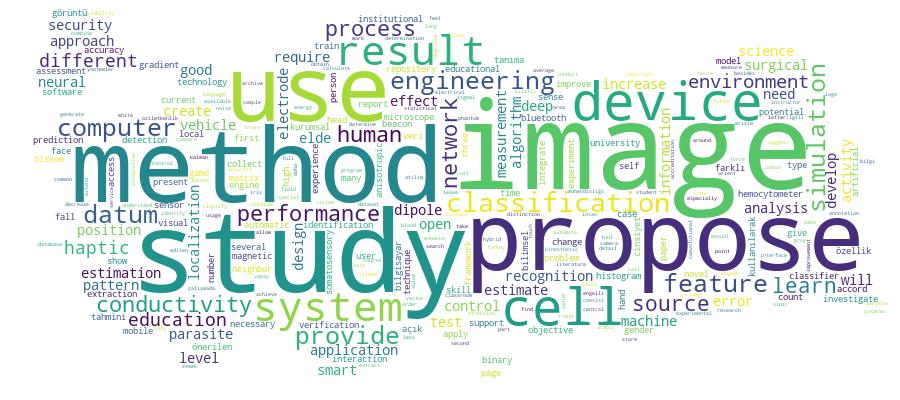
Competency Cloud
83 results
Scholarly Output Search Results
Now showing 1 - 10 of 83
Article Citation - WoS: 50Citation - Scopus: 70Deep Learning Based Fall Detection Using Smartwatches for Healthcare Applications(Elsevier Sci Ltd, 2022) Sengul, Gokhan; Karakaya, Murat; Misra, Sanjay; Abayomi-Alli, Olusola O.; Damasevicius, RobertasWe implement a smart watch-based system to predict fall detection. We differentiate fall detection from four common daily activities: sitting, squatting, running, and walking. Moreover, we separate falling into falling from a chair and falling from a standing position. We develop a mobile application that collects the acceleration and gyroscope sensor data and transfers them to the cloud. In the cloud, we implement a deep learning algorithm to classify the activity according to the given classes. To increase the number of data samples available for training, we use the Bica cubic Hermite interpolation, which allows us to improve the accuracy of the neural network. The 38 statistical data features were calculated using the rolling update approach and used as input to the classifier. For activity classification, we have adopted the bi-directional long short-term memory (BiLSTM) neural network. The results demonstrate that our system can detect falling with an accuracy of 99.59% (using leave-one-activityout cross-validation) and 97.35% (using leave-one-subject-out cross-validation) considering all activities. When considering only binary classification (falling vs. all other activities), perfect accuracy is achieved.Article Citation - WoS: 18Citation - Scopus: 24Fusion of Smartphone Sensor Data for Classification of Daily User Activities(Springer, 2021) Sengul, Gokhan; Ozcelik, Erol; Misra, Sanjay; Damasevicius, Robertas; Maskeliunas, RytisNew mobile applications need to estimate user activities by using sensor data provided by smart wearable devices and deliver context-aware solutions to users living in smart environments. We propose a novel hybrid data fusion method to estimate three types of daily user activities (being in a meeting, walking, and driving with a motorized vehicle) using the accelerometer and gyroscope data acquired from a smart watch using a mobile phone. The approach is based on the matrix time series method for feature fusion, and the modified Better-than-the-Best Fusion (BB-Fus) method with a stochastic gradient descent algorithm for construction of optimal decision trees for classification. For the estimation of user activities, we adopted a statistical pattern recognition approach and used the k-Nearest Neighbor (kNN) and Support Vector Machine (SVM) classifiers. We acquired and used our own dataset of 354 min of data from 20 subjects for this study. We report a classification performance of 98.32 % for SVM and 97.42 % for kNN.Conference Object Deep Learning and Current Trends in Machine Learning(Institute of Electrical and Electronics Engineers Inc., 2018) Bostan,A.; Ekin,C.; Sengul,G.; Karakaya,M.; Tirkes,G.Academic interest and commercial attention can be used to identify how much potential a novel technology may have. Since the prospective advantages in it may help solving some problems that are not solved yet or improving the performance of readily available ones. In this study, we have investigated the Web of Science (WOS) indexing service database for the publications on Deep Learning (DL), Machine Learning (ML), Convolutional Neural Networks (CNN), and Image Processing to reveal out the current trend. The figures indicate the strong potential in DL approach especially in image processing domain. © 2018 IEEE.Article İnsan Kafasındaki Dokuların Öziletkenliklerinin İn Vivo E/meg Verileri ile Kestirilmesi ve Üç Değişik Kestirim Algoritma Sonuçlarının Karşılaştırılması(Signal Processing and Communications Applications Conference, 2004) Şengül, Gökhan; Baysal, Uğur; Haueısen, JensDoku öziletkenliklerinin bilinmesi, insan vücudunun güvenilir hacim iletken modellerinin oluşturulmasında ve ileri/ters biyoelektrik alan problemlerinin çözümünde gereklidir. Bu çalışmada, insan kafasindaki dokulann öziletkenliklerinin EEG ve MEG verileri kullanılarak in vivo kestirimi ipin üç farklı kestirim algoritmasi kullanılarak elde edilen sonuçlar karşılaştırılmıştır. Uygulanan bu algoritmalar; En Küçük Hatalar Karesi (E.K.H.K) kestirim algoritmasi, Bayesian MAP kestirim algoritmasi ve istatistiksel Kısıtlı Minimum Ortalama Hatalar Karesi (1.K.M.O.H.K) algoritmasıdır. Algoritmalar, geometrik yapı, ön bilgisi ile doku öziletkenlikleri ile doğrusallaştırma ve enstrümantasyon gürültüsünün istatistiksel ön bilgilerini girdi olarak kullanır. E/MEG verileri, medyan sinirin uyarıkdığı kaynak konumlandırma deneyinden sırasıyla 32 kanallı EEG ve 31 kanallı magnetometre ile somatosensory korteks üzerinden ölçülmüştür. Kafanın anatomik geometri bilgisi 256 adet TI ağırlıklı MRI görüntüden elde edilmiş ve kafa derisi, kafatası ve beyin olarak homojen üç bölgeye bölütlendirilmiştir. Sözkonusu algoritmalar kullanılarak kafa derisi, kafatası ve beyin öziletkenlikleri ve hata oranları üç farklı algoritma ile kestirilmiştir. Hata oranları E.K.H.K için %90, Bayesian Map kestirim algoriması için % 20.5 ve İ.K.M.O.H.K algoritması için %12.5 olarak hesaplanmıştır. Sonuçta İ.K.M.O.H.K algoritmasının diğer algoritmalara kıyasla daha düşük hata oranları verdiği gösterilmiştir.Conference Object A Fully Automatic Photogrammetric System Design Using a 1.3 Mp Web Camera To Determine Eeg Electrode Positions;(2010) Şengül,G.; Baysal,U.In this study a fully automatic fotogrammetric system is designed to determine the EEG electrode positions in 3D. The proposed system uses a 1.3 MP web camera rotating over the subject's head. The camera is driven by a step motor. The camera takes photos in every 7.20 angles during the rotation. In order to realize full automation, electrodes are labeled by colored circular markers and an electrode identification algorithm is develeoped for full automation. The proposed method is tested by using a realistic head phantom carrying 25 electrodes. The positions of the test electrodes are also measured by a conventional 3-D digitizer. The measurements are repeated 3 times for repeatibility purposes. It is found that 3-d digitizer localizes the electrodes with an average error of 8.46 mm, 7.63 mm and 8.32 mm, while the proposed system localizes the electrodes with an average error of 1.76 mm, 1.42 mm and 1.53 mm. ©2010 IEEE.Article Citation - WoS: 11Citation - Scopus: 31An Improved Random Bit-Stuffing Technique With a Modified Rsa Algorithm for Resisting Attacks in Information Security (rbmrsa)(Cairo Univ, Fac Computers & information, 2022) Mojisola, Falowo O.; Misra, Sanjay; Febisola, C. Falayi; Abayomi-Alli, Olusola; Sengul, Gokhan; Falayi Febisola, C.The recent innovations in network application and the internet have made data and network security the major role in data communication system development. Cryptography is one of the outstanding and powerful tools for ensuring data and network security. In cryptography, randomization of encrypted data increases the security level as well as the Computational Complexity of cryptographic algorithms involved. This research study provides encryption algorithms that bring confidentiality and integrity based on two algorithms. The encryption algorithms include a well-known RSA algorithm (1024 key length) with an enhanced bit insertion algorithm to enhance the security of RSA against different attacks. The security classical RSA has depreciated irrespective of the size of the key length due to the development in computing technology and hacking system. Due to these lapses, we have tried to improve on the contribution of the paper by enhancing the security of RSA against different attacks and also increasing diffusion degree without increasing the key length. The security analysis of the study was compared with classical RSA of 1024 key length using mathematical evaluation proofs, the experimental results generated were compared with classical RSA of 1024 key length using avalanche effect in (%) and computational complexity as performance evaluation metrics. The results show that RBMRSA is better than classical RSA in terms of security but at the cost of execution time. (C) 2022 THE AUTHORS. Published by Elsevier B.V. on behalf of Faculty of Computers and Information, Cairo University.Article Citation - WoS: 19Citation - Scopus: 24Gender Detection Using 3d Anthropometric Measurements by Kinect(Polska Akad Nauk, Polish Acad Sciences, 2018) Camalan, Seda; Sengul, Gokhan; Misra, Sanjay; Maskeliunas, Rytis; Damasevicius, RobertasAutomatic gender detection is a process of determining the gender of a human according to the characteristic properties that represent the masculine and feminine attributes of a subject. Automatic gender detection is used in many areas such as customer behaviour analysis, robust security system construction, resource management, human-computer interaction, video games, mobile applications, neuro-marketing etc., in which manual gender detection may be not feasible. In this study, we have developed a fully automatic system that uses the 3D anthropometric measurements of human subjects for gender detection. A Kinect 3D camera was used to recognize the human posture, and body metrics are used as features for classification. To classify the gender, KNN, SVM classifiers and Neural Network were used with the parameters. A unique dataset gathered from 29 female and 31 male (a total of 60 people) participants was used in the experiment and the Leave One Out method was used as the cross-validation approach. The maximum accuracy achieved is 96.77% for SVM with an MLP kernel function.Article Citation - WoS: 6Citation - Scopus: 7Teaching Software Verification and Validation Course: a Case Study(Tempus Publications, 2014) Mishra, Deepti; Hacaloglu, Tuna; Mishra, Alok; Computer Engineering; Software Engineering; Information Systems EngineeringSoftware verification and validation (V & V) is one of the significant areas of software engineering for developing high quality software. It is also becoming part of the curriculum of a universities' software and computer engineering departments. This paper reports the experience of teaching undergraduate software engineering students and discusses the main problems encountered during the course, along with suggestions to overcome these problems. This study covers all the different topics generally covered in the software verification and validation course, including static verification and validation. It is found that prior knowledge about software quality concepts and good programming skills can help students to achieve success in this course. Further, team work can be chosen as a strategy, since it facilitates students' understanding and motivates them to study. It is observed that students were more successful in white box testing than in black box testing.Article İnsan Kafasındaki Dokuların Öziletkenliklerin Kestirimi İçin Kullanılan İstatistiksel Kısıtlı Minimum Ortalama Hatalar Karesi Algoritmasının Kaynak Yerelleştirimine Etkisi(2012) Şengül, Gökhan; Baysal, UğurEEG ve/veya MEG ölçümleri verildiğinde, insan beynindeki aktif kaynakların bulunması\"EEG/MEG biyoelektromanyetik ters problemi\", \"aktivite kaynağının belirlenmesi\" ya da\"kaynak yerelleştirimi\" (source localization) olarak tanımlanır. Tipik bir kaynak yerelleştirimisistemi EEG/MEG ölçümlerinin yanısıra hastanın/deneğin kafasına ait geometri bilgisine,elektriksel kaynak hakkındaki ön bilgiye, ölçüm elektrotlarının sayısına ve bu elektrotların üçboyutlu uzaydaki konumuna ve kafa modelinde yer alan dokularınöziletkenliklerine/özdirençlerine ihtiyaç duyar. Bu çalışmada insan kafasındaki dokularınöziletkenliklerini kestirmek için daha önce önerilen İstatistiksel Kısıtlı Minimum OrtalamaHatalar Karesi algoritmasının, öziletkenlik kestirimindeki başarımı benzetim çalışmaları ilehesaplanmış ve kaynak yerelleştirimine etkisi araştırılmıştır. Beyin, kafa tası ve kafaderisinden oluşan üç kompartımanlı gerçekçi bir kafa modeli kullanılarak yapılan benzetimçalışmalarında 100 farklı öziletkenlik değeri kestirilmeye çalışılmış ve kestirim hataları kafaderisi için ortalamada %23, kafatası için % 40 ve beyin için de %17 olarak hesaplanmıştır.Çalışmanın ikinci bölümünde ise literatürde verilen ortalama öziletkenlik değerlerikullanıldığında ve önerilen algoritma ile kestirilen öziletkenlik değerleri kullanıldığındaortaya çıkan kaynak yerelleştirimi hataları yine benzetim çalışmaları ile araştırılmıştır.Çalışma sonunda literatürde verilen ortalama öziletkenlik değerleri kullanıldığında 10,1 mmkaynak yerelleştirimi hatası bulunurken önerilen algoritma ile kestirilen öziletkenlik değerlerikullanıldığında ise bu hata 2,7 mm'ye inmiştir. Burada bulunan sonuçlara göre İ.K.M.O.H.K.algoritması ile kestirilen doku öziletkenlikleri kullanıldığında kaynak yerelleştirimi konumhatasında ortalama öziletkenlik kullanılması durumuna göre %73,07'lik azalmagörülmektedir. Sonuç olarak kaynak yerelleştirimi uygulamalarında İ.K.M.O.H.K. algoritmasıile kişiye özgü olarak elde edilen doku öziletkenliklerini kullanmak, ortalama öziletkenlikkullamaya kıyasla hata oranlarını azalttığı sonucuna varılabilir.Article An Experimental Study on the Effect of the Anisotropic Regions in a Realistically Shaped Torso Phantom(Annals of Biomedical Engineering, 2008) Şengül, Gökhan; Lıehr, Mario; Haueısen, Jens; Baysal, UğurDetermination of electrically active regions in the human body by observing generated bioelectric and/or biomagnetic signals is known as source reconstruction. In the reconstruction process, it is assumed that the volume conductor consists of isotropic compartments and homoge neous tissue bioelectric parameters but this assumption introduces errors when the tissue of interest is anisotropic. The aim of this study was to investigate changes in the measured signal strengths and the estimated positions and orientations of current dipoles in a realistically shaped torso phantom having a heart region built from single guar gum skeins. Electric data were recorded with 60 electrodes on the front of the chest and 195 sensors measured the magnetic field 2 cm above the chest. The artificial rotating dipoles were located underneath the anisotropic skeins distant from the sensors. It was found that the signal strengths and estimated dipole orientations were influenced by the anisotropy while the estimated dipole positions were not significantly influ enced. The signal strength was reduced between 17% and 43% for the different dipole positions when comparing the parallel alignment of dipole orientation and anisotropy direction with the orthogonal alignment. The largest error in the estimation of dipole orientation was 42 degrees. The observed changes in the magnetic fields and electric poten tials can be explained by the fact that the anisotropic skeins force the current along its direction. We conclude that taking into account anisotropic structures in the volume conductor might improve signal analysis as well as source strength and orientation estimations for bioelectric and biomagnetic investigations.
