
Şengül, Gökhan
Loading...
Profile URL
Name Variants
Gokhan, Sengul
Sengul, Gokhan
Sengul,G.
Gökhan, Şengül
Engul G.
Şengül G.
Şengül, Gökhan
G.,Sengul
Sengul, G.
S.,Gokhan
Sengul G.
Ş., Gökhan
G.,Şengül
G., Sengul
Şengül,G.
G., Şengül
S., Gokhan
Ş.,Gökhan
Sengul, Gokhan
Sengul,G.
Gökhan, Şengül
Engul G.
Şengül G.
Şengül, Gökhan
G.,Sengul
Sengul, G.
S.,Gokhan
Sengul G.
Ş., Gökhan
G.,Şengül
G., Sengul
Şengül,G.
G., Şengül
S., Gokhan
Ş.,Gökhan
Job Title
Profesor Doktor
Email Address
gokhan.sengul@atilim.edu.tr
Main Affiliation
Computer Engineering
Status
Website
ORCID ID
Scopus Author ID
Turkish CoHE Profile ID
Google Scholar ID
WoS Researcher ID
Sustainable Development Goals
 1
1NO POVERTY
0
Research Products
 2
2ZERO HUNGER
0
Research Products
 3
3GOOD HEALTH AND WELL-BEING
4
Research Products
 4
4QUALITY EDUCATION
1
Research Products
 5
5GENDER EQUALITY
1
Research Products
 6
6CLEAN WATER AND SANITATION
0
Research Products
 7
7AFFORDABLE AND CLEAN ENERGY
1
Research Products
 8
8DECENT WORK AND ECONOMIC GROWTH
0
Research Products
 9
9INDUSTRY, INNOVATION AND INFRASTRUCTURE
2
Research Products
 10
10REDUCED INEQUALITIES
0
Research Products
 11
11SUSTAINABLE CITIES AND COMMUNITIES
1
Research Products
 12
12RESPONSIBLE CONSUMPTION AND PRODUCTION
0
Research Products
 13
13CLIMATE ACTION
0
Research Products
 14
14LIFE BELOW WATER
1
Research Products
 15
15LIFE ON LAND
0
Research Products
 16
16PEACE, JUSTICE AND STRONG INSTITUTIONS
1
Research Products
 17
17PARTNERSHIPS FOR THE GOALS
0
Research Products

Documents
40
Citations
343
h-index
12

Documents
17
Citations
105

Scholarly Output
83
Articles
49
Views / Downloads
104/171
Supervised MSc Theses
9
Supervised PhD Theses
3
WoS Citation Count
216
Scopus Citation Count
331
Patents
0
Projects
0
WoS Citations per Publication
2.60
Scopus Citations per Publication
3.99
Open Access Source
18
Supervised Theses
12
| Journal | Count |
|---|---|
| Biomedical Research (India) | 5 |
| UBMK 2018 - 3rd International Conference on Computer Science and Engineering -- 3rd International Conference on Computer Science and Engineering, UBMK 2018 -- 20 September 2018 through 23 September 2018 -- Sarajevo -- 143560 | 4 |
| 3rd International Conference on Computer Science and Engineering (UBMK) -- SEP 20-23, 2018 -- Sarajevo, BOSNIA & HERCEG | 2 |
| 2016 24th Signal Processing and Communication Application Conference, SIU 2016 - Proceedings -- 24th Signal Processing and Communication Application Conference, SIU 2016 -- 16 May 2016 through 19 May 2016 -- Zonguldak -- 122605 | 2 |
| International Journal of Engineering Education | 2 |
Current Page: 1 / 9
Scopus Quartile Distribution
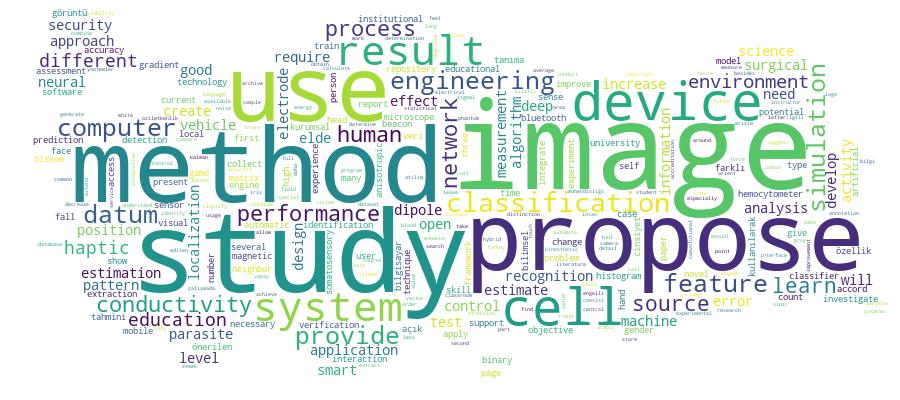
Competency Cloud
12 results
Scholarly Output Search Results
Now showing 1 - 10 of 12
Article Crack Detection on Asphalt Runway Using Unmanned Aerial Vehicle Data with Non-Crack Object Removal and Deep Learning Methods(Pontificia Univ Catolica Chile, Escuela Construccion Civil, 2025) Tapkin, Serkan; Tercan, Emre; Bostan, Atila; Sengul, GokhanUnmanned aerial vehicles are extensively utilized for image acquisition in a cheap, fast, and effective way. In this study, an automatic crack detection method with non-crack object removal and deep learning-based approaches are developed and tested on images captured by unmanned aerial vehicle. The motivation of this study is to detect either a crack exists or not in the asphalt-runway. The novelty of this study lies in integrating a non-crack artifact removal process with six classical edge detectors and comparing the resulting performance with four lightweight CNN models on the same UAV-acquired runway image dataset, enabling a unified evaluation of classical and learning-based approaches. For deep learning-based approach, four lightweight CNN models, namely GoogleNet, SqueezeNet, MobileNetv2, and ShuffleNet, are trained and the best accuracy of %87.9 is obtained whenever GoogleNet model is used. For the non-crack object removal approach, exclusion of non-crack objects from the images is the first step, where crack-detection which makes use of edge-detection techniques is the latter. In the study, Sobel, Prewitt, Canny, Laplacian of Gaussian, Roberts and Zero Cross edge detection algorithms are examined and their success rates in detecting cracks are comparatively presented. With sensitivity=0.981, specificity=0.744, accuracy=0.917, precision=0.912 and F-score=0.945 values Canny algorithm performs significantly better than others in detecting the cracks. This study provides enough evidence for the practicability of automated crack detection on unprocessed digital photographs by the results of the study conducted on asphalt runway.Conference Object A Comparison of Pattern Recognition Approaches for Recognizing Handwriting in Arabic Letters(Institute of Electrical and Electronics Engineers Inc., 2021) Douma,A.; Ahmed,A.A.; Sengul,G.; Santhosh,J.; Jomah,O.S.M.; Ibrahim Salem,F.G.For Arabic letters recognition, we achieve three of pattern recognition approaches namely gray level co-occurrence matrix (GLCM), local binary pattern recognition (LBP) and artificial neural network (ANN) and compare between them to result best performance. Two of these methods level co-occurrence matrix and local binary pattern recognition are used for feature extraction whereas in artificial neural network (ANN) we use the intensity values of pixels for input of the neural network. Two classifiers are used, the K-Nearest Neighbor classifier (KNN) for the LBP, GLCM and neural network classifier for (ANN) artificial neural network. Also, we evaluate the results by using leave one person out approach, fold classification and leave one out. © 2021 IEEE.Master Thesis Görüntü İşleme ve Makine Öğrenme Yöntemleri ile Yüz Tanıma(2020) Rushdı, Iman Raad; Şengül, Gökhanİnsan yüzü tanıma, insan yüzünün çok boyutlu karmaşık bir yapı olması nedeniyle zor ve karmaşık bir problemdir. Temel olarak; yüz tanıma bir insanın yüz görüntüsünden kimliğinin belirlenmesi olarak tanımlanabilir. Bu nedenle yüz tanımada görüntü işleme, bilgisayarlı görü ve makine öğrenmesi gibi farklı disiplinlerin bir arada çalışması gerekir. Yüz tanımlamasıyla ilgili temel zorluk; yüz tanımlamasıyla ilgili doğru özelliklerin, doğru bir şekilde nasıl tanımlanacağıdır. Bu çalışma, görüntüden özellik çıkarma ve özellik seçimine dayalı olarak insan yüzünün tanınması için bir yaklaşım sunmaktadır. Önerilen yüz tanıma sistemi ORL ve YALE veri kümelerinde test edilmiştir. Önerilen yöntem başlangıçta üç adımda uygulanmıştır. Ön işleme aşaması için Daubechies dönüşümü ile Ayrık Dalgacık Dönüşümü (DWT) uygulanmıştır. İkinci aşamada, Yerel İkili Kalıp (LBP) ve Gri Seviye Eş-Oluşum Matrisi (GLCM) esas alınarak özellik çıkarma aşaması uygulanmıştır. Üçüncü adım, Öklid Uzaklığı ile sınıflandırma aşamasını içermektedir. Ayrıca, özellik seçimi yaklaşımı için Parçacık Sürüsü Optimizasyonu (PSO) uygulanarak aynı deneyler uygulanmıştır. Çalışmada birkaç sonuç gözlemlemiştir: DWT ve LBP'nin birlikte uygulandığı ilk deneylerde; eğitim kümesindeki görüntü sayısındaki artışla birlikte ORL veritabanında %82,50 tanıma oranı, YALE veritabanında ise %90 tanıma oranı elde edilmiştir. Bununla birlikte, PSO algoritmasının uygulanması durumunda, ORL veritabanı için doğruluk oranını %95'e ve YALE veritabanında doğruluk oranı %93'e kadar artmıştır.Article Citation - WoS: 2Citation - Scopus: 3A Hybrid Approach for Semantic Image Annotation(Ieee-inst Electrical Electronics Engineers inc, 2021) Sezen, Arda; Turhan, Cigdem; Sengul, GokhanIn this study, a framework that generates natural language descriptions of images within a controlled environment is proposed. Previous work on neural networks mostly focused on choosing the right labels and/or increasing the number of related labels to depict an image. However, creating a textual description of an image is a completely different phenomenon, structurally, syntactically, and semantically. The proposed semantic image annotation framework presents a novel combination of deep learning models and aligned annotation results derived from the instances of the ontology classes to generate sentential descriptions of images. Our hybrid approach benefits from the unique combination of deep learning and semantic web technologies. We detect objects from unlabeled sports images using a deep learning model based on a residual network and a feature pyramid network, with the focal loss technique to obtain predictions with high probability. The proposed framework not only produces probabilistically labeled images, but also the contextual results obtained from a knowledge base exploiting the relationship between the objects. The framework's object detection and prediction performances are tested with two datasets where the first one includes individual instances of images containing everyday scenes of common objects and the second custom dataset contains sports images collected from the web. Moreover, a sample image set is created to obtain annotation result data by applying all framework layers. Experimental results show that the framework is effective in this controlled environment and can be used with other applications via web services within the supported sports domain.Article Citation - WoS: 50Citation - Scopus: 70Deep Learning Based Fall Detection Using Smartwatches for Healthcare Applications(Elsevier Sci Ltd, 2022) Sengul, Gokhan; Karakaya, Murat; Misra, Sanjay; Abayomi-Alli, Olusola O.; Damasevicius, RobertasWe implement a smart watch-based system to predict fall detection. We differentiate fall detection from four common daily activities: sitting, squatting, running, and walking. Moreover, we separate falling into falling from a chair and falling from a standing position. We develop a mobile application that collects the acceleration and gyroscope sensor data and transfers them to the cloud. In the cloud, we implement a deep learning algorithm to classify the activity according to the given classes. To increase the number of data samples available for training, we use the Bica cubic Hermite interpolation, which allows us to improve the accuracy of the neural network. The 38 statistical data features were calculated using the rolling update approach and used as input to the classifier. For activity classification, we have adopted the bi-directional long short-term memory (BiLSTM) neural network. The results demonstrate that our system can detect falling with an accuracy of 99.59% (using leave-one-activityout cross-validation) and 97.35% (using leave-one-subject-out cross-validation) considering all activities. When considering only binary classification (falling vs. all other activities), perfect accuracy is achieved.Article Citation - WoS: 18Citation - Scopus: 24Fusion of Smartphone Sensor Data for Classification of Daily User Activities(Springer, 2021) Sengul, Gokhan; Ozcelik, Erol; Misra, Sanjay; Damasevicius, Robertas; Maskeliunas, RytisNew mobile applications need to estimate user activities by using sensor data provided by smart wearable devices and deliver context-aware solutions to users living in smart environments. We propose a novel hybrid data fusion method to estimate three types of daily user activities (being in a meeting, walking, and driving with a motorized vehicle) using the accelerometer and gyroscope data acquired from a smart watch using a mobile phone. The approach is based on the matrix time series method for feature fusion, and the modified Better-than-the-Best Fusion (BB-Fus) method with a stochastic gradient descent algorithm for construction of optimal decision trees for classification. For the estimation of user activities, we adopted a statistical pattern recognition approach and used the k-Nearest Neighbor (kNN) and Support Vector Machine (SVM) classifiers. We acquired and used our own dataset of 354 min of data from 20 subjects for this study. We report a classification performance of 98.32 % for SVM and 97.42 % for kNN.Master Thesis El Geometri Bilgileri ile İnsan Tanımlama ve Doğrulama(2022) Mustafa, Mustafa Kanaan; Şengül, GökhanBu tezde, el geometrisi tabanlı bir insan tanımlama sistemi önerilmiştir. El, insan vücudunun hayati bir bileşenidir. İnsan tanımlama ve doğrulama sistemleri için kullanılabilecek birçok benzersiz özellikten oluşur. Bu çalışma, el görüntülerinden çıkarılan öznitelikleri kullanarak insanı tanımaya yönelik bir yaklaşım sunmaktadır. Önerilen yöntem, ön işleme, özellik çıkarma ve sınıflandırma aşamaları olmak üzere üç aşamada gerçekleştirilmiştir. Ön işleme adımında, özellik çıkarım modeli için el görüntüleri yeniden boyutlandırılır. Öznitelik çıkarma aşamasında, el özniteliklerini çıkarmak için evrişimli sinir ağı (AlexNet modeli) kullanılır. Çıkarılan özellikler, iyi bilinen Destek Vektör Makineleri (SVM) ve k-en yakın komşu sınıflandırıcıları kullanılarak sınıflandırılır. Önerilen yöntem, farklı sayıda eğitim ve test görüntüsü kullanılarak CASIA-MS-Palmprint veri kümesi üzerinde test edilmiştir. el geometrisi tabanlı tanıma sistemi için kullanılır. Ortalama doğruluk, duyarlılık ve özgüllük 94.36, 89.96 ve 90.36 idi. Sistem yeterli sayıda görüntü ile eğitildiğinde tanıma doğruluğu oranının makul olduğu sonucuna varıyoruz.Article Citation - WoS: 10Citation - Scopus: 31An Improved Random Bit-Stuffing Technique With a Modified Rsa Algorithm for Resisting Attacks in Information Security (rbmrsa)(Cairo Univ, Fac Computers & information, 2022) Mojisola, Falowo O.; Misra, Sanjay; Febisola, C. Falayi; Abayomi-Alli, Olusola; Sengul, Gokhan; Falayi Febisola, C.The recent innovations in network application and the internet have made data and network security the major role in data communication system development. Cryptography is one of the outstanding and powerful tools for ensuring data and network security. In cryptography, randomization of encrypted data increases the security level as well as the Computational Complexity of cryptographic algorithms involved. This research study provides encryption algorithms that bring confidentiality and integrity based on two algorithms. The encryption algorithms include a well-known RSA algorithm (1024 key length) with an enhanced bit insertion algorithm to enhance the security of RSA against different attacks. The security classical RSA has depreciated irrespective of the size of the key length due to the development in computing technology and hacking system. Due to these lapses, we have tried to improve on the contribution of the paper by enhancing the security of RSA against different attacks and also increasing diffusion degree without increasing the key length. The security analysis of the study was compared with classical RSA of 1024 key length using mathematical evaluation proofs, the experimental results generated were compared with classical RSA of 1024 key length using avalanche effect in (%) and computational complexity as performance evaluation metrics. The results show that RBMRSA is better than classical RSA in terms of security but at the cost of execution time. (C) 2022 THE AUTHORS. Published by Elsevier B.V. on behalf of Faculty of Computers and Information, Cairo University.Article Citation - Scopus: 22Comparative Analysis of Programming Languages Utilized in Artificial Intelligence Applications: Features, Performance, and Suitability(Prof.Dr. İskender AKKURT, 2024) Sezen, Arda; Türkmen, Güzin; Şengül, GökhanThis study presents a detailed comparative analysis of the foremost programming languages employed in Artificial Intelligence (AI) applications: Python, R, Java, and Julia. These languages are analysed for their performance, features, ease of use, scalability, library support, and their applicability to various AI tasks such as machine learning, data analysis, and scientific computing. Each language is evaluated based on syntax and readability, execution speed, library ecosystem, and integration with external tools. The analysis incorporates a use case of code writing for a linear regression task. The aim of this research is to guide AI practitioners, researchers, and developers in choosing the most appropriate programming language for their specific needs, optimizing both the development process and the performance of AI applications. The findings also highlight the ongoing evolution and community support for these languages, influencing long-term sustainability and adaptability in the rapidly advancing field of AI. This comparative assessment contributes to a deeper understanding of how programming languages can enhance or constrain the development and implementation of AI technologies.Master Thesis Makine öğrenme algoritmalarıyla yüz tespiti(2020) Hamamchı, Ahmed Ameer Hamdı; Şengül, GökhanBir görüntüdeki yüzlerin ve yüz olmayanların varlığının tespiti, yüzün tutumu (Lokalizasyon), ifade ve ayrımcılık gibi yüz uygulamalarının ilk hareketidir. Yüz tanımanın amacı, bir yüzün bir resimde görünüp görünmediğini belirlemektir. Yüzün bulunduğu görüntünün konumunu bilmek veya bulmak, herhangi bir yüz algılama işleme sisteminin en kritik adımlarından biridir. Yüz algılama sisteminde gerçekleştirilen performans, yüzlerin statik olmadığı (sabit değil) ve duruş, renk, aydınlatma durumu ve ölçek açısından büyük farklılıklar göstermesi nedeniyle, uygulamaların doğru çalışmasına anında etki eder. Yukarıda belirtilen tüm sorunların üstesinden gelmek için otomatik bir sistem planlamak ve hedeflemek zordur. Bu nedenle makine öğrenimi algoritmaları, iyi performans gösteren bir yüz algılama sistemi oluşturmak için başarılı uygulama araçlarından biri olarak bilinir. Yüz algılama sorunu, bir resimdeki insan yüzünün bir veya birden fazla yüzünün algılanmasını içeren bilgisayar görüşü için bir görev olarak adlandırılabilir. Yüzün algılanması, yüz analizlerinin önemli hareketlerinden biridir. Bu tezde, yüzlerin özelliklerini ortaya çıkarmak ve ardından yüzleri sınıflandırmak için kullanılan viyola & jones, LBP (Özellik çıkarıcı), K-NN ve SVM (Sınıflandırıcılar) algoritmalarının genel bir incelemesi, sağlam, verimli ve güvenilir bir yüz algılama sistemi oluşturmak ve her yöntemin avantajları ve dezavantajları kısaca ve ayrıntılı olarak açıklanmakta, ardından hangi yaklaşımın diğerlerine göre daha kesin ve güçlü olduğuna karar verilmektedir. Sonunda, binlerce yüz ve yüz olmayan görüntüden oluşan çalışmamızda kullanılan veri setlerine dayalı olarak SVM, K-NN, LBP ve Viola & Jones için bir karşılaştırma ve değerlendirme yapılır. LBP, K-NN, SVM ve Viola & Jones yöntemleri hızı, doğruluğu, öğrenme yeteneği ve basitliği nedeniyle yüz tanıma için kullanılacak uygun yöntemler gibi görünmektedir. Bu çalışmanın sonuçları, eğitim görüntülerinin sayısı artırılarak sistem doğruluğunun iyileştirilebileceğini göstermiştir. Çalışmada aynı ve farklı boyutlarda iki veri seti kullanılmıştır. Yüzler için aynı yüz boyutlarına sahip veri seti kullanılarak SVM kullanılarak LBP için% 85, K-NN kullanılarak LBP için% 100 ve Viola & Jones için% 88 doğruluk elde edilir. Yüz için farklı boyutlardaki veri seti kullanılarak yüzler için SMV kullanılarak LBP için% 83, K-NN kullanılarak LBP için% 57 ve Viola & Jones için% 68 doğruluk elde edilmiştir.
