
Kılıç, Sadık Engin
Loading...
Profile URL
Name Variants
K.,Sadik Engin
Sadık Engin, Kılıç
Kılıç S.
S. E. Kılıç
Kılıç, Sadık Engin
S.E.Kılıç
Kiliç S.
S.,Kılıç
Kilic S.
K.,Sadık Engin
K., Sadik Engin
Kilic,S.E.
S. E. Kilic
K., Sadık Engin
Kılıç,S.E.
Sadik Engin, Kilic
Sadık Engin Kılıç
S., Kilic
Kilic, Sadik Engin
Kilic,Sadik Engin
S.E.Kilic
Kilic, S. Engin
Sadık Engin, Kılıç
Kılıç S.
S. E. Kılıç
Kılıç, Sadık Engin
S.E.Kılıç
Kiliç S.
S.,Kılıç
Kilic S.
K.,Sadık Engin
K., Sadik Engin
Kilic,S.E.
S. E. Kilic
K., Sadık Engin
Kılıç,S.E.
Sadik Engin, Kilic
Sadık Engin Kılıç
S., Kilic
Kilic, Sadik Engin
Kilic,Sadik Engin
S.E.Kilic
Kilic, S. Engin
Job Title
Profesör Doktor
Email Address
engin.kilic@atilim.edu.tr
Main Affiliation
Manufacturing Engineering
Status
ORCID ID
Scopus Author ID
Turkish CoHE Profile ID
Google Scholar ID
WoS Researcher ID
Sustainable Development Goals
 1
1NO POVERTY
0
Research Products
 2
2ZERO HUNGER
0
Research Products
 3
3GOOD HEALTH AND WELL-BEING
1
Research Products
 4
4QUALITY EDUCATION
0
Research Products
 5
5GENDER EQUALITY
0
Research Products
 6
6CLEAN WATER AND SANITATION
0
Research Products
 7
7AFFORDABLE AND CLEAN ENERGY
2
Research Products
 8
8DECENT WORK AND ECONOMIC GROWTH
0
Research Products
 9
9INDUSTRY, INNOVATION AND INFRASTRUCTURE
12
Research Products
 10
10REDUCED INEQUALITIES
0
Research Products
 11
11SUSTAINABLE CITIES AND COMMUNITIES
0
Research Products
 12
12RESPONSIBLE CONSUMPTION AND PRODUCTION
5
Research Products
 13
13CLIMATE ACTION
1
Research Products
 14
14LIFE BELOW WATER
0
Research Products
 15
15LIFE ON LAND
1
Research Products
 16
16PEACE, JUSTICE AND STRONG INSTITUTIONS
0
Research Products
 17
17PARTNERSHIPS FOR THE GOALS
0
Research Products

Documents
40
Citations
1067
h-index
17

Documents
29
Citations
610

Scholarly Output
34
Articles
19
Views / Downloads
214/1689
Supervised MSc Theses
4
Supervised PhD Theses
2
WoS Citation Count
382
Scopus Citation Count
483
Patents
0
Projects
0
WoS Citations per Publication
11.24
Scopus Citations per Publication
14.21
Open Access Source
10
Supervised Theses
6
| Journal | Count |
|---|---|
| The International Journal of Advanced Manufacturing Technology | 4 |
| Machining Science and Technology | 3 |
| Procedia CIRP | 3 |
| Journal of Cleaner Production | 2 |
| International Journal of Computer Integrated Manufacturing | 2 |
Current Page: 1 / 4
Scopus Quartile Distribution
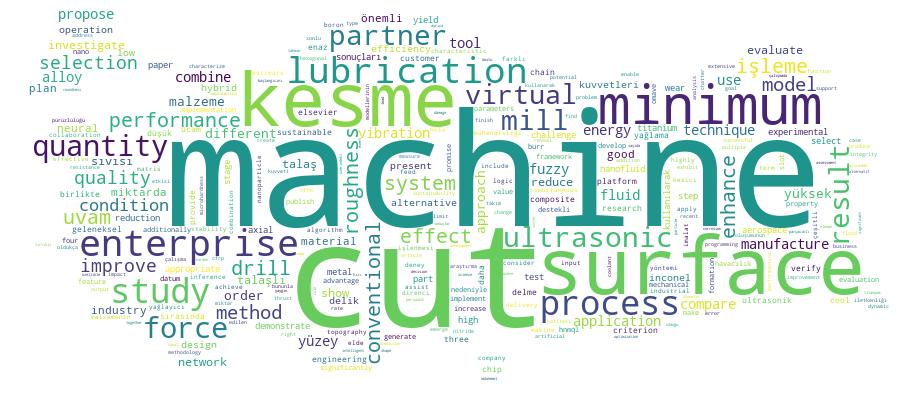
Competency Cloud
19 results
Scholarly Output Search Results
Now showing 1 - 10 of 19
Article Citation - WoS: 7Citation - Scopus: 10Combined Use of Ultrasonic-Assisted Drilling and Minimum Quantity Lubrication for Drilling of Niti Shape Memory Alloy(Taylor & Francis inc, 2023) Namlu, Ramazan Hakki; Lotfi, Bahram; Kilic, S. Engin; Yilmaz, Okan Deniz; Akar, SametThe drilling of shape-memory alloys based on nickel-titanium (Nitinol) is challenging due to their unique properties, such as high strength, high hardness and strong work hardening, which results in excessive tool wear and damage to the material. In this study, an attempt has been made to characterize the drillability of Nitinol by investigating the process/cooling interaction. Four different combinations of process/cooling have been studied as conventional drilling with flood cooling (CD-Wet) and with minimum quantity lubrication (CD-MQL), ultrasonic-assisted drilling with flood cooling (UAD-Wet) and with MQL (UAD-MQL). The drill bit wear, drilling forces, chip morphology and drilled hole quality are used as the performance measures. The results show that UAD conditions result in lower feed forces than CD conditions, with a 31.2% reduction in wet and a 15.3% reduction in MQL on average. The lowest feed forces are observed in UAD-Wet conditions due to better coolant penetration in the cutting zone. The UAD-Wet yielded the lowest tool wear, while CD-MQL exhibited the most severe. UAD demonstrated a & SIM;50% lower tool wear in the wet condition than CD and a 38.7% in the MQL condition. UAD is shown to outperform the CD process in terms of drilled-hole accuracy.Article Citation - WoS: 14Citation - Scopus: 17An Experimental Study on Ultrasonic-Assisted Drilling of Inconel 718 Under Different Cooling/Lubrication Conditions(Springer London Ltd, 2024) Erturun, Omer Faruk; Tekaut, Hasan; Cicek, Adem; Ucak, Necati; Namlu, Ramazan Hakki; Lotfi, Bahram; Kilic, S. EnginUltrasonic-assisted drilling (UAD) is one of the efficient and innovative methods to improve the drillability of difficult-to-cut materials. In the present study, the UAD of Inconel 718 was investigated under different cooling and/or lubrication conditions. The drilling tests were carried out at a constant cutting speed (15 m/min) and a feed (0.045 mm/rev) using uncoated and TiAlN-coated solid carbide drills under dry, conventional cutting fluid (CCF), and minimum quantity lubrication (MQL) conditions. The applicability of UAD to drilling Inconel 718 was evaluated in terms of thrust force, surface roughness, roundness error, burr formation, subsurface microstructure and microhardness, tool wear, and chip morphology. The test results showed that, when compared to conventional drilling (CD), UAD reduced the thrust force and improved the hole quality, tool life, and surface integrity under all conditions. Good surface finish, lower roundness error, and minimum burr heights were achieved under CCF conditions. MQL drilling provided lower thrust forces, better tool performance, and good subsurface quality characteristics. In addition, the simultaneous application of CCF-UAD and MQD-UAD showed significantly better performance, especially when using the coated tool.Article Citation - WoS: 41Citation - Scopus: 42Enhancing Machining Efficiency of Ti-6al Through Multi-Axial Ultrasonic Vibration-Assisted Machining and Hybrid Nanofluid Minimum Quantity Lubrication(Elsevier Sci Ltd, 2024) Namlu, Ramazan Hakki; Lotfi, Bahram; Kilic, S. EnginTi-6Al-4V offers a balance of good strength with lightweight properties. Yet, Ti-6Al-4V poses machining challenges, including low thermal conductivity, chemical adhesion to cutting tools, and chip removal difficulties. To improve machining efficiency, Ultrasonic Vibration-Assisted Machining (UVAM) has emerged as a promising approach. UVAM has demonstrated reduced tool wear, cutting forces, and improved surface quality compared to Conventional Machining (CM). Additionally, Minimum Quantity Lubrication (MQL) methods offer sustainable coolant alternatives, with recent research focusing on Nanofluid-MQL (NMQL) and Hybrid Nanofluid-MQL (HNMQL) for enhanced performance. Although there exists a body of literature showcasing the promising effects of UVAM and MQL methods individually, comprehensive investigations into the synergistic effects of these methodologies remain limited. This study addresses these critical research gaps by conducting a systematic examination of combined application of multi-axial UVAM and HNMQL. Specifically, it delves into the comparison of different vibration directions within UVAM, evaluates the effectiveness of UVAM when combined with cutting fluids incorporating Al2O3 and CuO nanoparticles in NMQLs and HNMQLs, and contrasts these novel approaches with conventional machining methods. The study unfolds in three distinct stages. The first stage examines the ultrasonic cutting mechanism and its combined application with the MQL technique. In the second stage, the study investigates the physical properties of the cutting fluids, including contact angle and surface tension. The final stage encompasses slot milling operations, where an array of parameters such as cutting forces, surface roughness, surface topography, surface texture, and the occurrence of burr formations are rigorously analyzed. The results demonstrate that the combination of multi-axial UVAM with HNMQL yields substantial advantages over traditional machining methods. Notably, it leads to a remarkable reduction in cutting forces (up to 37.6 %) and surface roughness (up to 37.4 %). Additionally, this combination engenders the production of highly homogeneous and uniform surface textures, characterized by minimal surface defects and a significantly diminished occurrence of burr formations. These findings underscore the potential of multi-axial UVAM combined with HNMQL as a promising approach in enhancing the machining of Ti-6Al-4V, thus offering a pathway to enhance the efficiency and precision of aerospace component manufacturing processes.Article An Experimental Study of the Effects of Ultrasonic Cavitation-Assisted Machining on Ti-6al(Inderscience Publishers, 2024) Koçak,B.; Canbaz,H.İ.; Zengin,N.N.; Mumcuoğlu,A.B.; Aydın,M.B.; Namlu,R.H.; Kılıç,S.E.Ti-6Al-4V has extensive applications in high-tech industries like aviation, defence and biomedical. However, the cutting of Ti-6Al-4V is challenging due to its poor machinability. Recently, ultrasonic cavitation-assisted machining (UCAM) has emerged as a cutting process that utilises high-frequency and low-amplitude vibrations to induce the formation of cavitation bubbles, thereby improving cutting performance. Despite the benefits of UCAM, there is lack of research investigating its application in Ti-6Al-4V. This study aims to investigate the efficacy of UCAM in improving the cutting performance of Ti-6Al-4V and compare it with conventional methods. Specifically, the study compares UCAM with conventional machining (CM) under conventional cutting fluid. The study reveals that UCAM can reduce cutting forces by up to 49.5% and surface roughness by up to 51.9%. Additionally, UCAM yields more uniform, homogeneous surfaces with reduced surface damage compared to CM. These results demonstrate the potential of UCAM for enhancing cutting performance of Ti-6Al-4V. Copyright © 2024 Inderscience Enterprises Ltd.Article Citation - WoS: 77Citation - Scopus: 101An Intelligent Process Planning System for Prismatic Parts Using Step Features(Springer London Ltd, 2007) Amaitik, Saleh M.; Kilic, S. EnginThis paper presents an intelligent process planning system using STEP features (ST-FeatCAPP) for prismatic parts. The system maps a STEP AP224 XML data file, without using a complex feature recognition process, and produces the corresponding machining operations to generate the process plan and corresponding STEP-NC in XML format. It carries out several stages of process planning such as operations selection, tool selection, machining parameters determination, machine tools selection and setup planning. A hybrid approach of most recent techniques ( neural networks, fuzzy logic and rule-based) of artificial intelligence is used as the inference engine of the developed system. An object-oriented approach is used in the definition and implementation of the system. An example part is tested and the corresponding process plan is presented to demonstrate and verify the proposed CAPP system. The paper thus suggests a new feature-based intelligent CAPP system for avoiding complex feature recognition and knowledge acquisition problems.Article Citation - WoS: 11Citation - Scopus: 14A Neural Network Model for the Assessment of Partners' Performance in Virtual Enterprises(Springer London Ltd, 2007) Sari, Burak; Amaitik, Saleh; Kilic, S. EnginIn response to increasing international competition, enterprises have been investigating new ways of cooperating with each other to cope with today's unpredictable market behaviour. Advanced developments in information & communication technology (ICT) enabled reliable and fast cooperation to support real-time alliances. In this context, the virtual enterprise (VE) represents an appropriate cooperation alternative and competitive advantage for the enterprises. VE is a temporary network of independent companies or enterprises that can quickly bring together a set of core competencies to take advantage of market opportunity. In this emerging business model of VE, the key to enhancing the quality of decision making in the partner companies' performance evaluation function is to take advantage of the powerful computer-related concepts, tools and technique that have become available in the last few years. This paper attempts to introduce a neural network model, which is able to contribute to the extrapolation of the probable outcomes based on available pattern of events in a virtual enterprise. Quality, delivery and progress were selected as determinant factors effecting the performance assessment. Considering the features of partner performance assessment and neural network models, a back-propagation neural network that includes a two hidden layers was used to evaluate the partner performance.Article Citation - Scopus: 5Micro-Wedm of Ni55.8ti Shape Memory Superalloy: Experimental Investigation and Optimisation(Inderscience Publishers, 2021) Meshri,H.A.M.; Akar,S.; Seyedzavvar,M.; Kiliç,S.E.Nickel-titanium superalloy has gained significant acceptance for engineering applications as orthotropic implants, orthodontic devices, automatic actuators, etc. Considering the unique properties of these alloys, such as high hardness, toughness, strain hardening, and development of straininduced martensite, micro-wire electro-discharge machining (μ-WEDM) process has been accepted as one of the main options for cutting intricate shapes of these alloys in micro-scale. This paper presents the results of a comprehensive study to address the material removal rate (MRR) and surface integrity of Ni55.8Ti shape memory superalloy (SMA) in the μ-WEDM process. The effects of discharge current, pulse on-time, pulse off-time, and servo voltage on the performance of this process, including MRR, white layer thickness, surface roughness, and micro-hardness of the machined surface, were investigated by multi-regression analysis using response surface methodology (RSM). The optimisation of input parameters based on the gradient and the swarm optimisation algorithms were also conducted to maximise the MRR and minimise the white layer thickness, surface roughness, and micro-hardness of the machined samples. © 2021 Inderscience Enterprises Ltd.. All rights reserved.Article Citation - WoS: 16Citation - Scopus: 22Tool-Life Modelling of Carbide and Ceramic Cutting Tools Using Multi-Linear Regression Analysis(Sage Publications Ltd, 2006) Amaitik, S. M.; Tasgin, T. T.; Kilic, S. E.This paper presents a study for the development of tool-life models for machining operations by means of a statistical approach called multi-linear regression analysis. The study was applied to a milling process for machining SAE 121 cast iron in a factory without interrupting the mass production. Different cutting tool materials under dry conditions were used in the cutting tests. Several machining experiments were performed and mathematical models for tool life have been postulated by using least-square regression analysis. The analysis was based on a first-order model in which the tool life is expressed as a function of two independent variables; cutting speed and feed rate. Analysis of variance was applied to check the adequacy of the mathematical models and their respective parameters. In order to demonstrate the usefulness of the developed models, tool-life contours have been generated and presented in different plots.Article Citation - WoS: 1Citation - Scopus: 1An Experimental Study on Ultrasonic-Assisted Drilling of CFRP Composites with Minimum Quantity Lubrication(MDPI, 2025) Namlu, Ramazan Hakki; Sagener, Mustafa Burak; Kilic, Zekai Murat; Colak, Oguz; Kilic, Sadik EnginThe increasing use of carbon fiber reinforced polymer (CFRP) composites in industries such as aerospace, due to its high strength-to-weight ratio, durability, and resistance to corrosion has led to a growing demand for more efficient machining processes. However, the multilayered structure of CFRP composites, composed of densely packed fibers, presents significant challenges during machining. Additionally, when cutting fluids are used to improve effective cooling and lubrication, the material tends to absorb the fluid, causing damage and leading to problem of weaking of composite structure. To address these issues, this study compares ultrasonic-assisted drilling (UAD) and minimum quantity lubrication (MQL) techniques with conventional drilling (CD) and dry cutting to improve the performance of CFRP composite drilling. The results show that using UAD and MQL together reduced thrust force by up to 27%, improved surface roughness inside the holes by up to 31%, reduced improved hole diameter, cylindricity, roundness, and delamination.Article Citation - WoS: 8Citation - Scopus: 12An Ontology-Based Multi-Agent Virtual Enterprise System (omave): Part 2: Partner Selection(Taylor & Francis Ltd, 2017) Sadigh, Bahram Lotfi; Nikghadam, Shahrzad; Ozbayoglu, A. Murat; Unver, Hakki Ozgur; Dogdu, Erdogan; Kilic, S. EnginA virtual enterprise (VE) is a collaboration model between multiple business partners in a value chain. The VE model is particularly feasible and appropriate for small- and medium-sized enterprises (SMEs) and industrial parks containing multiple SMEs that have different vertical competencies. The VE consortium's success highly depends on its members. Therefore, it is crucial to select the most appropriate enterprises when forming a VE consortium. In this study, a new multi-agent hybrid partner selection algorithm is developed for application in the development of an ontology-based multi-agent virtual enterprise (OMAVE) system. In this platform, the agent's interactions are supported by agent ontology, which provides concepts, properties and all message formats for the agents. Different types of agents collaborate and compete with each other so that unqualified or inefficient enterprises are eliminated from the enterprise pool. Only the remaining enterprises would be allowed to enter the negotiation process and propose in the bidding. The agent-based auctioning platform is coupled with a fuzzy-AHP-TOPSIS algorithm to evaluate partners based on their proposals and background. Accordingly, the winning enterprise for each task is identified and the whole project can be accomplished by assigning tasks to the responsible partners. To test and verify the functionality of the developed OMAVE system, a sample module using OMAVE applications and tools was manufactured. The last section of this paper presents the results of this case study, which validate the applicability of the proposed technique.
