
Kılıç, Sadık Engin
Loading...
Profile URL
Name Variants
K.,Sadik Engin
Sadık Engin, Kılıç
Kılıç S.
S. E. Kılıç
Kılıç, Sadık Engin
S.E.Kılıç
Kiliç S.
S.,Kılıç
Kilic S.
K.,Sadık Engin
K., Sadik Engin
Kilic,S.E.
S. E. Kilic
K., Sadık Engin
Kılıç,S.E.
Sadik Engin, Kilic
Sadık Engin Kılıç
S., Kilic
Kilic, Sadik Engin
Kilic,Sadik Engin
S.E.Kilic
Kilic, S. Engin
Sadık Engin, Kılıç
Kılıç S.
S. E. Kılıç
Kılıç, Sadık Engin
S.E.Kılıç
Kiliç S.
S.,Kılıç
Kilic S.
K.,Sadık Engin
K., Sadik Engin
Kilic,S.E.
S. E. Kilic
K., Sadık Engin
Kılıç,S.E.
Sadik Engin, Kilic
Sadık Engin Kılıç
S., Kilic
Kilic, Sadik Engin
Kilic,Sadik Engin
S.E.Kilic
Kilic, S. Engin
Job Title
Profesör Doktor
Email Address
engin.kilic@atilim.edu.tr
Main Affiliation
Manufacturing Engineering
Status
ORCID ID
Scopus Author ID
Turkish CoHE Profile ID
Google Scholar ID
WoS Researcher ID
Sustainable Development Goals
 1
1NO POVERTY
0
Research Products
 2
2ZERO HUNGER
0
Research Products
 3
3GOOD HEALTH AND WELL-BEING
1
Research Products
 4
4QUALITY EDUCATION
0
Research Products
 5
5GENDER EQUALITY
0
Research Products
 6
6CLEAN WATER AND SANITATION
0
Research Products
 7
7AFFORDABLE AND CLEAN ENERGY
2
Research Products
 8
8DECENT WORK AND ECONOMIC GROWTH
0
Research Products
 9
9INDUSTRY, INNOVATION AND INFRASTRUCTURE
12
Research Products
 10
10REDUCED INEQUALITIES
0
Research Products
 11
11SUSTAINABLE CITIES AND COMMUNITIES
0
Research Products
 12
12RESPONSIBLE CONSUMPTION AND PRODUCTION
5
Research Products
 13
13CLIMATE ACTION
1
Research Products
 14
14LIFE BELOW WATER
0
Research Products
 15
15LIFE ON LAND
1
Research Products
 16
16PEACE, JUSTICE AND STRONG INSTITUTIONS
0
Research Products
 17
17PARTNERSHIPS FOR THE GOALS
0
Research Products

Documents
40
Citations
1067
h-index
17

Documents
29
Citations
610

Scholarly Output
34
Articles
19
Views / Downloads
214/1689
Supervised MSc Theses
4
Supervised PhD Theses
2
WoS Citation Count
382
Scopus Citation Count
483
Patents
0
Projects
0
WoS Citations per Publication
11.24
Scopus Citations per Publication
14.21
Open Access Source
10
Supervised Theses
6
| Journal | Count |
|---|---|
| The International Journal of Advanced Manufacturing Technology | 4 |
| Machining Science and Technology | 3 |
| Procedia CIRP | 3 |
| Journal of Cleaner Production | 2 |
| International Journal of Computer Integrated Manufacturing | 2 |
Current Page: 1 / 4
Scopus Quartile Distribution
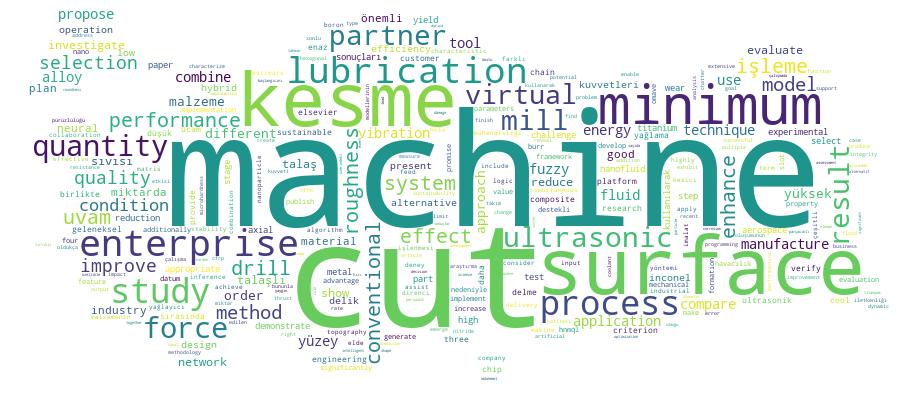
Competency Cloud
25 results
Scholarly Output Search Results
Now showing 1 - 10 of 25
Article Citation - WoS: 77Citation - Scopus: 101An Intelligent Process Planning System for Prismatic Parts Using Step Features(Springer London Ltd, 2007) Amaitik, Saleh M.; Kilic, S. EnginThis paper presents an intelligent process planning system using STEP features (ST-FeatCAPP) for prismatic parts. The system maps a STEP AP224 XML data file, without using a complex feature recognition process, and produces the corresponding machining operations to generate the process plan and corresponding STEP-NC in XML format. It carries out several stages of process planning such as operations selection, tool selection, machining parameters determination, machine tools selection and setup planning. A hybrid approach of most recent techniques ( neural networks, fuzzy logic and rule-based) of artificial intelligence is used as the inference engine of the developed system. An object-oriented approach is used in the definition and implementation of the system. An example part is tested and the corresponding process plan is presented to demonstrate and verify the proposed CAPP system. The paper thus suggests a new feature-based intelligent CAPP system for avoiding complex feature recognition and knowledge acquisition problems.Conference Object Citation - WoS: 5Citation - Scopus: 6Investigation of the Effects of Axial Ultrasonic Vibrations on Chatter Stability in Milling with Bull Nose Cutters(Elsevier Science BV, 2023) Namlu, Ramazan Hakki; Kilic, Zekai Murat; Lorain, Raphael; Kilic, Sadik EnginUltrasonic vibrations-assisted machining has positive effects on the chatter stability and surface integrity of the process. Radial vibration-assisted milling is effective but it needs an advanced control of vibration trajectory hence is not easy to implement. The aim of this paper is to investigate the effects of axial ultrasonic vibrations on stability through disturbing the chip regeneration. A simple way of predicting the stability increase is proposed using missed-cut effect that reduces the effective number of teeth in cut. The axial vibrations are shown to introduce radial runout such that a regular cutter will show the characteristics of a serrated tool. For a 2-tooth bull nose cutter, the proposed method was verified by milling of Ti-6Al-4V material. The results showed that the axial ultrasonic vibrations increased limit axial depth of cut by more than 40%. Therefore, applying axial vibrations would be a simple solution to improve chatter resistance in machining difficult-to-cut materials while avoiding the cost and complexity of serrated rounded edges. The attention on using axial ultrasonic vibrations in milling is increasing, hence further research on modelling the machining dynamics combined with the velocity effects will be needed following this study. (c) 2023 The Authors. Published by Elsevier B.V. This is an open access article under the CC BY-NC-ND license (https://creativecommons.org/licenses/by-nc-nd/4.0)Conference Object Partner Selection in Formation of Virtual Enterprises Using Fuzzy Logic(SciTePress, 2015) Nikghadam,S.; Sadigh,B.L.; Ozbayoglu,A.M.; Unver,H.O.; Kilic,S.E.Virtual Enterprise (VE) is a temporary cooperation among independent enterprises to build up a dynamic collaboration framework for manufacturing. One of the most important steps to construct a successful VE is to select the most qualified partners to take role in the project. This paper is a survey of ranking the volunteer companies with respect to four evaluation criteria, proposed unit price, delivery time, quality and enterprises' past performance. Fuzzy logic method is proposed to deal with these four conflicting criteria, considered as input variables of the model. As each criterion is different in nature with the other criterion, various membership functions are used to fuzzify the input values. The next step is to construct the logical fuzzy rules combining the inputs to conclude the output. Mamdani's approach is adopted to evaluate the output in this Fuzzy Inference System. The result of the model is the partnership chance of each partner to participate in VE. A partner with highest partnership chance will be the winner of the negotiation. Implementation of this model to the illustrative example of a partner selection problem in virtual enterprise and comparing it with fuzzy-TOPSIS approach verifies the feasibility of the proposed approach and the computational results are satisfactory. Copyright © 2015 SCITEPRESS - Science and Technology Publications All rights reserve.Article Citation - WoS: 13Citation - Scopus: 17Cutting Force Prediction in Ultrasonic-Assisted Milling of Ti-6al With Different Machining Conditions Using Artificial Neural Network(Cambridge University Press, 2021) Namlu,R.H.; Turhan,C.; Sadigh,B.L.; Kiliç,S.E.Ti-6Al-4V alloy has superior material properties such as high strength-to-weight ratio, good corrosion resistance, and excellent fracture toughness. Therefore, it is widely used in aerospace, medical, and automotive industries where machining is an essential process for these industries. However, machining of Ti-6Al-4V is a material with extremely low machinability characteristics; thus, conventional machining methods are not appropriate to machine such materials. Ultrasonic-assisted machining (UAM) is a novel hybrid machining method which has numerous advantages over conventional machining processes. In addition, minimum quantity lubrication (MQL) is an alternative type of metal cutting fluid application that is being used instead of conventional lubrication in machining. One of the parameters which could be used to measure the performance of the machining process is the amount of cutting force. Nevertheless, there is a number of limited studies to compare the changes in cutting forces by using UAM and MQL together which are time-consuming and not cost-effective. Artificial neural network (ANN) is an alternative method that may eliminate the limitations mentioned above by estimating the outputs with the limited number of data. In this study, a model was developed and coded in Python programming environment in order to predict cutting forces using ANN. The results showed that experimental cutting forces were estimated with a successful prediction rate of 0.99 with mean absolute percentage error and mean squared error of 1.85% and 13.1, respectively. Moreover, considering too limited experimental data, ANN provided acceptable results in a cost-and time-effective way. Copyright © The Author(s), 2020. Published by Cambridge University Press.Conference Object Citation - Scopus: 2Evaluation of Partner Companies Based on Fuzzy Inference System for Establishing Virtual Enterprise Consortium(Springer Verlag, 2015) Nikghadam,S.; LotfiSadigh,B.; Ozbayoglu,A.M.; Unver,H.O.; Kilic,S.E.Virtual Enterprise (VE) is one of the growing trends in agile manufacturing concepts. Under this platform companies with different skills and core competences are cooperate with each other in order to accomplish a manufacturing goal. Success of VE, as a consortium, highly depends on the success of its partners. So it is very important to choose the most appropriate companies to enroll in VE. In this study a Fuzzy Inference System (FIS) based approach is developed to evaluate and select the potential enterprises. The evaluation is conducted based on four main criteria; unit price, delivery time, quality and past performance. These criteria are considered as inputs of FIS and specific membership functions are designed for each. By applying fuzzy rules the output of the model, partnership chance, is calculated. In the end, the trustworthy of the model is tested and verified by comparing it with fuzzy-TOPSIS technique providing a sample. © Springer International Publishing Switzerland 2015.Article Citation - WoS: 1Citation - Scopus: 1An Experimental Study on Ultrasonic-Assisted Drilling of CFRP Composites with Minimum Quantity Lubrication(MDPI, 2025) Namlu, Ramazan Hakki; Sagener, Mustafa Burak; Kilic, Zekai Murat; Colak, Oguz; Kilic, Sadik EnginThe increasing use of carbon fiber reinforced polymer (CFRP) composites in industries such as aerospace, due to its high strength-to-weight ratio, durability, and resistance to corrosion has led to a growing demand for more efficient machining processes. However, the multilayered structure of CFRP composites, composed of densely packed fibers, presents significant challenges during machining. Additionally, when cutting fluids are used to improve effective cooling and lubrication, the material tends to absorb the fluid, causing damage and leading to problem of weaking of composite structure. To address these issues, this study compares ultrasonic-assisted drilling (UAD) and minimum quantity lubrication (MQL) techniques with conventional drilling (CD) and dry cutting to improve the performance of CFRP composite drilling. The results show that using UAD and MQL together reduced thrust force by up to 27%, improved surface roughness inside the holes by up to 31%, reduced improved hole diameter, cylindricity, roundness, and delamination.Conference Object Citation - WoS: 12Citation - Scopus: 12Multi-Axial Ultrasonic Vibration-Assisted Machining of Inconel 718 Using Al2O3-CuO Hybrid Nanofluid MQL(Elsevier Science BV, 2024) Namlu, Ramazan Hakki; Lotfi, Bahram; Kilic, Sadik EnginInconel 718 is a widely used superalloy in the aerospace industry, owing to its exceptional creep and corrosion resistance, as well as its ability to retain strength at elevated temperatures. However, its machinability presents challenges due to its low thermal conductivity and high work hardening rate during conventional machining, resulting in inadequate surface quality. To address this issue, a recent technique known as Ultrasonic Vibration-Assisted Machining (UVAM) has emerged. UVAM involves applying high-frequency, low-amplitude vibrations to the cutting tool or workpiece. Additionally, Minimum Quantity Lubrication (MQL) has been considered as an alternative cooling technique to enhance machining performance. Optimizing the performance of UVAM can be achieved by employing various vibration axes. Additionally, the effectiveness of MQL can be enhanced through the utilization of nanofluids. This study investigates the combined application of multi-axis UVAM and Al2O3-CuO added Hybrid Nanofluid MQL (HNMQL) during the milling of Inconel 718. The evaluation parameters include surface roughness, topography, burr formations, and cutting forces. The results demonstrate that the simultaneous use of multi-axis UVAM and HNMQL significantly improves the machining performance of Inconel 718. This combination leads to better surface quality and overall process efficiency, offering promising prospects for the aerospace industry and other applications involving difficult-to-cut materials. (c) 2024 The Authors. Published by Elsevier B.V.Conference Object Citation - WoS: 5Citation - Scopus: 10Design of a Customer's Type Based Algorithm for Partner Selection Problem of Virtual Enterprise(Elsevier Science Bv, 2016) Nikghadam, Shahrzad; Ozbayoglu, Ahmet Murat; Unver, Hakki Ozgur; Kilic, Sadik EnginVirtual Enterprise (VE) is a temporary platform for individual enterprises to collaborate with each other, sharing their core competencies to fulfill a customer demand. In order to improve the customer satisfaction, the most successful VEs select their consortium's members based on customer's preferences. There is quite extensive literature in the field of partner selection in VE, each proposing a new approach to evaluate and select the most appropriate partners among pool of enterprises. However, none of the studies in literature recommend which partner selection methodology should be used in each project with a particular customer attitude. In this study an algorithm is proposed which classifies the customers into three categories; passive, standard and assertive. Three different approaches; Fuzzy Logic-FAHP TOPSIS and Goal programming are used for each customer type respectively. This classification is beneficial since the problem's characteristics; such as vagueness of data, change as the customer's attitude varies. The results certify that, adopting this algorithm not only helps the VE to select the most appropriate partners based on customer preferences, but also the model adapts itself to each customer's attitude. As a result, the overall system flexibility is significantly improved. (C) 2016 The Authors. Published by Elsevier B.V.Article Citation - WoS: 3Citation - Scopus: 4Investigation of the Combined Effects of Ultrasonic Vibration-Assisted Machining and Minimum Quantity Lubrication on Al7075-T6(John Wiley and Sons Ltd, 2024) Namlu, R.H.; Cetin, B.; Lotfi, B.; Kiliç, S.E.The aluminum alloy Al7075-T6 finds extensive application in the aviation and automotive industries, where machining plays a pivotal role. Emerging techniques such as Ultrasonic Vibration-Assisted Machining (UVAM) and Minimum Quantity Lubrication (MQL) hold promise for enhancing machining efficiency. In this study, the combined use of UVAM and MQL for slot milling of Al7075-T6 was investigated. The results demonstrate that UVAM reduced cutting forces by an average of 10.87% in MQL and 8.31% in Conventional Cutting Fluid (CCF) conditions when compared to Conventional Machining (CM). In addition, UVAM yielded significantly improved surface finishes, characterized by an average reduction in surface roughness of 41.86% in MQL and 32.11% in CCF conditions relative to CM. Furthermore, surfaces subjected to UVAM exhibited fewer instances of burn marks and tool-induced markings, reduced chip splashing, and more uniform surface integrity compared to those manufactured with CM. Lastly, chips generated through UVAM exhibited distinct characteristics, notably shorter length, curvier shape, and a distinctive half-turn morphology when compared with the irregular chips produced through CM. In conclusion, our findings underscore the potential of UVAM in synergy with MQL to augment the machining of Al7075-T6 alloy, thereby yielding superior-quality machined components with enhanced operational efficiency. © 2025 Elsevier B.V., All rights reserved.Article Citation - WoS: 15Citation - Scopus: 20A Survey of Partner Selection Methodologies for Virtual Enterprises and Development of a Goal Programming-Based Approach(Springer London Ltd, 2016) Nikghadam, Shahrzad; Sadigh, Bahram Lotfi; Ozbayoglu, Ahmet Murat; Unver, Hakki Ozgur; Kilic, Sadik EnginA virtual enterprise (VE) is a platform that enables dynamic collaboration among manufacturers and service providers with complementary capabilities in order to enhance their market competitiveness. The performance of a VE as a system depends highly on the performance of its partner enterprises. Hence, choosing an appropriate methodology for evaluating and selecting partners is a crucial step toward creating a successful VE. In this paper, we begin by presenting an extensive review of articles that address the VE partner selection problem. To fill a significant research gap, we develop a new goal programming (GP)-based approach that can be applied in extreme bidding conditions such as tight delivery timelines for large demand volumes. In this technique, fuzzy analytic hierarchy process (F-AHP) is used to determine customer preferences for four main criteria: proposed unit price, on-time delivery reliability, enterprises' past performance, and service quality. These weights are then incorporated into the GP model to evaluate bidders based on customers' preferences and goals. We present a case study in which we implement the F-AHP-GP technique and verify the model's applicability, as it provides a more flexible platform for matching customers' preferences.

- «
- 1 (current)
- 2
- 3
- »