Kılıç, Sadık Engin

Loading...
Profile Picture
Name Variants
K.,Sadik Engin
Sadık Engin, Kılıç
Kılıç S.
S. E. Kılıç
Kılıç, Sadık Engin
S.E.Kılıç
Kiliç S.
S.,Kılıç
Kilic S.
K.,Sadık Engin
K., Sadik Engin
Kilic,S.E.
S. E. Kilic
K., Sadık Engin
Kılıç,S.E.
Sadik Engin, Kilic
Sadık Engin Kılıç
S., Kilic
Kilic, Sadik Engin
Kilic,Sadik Engin
S.E.Kilic
Kilic, S. Engin
Job Title
Profesör Doktor
Email Address
engin.kilic@atilim.edu.tr
Main Affiliation
Manufacturing Engineering
Status
Scopus Author ID
Turkish CoHE Profile ID
Google Scholar ID
WoS Researcher ID

Sustainable Development Goals

NO POVERTY1
NO POVERTY
0
Research Products
ZERO HUNGER2
ZERO HUNGER
0
Research Products
GOOD HEALTH AND WELL-BEING3
GOOD HEALTH AND WELL-BEING
1
Research Products
QUALITY EDUCATION4
QUALITY EDUCATION
0
Research Products
GENDER EQUALITY5
GENDER EQUALITY
0
Research Products
CLEAN WATER AND SANITATION6
CLEAN WATER AND SANITATION
0
Research Products
AFFORDABLE AND CLEAN ENERGY7
AFFORDABLE AND CLEAN ENERGY
2
Research Products
DECENT WORK AND ECONOMIC GROWTH8
DECENT WORK AND ECONOMIC GROWTH
0
Research Products
INDUSTRY, INNOVATION AND INFRASTRUCTURE9
INDUSTRY, INNOVATION AND INFRASTRUCTURE
12
Research Products
REDUCED INEQUALITIES10
REDUCED INEQUALITIES
0
Research Products
SUSTAINABLE CITIES AND COMMUNITIES11
SUSTAINABLE CITIES AND COMMUNITIES
0
Research Products
RESPONSIBLE CONSUMPTION AND PRODUCTION12
RESPONSIBLE CONSUMPTION AND PRODUCTION
5
Research Products
CLIMATE ACTION13
CLIMATE ACTION
1
Research Products
LIFE BELOW WATER14
LIFE BELOW WATER
0
Research Products
LIFE ON LAND15
LIFE ON LAND
1
Research Products
PEACE, JUSTICE AND STRONG INSTITUTIONS16
PEACE, JUSTICE AND STRONG INSTITUTIONS
0
Research Products
PARTNERSHIPS FOR THE GOALS17
PARTNERSHIPS FOR THE GOALS
0
Research Products
Documents

40

Citations

1067

h-index

17

Documents

29

Citations

610

Scholarly Output

34

Articles

19

Views / Downloads

214/1689

Supervised MSc Theses

4

Supervised PhD Theses

2

WoS Citation Count

382

Scopus Citation Count

483

Patents

0

Projects

0

WoS Citations per Publication

11.24

Scopus Citations per Publication

14.21

Open Access Source

10

Supervised Theses

6

JournalCount
The International Journal of Advanced Manufacturing Technology4
Machining Science and Technology3
Procedia CIRP3
Journal of Cleaner Production2
International Journal of Computer Integrated Manufacturing2
Current Page: 1 / 4

Scopus Quartile Distribution

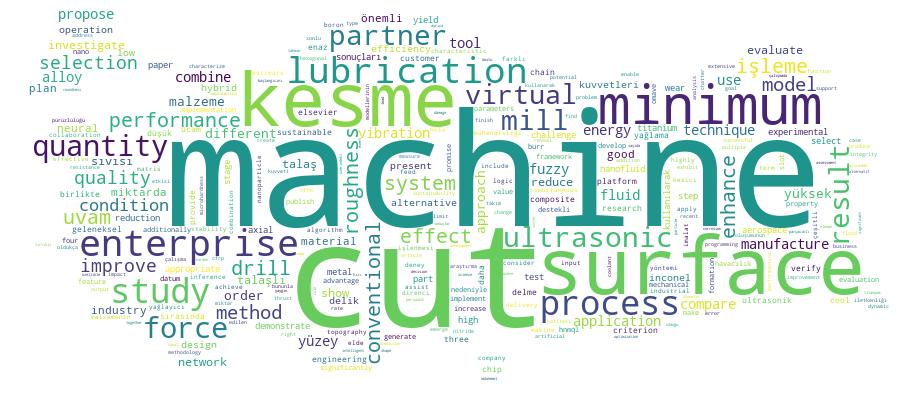
Competency Cloud

GCRIS Competency Cloud

Scholarly Output Search Results

Now showing 1 - 2 of 2
  • Article
    An Experimental Study of the Effects of Ultrasonic Cavitation-Assisted Machining on Ti-6al
    (Inderscience Publishers, 2024) Koçak,B.; Canbaz,H.İ.; Zengin,N.N.; Mumcuoğlu,A.B.; Aydın,M.B.; Namlu,R.H.; Kılıç,S.E.
    Ti-6Al-4V has extensive applications in high-tech industries like aviation, defence and biomedical. However, the cutting of Ti-6Al-4V is challenging due to its poor machinability. Recently, ultrasonic cavitation-assisted machining (UCAM) has emerged as a cutting process that utilises high-frequency and low-amplitude vibrations to induce the formation of cavitation bubbles, thereby improving cutting performance. Despite the benefits of UCAM, there is lack of research investigating its application in Ti-6Al-4V. This study aims to investigate the efficacy of UCAM in improving the cutting performance of Ti-6Al-4V and compare it with conventional methods. Specifically, the study compares UCAM with conventional machining (CM) under conventional cutting fluid. The study reveals that UCAM can reduce cutting forces by up to 49.5% and surface roughness by up to 51.9%. Additionally, UCAM yields more uniform, homogeneous surfaces with reduced surface damage compared to CM. These results demonstrate the potential of UCAM for enhancing cutting performance of Ti-6Al-4V. Copyright © 2024 Inderscience Enterprises Ltd.
  • Article
    Citation - WoS: 13
    Citation - Scopus: 17
    Cutting Force Prediction in Ultrasonic-Assisted Milling of Ti-6al With Different Machining Conditions Using Artificial Neural Network
    (Cambridge University Press, 2021) Namlu,R.H.; Turhan,C.; Sadigh,B.L.; Kiliç,S.E.
    Ti-6Al-4V alloy has superior material properties such as high strength-to-weight ratio, good corrosion resistance, and excellent fracture toughness. Therefore, it is widely used in aerospace, medical, and automotive industries where machining is an essential process for these industries. However, machining of Ti-6Al-4V is a material with extremely low machinability characteristics; thus, conventional machining methods are not appropriate to machine such materials. Ultrasonic-assisted machining (UAM) is a novel hybrid machining method which has numerous advantages over conventional machining processes. In addition, minimum quantity lubrication (MQL) is an alternative type of metal cutting fluid application that is being used instead of conventional lubrication in machining. One of the parameters which could be used to measure the performance of the machining process is the amount of cutting force. Nevertheless, there is a number of limited studies to compare the changes in cutting forces by using UAM and MQL together which are time-consuming and not cost-effective. Artificial neural network (ANN) is an alternative method that may eliminate the limitations mentioned above by estimating the outputs with the limited number of data. In this study, a model was developed and coded in Python programming environment in order to predict cutting forces using ANN. The results showed that experimental cutting forces were estimated with a successful prediction rate of 0.99 with mean absolute percentage error and mean squared error of 1.85% and 13.1, respectively. Moreover, considering too limited experimental data, ANN provided acceptable results in a cost-and time-effective way. Copyright © The Author(s), 2020. Published by Cambridge University Press.