Hacaloğlu, Tuna

Loading...
Profile Picture
Name Variants
Hacaloğlu,T.
H.,Tuna
T., Hacaloğlu
T.,Hacaloğlu
Hacaloglu, Tuna
Tuna, Hacaloğlu
Hacaloglu,T.
T., Hacaloglu
H., Tuna
Tuna, Hacaloglu
T.,Hacaloglu
Hacaloğlu, Tuna
Hacaloglu T.
Job Title
Doktor Öğretim Üyesi
Email Address
tuna.hacaloglu@atilim.edu.tr
Main Affiliation
Information Systems Engineering
Status
Website
ORCID ID
Scopus Author ID
Turkish CoHE Profile ID
Google Scholar ID
WoS Researcher ID

Sustainable Development Goals

2

ZERO HUNGER
ZERO HUNGER Logo

0

Research Products

11

SUSTAINABLE CITIES AND COMMUNITIES
SUSTAINABLE CITIES AND COMMUNITIES Logo

0

Research Products

14

LIFE BELOW WATER
LIFE BELOW WATER Logo

0

Research Products

6

CLEAN WATER AND SANITATION
CLEAN WATER AND SANITATION Logo

0

Research Products

1

NO POVERTY
NO POVERTY Logo

0

Research Products

5

GENDER EQUALITY
GENDER EQUALITY Logo

0

Research Products

9

INDUSTRY, INNOVATION AND INFRASTRUCTURE
INDUSTRY, INNOVATION AND INFRASTRUCTURE Logo

0

Research Products

16

PEACE, JUSTICE AND STRONG INSTITUTIONS
PEACE, JUSTICE AND STRONG INSTITUTIONS Logo

0

Research Products

17

PARTNERSHIPS FOR THE GOALS
PARTNERSHIPS FOR THE GOALS Logo

3

Research Products

15

LIFE ON LAND
LIFE ON LAND Logo

0

Research Products

10

REDUCED INEQUALITIES
REDUCED INEQUALITIES Logo

0

Research Products

7

AFFORDABLE AND CLEAN ENERGY
AFFORDABLE AND CLEAN ENERGY Logo

0

Research Products

8

DECENT WORK AND ECONOMIC GROWTH
DECENT WORK AND ECONOMIC GROWTH Logo

0

Research Products

4

QUALITY EDUCATION
QUALITY EDUCATION Logo

0

Research Products

12

RESPONSIBLE CONSUMPTION AND PRODUCTION
RESPONSIBLE CONSUMPTION AND PRODUCTION Logo

0

Research Products

3

GOOD HEALTH AND WELL-BEING
GOOD HEALTH AND WELL-BEING Logo

0

Research Products

13

CLIMATE ACTION
CLIMATE ACTION Logo

0

Research Products
Documents

25

Citations

285

h-index

8

Documents

15

Citations

153

Scholarly Output

28

Articles

13

Views / Downloads

96/0

Supervised MSc Theses

0

Supervised PhD Theses

0

WoS Citation Count

153

Scopus Citation Count

265

WoS h-index

6

Scopus h-index

8

Patents

0

Projects

0

WoS Citations per Publication

5.46

Scopus Citations per Publication

9.46

Open Access Source

9

Supervised Theses

0

Google Analytics Visitor Traffic

JournalCount
IEEE Software2
CEUR Workshop Proceedings -- Joint of the 33rd International Workshop on Software Measurement and the 18th International Conference on Software Process and Product Measurement, IWSM-MENSURA 2024 -- 30 September 2024 through 4 October 2024 -- Montreal -- 2044672
18th IFIP WG 6.11Conference on e-Business, e-Services, and e-Society (I3E) -- SEP 18-20, 2019 -- Norwegian Univ Sci & Technol, Fac Informat Technol & Elect Engn, Dept Comp, Trondheim, NORWAY1
45th Euromicro Conference on Software Engineering and Advanced Applications (SEAA) / 22nd Euromicro Conference on Digital System Design (DSD) -- AUG 28-30, 2019 -- Kallithea, GREECE1
48th Euromicro Conference on Software Engineering and Advanced Applications -- AUG 31-SEP 02, 2022 -- SPAIN1
Current Page: 1 / 5

Scopus Quartile Distribution

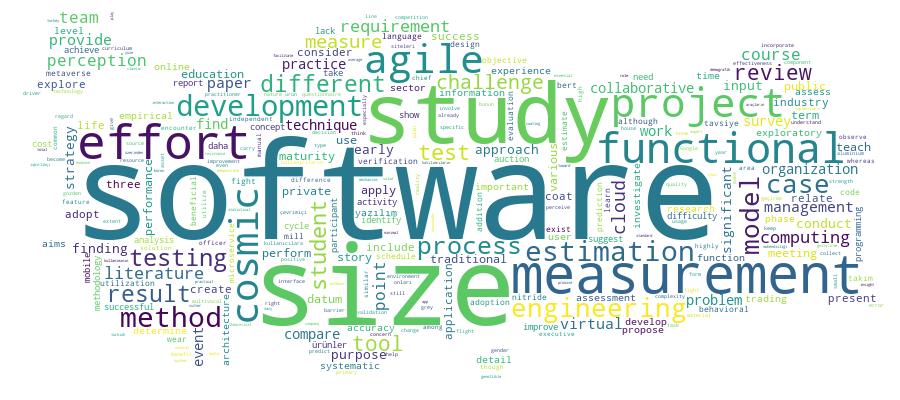
Competency Cloud

GCRIS Competency Cloud

Scholarly Output Search Results

Now showing 1 - 6 of 6
  • Conference Object
    Citation - Scopus: 1
    A Survey on Cosmic Students Estimation Challenge
    (CEUR-WS, 2022) Hacaloglu,T.; Say,B.; Unlu,H.; Omural,N.K.; Demirors,O.
    Software project management is a significant software engineering practice that is highly related to achieving software-specific project goals. This study aims to share students’ perceptions of incorporating an international software estimation challenge called “COSMIC Students’ Estimation Challenge” into a software project management course. For this aim, students were taught the COSMIC Functional Size Measurement method and entered the competition. After the competition, a questionnaire asking for the students’ opinions was collected. The objective of the research is to get an insight into to what extent incorporating this type of competition activity -a challenge- can contribute to students’ learning perceptions. In the long run, the findings can contribute to creating a foresight about making the necessary curriculum arrangements to form a more up-to-date and dynamic education plan by including the methods applied in the software industry in Software Engineering education. The results suggest that this kind of competition experience and preparation is helpful for students to learn the COSMIC method. © 2020 Copyright for this paper by its authors.
  • Conference Object
    Citation - Scopus: 8
    An Exploratory Case Study on Effort Estimation in Microservices
    (Institute of Electrical and Electronics Engineers Inc., 2023) Unlu,H.; Hacaloglu,T.; Omural,N.K.; Caliskanel,N.; Leblebici,O.; Demirors,O.
    Software project management plays an important role in producing high-quality software, and effort estimation can be considered as a backbone for successful project management. Size is a very significant attribute of software by being the only input to perform early effort estimation. Even though functional size measurement methods showed successful results in effort estimation of traditional data-centric architectures such as monoliths, they were not designed for today's architectures which are more service-based and decentralized such as microservices. In these new systems, the event concept is highly used specifically for communication among different services. By being motivated by this fact, in this study, we looked for more microservice-compatible ways of sizing microservices using events and developed a method accordingly. Then, we conducted an exploratory case study in an organization using agile methods and measured the size of 17 Product Backlog Items (PBIs) to assess how this proposed method can be useful in effort estimation in microservices. The implication from the case study is that despite performing a more accurate effort estimation using the proposed size measurement than COSMIC, we were unable to significantly outperform using the total number of events. However, our suggested approach demonstrated to us a different way to use software size in terms of events, namely, to determine the coupling complexity of the project. This finding can be beneficial specifically when evaluating the change requests. © 2023 IEEE.
  • Conference Object
    Cosmic Light Vs Cosmic Classic Manual: Case Studies in Functional Size Measurement
    (CEUR-WS, 2020) Hacaloglu,T.; Unlu,H.; Demirors,O.; Abran,A.
    Functional size has been used in software engineering for more than 40 years. When measured early in the software development life cycle, it can serve as direct input for effort estimation. The COSMIC Functional Size Measurement (FSM) method developed by the Common Software Measurement Consortium (COSMIC) is the latest ISO-compliant functional sizing method. A streamlined manual titled ''Software Development Velocity with COSMIC Function Points'' summarizes the measurement process and shortens the learning time. The aim of this study is to compare the classic COSMIC FSM manual and this new “light” manual in terms of accuracy of the resulting FSM applied to case studies. The findings show that use of the light manual results in accurate measurement. In addition, there were no significant time differences between the two. With respect to the variations in COSMIC Function Points (CFP) values in the two case studies, they three causes were identified: the Object of Interest (OOI) concept and corresponding data groups, details regarding Functional Process Independence, and Error/Confirmation messages related to the scope of the information included in the manuals. Copyright © 2020 for this paper by its authors.
  • Conference Object
    Citation - WoS: 3
    Citation - Scopus: 4
    Effort Prediction for Microservices: a Case Study
    (Ieee, 2021) Unlu, Huseyin; Hacaloglu, Tuna; Leblebici, Onur; Demirors, Onur
    Software size measurement is critical as an input to perform important project management processes such as effort, cost and schedule estimation. Functional size measurement (FSM) methods are beneficial in terms of being applicable in the early phases of the software life cycle over functional requirements and providing a systematic and repeatable method. However, in agile organizations, it can be challenging to seperate measurement components of FSM methods from requirements in the early phases as the documentation is kept to a minimum compared to traditional methods such as the Waterfall Model and is detailed as the project steps. In addition, the existing FSM methods are not fully compatible with today's architectural structures, which are from being data-driven and to evolve into a behaviour-oriented structure. In this study, we performed a case study which includes a project developed with agile methods and using microservice-based architecture to compare the effectiveness of COSMIC FSM and event-based software size measurement. For this purpose, we measured the size of the project and created effort estimation models based on two methods. The measurers had difficulty in applying both methods due to the limited detail level of the requirements in the project. However, the event-based method was found to estimate effort with less error than the COSMIC FSM method.
  • Conference Object
    Citation - Scopus: 42
    Effort Estimation for Agile Software Development: Comparative Case Studies Using Cosmic Functional Size Measurement and Story Points
    (Association for Computing Machinery, 2017) Salmanoglu,M.; Hacaloglu,T.; Demirors,O.
    Agile methodologies have gained significant popularity among software development organizations during the last decade. Although agile methodologies are regarded as minimizing formal processes, they still utilize an estimation methodology for proper management. Story point is the most common input for agile effort estimation. Story point is an arbitrary measure; it reflects experiences of project participants. On the other hand, functional size is an alternative measure used in practice as an input for effort estimation. In this research, we collect and present the outcomes of three case studies which compared the effectiveness of COSMIC-based and story point based effort estimation in agile context. On selected projects of these organizations, software functional size was measured with COSMIC functional size measurement methodology. Effort prediction models were formed by using COSMIC size and actual effort spent; and the models were tested in terms of their effectiveness. The results show controversial outcomes. For all the cases, COSMIC based estimation was more precise. Therefore, COSMIC is an appropriate measure to estimate the effort in organizations that adopt agile software development. It is also observed that COSMIC allowed for computing productivity which has less disperse distribution than the productivity computed with SP. The data is also provided to help other researchers conduct their own studies. © 2017 Association for Computing Machinery.
  • Conference Object
    Citation - WoS: 16
    Citation - Scopus: 21
    Measureability of Functional Size in Agile Software Projects: Multiple Case Studies With Cosmic Fsm
    (Ieee, 2019) Hacaloglu, Tuna; Demirors, Onur
    Functional size measurement (FSM) has been used in software engineering for decades as a main driver for estimation and significant input for other various project management activities throughout the project life span. To apply FSM accurately at the early stages of software development process, especially for estimation purposes, functional user requirements need to be available in detail as required by the adopted FSM method. However, in agile software development, requirement specifications, in general, are kept minimal. For this reason, the adjustment of the requirements to the necessary granularity level has been articulated as one of the barriers preventing the diffusion of FSM practices among agile teams. In this paper, we take a closer look at this problem in order to investigate the usability of FSM and to reveal FSM related challenges empirically through case studies on real agile projects from different software organizations. This study also provides a snapshot of agile organizations in terms of requirement specification and estimation related practices