
Güler, Enver
Loading...
Profile URL
Name Variants
G.,Enver Guler, Enver G., Enver E., Güler E.,Güler Güler,E. Enver, Güler E., Guler Guler,E. Enver, Guler Guler E. Güler E. Güler, Enver E.,Guler Guler, E.
Job Title
Doçent Doktor
Email Address
enver.guler@atilim.edu.tr
Main Affiliation
Chemical Engineering
Status
Website
ORCID ID
Scopus Author ID
Turkish CoHE Profile ID
Google Scholar ID
WoS Researcher ID
No research topics data found.
Sustainable Development Goals
 1
1NO POVERTY
0
Research Products
 2
2ZERO HUNGER
1
Research Products
 3
3GOOD HEALTH AND WELL-BEING
0
Research Products
 4
4QUALITY EDUCATION
0
Research Products
 5
5GENDER EQUALITY
0
Research Products
 6
6CLEAN WATER AND SANITATION
9
Research Products
 7
7AFFORDABLE AND CLEAN ENERGY
13
Research Products
 8
8DECENT WORK AND ECONOMIC GROWTH
1
Research Products
 9
9INDUSTRY, INNOVATION AND INFRASTRUCTURE
2
Research Products
 10
10REDUCED INEQUALITIES
0
Research Products
 11
11SUSTAINABLE CITIES AND COMMUNITIES
0
Research Products
 12
12RESPONSIBLE CONSUMPTION AND PRODUCTION
2
Research Products
 13
13CLIMATE ACTION
1
Research Products
 14
14LIFE BELOW WATER
2
Research Products
 15
15LIFE ON LAND
1
Research Products
 16
16PEACE, JUSTICE AND STRONG INSTITUTIONS
0
Research Products
 17
17PARTNERSHIPS FOR THE GOALS
1
Research Products

Scopus data could not be loaded because of an error. Please refresh the page or try again later.

Documents
30
Citations
1597
No records found in other affiliations.

Scholarly Output
34
Articles
22
Views / Downloads
162/1013
Supervised MSc Theses
6
Supervised PhD Theses
1
WoS Citation Count
159
Scopus Citation Count
265
Patents
0
Projects
0
WoS Citations per Publication
4.68
Scopus Citations per Publication
7.79
Open Access Source
9
Supervised Theses
7
| Journal | Count |
|---|---|
| Journal of Membrane Science and Research | 4 |
| Membranes | 3 |
| Desalination | 2 |
| International Journal of Hydrogen Energy | 2 |
| Current Trends and Future Developments on (Bio-) Membranes: Recent Achievements for Ion-Exchange Membranes | 1 |
Current Page: 1 / 4
Scopus Quartile Distribution
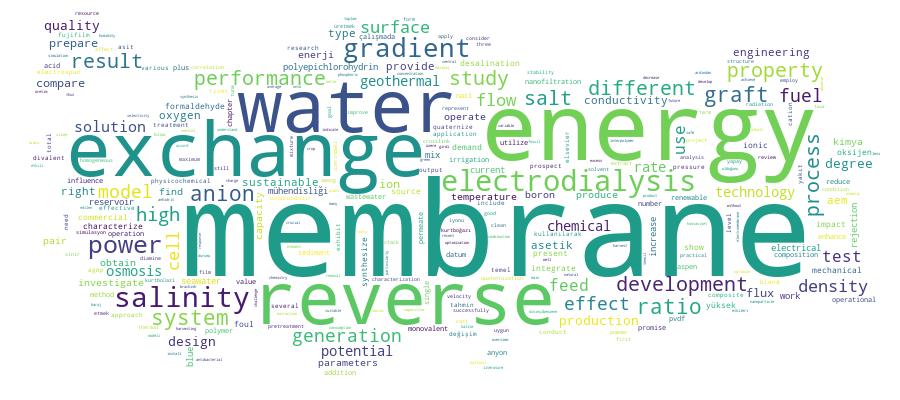
Competency Cloud
34 results
Scholarly Output Search Results
Now showing 1 - 10 of 34
Doctoral Thesis Baraj Rezervuarlarında Sediment Oksijen İhtiyacı ile Su Kalitesi ve Besin Madde İlişkisinin Modellenmesi(2022) Abdulqader, Noor N.; Güler, Enver; Genç, Aslı NumanoğluBurada sunulan çalışma, Ankara'daki Kurtboğazı baraj rezervuarının yüzey ve dip çökellerindeki kirleticileri temsil etmek üzere simüle edilen bir su kalitesi modeli olan WASP8'e (Su analizi simülasyon programı) dayalı bir model yaklaşımıdır. Çalışmada yeralan su kalitesi değişkenleri şunlardır: sıcaklık, nitrat, toplam fosfor, toplam Kjeldahl, çözünmüş oksijen, Klorofil a ve amonyum. Rezervuardaki gerçek durumu temsil etmesini sağlamak için simülasyon modelimizin sonuçları Kurtboğazı baraj sahasından alınan gerçek veriler kullanılarak kalibre edilmiş ve istatiksel verilerden yararlanılmıştır. Bu çalışmada özgün olarak, su kütlesinde meydana gelen durum değişkenlerinin tepkilerini, birbirleriyle nasıl etkileşime girdiklerini ve bunların Kurtboğazı rezervuarının genel kalite durumu üzerindeki etkilerini tahmin etmek için bir kalite modelinin geliştirilmesi araştırılmıştır. Modelin doğruluğu, simüle edilmiş modelimizin rezervuar alanındaki özellikleri temsil edebildiğini gösteren mükemmel sonuç aralıkları üreten belirleme katsayısı ve bağıl hata biçimindeki istatistik teknikleri kullanılarak kontrol edilmiştir. Kurtboğazı baraj rezervuarı, tabakalaşma dönemlerinde hipolimnetik tabakada çözülmüş oksijen tükenmesi gibi olumsuz etkilerden etkilenmiştir. Bununla birlikte, tortu-su arayüzündeki oksijen tüketimi süreçlerini kavramak hala zordur. Temel olarak, tortu oksijen tükenmesi ve tortu oksijen talebi SOD ile bağlantılıdır. Bu nedenle, bu model, su yöneticileri için anoksik durumu ve bentik akıyı etkileyen parametrelerin tahmini için faydalı bir araç olarak hizmet edebilir.Article Citation - WoS: 3Citation - Scopus: 3Synthesis of Silver Nanoparticle-Immobilized Antibacterial Anion-Exchange Membranes for Salinity Gradient Energy Production by Reverse Electrodialysis(Amer Chemical Soc, 2024) Eti, Mine; Cihanoglu, Aydin; Hamaloglu, Kadriye Ozlem; Altiok, Esra; Guler, Enver; Tuncel, Ali; Kabay, NalanBiofouling, stemming from the attachment of living microorganisms, such as bacteria, which form resilient biofilms on membrane surfaces, presents a significant challenge that hampers the efficiency of anion-exchange membranes (AEMs) in reverse electrodialysis (RED) applications. This limitation curtails the generation of electrical power from salinity gradients, which notably is a sustainable form of energy known as osmotic energy. RED stands as a clean and promising process to harness this renewable energy source. This study aimed to impart antibacterial activity to synthesized AEMs by using silver nanoparticles (AgNPs). For that purpose, AgNPs were synthesized at 30 degree celsius using two different pH values (6.0 and 9.0) and immobilized into synthesized AEMs using the dip-coating technique. In nanoparticle synthesis, ascorbic acid and trisodium citrate were used as a reductant and a stabilizer, respectively, to take control of the particle size and agglomeration behavior. The results indicated that AgNPs synthesized at pH 6.0 were dispersed on the AEM surface without agglomeration. The stability of AgNPs immobilized on the membrane surface was tested under low- and high-saline solutions. The antibacterial activities of AEMs were determined with the colony-counting method using Gram-negative (Escherichia coli) bacterial suspension. The viability of bacteria dramatically decreased after the immobilization of AgNPs in the AEMs. In the short- and long-term RED tests, it has been observed that the AEMs having AgNPs have high energy-generating potentials, and power density up to 0.372 W/m(2) can be obtained.Review Citation - Scopus: 7Ion Exchange Membranes for Reverse Electrodialysis (red) Applications - Recent Developments(Amirkabir University of Technology - Membrane Processes Research Laboratory, 2021) Eti,M.; Othman,N.H.; Guler,E.; Kabay,N.The innovative membrane-based technology called reverse electrodialysis (RED) is capable of producing electrical power from the controlled mixing of two aqueous streams of different salinity. There has been tremendous progress so far in the development of RED process in terms of system development, spacer design, membranes properties and operational conditions optimization. Among those, characteristics of the ion exchange membranes are found to be the critical element affecting the performances of RED process. In this respect, a brief overview of the latest developments in ion exchange membranes were presented in this review, focussing on their properties and performances in RED applications. The recent developments of nanocomposite and ion selective membranes, particularly pore filling ion exchange membranes due to their high performances and inexpensive fabrication cost were also summarized. Shortly, fouling problem for the ion exchange membranes employed in the RED system was mentioned. © 2021 Amirkabir University of Technology - Membrane Processes Research Laboratory. All rights reserved.Article The Impact of Quaternization Degree in Polyepichlorohydrin-Based Anion Exchange Membranes on Salinity Gradient Energy Generation by Reverse Electrodialysis(Elsevier, 2025) Cihanoglu, Aydin; Guler, Enver; Kabay, NalanAnion exchange membranes with tailored fixed-charge densities can improve monovalent ion selectivity and performance in reverse electrodialysis for salinity gradient power generation. In this study, poly(epichlorohydrin) was blended with polyacrylonitrile and quaternized with 1,4-diazabicyclo[2.2.2]octane at three different molar ratios to produce AEMs with systematically varied quaternization degrees via a one-step amination/ crosslinking procedure. The resulting membranes were characterized for their physicochemical, electrochemical, and RED performance using ATR-FTIR, XPS, SEM, AFM, water uptake, swelling degree, contact angle, surface zeta potential, ion exchange capacity, fixed charge density, and electrical resistance. Higher quaternization increased the IEC, reduced resistance, and shifted surface charge, leading to improved stack power output in model NaCl solutions. In the presence of Na2SO4, power loss was reduced for more highly quaternized membranes, indicating enhanced exclusion of divalent anions (SO42-) and reduced uphill transport. Fouling tests with humic acid/fulvic acid mixtures showed greater stability for quaternized membranes compared to a commercial benchmark. Moreover, stability tests conducted on fouled membranes revealed that the tailor-made membrane exhibits superior durability and lower fouling-induced power loss than commercial Fujifilm Type II AEMs. Overall, these results demonstrate that tuning the degree of quaternization is an effective strategy to balance conductivity and ion selectivity in AEMs for RED applications.Article Citation - WoS: 6Citation - Scopus: 6Further Development of Polyepichlorohydrin Based Anion Exchange Membranes for Reverse Electrodialysis by Tuning Cast Solution Properties(Mdpi, 2022) Eti, Mine; Cihanoglu, Aydin; Guler, Enver; Gomez-Coma, Lucia; Altiok, Esra; Arda, Muserref; Kabay, NalanRecently, there have been several studies done regarding anion exchange membranes (AEMs) based on polyepichlorohydrin (PECH), an attractive polymer enabling safe membrane fabrication due to its inherent chloromethyl groups. However, there are still undiscovered properties of these membranes emerging from different compositions of cast solutions. Thus, it is vital to explore new membrane properties for sustainable energy generation by reverse electrodialysis (RED). In this study, the cast solution composition was easily tuned by varying the ratio of active polymer (i.e., blend ratio) and quaternary agent (i.e., excess diamine ratio) in the range of 1.07-2.00, and 1.00-4.00, respectively. The membrane synthesized with excess diamine ratio of 4.00 and blend ratio of 1.07 provided the best results in terms of ion exchange capacity, 3.47 mmol/g, with satisfactory conductive properties (area resistance: 2.4 omega center dot cm(2), electrical conductivity: 6.44 mS/cm) and high hydrophilicity. RED tests were performed by AEMs coupled with the commercially available Neosepta CMX cation exchange membrane (CEMs).Master Thesis Alkali Yakıt Hücreleri için Yarı-iç İçe Geçen Polietersülfon Kuaternize Nişasta Polimer Ağına Dayalı Anyon Değişim Membranı(2021) Almurumudhe, Osamah Kadhım Hılal; Güler, EnverZehirli emisyonlar olmadan güç üretmeye yönelik birçok etkili cihaz ortaya çıkmış ve geliştirilmiştir. Proton değişim membranlı yakıt hücresi (PEMFC) bu etkili cihazlardan biridir. Elektrokatalizör olarak platine tamamen bağımlı olması son derece rekabetçi olan pazardaki uygulamasını sınırlandırmıştır. Değerli olmayan metal katalizörün potansiyel kullanımı, anyon değişim membranlı yakıt hücresinin (AEMFC) yeniden dikkati çekmesini sağlamıştır. Anyon değişim membranı (AEM), AEMFC'nin kalbi olarak kabul edilir ve aynı zamanda AEM´lerin hazırlanması, bu yakıt hücrelerin geliştirilmesindeki en büyük zorluk olarak kabul edilmiştir. Yüksek iletkenliğe ve yüksek alkali direncine sahip anyon değişim membranların üretimi, bu alanda aktif bir araştırma alanı haline gelmiştir. Bu çalışmada, alkali yakıt hücreleri için iki tür anyon değişim membranı, basit ve yeni bir stratejiye göre tek aşamalı kuaternizasyon yöntemi ile üretilmiştir, Nişastanin kolin klorür ve epiklorohidrin ile kuaternizasyonu ̸ çapraz bağlanması ve ardından polietersülfon (PES) ile karıştırılması, iç içe geçen bir polimer ağıyla (IPN) sonuçlanmıştır. Birinci tip, 133.33 μm kalınlığa sahip gözenekli polieter sülfon AEM, % 376.7 su alımı ve % 5.3 şişmevi oranı sergilemiştir. İkinci tip ise, 55.48 μm ile yoğun polieter sülfon AEM, % 69.9 su alımı ve % 7.5 şişme oranı sergilemiştir. Karakterizasyon sonuçları, üretim rotamızın çok başarılı olduğunu ve üretilen anyon değiştirici membranlarımızın alkali yakıt hücresi uygulamaları için umut verici olduğunu doğrulamıştır.Book Part Citation - Scopus: 3Ion Exchange Membranes in Electrodialysis Process for Wastewater Treatment(Elsevier, 2023) Altıok,E.; Cihanoğlu,A.; Güler,E.; Kabay,N.Water is the most important natural resource on earth. Survival without water is impossible and industries cannot operate without water as well. Availability of safe and reliable source of water is therefore essential. Different practical solutions are needed for sustainable preservation of water resources as freshwater resources are limited in terms of technical and economical aspects. Membrane technologies can be applied to water and wastewater treatment for removal of various unwanted substances from water. Recently, the utilization of membrane technologies in the water purification sector has grown exponentially. Compared to conventional reclamation methods, membrane technologies are much more efficient for removal of various contaminants and they are able to overcome more stringent water regulations. Membrane separation processes employed for water treatment include reverse osmosis, nanofiltration, ultrafiltration, microfiltration, and electrodialysis (ED). In this chapter, we reviewed the basic principles of electromembrane processes, such as ED, electrodeionization, electrodialysis reversal, and bipolar membrane ED based on ion exchange membranes (IEMs) along with few examples of the use of these processes in water and wastewater treatment. In addition, fouling of IEMs is also discussed. © 2024 Elsevier Inc. All rights reserved.Article Citation - WoS: 7Citation - Scopus: 7Salinity Gradient Energy Conversion by Custom-Made Interpolymer Ion Exchange Membranes Utilized in Reverse Electrodialysis System(Elsevier Sci Ltd, 2023) Altiok, Esra; Kaya, Tugce Zeynep; Smolinska-Kempisty, Katarzyna; Guler, Enver; Kabay, Nalan; Tomaszewska, Barbara; Bryjak, MarekReverse electrodialysis (RED) is one of methods to extract salinity gradient energy between two aqueous solu-tions with different salt concentrations. In this work, custom-made interpolymer ion exchange membranes were employed in the RED stack. The effects of divalent (Mg2+, Ca2+ , SO42-) and monovalent (Li+, K+ and Cl-) ions in the feed solutions prepared from NaCl salt as a function of such process parameters as number of membrane pairs, flow rate , salinity ratio on power generation by the RED method were studied. It was shown that the maximum power density of 0.561 W/m2 was reached by using three membrane pairs using 1:45 of salt ratio with a feed flow rate of 120 mL/min using only NaCl salt in the feed solutions. The maximum power density was 0.398 W/m2 at 120 mL/min of the flow rate of the feed solutions composed of 90 wt% NaCl and 10 wt% KCl by using a salt ratio of 1:30 while the lowest power density of 0.246 W/m2 was obtained with a feed flow rate of 30 mL/min in the presence of SO42-ions with a similar salt ratio. Consequently, it was seen that while the presence of divalent ions in NaCl solutions had negative impact on power generation by RED system, the addition of monovalent ions having smaller hydrated radius than that of the Na+ ions contributed positively to the power generation.Article Citation - WoS: 15Metal-Salt Enhanced Grafting of Vinylpyridine and Vinylimidazole Monomer Combinations in Radiation Grafted Membranes for High-Temperature PEM Fuel Cells(Amer Chemical Soc, 2020) Mojarrad, Naeimeh Rajabalizadeh; Sadeghi, Sahl; Kaplan, Begum Yarar; Guler, Enver; Gursel, Selmiye AlkanProton exchange membranes were prepared and characterized for utilization in high-temperature proton exchange membrane fuel cells, HT-PEMFCs. 1-vinylimidazole (1-VIm) and 4-vinylpyridine (4VP) monomers were simultaneously grafted onto pre-irradiated ETFE (ethylene-co-tetrafluoroethylene) films which were prepared using gamma-rays with a dose of 100 kGy, as a robust substrate to prepare acid-base composite membranes. The grafting reaction was performed at 60 degrees C for 24 h followed by protonation via phosphoric acid doping in the subsequent step. The effect of adding ferrous salts as promoters in grafting was investigated by characterization of resultant membranes via thermal gravimetric analysis and mechanical tests. The fuel cell tests were conducted under different relative humidities (RHs) and applied temperatures. Membranes prepared with salt addition exhibited superior proton conductivities. Results including up to 80 mS cm(-1) conductivity at 110 degrees C in 60% RH and excellent thermal stability, even at 300 degrees C, suggest these membranes are promising for HT-PEMFC applications.Article Citation - WoS: 24Citation - Scopus: 28Enhancing Proton Conductivity Via Sub-Micron Structures in Proton Conducting Membranes Originating From Sulfonated Pvdf Powder by Radiation-Induced Grafting(Elsevier Science Bv, 2018) Sadeghi, Sahl; Sanli, Lale Isikel; Guler, Enver; Gursel, Selmiye Alkan; Işıkel Şanlı, Lale; Alkan Gürsel, SelmiyeWe report here submicron-structured proton conducting poly(vinylidene fluoride)-graft-poly(styrene sulfonic acid) (PVDF-g-PSSA) membranes for polymer electrolyte membrane fuel cells (PEMFC). Highly conductive proton exchange membranes were obtained by single-step radiation grafting of sodium styrene sulfonate (SSS) to powder-form PVDF, followed by casting and subsequent solvent evaporation. The obtained submicron structure of membrane through solvent evaporation led to the arrangement of ionic channels proving increasing proton conductivity with the increase in graft level. In addition, a temperature above melting point of PVDF was used for solvent evaporation to allow melted PVDF to fill the formed pores, providing denser structure resulting in improved mechanical properties of the membranes. SSS grafting to PVDF powder was verified by NMR spectroscopy, and resultant membranes were characterized for proton conductivity, water up-take, morphology, mechanical and thermal properties, and fuel cell performance. According to preliminary tests, proton conductivities which were observed to increase with graft level were found to be around 70 mS cm(2) at 35% graft level. Thus, this led to a promising power density of 250 mW/cm(2) at 650 mA/cm(2).