Doruk, Reşat Özgür

Loading...
Profile Picture
Name Variants
R.Ö.Doruk
Reşat Özgür Doruk
D.,Resat Ozgur
R. Ö. Doruk
R., Doruk
Doruk, Resat Ozgur
Doruk,R.O.
R.,Doruk
Doruk R.
D.,Reşat Özgür
özgür Doruk R.
Reşat Özgür, Doruk
R. O. Doruk
Özgür Doruk R.
R.O.Doruk
Doruk,R.Ö.
D., Reşat Özgür
D., Resat Ozgur
Resat Ozgur, Doruk
Doruk,Resat Ozgur
Doruk, Reşat Özgür
Doruk, R. Ozgur
Job Title
Profesör Doktor
Email Address
resat.doruk@atilim.edu.tr
Main Affiliation
Electrical-Electronics Engineering
Status
Website
Scopus Author ID
Turkish CoHE Profile ID
Google Scholar ID
WoS Researcher ID

Sustainable Development Goals

2

ZERO HUNGER
ZERO HUNGER Logo

0

Research Products

11

SUSTAINABLE CITIES AND COMMUNITIES
SUSTAINABLE CITIES AND COMMUNITIES Logo

0

Research Products

14

LIFE BELOW WATER
LIFE BELOW WATER Logo

0

Research Products

6

CLEAN WATER AND SANITATION
CLEAN WATER AND SANITATION Logo

0

Research Products

1

NO POVERTY
NO POVERTY Logo

0

Research Products

5

GENDER EQUALITY
GENDER EQUALITY Logo

0

Research Products

9

INDUSTRY, INNOVATION AND INFRASTRUCTURE
INDUSTRY, INNOVATION AND INFRASTRUCTURE Logo

0

Research Products

16

PEACE, JUSTICE AND STRONG INSTITUTIONS
PEACE, JUSTICE AND STRONG INSTITUTIONS Logo

0

Research Products

17

PARTNERSHIPS FOR THE GOALS
PARTNERSHIPS FOR THE GOALS Logo

0

Research Products

15

LIFE ON LAND
LIFE ON LAND Logo

0

Research Products

10

REDUCED INEQUALITIES
REDUCED INEQUALITIES Logo

0

Research Products

7

AFFORDABLE AND CLEAN ENERGY
AFFORDABLE AND CLEAN ENERGY Logo

1

Research Products

8

DECENT WORK AND ECONOMIC GROWTH
DECENT WORK AND ECONOMIC GROWTH Logo

0

Research Products

4

QUALITY EDUCATION
QUALITY EDUCATION Logo

0

Research Products

12

RESPONSIBLE CONSUMPTION AND PRODUCTION
RESPONSIBLE CONSUMPTION AND PRODUCTION Logo

0

Research Products

3

GOOD HEALTH AND WELL-BEING
GOOD HEALTH AND WELL-BEING Logo

0

Research Products

13

CLIMATE ACTION
CLIMATE ACTION Logo

1

Research Products
This researcher does not have a Scopus ID.
Documents

20

Citations

78

Scholarly Output

33

Articles

16

Views / Downloads

171/2205

Supervised MSc Theses

10

Supervised PhD Theses

7

WoS Citation Count

40

Scopus Citation Count

51

WoS h-index

4

Scopus h-index

5

Patents

0

Projects

0

WoS Citations per Publication

1.21

Scopus Citations per Publication

1.55

Open Access Source

11

Supervised Theses

17

Google Analytics Visitor Traffic

JournalCount
Turkish Journal of Electrical Engineering and Computer Sciences2
Computer Methods and Programs in Biomedicine2
Journal of Biological Physics2
Süleyman Demirel Üniversitesi Fen Bilimleri Enstitüsü Dergisi2
Gazi Üniversitesi Mühendislik Mimarlık Fakültesi Dergisi1
Current Page: 1 / 3

Scopus Quartile Distribution

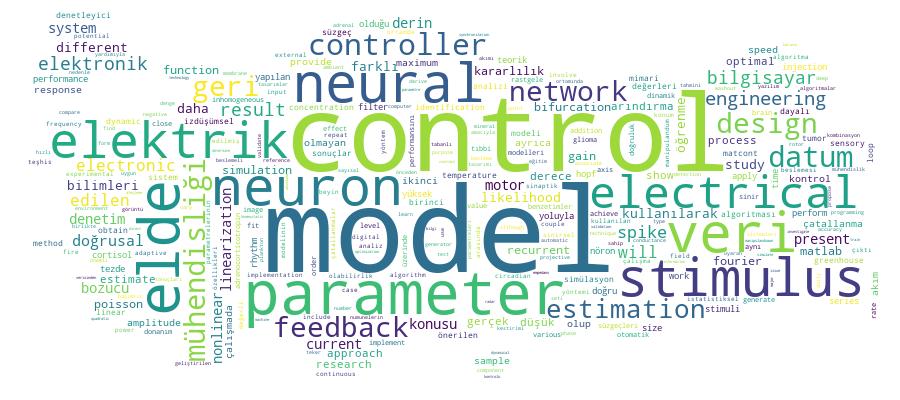
Competency Cloud

GCRIS Competency Cloud

Scholarly Output Search Results

Now showing 1 - 5 of 5
  • Article
    Neuron Modeling: Estimating the Parameters of a Neuron Model From Neural Spiking Data
    (Tubitak Scientific & Technological Research Council Turkey, 2018) Doruk, Resat Ozgur
    We present a modeling study aiming at the estimation of the parameters of a single neuron model from neural spiking data. The model receives a stimulus as input and provides the firing rate of the neuron as output. The neural spiking data will be obtained from point process simulation. The resultant data will be used in parameter estimation based on the inhomogeneous Poisson maximum likelihood method. The model will be stimulated by various forms of stimuli, which are modeled by a Fourier series (FS), exponential functions, and radial basis functions (RBFs). Tabulated results presenting cases with different sample sizes (# of repeated trials), stimulus component sizes (FS and RBF), amplitudes, and frequency ranges (FS) will be presented to validate the approach and provide a means of comparison. The results showed that regardless of the stimulus type, the most effective parameter on the estimation performance appears to be the sample size. In addition, the lowest variance of the estimates is obtained when a Fourier series stimulus is applied in the estimation.
  • Article
    Citation - WoS: 8
    Citation - Scopus: 8
    Parameter Identification and Speed Control of a Small-Scale BLDC Motor: Experimental Validation and Real-Time PI Control with Low-Pass Filtering
    (MDPI, 2025) Abouseda, Ayman Ibrahim; Doruk, Resat Ozgur; Amini, Ali
    This paper presents a structured and experimentally validated approach to the parameter identification, modeling, and real-time speed control of a brushless DC (BLDC) motor. Electrical parameters, including resistance and inductance, were measured through DC and AC testing under controlled conditions, respectively, while mechanical and electromagnetic parameters such as the back electromotive force (EMF) constant and rotor inertia were determined experimentally using an AVL dynamometer. The back EMF was obtained by operating the motor as a generator under varying speeds, and inertia was identified using a deceleration method based on the relationship between angular acceleration and torque. The identified parameters were used to construct a transfer function model of the motor, which was implemented in MATLAB/Simulink R2024b and validated against real-time experimental data using sinusoidal and exponential input signals. The comparison between simulated and measured speed responses showed strong agreement, confirming the accuracy of the model. A proportional-integral (PI) controller was developed and implemented for speed regulation, using a low-cost National Instruments (NI) USB-6009 data acquisition (DAQ) and a Kelly controller. A first-order low-pass filter was integrated into the control loop to suppress high-frequency disturbances and improve transient performance. Experimental tests using a stepwise reference speed profile demonstrated accurate tracking, minimal overshoot, and robust operation. Although the modeling and control techniques applied are well known, the novelty of this work lies in its integration of experimental parameter identification, real-time validation, and practical hardware implementation within a unified and replicable framework. This approach provides a solid foundation for further studies involving more advanced or adaptive control strategies for BLDC motors.
  • Article
    Citation - WoS: 5
    Citation - Scopus: 10
    Control of Hopf Bifurcations in Hodgkin-Huxley Neurons by Automatic Temperature Manipulation
    (Anka Publisher, 2018) Doruk, Resat Ozgur
    The purpose of this research is to revisit the bifurcation control problem in Hodgkin-Huxley neurons. As a difference from the classical membrane potential feedback to manipulate the external current injection, we will actuate the temperature of the neural environment to control the bifurcations. In order to achieve this a linear feedback from the membrane potential is established to generate a time varying temperature profile. The considered bifurcating parameter is the external current injection. Upon finishing the controllers, the bifurcation analysis against the changes in external current injection is repeated in order to see the possibility of relapse of any bifurcation phenomena at nearby points. In addition to that, simulations are also provided to show the performances of the controllers.
  • Article
    Citation - WoS: 13
    Citation - Scopus: 16
    Estimating the Parameters of Fitzhugh-Nagumo Neurons From Neural Spiking Data
    (Mdpi, 2019) Doruk, Resat Ozgur; Abosharb, Laila
    A theoretical and computational study on the estimation of the parameters of a single Fitzhugh-Nagumo model is presented. The difference of this work from a conventional system identification is that the measured data only consist of discrete and noisy neural spiking (spike times) data, which contain no amplitude information. The goal can be achieved by applying a maximum likelihood estimation approach where the likelihood function is derived from point process statistics. The firing rate of the neuron was assumed as a nonlinear map (logistic sigmoid) relating it to the membrane potential variable. The stimulus data were generated by a phased cosine Fourier series having fixed amplitude and frequency but a randomly shot phase (shot at each repeated trial). Various values of amplitude, stimulus component size, and sample size were applied to examine the effect of stimulus to the identification process. Results are presented in tabular and graphical forms, which also include statistical analysis (mean and standard deviation of the estimates). We also tested our model using realistic data from a previous research (H1 neurons of blowflies) and found that the estimates have a tendency to converge.
  • Article
    Citation - WoS: 3
    Citation - Scopus: 3
    Angiogenic Inhibition Therapy, a Sliding Mode Control Adventure
    (Elsevier Ireland Ltd, 2020) Doruk, Resat Ozgur
    [No Abstract Available]