Mıshra, Deepti

Loading...
Profile Picture
Name Variants
Deepti, Mıshra
Deepti, Mishra
M.,Deepti
M., Deepti
Mishra,D.
D.,Mıshra
Mishra, Deepti
Mıshra, Deepti
Mıshra,D.
D.,Mishra
D., Mishra
Mıshra, Deeptı
Mishra, D
Job Title
Doktor Öğretim Üyesi
Email Address
Main Affiliation
Computer Engineering
Status
Former Staff
Website
ORCID ID
Scopus Author ID
Turkish CoHE Profile ID
Google Scholar ID
WoS Researcher ID

Sustainable Development Goals

2

ZERO HUNGER
ZERO HUNGER Logo

0

Research Products

11

SUSTAINABLE CITIES AND COMMUNITIES
SUSTAINABLE CITIES AND COMMUNITIES Logo

0

Research Products

14

LIFE BELOW WATER
LIFE BELOW WATER Logo

4

Research Products

6

CLEAN WATER AND SANITATION
CLEAN WATER AND SANITATION Logo

0

Research Products

1

NO POVERTY
NO POVERTY Logo

0

Research Products

5

GENDER EQUALITY
GENDER EQUALITY Logo

1

Research Products

9

INDUSTRY, INNOVATION AND INFRASTRUCTURE
INDUSTRY, INNOVATION AND INFRASTRUCTURE Logo

2

Research Products

16

PEACE, JUSTICE AND STRONG INSTITUTIONS
PEACE, JUSTICE AND STRONG INSTITUTIONS Logo

3

Research Products

17

PARTNERSHIPS FOR THE GOALS
PARTNERSHIPS FOR THE GOALS Logo

1

Research Products

15

LIFE ON LAND
LIFE ON LAND Logo

0

Research Products

10

REDUCED INEQUALITIES
REDUCED INEQUALITIES Logo

0

Research Products

7

AFFORDABLE AND CLEAN ENERGY
AFFORDABLE AND CLEAN ENERGY Logo

0

Research Products

8

DECENT WORK AND ECONOMIC GROWTH
DECENT WORK AND ECONOMIC GROWTH Logo

0

Research Products

4

QUALITY EDUCATION
QUALITY EDUCATION Logo

4

Research Products

12

RESPONSIBLE CONSUMPTION AND PRODUCTION
RESPONSIBLE CONSUMPTION AND PRODUCTION Logo

3

Research Products

3

GOOD HEALTH AND WELL-BEING
GOOD HEALTH AND WELL-BEING Logo

8

Research Products

13

CLIMATE ACTION
CLIMATE ACTION Logo

4

Research Products
This researcher does not have a Scopus ID.
This researcher does not have a WoS ID.
Scholarly Output

101

Articles

41

Views / Downloads

299/547

Supervised MSc Theses

4

Supervised PhD Theses

1

WoS Citation Count

862

Scopus Citation Count

1291

WoS h-index

15

Scopus h-index

17

Patents

0

Projects

0

WoS Citations per Publication

8.53

Scopus Citations per Publication

12.78

Open Access Source

13

Supervised Theses

5

Google Analytics Visitor Traffic

JournalCount
Acta Polytechnica Hungarica4
Journal of Universal Computer Science3
Computer Standards & Interfaces3
Confederated International Workshops and Posters: EI2N plus NSF ICE, ICSP plus INBAST, ISDE, ORM, OTMA, SWWS plus MONET plus SeDeS, and VADER -- OCT 17-21, 2011 -- Hersonissos, GREECE3
Tehnicki Vjesnik3
Current Page: 1 / 14

Scopus Quartile Distribution

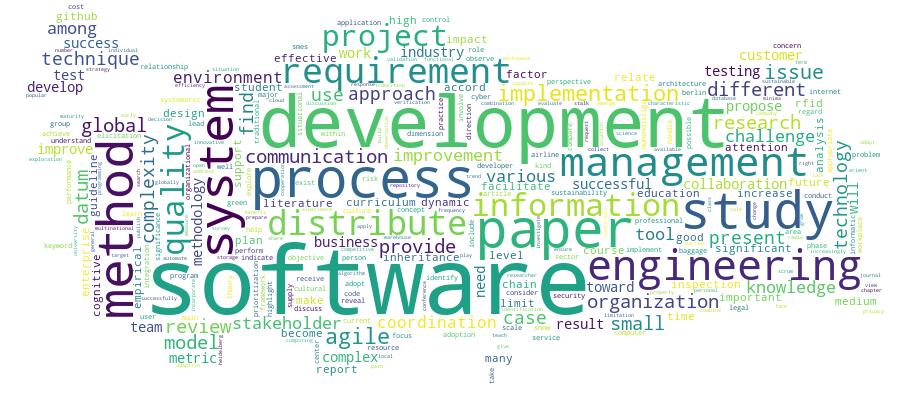
Competency Cloud

GCRIS Competency Cloud

Scholarly Output Search Results

Now showing 1 - 3 of 3
  • Article
    Citation - WoS: 22
    Citation - Scopus: 31
    Organizational Issues in Embracing Agile Methods: an Empirical Assessment
    (Springer india, 2021) Mishra, Alok; Abdalhamid, Samia; Mishra, Deepti; Ostrovska, Sofiya
    This study provides empirical evidence to the body of knowledge in Agile methods adoption in small, medium and large organizations in international context. This research explores the factors involved in the adoption of Agile methods in software development organizations. A survey was conducted among Agile professionals to gather survey data from 52 software organizations in seven countries across the world. Statistical techniques are applied towards empirical assessment. Organizational culture, team structure and management support are found to be crucial success factors whereas lack of management support, a large organization size and traditional organizational culture are found to be detrimental for the adoption of Agile approach in an organization. The selection of an appropriate Agile method depends on the project size and, for each size, there are specific methods preferred by different enterprises. Providing better control over the work is viewed as the primary advantage of the Agile methods within large and small organizations, while for the medium-size organizations, the priority is switched to coping with changing user requirements. Majority of the respondents did not consider embracing agile methods as a reason for project failure which indicates that Agile methods are, indeed, beneficial.
  • Article
    Citation - WoS: 1
    Citation - Scopus: 1
    Personal Response Systems Through the Prism of Students' Experiences
    (Wiley, 2020) Mishra, Deepti; Chew, Esyin; Ostrovska, Sofiya; Wong, Jojo
    Personal response systems (PRSs) today offer an opportunity to the field of education in terms of improving teaching and learning outcomes through active engagement in classrooms. The present paper investigates students' attitudes to different types of PRSs, namely, Socrative and Clickers. Both qualitative and quantitative data are gathered and classified. The performed thematic analysis reveals major categories within the framework of this study, namely educational efficacy, psychological aspects, technology-related issues, and administrative issues. It has been found that Socrative fares better in the "educational efficacy" and "administrative issues," whereas Clickers outperforms Socrative in the "technological-related issues." It is worth pointing out that both Socrative and Clickers are tantamount in "psychological aspects" yielding no negative experiences. The results of this study reveal that two main factors, cost and technological infrastructure, are determinative in the incorporation and appreciation of such systems in an educational setting.
  • Article
    Citation - WoS: 4
    Citation - Scopus: 4
    Women's Professional Career and Culture: Software Organizations in India
    (Sage Publications inc, 2022) Mishra, Deepti; Mishra, Sushma; Ostrovska, Sofiya
    In this work, we conduct an investigation on perspectives and existing barriers for women trying to pursue a career in the Indian software industry. The study is focused on three dimensions: organizational policies and practices, workplace environment, and social-familial factors. Another goal is to compare the perception of male and female software professionals concerning the impact of these dimensions on the careers of female software professionals. The study reveals that formally organizations provide gender-neutral policies, and currently the emphasis needs to be placed on their implementation. It has been observed that, on the whole, there is a favorable work environment and unbiased attitude toward female software employees. At the same time, we conclude that, despite significant progress, hurdles - mainly coming from the society and family traditions-still exist restraining flourishing careers of women in the software sector.