
Baranoğlu, Besim
Loading...

Profile URL
Name Variants
Besim, Baranoğlu
Baranoğlu, Besim
B.,Besim
Baranoğlu,B.
B., Besim
B.,Baranoğlu
Baranoglu, Besim
Baranoglu,B.
B., Baranoglu
Besim, Baranoglu
B.,Baranoglu
Baranoğlu, Besim
B.,Besim
Baranoğlu,B.
B., Besim
B.,Baranoğlu
Baranoglu, Besim
Baranoglu,B.
B., Baranoglu
Besim, Baranoglu
B.,Baranoglu
Job Title
Doktor Öğretim Üyesi
Email Address
besim.baranoglu@atilim.edu.tr
Main Affiliation
Manufacturing Engineering
Status
Former Staff
Website
ORCID ID
Scopus Author ID
Turkish CoHE Profile ID
Google Scholar ID
WoS Researcher ID
Sustainable Development Goals
 1
1NO POVERTY
0
Research Products
 2
2ZERO HUNGER
0
Research Products
 3
3GOOD HEALTH AND WELL-BEING
0
Research Products
 4
4QUALITY EDUCATION
0
Research Products
 5
5GENDER EQUALITY
0
Research Products
 6
6CLEAN WATER AND SANITATION
0
Research Products
 7
7AFFORDABLE AND CLEAN ENERGY
1
Research Products
 8
8DECENT WORK AND ECONOMIC GROWTH
0
Research Products
 9
9INDUSTRY, INNOVATION AND INFRASTRUCTURE
0
Research Products
 10
10REDUCED INEQUALITIES
0
Research Products
 11
11SUSTAINABLE CITIES AND COMMUNITIES
0
Research Products
 12
12RESPONSIBLE CONSUMPTION AND PRODUCTION
0
Research Products
 13
13CLIMATE ACTION
0
Research Products
 14
14LIFE BELOW WATER
0
Research Products
 15
15LIFE ON LAND
0
Research Products
 16
16PEACE, JUSTICE AND STRONG INSTITUTIONS
0
Research Products
 17
17PARTNERSHIPS FOR THE GOALS
0
Research Products

This researcher does not have a Scopus ID.

This researcher does not have a WoS ID.

Scholarly Output
28
Articles
13
Views / Downloads
49/111
Supervised MSc Theses
8
Supervised PhD Theses
2
WoS Citation Count
65
Scopus Citation Count
76
Patents
0
Projects
0
WoS Citations per Publication
2.32
Scopus Citations per Publication
2.71
Open Access Source
6
Supervised Theses
10
| Journal | Count |
|---|---|
| Engineering Analysis with Boundary Elements | 2 |
| Isı Bilimi ve Tekniği Dergisi | 2 |
| Advances in Materials and Processing Technologies | 1 |
| CMES - Computer Modeling in Engineering and Sciences | 1 |
| Conference on Optical Trapping and Optical Micromanipulation XII -- AUG 09-12, 2015 -- San Diego, CA | 1 |
Current Page: 1 / 4
Scopus Quartile Distribution
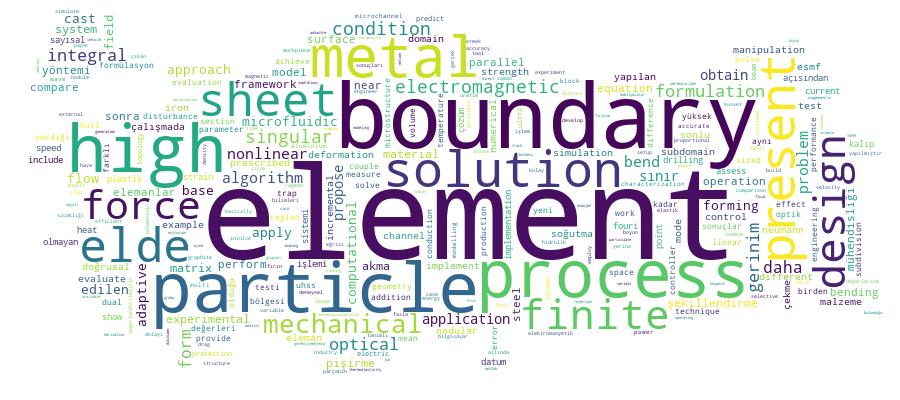
Competency Cloud
28 results
Scholarly Output Search Results
Now showing 1 - 10 of 28
Book Part Citation - Scopus: 1Boundary-Element Method in Microfluidics(Springer Science+Business Media, 2015) Çetin, Barbaros; Baranoğlu, BesimArticle DOĞRUSAL OLMAYAN SINIR KOŞULLARINA SAHİP ISI TRANSFERİ PROBLEMLERİNİN SINIR ELEMAN YÖNTEMİ İLE ANALİZİNE YÖNELİK YENİ BİR FORMÜLASYON(2019) Baranoğlu, BesimBu çalışmada Fourier denklemi ile ifade edilen ısı transferi problemlerinin bir ya da daha fazla bölgesinde tanımlı doğrusal olmayan sınır koşulları altında çözümüne yönelik sınır eleman yöntemi tabanlı etkili bir sayısal çözüm sunulmaktadır. Çözüm, sınır eleman yöntemi sistem matrislerinin üzerinde yapılan matematiksel işlemler ile bilinmeyenleri sadece doğrusal olmayan sınır bölgesindeki sıcaklık farkı olan indirgenmiş matris denklemleri elde etmektedir. Bu sayede doğrusal olmayan sınır koşullarına dayalı iterasyonlar daha hızlı gerçekleştirilebilmektedir. Doğrusal olmayan sınır koşullarının tanımlı olduğu bölgelerde çözüm elde edildikten sonra tüm sınır çözümü tanımlı bir son-işlem ile gerçekleştirilebilmektedir. Gerçek çözümü elde edilmiş bir örnek kullanılarak elde edilen sonuçlar değerlendirilmiştir.Article Citation - WoS: 1A NEW FORMULATION FOR THE BOUNDARY ELEMENT ANALYSIS OF HEAT CONDUCTION PROBLEMS WITH NONLINEAR BOUNDARY CONDITIONS(Turkish Soc thermal Sciences Technology, 2019) Baranoglu, BesimAn effective numerical method based on the boundary element formulation is presented to solve heat conduction equations which are governed by the Fourier equation, with nonlinear boundary conditions on one or more sections of the prescribed boundary. The solution involves the manipulation of the system matrices of the boundary element method and obtaining a smaller ranked matrix equation in which the unknown is only the temperature difference over the nonlinear boundary condition region. This way, the iterations to deal with the nonlinear conditions are performed faster. After finding the solution over the nonlinear boundary condition region, the solution over the entire boundary is obtained as a post-process through a prescribed relation. An example with a proven exact solution is employed to assess the results.Master Thesis Yüksek Mukavemetli Kalın Çelik Plakaların Adımsal Bükülmesine Yönelik Yeni Bir Proses Tasarımı ve Uygulaması(2018) Çetin, Barış; Billur, Eren; Baranoğlu, BesimZırhlı muharebe aracı üretiminin önemli bir alt işlemi olan gövde imalatında ultra yüksek mukavemetli çeliklerin (UHSS) bükülmesi önemli bir üretim aşamasıdır. Bu bükme işlemi genellikle havada bükme koşulunda (air bending) yüksek tonajlı abkant preslerde gerçekleştirilmektedir. Gövde üretiminde kullanılan çelikler, 1250 MPa gibi geleneksel yumuşak çeliklere kıyasla çok yüksek kopma mukavemetlerine sahip olabilmektedir. Bu mukavemet seviyelerinin doğal bir sonucu olarak yüksek bükme kuvvetlerine ihtiyaç doğmaktadır. Diğer yandan, yeni nesil bir imalat yöntemi olarak adlandırılabilecek olan, plastik şekil değiştirmenin adımsal olarak uygulanmasına dayanan adımsal sac şekillendirme yöntemi, son dönemlerde metal şekillendirme endüstrisinde kullanılmaktadır. Bu yeni teknik, şekillendirilebilirliğin arttırılması, karmaşık kalıp tasarımlarına olan gerekliliğin ortadan kaldırılması ve şekillendirme kuvvetlerinin önemli ölçüde azaltılmasında bazı avantajlara sahiptir. Bu tez çalışmasında temel olarak adımsal şekillendirme prosesinin büküm kuvvetinin azaltılması üzerindeki potansiyeli araştırılmıştır. Tezin kapsamı içerisinde yeni bir adımsal bükme prosesi önerilmiş, proses sonlu elemanlar yöntemi ile benzetilmiş ve deneysel olarak doğrulanmıştır. Benzetimler ve deneysel çalışmalar sonucunda elde edilen datalar üzerinde yapılan çalışmalar sayesinde bazı proses parametreleri de optimize edilmiştir. Bununla birlikte, adımsal bükme işlemi, konvansiyonel havada bükme işlemi de ile karşılaştırılmıştır.Conference Object Citation - WoS: 1Citation - Scopus: 3Boundary Element Method for Optical Force Calibration in Microfluidic Dual-Beam Optical Trap(Spie-int Soc Optical Engineering, 2015) Solmaz, Mehmet E.; Cetin, Barbaros; Baranoglu, Besim; Serhathoglu, Murat; Biyikh, Neemi; Serhatloglu, Murat; Biyikli, NecmiThe potential use of optical forces in microfluidic environment enables highly selective bio-particle manipulation. Manipulation could be accomplished via trapping or pushing a particle due to optical field. Empirical determination of optical force is often needed to ensure efficient operation of manipulation. The external force applied to a trapped particle in a microfluidic channel is a combination of optical and drag forces. The optical force can be found by measuring the particle velocity for a certain laser power level and a multiplicative correction factor is applied for the proximity of the particle to the channel surface. This method is not accurate especially for small microfluidic geometries where the particle size is in Mie regime and is comparable to channel cross section. In this work, we propose to use Boundary Element Method (BEM) to simulate fluid flow within the micro-channel with the presence of the particle to predict drag force. Pushing experiments were performed in a dual-beam optical trap and particle's position information was extracted. The drag force acting on the particle was then obtained using BEM and other analytical expressions, and was compared to the calculated optical force. BEM was able to predict the behavior of the optical force due to the inclusion of all the channel walls.Master Thesis Alüminyum Ekstrüzyonu Üzerine Sayısal ve Deneysel Bir İnceleme(2011) Kalkan, Hakan; Baranoğlu, Besim; Özdemir, İzzetBu çalışmada endüstriyel boyutta alüminyum ekstrüzyon işlemi nümerik ve deneysel olarak incelenmiştir. Proses parametreleri ve kalıp geometrisi ASAŞ Alüminyum tarafından sağlanmış ve model Sonlu Elemanlar ve Sonlu Hacimler yöntemlerine dayalı farklı yazılım paketlerinde hazırlanmıştır. Gerekli malzeme karakterizasyonu tek eksenli basma deneyiyle elde edilmiş ve bu test için yüksek sıcaklıklarda da kullanılabilen bir test düzeneği geliştirilip imal edilmiştir. Ölçülen kuvvet-yer değiştirme ve çıkış sıcaklığı ile ilgili grafikler nümerik sonuçlarla karşılaştırılmıştır. İlaveten Sonlu Elemanlar ve Sonlu Hacimler yöntemleri de kendi içlerinde karşılaştırılmışlardır. Bu sonuçlar göstermiştir ki, doğru malzeme karakterizasyonuyla Sonlu Elemanlar yöntemi ile elde edilen sonuçlar gerçek işlemde ölçülen değerlere yakın çıkmaktadır.Article Citation - WoS: 11Citation - Scopus: 12A Multi-Domain Direct Boundary Element Formulation for Particulate Flow in Microchannels(Elsevier Sci Ltd, 2021) Topuz, Alper; Baranoglu, Besim; Cetin, BarbarosIn the present study, a multi-domain boundary element formulation is developed for high surface-area-to-volume ratio problems (i.e. particulate flow in high aspect ratio microfluidic channels, in a porous medium or in microfluidic devices with repetitive structures). The solution domain is decomposed into subdomains and the variable condensation technique is implemented. The solution matrices are built for each subdomain, and the matrices are updated at each time step only for the subdomains in which the particles move at each time step. Ghost domains, which are fictitious domains encapsulating the interfaces between the subdomains, are also introduced in the formulation to treat the particles crossing the interfaces between the subdomains. The formulation reveals that the computation of the subdomain matrices is further simplified for solution domains composed of periodic structures. The results of our study revealed that speed-up values as high as 50 is achievable with the current formulation.Article Citation - WoS: 23Citation - Scopus: 29Modeling of Dielectrophoretic Particle Motion: Point Particle Versus Finite-Sized Particle(Wiley, 2017) Cetin, Barbaros; Oner, S. Dogan; Baranoglu, BesimDielectrophoresis (DEP) is a very popular technique for microfluidic bio-particle manipulation. For the design of a DEP-based microfluidic device, simulation of the particle trajectory within the microchannel network is crucial. There are basically two approaches: (i) point-particle approach and (ii) finite-sized particle approach. In this study, many aspects of both approaches are discussed for the simulation of direct current DEP, alternating current DEP, and traveling-wave DEP applications. Point-particle approach is implemented using Lagrangian tracking method, and finite-sized particle is implemented using boundary element method. The comparison of the point-particle approach and finite-sized particle approach is presented for different DEP applications. Moreover, the effect of particle-particle interaction is explored by simulating the motion of closely packed multiple particles for the same applications, and anomalous-DEP, which is a result of particle-wall interaction at the close vicinity of electrode surface, is illustrated.Article An Adaptive Element Division Algorithm for Accurate Evaluation of Singular and Near Singular Integrals in 3d(Turkiye Klinikleri, 2021) Bayindir,H.; Baranoğlu,B.; Yazici,A.An adaptive algorithm for evaluation of singular and near singular integrals in 3D is presented. The algorithm is based on successive adaptive/selective subdivisions of the element until a prescribed error criteria is met. For evaluating the integrals in each subdivision, Gauss quadrature is applied. The method is computationally simple, memory efficient and can be applied for both triangular and quadrilateral elements, including the elements with nonplanar and/or curved surfaces. To assess the method, several examples are discussed. It has shown that the algorithm performs well for singular and near-singular integral examples presented in the paper and evaluates the integrals with very high accuracy. © TÜBİTAKConference Object Citation - WoS: 3Citation - Scopus: 5An Application of High-Power Electromagnetic Pulse: Forming of Sheet Metal Using Electromagnetic Waves(Institute of Electrical and Electronics Engineers Inc., 2016) Inanan,G.; Baranoglu,B.; Aydin,E.In this study, the application of high velocity metal forming process by means of electromagnetic field is proposed. Electromagnetic Sheet Metal Forming (ESMF) is a process of forming sheet metal with very high speed (in milliseconds) without mechanical contact using the energy density of a pulsed magnetic field. In this process, deformation of the workpiece is driven by a transient electric current that is induced in a coil using a capacitor bank and discharge switch. This study presents some experiments and their results by examining the effects of different parameters in the proposed ESMF setup. The analysis and modelling of Electromagnetic sheet metal forming (ESMF) process is presented, as well. It has been seen that, it is possible to design a new system using the outcomes of this study. © 2015 Chamber of Electrical Engineers of Turkey.

- «
- 1 (current)
- 2
- 3
- »