Lotfısadıgh, Bahram

Loading...
Profile Picture
Name Variants
Lotfisadigh, B.
Lotfısadıgh, Bahram
Bahram, Lotfısadıgh
Lotfisadigh, Bahram
L.,Bahram
B.,Lotfisadigh
L., Bahram
Bahram, Lotfisadigh
B., Lotfisadigh
B.,Lotfısadıgh
Lotfısadıgh,B.
Lotfisadigh,B.
Sadigh, Bahram Lotfi
Job Title
Doktor Öğretim Üyesi
Email Address
bahram.lotfisadigh@atilim.edu.tr
Main Affiliation
Manufacturing Engineering
Status
Former Staff
Website
ORCID ID
Scopus Author ID
Turkish CoHE Profile ID
Google Scholar ID
WoS Researcher ID

Sustainable Development Goals

2

ZERO HUNGER
ZERO HUNGER Logo

0

Research Products

11

SUSTAINABLE CITIES AND COMMUNITIES
SUSTAINABLE CITIES AND COMMUNITIES Logo

1

Research Products

14

LIFE BELOW WATER
LIFE BELOW WATER Logo

0

Research Products

6

CLEAN WATER AND SANITATION
CLEAN WATER AND SANITATION Logo

0

Research Products

1

NO POVERTY
NO POVERTY Logo

0

Research Products

5

GENDER EQUALITY
GENDER EQUALITY Logo

0

Research Products

9

INDUSTRY, INNOVATION AND INFRASTRUCTURE
INDUSTRY, INNOVATION AND INFRASTRUCTURE Logo

6

Research Products

16

PEACE, JUSTICE AND STRONG INSTITUTIONS
PEACE, JUSTICE AND STRONG INSTITUTIONS Logo

0

Research Products

17

PARTNERSHIPS FOR THE GOALS
PARTNERSHIPS FOR THE GOALS Logo

0

Research Products

15

LIFE ON LAND
LIFE ON LAND Logo

1

Research Products

10

REDUCED INEQUALITIES
REDUCED INEQUALITIES Logo

0

Research Products

7

AFFORDABLE AND CLEAN ENERGY
AFFORDABLE AND CLEAN ENERGY Logo

0

Research Products

8

DECENT WORK AND ECONOMIC GROWTH
DECENT WORK AND ECONOMIC GROWTH Logo

0

Research Products

4

QUALITY EDUCATION
QUALITY EDUCATION Logo

0

Research Products

12

RESPONSIBLE CONSUMPTION AND PRODUCTION
RESPONSIBLE CONSUMPTION AND PRODUCTION Logo

1

Research Products

3

GOOD HEALTH AND WELL-BEING
GOOD HEALTH AND WELL-BEING Logo

1

Research Products

13

CLIMATE ACTION
CLIMATE ACTION Logo

0

Research Products
This researcher does not have a Scopus ID.
This researcher does not have a WoS ID.
Scholarly Output

22

Articles

12

Views / Downloads

141/2129

Supervised MSc Theses

5

Supervised PhD Theses

1

WoS Citation Count

227

Scopus Citation Count

276

WoS h-index

11

Scopus h-index

12

Patents

0

Projects

0

WoS Citations per Publication

10.32

Scopus Citations per Publication

12.55

Open Access Source

5

Supervised Theses

6

Google Analytics Visitor Traffic

JournalCount
Machining Science and Technology3
International Journal of Computer Integrated Manufacturing2
Procedia CIRP2
The International Journal of Advanced Manufacturing Technology2
Artificial Intelligence for Engineering Design, Analysis and Manufacturing: AIEDAM1
Current Page: 1 / 3

Scopus Quartile Distribution

Competency Cloud

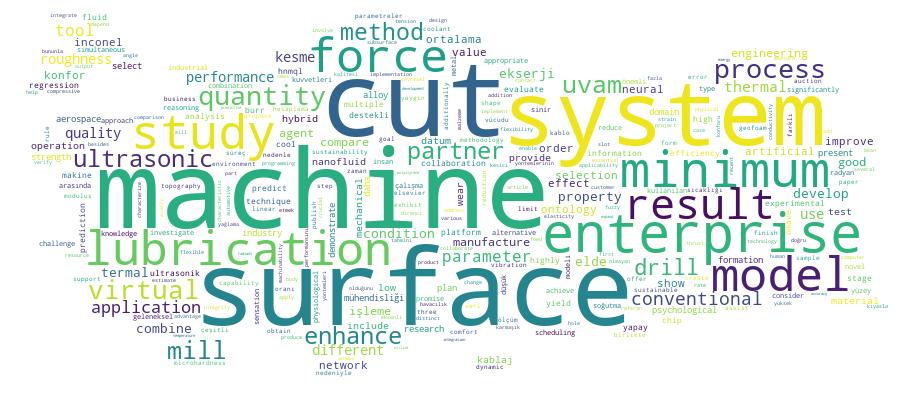
GCRIS Competency Cloud

Scholarly Output Search Results

Now showing 1 - 2 of 2
  • Article
    Citation - WoS: 25
    Citation - Scopus: 26
    Machining Performance and Sustainability Analysis of Al2o3< Hybrid Nanofluid Mql Application for Milling of Ti-6al
    (Taylor & Francis inc, 2024) Lotfi, Bahram; Namlu, Ramazan Hakki; Kilic, S. Engin
    Machining of Ti-6Al-4V presents challenges due to its low thermal conductivity, and conventional cutting fluids (CCF) are inadequate in providing a productive and sustainable solution. This study aims to achieve more sustainable and productive machining of Ti-6Al-4V by utilizing Al2O3 and CuO-added Nanofluid Minimum Quantity Lubrication (NMQL) individually and in hybrid form with different concentrations. A comparison is made with pure-MQL, CCF and dry conditions. The study consists of three stages. In the first stage, the physical properties of the coolants, like contact angle and surface tension, are investigated. The second stage involves slot milling operations, and various outputs including cutting forces, surface roughness, surface topography, surface finish, and subsurface microhardness are analyzed. In the last stage, a sustainability analysis is conducted based on the Pugh Matrix Approach. The results indicate that Al2O3-NMQL exhibits lower contact angles and surface tensions compared to other conditions. Furthermore, HNMQL applications result in lower cutting forces (up to 46.5%), surface roughness (up to 61.2%), and microhardness (up to 6.6%), while yielding better surface finish and topography compared to CCF. The sustainability analysis demonstrates that HNMQL application is the most suitable option for achieving sustainable machining of Ti-6Al-4V.
  • Article
    Citation - WoS: 13
    Citation - Scopus: 17
    Cutting Force Prediction in Ultrasonic-Assisted Milling of Ti-6al With Different Machining Conditions Using Artificial Neural Network
    (Cambridge University Press, 2021) Namlu,R.H.; Turhan,C.; Sadigh,B.L.; Kiliç,S.E.
    Ti-6Al-4V alloy has superior material properties such as high strength-to-weight ratio, good corrosion resistance, and excellent fracture toughness. Therefore, it is widely used in aerospace, medical, and automotive industries where machining is an essential process for these industries. However, machining of Ti-6Al-4V is a material with extremely low machinability characteristics; thus, conventional machining methods are not appropriate to machine such materials. Ultrasonic-assisted machining (UAM) is a novel hybrid machining method which has numerous advantages over conventional machining processes. In addition, minimum quantity lubrication (MQL) is an alternative type of metal cutting fluid application that is being used instead of conventional lubrication in machining. One of the parameters which could be used to measure the performance of the machining process is the amount of cutting force. Nevertheless, there is a number of limited studies to compare the changes in cutting forces by using UAM and MQL together which are time-consuming and not cost-effective. Artificial neural network (ANN) is an alternative method that may eliminate the limitations mentioned above by estimating the outputs with the limited number of data. In this study, a model was developed and coded in Python programming environment in order to predict cutting forces using ANN. The results showed that experimental cutting forces were estimated with a successful prediction rate of 0.99 with mean absolute percentage error and mean squared error of 1.85% and 13.1, respectively. Moreover, considering too limited experimental data, ANN provided acceptable results in a cost-and time-effective way. Copyright © The Author(s), 2020. Published by Cambridge University Press.