
Namlu, Ramazan Hakkı
Loading...
Profile URL
Name Variants
Ramazan Hakki, Namlu
Ramazan Hakkı Namlu
N., Ramazan Hakkı
Namlu,R.H.
R.H.Namlu
N.,Ramazan Hakkı
Namlu, Ramazan Hakki
Ramazan Hakkı, Namlu
R. H. Namlu
R.,Namlu
Namlu R.
N., Ramazan Hakki
N.,Ramazan Hakki
Namlu, Ramazan Hakkı
R., Namlu
Namlu,Ramazan Hakki
Ramazan Hakkı Namlu
N., Ramazan Hakkı
Namlu,R.H.
R.H.Namlu
N.,Ramazan Hakkı
Namlu, Ramazan Hakki
Ramazan Hakkı, Namlu
R. H. Namlu
R.,Namlu
Namlu R.
N., Ramazan Hakki
N.,Ramazan Hakki
Namlu, Ramazan Hakkı
R., Namlu
Namlu,Ramazan Hakki
Job Title
Doktor Öğretim Üyesi
Email Address
ramazan.namlu@atilim.edu.tr
Main Affiliation
Mechanical Engineering
Status
ORCID ID
Scopus Author ID
Turkish CoHE Profile ID
Google Scholar ID
WoS Researcher ID
Sustainable Development Goals
14
LIFE BELOW WATER

0
Research Products
2
ZERO HUNGER

0
Research Products
11
SUSTAINABLE CITIES AND COMMUNITIES

0
Research Products
1
NO POVERTY

0
Research Products
12
RESPONSIBLE CONSUMPTION AND PRODUCTION

3
Research Products
7
AFFORDABLE AND CLEAN ENERGY

0
Research Products
5
GENDER EQUALITY

0
Research Products
3
GOOD HEALTH AND WELL-BEING

2
Research Products
9
INDUSTRY, INNOVATION AND INFRASTRUCTURE

8
Research Products
13
CLIMATE ACTION

0
Research Products
6
CLEAN WATER AND SANITATION

0
Research Products
10
REDUCED INEQUALITIES

0
Research Products
4
QUALITY EDUCATION

0
Research Products
15
LIFE ON LAND

1
Research Products
16
PEACE, JUSTICE AND STRONG INSTITUTIONS

0
Research Products
17
PARTNERSHIPS FOR THE GOALS

0
Research Products
8
DECENT WORK AND ECONOMIC GROWTH

0
Research Products

Documents
19
Citations
207
h-index
8

Documents
15
Citations
173

Scholarly Output
22
Articles
13
Views / Downloads
14/0
Supervised MSc Theses
2
Supervised PhD Theses
1
WoS Citation Count
172
Scopus Citation Count
206
WoS h-index
7
Scopus h-index
8
Patents
0
Projects
1
WoS Citations per Publication
7.82
Scopus Citations per Publication
9.36
Open Access Source
6
Supervised Theses
3
Google Analytics Visitor Traffic
| Journal | Count |
|---|---|
| Procedia CIRP | 4 |
| Machining Science and Technology | 3 |
| Cirp Annals-Manufacturing Technology | 1 |
| International Journal of Advanced Manufacturing Technology | 1 |
| International Journal of Machining and Machinability of Materials | 1 |
Current Page: 1 / 3
Scopus Quartile Distribution
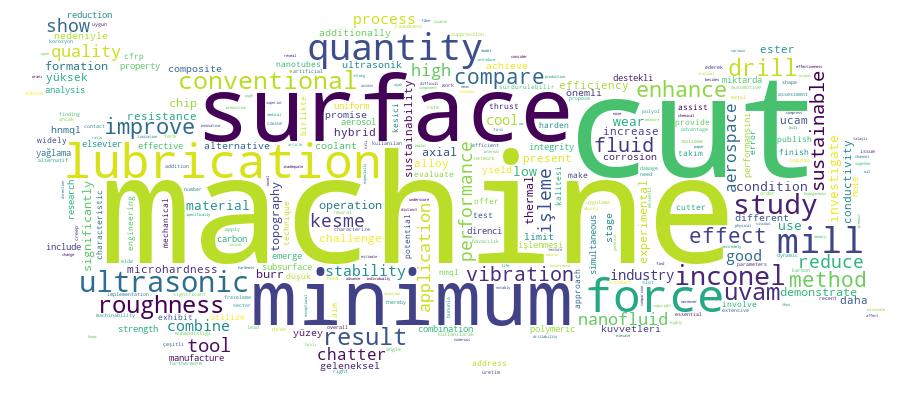
Competency Cloud
12 results
Scholarly Output Search Results
Now showing 1 - 10 of 12
Article Citation - WoS: 41Citation - Scopus: 41Enhancing Machining Efficiency of Ti-6al Through Multi-Axial Ultrasonic Vibration-Assisted Machining and Hybrid Nanofluid Minimum Quantity Lubrication(Elsevier Sci Ltd, 2024) Namlu, Ramazan Hakki; Lotfi, Bahram; Kilic, S. EnginTi-6Al-4V offers a balance of good strength with lightweight properties. Yet, Ti-6Al-4V poses machining challenges, including low thermal conductivity, chemical adhesion to cutting tools, and chip removal difficulties. To improve machining efficiency, Ultrasonic Vibration-Assisted Machining (UVAM) has emerged as a promising approach. UVAM has demonstrated reduced tool wear, cutting forces, and improved surface quality compared to Conventional Machining (CM). Additionally, Minimum Quantity Lubrication (MQL) methods offer sustainable coolant alternatives, with recent research focusing on Nanofluid-MQL (NMQL) and Hybrid Nanofluid-MQL (HNMQL) for enhanced performance. Although there exists a body of literature showcasing the promising effects of UVAM and MQL methods individually, comprehensive investigations into the synergistic effects of these methodologies remain limited. This study addresses these critical research gaps by conducting a systematic examination of combined application of multi-axial UVAM and HNMQL. Specifically, it delves into the comparison of different vibration directions within UVAM, evaluates the effectiveness of UVAM when combined with cutting fluids incorporating Al2O3 and CuO nanoparticles in NMQLs and HNMQLs, and contrasts these novel approaches with conventional machining methods. The study unfolds in three distinct stages. The first stage examines the ultrasonic cutting mechanism and its combined application with the MQL technique. In the second stage, the study investigates the physical properties of the cutting fluids, including contact angle and surface tension. The final stage encompasses slot milling operations, where an array of parameters such as cutting forces, surface roughness, surface topography, surface texture, and the occurrence of burr formations are rigorously analyzed. The results demonstrate that the combination of multi-axial UVAM with HNMQL yields substantial advantages over traditional machining methods. Notably, it leads to a remarkable reduction in cutting forces (up to 37.6 %) and surface roughness (up to 37.4 %). Additionally, this combination engenders the production of highly homogeneous and uniform surface textures, characterized by minimal surface defects and a significantly diminished occurrence of burr formations. These findings underscore the potential of multi-axial UVAM combined with HNMQL as a promising approach in enhancing the machining of Ti-6Al-4V, thus offering a pathway to enhance the efficiency and precision of aerospace component manufacturing processes.Article An Experimental Study of the Effects of Ultrasonic Cavitation-Assisted Machining on Ti-6al(Inderscience Publishers, 2024) Koçak,B.; Canbaz,H.İ.; Zengin,N.N.; Mumcuoğlu,A.B.; Aydın,M.B.; Namlu,R.H.; Kılıç,S.E.Ti-6Al-4V has extensive applications in high-tech industries like aviation, defence and biomedical. However, the cutting of Ti-6Al-4V is challenging due to its poor machinability. Recently, ultrasonic cavitation-assisted machining (UCAM) has emerged as a cutting process that utilises high-frequency and low-amplitude vibrations to induce the formation of cavitation bubbles, thereby improving cutting performance. Despite the benefits of UCAM, there is lack of research investigating its application in Ti-6Al-4V. This study aims to investigate the efficacy of UCAM in improving the cutting performance of Ti-6Al-4V and compare it with conventional methods. Specifically, the study compares UCAM with conventional machining (CM) under conventional cutting fluid. The study reveals that UCAM can reduce cutting forces by up to 49.5% and surface roughness by up to 51.9%. Additionally, UCAM yields more uniform, homogeneous surfaces with reduced surface damage compared to CM. These results demonstrate the potential of UCAM for enhancing cutting performance of Ti-6Al-4V. Copyright © 2024 Inderscience Enterprises Ltd.Article Enhancing Machining Efficiency and Sustainability of Ti-6Al-4V Through Minimum Quantity Lubrication With Ester-Based Oils(Taylor & Francis Ltd, 2025) Namlu, Ramazan Hakki; Kavut, Kuebra; Tom, Hanife GulenTi-6Al-4 V is known as difficult-to-cut due to its low thermal conductivity and high chemical reactivity. While cutting fluids aid lubrication and reduce friction, Conventional Cutting Fluids (CCF) have high consumption, limited efficiency gains and negative environmental and health effects. Therefore, there is an ongoing search for more sustainable alternatives to CCF that do not adversely affect machining performance. Minimum Quantity Lubrication (MQL), which delivers compressed air - oil aerosol, has emerged as a promising solution by drastically reducing fluid use and associated risks. Selecting the right MQL fluid is key to optimising machining performance. This study evaluates MQL fluids based on polyol and polymeric esters for Ti-6Al-4 V machining and compares their performance with CCF. Cutting forces, surface roughness and topography are examined. Results show that MQL reduces cutting forces up to 21.7% and surface roughness up to 57.6% compared to CCF, with more uniform surface topography. Among MQL oils, polymeric esters perform better than polyol esters, with a reduction in cutting force up to 14.6% and surface roughness up to 47.7%. High viscosity indexed polymeric esters showed the best overall performance due to their thermal stability. Moreover, according to the sustainability assessment analysis polymeric esters were identified as the most sustainable option.Article Citation - WoS: 7Citation - Scopus: 10Combined Use of Ultrasonic-Assisted Drilling and Minimum Quantity Lubrication for Drilling of Niti Shape Memory Alloy(Taylor & Francis inc, 2023) Namlu, Ramazan Hakki; Lotfi, Bahram; Kilic, S. Engin; Yilmaz, Okan Deniz; Akar, SametThe drilling of shape-memory alloys based on nickel-titanium (Nitinol) is challenging due to their unique properties, such as high strength, high hardness and strong work hardening, which results in excessive tool wear and damage to the material. In this study, an attempt has been made to characterize the drillability of Nitinol by investigating the process/cooling interaction. Four different combinations of process/cooling have been studied as conventional drilling with flood cooling (CD-Wet) and with minimum quantity lubrication (CD-MQL), ultrasonic-assisted drilling with flood cooling (UAD-Wet) and with MQL (UAD-MQL). The drill bit wear, drilling forces, chip morphology and drilled hole quality are used as the performance measures. The results show that UAD conditions result in lower feed forces than CD conditions, with a 31.2% reduction in wet and a 15.3% reduction in MQL on average. The lowest feed forces are observed in UAD-Wet conditions due to better coolant penetration in the cutting zone. The UAD-Wet yielded the lowest tool wear, while CD-MQL exhibited the most severe. UAD demonstrated a & SIM;50% lower tool wear in the wet condition than CD and a 38.7% in the MQL condition. UAD is shown to outperform the CD process in terms of drilled-hole accuracy.Article Citation - WoS: 14Citation - Scopus: 17An Experimental Study on Ultrasonic-Assisted Drilling of Inconel 718 Under Different Cooling/Lubrication Conditions(Springer London Ltd, 2024) Erturun, Omer Faruk; Tekaut, Hasan; Cicek, Adem; Ucak, Necati; Namlu, Ramazan Hakki; Lotfi, Bahram; Kilic, S. EnginUltrasonic-assisted drilling (UAD) is one of the efficient and innovative methods to improve the drillability of difficult-to-cut materials. In the present study, the UAD of Inconel 718 was investigated under different cooling and/or lubrication conditions. The drilling tests were carried out at a constant cutting speed (15 m/min) and a feed (0.045 mm/rev) using uncoated and TiAlN-coated solid carbide drills under dry, conventional cutting fluid (CCF), and minimum quantity lubrication (MQL) conditions. The applicability of UAD to drilling Inconel 718 was evaluated in terms of thrust force, surface roughness, roundness error, burr formation, subsurface microstructure and microhardness, tool wear, and chip morphology. The test results showed that, when compared to conventional drilling (CD), UAD reduced the thrust force and improved the hole quality, tool life, and surface integrity under all conditions. Good surface finish, lower roundness error, and minimum burr heights were achieved under CCF conditions. MQL drilling provided lower thrust forces, better tool performance, and good subsurface quality characteristics. In addition, the simultaneous application of CCF-UAD and MQD-UAD showed significantly better performance, especially when using the coated tool.Article Citation - WoS: 26Citation - Scopus: 26Machining Performance and Sustainability Analysis of Al2o3< Hybrid Nanofluid Mql Application for Milling of Ti-6al(Taylor & Francis inc, 2024) Lotfi, Bahram; Namlu, Ramazan Hakki; Kilic, S. EnginMachining of Ti-6Al-4V presents challenges due to its low thermal conductivity, and conventional cutting fluids (CCF) are inadequate in providing a productive and sustainable solution. This study aims to achieve more sustainable and productive machining of Ti-6Al-4V by utilizing Al2O3 and CuO-added Nanofluid Minimum Quantity Lubrication (NMQL) individually and in hybrid form with different concentrations. A comparison is made with pure-MQL, CCF and dry conditions. The study consists of three stages. In the first stage, the physical properties of the coolants, like contact angle and surface tension, are investigated. The second stage involves slot milling operations, and various outputs including cutting forces, surface roughness, surface topography, surface finish, and subsurface microhardness are analyzed. In the last stage, a sustainability analysis is conducted based on the Pugh Matrix Approach. The results indicate that Al2O3-NMQL exhibits lower contact angles and surface tensions compared to other conditions. Furthermore, HNMQL applications result in lower cutting forces (up to 46.5%), surface roughness (up to 61.2%), and microhardness (up to 6.6%), while yielding better surface finish and topography compared to CCF. The sustainability analysis demonstrates that HNMQL application is the most suitable option for achieving sustainable machining of Ti-6Al-4V.Article Citation - WoS: 3Citation - Scopus: 4Investigation of the Combined Effects of Ultrasonic Vibration-Assisted Machining and Minimum Quantity Lubrication on Al7075-T6(John Wiley and Sons Ltd, 2024) Namlu, R.H.; Cetin, B.; Lotfi, B.; Kiliç, S.E.The aluminum alloy Al7075-T6 finds extensive application in the aviation and automotive industries, where machining plays a pivotal role. Emerging techniques such as Ultrasonic Vibration-Assisted Machining (UVAM) and Minimum Quantity Lubrication (MQL) hold promise for enhancing machining efficiency. In this study, the combined use of UVAM and MQL for slot milling of Al7075-T6 was investigated. The results demonstrate that UVAM reduced cutting forces by an average of 10.87% in MQL and 8.31% in Conventional Cutting Fluid (CCF) conditions when compared to Conventional Machining (CM). In addition, UVAM yielded significantly improved surface finishes, characterized by an average reduction in surface roughness of 41.86% in MQL and 32.11% in CCF conditions relative to CM. Furthermore, surfaces subjected to UVAM exhibited fewer instances of burn marks and tool-induced markings, reduced chip splashing, and more uniform surface integrity compared to those manufactured with CM. Lastly, chips generated through UVAM exhibited distinct characteristics, notably shorter length, curvier shape, and a distinctive half-turn morphology when compared with the irregular chips produced through CM. In conclusion, our findings underscore the potential of UVAM in synergy with MQL to augment the machining of Al7075-T6 alloy, thereby yielding superior-quality machined components with enhanced operational efficiency. © 2025 Elsevier B.V., All rights reserved.Article Citation - WoS: 2Citation - Scopus: 2Feasibility Study of Chatter Suppression in Milling Through Internal Channels(Springer London Ltd, 2025) Dogan, Hakan; Ozsoy, Muhammet; Namlu, Ramazan HakkiMilling chatter significantly affects machining productivity, and methods to eliminate chatter caused by milling cutter dynamics are limited due to space constraints and the rotation of the milling cutter. This study investigates the impact of fluid-induced damping effect on chatter stability in milling operations and proposes it as an easy to implement and effective method to improve chatter stability caused by a cutter's vibration mode. The approach utilises a viscous fluid, silicone oil, filled into internal coolant channel of the cutting tool to improve stability by increasing the damping. Both modal and milling tests were conducted for the tool with and without silicone oil. The results show that stability can be significantly increased by this method presenting it as a viable chatter suppression technique. The results show a significant improvement in stability by presenting the method as a practical and cost-effective chatter suppression solution. Its ease of implementation makes it attractive for industrial use.Article Citation - WoS: 1Citation - Scopus: 1Ultrasonic Vibration-Assisted Machining of Invar 36 Alloy Manufactured by Wire Arc Additive Manufacturing(Elsevier, 2025) Namlu, Ramazan Hakk i; Kucukoztasa, Korcan; Kalkan, Hakan; Kaftanoglu, BilginInvar 36, known for its low coefficient of thermal expansion, is widely used in applications like composite moulds, electronics, and optics. Although Wire Arc Additive Manufacturing (WAAM) offers high deposition rates and cost-effectiveness for Invar 36, it creates rough surface textures requiring machining as post-processing. In order to overcome Invar 36's machinability challenges, Ultrasonic Vibration-Assisted Machining (UVAM) was applied for the first time on WAAM-fabricated Invar 36. The results showed that UVAM outperformed conventional machining in terms of cutting force, surface roughness and topography, subsurface microhardness and tool wear with improvements observed in both building and deposition directions. (c) 2025 CIRP. Published by Elsevier Ltd. All rights are reserved, including those for text and data mining, AI training, and similar technologies.Article Citation - WoS: 1Citation - Scopus: 1An Experimental Study on Ultrasonic-Assisted Drilling of CFRP Composites with Minimum Quantity Lubrication(MDPI, 2025) Namlu, Ramazan Hakki; Sagener, Mustafa Burak; Kilic, Zekai Murat; Colak, Oguz; Kilic, Sadik EnginThe increasing use of carbon fiber reinforced polymer (CFRP) composites in industries such as aerospace, due to its high strength-to-weight ratio, durability, and resistance to corrosion has led to a growing demand for more efficient machining processes. However, the multilayered structure of CFRP composites, composed of densely packed fibers, presents significant challenges during machining. Additionally, when cutting fluids are used to improve effective cooling and lubrication, the material tends to absorb the fluid, causing damage and leading to problem of weaking of composite structure. To address these issues, this study compares ultrasonic-assisted drilling (UAD) and minimum quantity lubrication (MQL) techniques with conventional drilling (CD) and dry cutting to improve the performance of CFRP composite drilling. The results show that using UAD and MQL together reduced thrust force by up to 27%, improved surface roughness inside the holes by up to 31%, reduced improved hole diameter, cylindricity, roundness, and delamination.
