Karakaya, Kasım Murat

Loading...
Profile Picture
Name Variants
Karakaya, Murat
Karakaya, Kasım Murat
K., Kasim Murat
K.,Kasım Murat
Karakaya,K.M.
Kasim Murat, Karakaya
K., Karakaya
K.,Kasim Murat
Karakaya, Kasim Murat
Kasım Murat, Karakaya
K.M.Karakaya
K.,Karakaya
Karakaya,M.
Karakaya,M.
Job Title
Profesör Doktor
Email Address
murat.karakaya@atilim.edu.tr
Main Affiliation
Computer Engineering
Status
Former Staff
Website
ORCID ID
Scopus Author ID
Turkish CoHE Profile ID
Google Scholar ID
WoS Researcher ID

Sustainable Development Goals

NO POVERTY1
NO POVERTY
0
Research Products
ZERO HUNGER2
ZERO HUNGER
0
Research Products
GOOD HEALTH AND WELL-BEING3
GOOD HEALTH AND WELL-BEING
1
Research Products
QUALITY EDUCATION4
QUALITY EDUCATION
0
Research Products
GENDER EQUALITY5
GENDER EQUALITY
0
Research Products
CLEAN WATER AND SANITATION6
CLEAN WATER AND SANITATION
0
Research Products
AFFORDABLE AND CLEAN ENERGY7
AFFORDABLE AND CLEAN ENERGY
1
Research Products
DECENT WORK AND ECONOMIC GROWTH8
DECENT WORK AND ECONOMIC GROWTH
0
Research Products
INDUSTRY, INNOVATION AND INFRASTRUCTURE9
INDUSTRY, INNOVATION AND INFRASTRUCTURE
0
Research Products
REDUCED INEQUALITIES10
REDUCED INEQUALITIES
0
Research Products
SUSTAINABLE CITIES AND COMMUNITIES11
SUSTAINABLE CITIES AND COMMUNITIES
4
Research Products
RESPONSIBLE CONSUMPTION AND PRODUCTION12
RESPONSIBLE CONSUMPTION AND PRODUCTION
0
Research Products
CLIMATE ACTION13
CLIMATE ACTION
0
Research Products
LIFE BELOW WATER14
LIFE BELOW WATER
0
Research Products
LIFE ON LAND15
LIFE ON LAND
0
Research Products
PEACE, JUSTICE AND STRONG INSTITUTIONS16
PEACE, JUSTICE AND STRONG INSTITUTIONS
0
Research Products
PARTNERSHIPS FOR THE GOALS17
PARTNERSHIPS FOR THE GOALS
0
Research Products
This researcher does not have a Scopus ID.
This researcher does not have a WoS ID.
Scholarly Output

44

Articles

20

Views / Downloads

148/417

Supervised MSc Theses

4

Supervised PhD Theses

0

WoS Citation Count

138

Scopus Citation Count

200

Patents

0

Projects

0

WoS Citations per Publication

3.14

Scopus Citations per Publication

4.55

Open Access Source

4

Supervised Theses

4

JournalCount
UBMK 2018 - 3rd International Conference on Computer Science and Engineering -- 3rd International Conference on Computer Science and Engineering, UBMK 2018 -- 20 September 2018 through 23 September 2018 -- Sarajevo -- 1435604
2017 IEEE 1st Ukraine Conference on Electrical and Computer Engineering, UKRCON 2017 - Proceedings -- 1st IEEE Ukraine Conference on Electrical and Computer Engineering, UKRCON 2017 -- 29 May 2017 through 2 June 2017 -- Kyiv -- 1317632
Proceedings - 6th International Conference on Computer Science and Engineering, UBMK 2021 -- 6th International Conference on Computer Science and Engineering, UBMK 2021 -- 15 September 2021 through 17 September 2021 -- Ankara -- 1768262
3rd International Conference on Computer Science and Engineering (UBMK) -- SEP 20-23, 2018 -- Sarajevo, BOSNIA & HERCEG2
1st International Informatics and Software Engineering Conference: Innovative Technologies for Digital Transformation, IISEC 2019 - Proceedings -- 1st International Informatics and Software Engineering Conference, IISEC 2019 -- 6 November 2019 through 7 November 2019 -- Ankara -- 1571112
Current Page: 1 / 5

Scopus Quartile Distribution

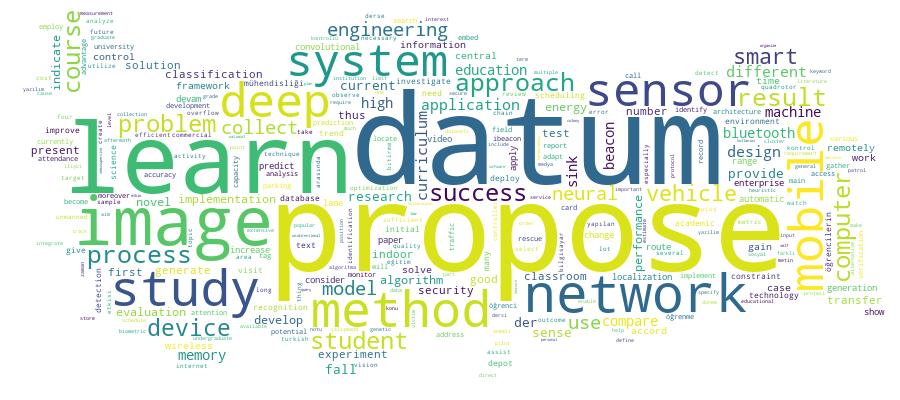
Competency Cloud

GCRIS Competency Cloud

Scholarly Output Search Results

Now showing 1 - 6 of 6
  • Master Thesis
    Ss-mla: Uzaktan Algılamalı Görüntülerin Çok Etiketli Sınıflandırması için Yeni Bir Çözüm
    (2021) Üstünkök, Tolga; Karakaya, Kasım Murat
    Uzaktan algılanan görüntülerin çok etiketli sınıflandırması çok önemli bir araştırma alanıdır. Kentsel büyümeyi izlemekten askeri gözetlemeye kadar birçok uygulamaya sahiptir. Uzaktan algılanan görüntülerin çok etiketli sınıflandırması için birçok algoritma ve yöntem önerilmiştir. Bu tezde iki yaklaşım sunulmaktadır. İlki, küçük veri kümelerinde karmaşık yöntemlerin daha basit olanlara göre avantajı olmadığını gösteren CNN tabanlı basit bir modeldir. İkincisi, uzaktan algılanan görüntülerin çoklu etiketli sınıflandırması için Semi-Supervised Multi-Label Annotizer (SS-MLA) adı verilen rekabetçi bir Vector-Quantized Temporal Associative Memory (VQTAM) tabanlı yöntemdir. İlk yöntem, uzaktan algılanmış dört farklı veri kümesi üzerinde F1-Skorlarına göre literatürdeki diğer son teknoloji yöntemlerle ve SS-MLA ile karşılaştırılmıştır. Deney sonuçları, yeni bir yaklaşım olarak SS-MLA'nın, karşılaştırmaların yarısından ve önerilen basit yöntemden daha iyi sonuçlar verdiğini göstermektedir. Algoritma ve yöntemlerin tüm uygulamaları için Python 3.8 ortamında Tensorflow-GPU 2.4.0 ve Numpy 1.19.5 çerçeveleri kullanılmıştır.
  • Article
    Citation - WoS: 1
    Citation - Scopus: 2
    Ss-Mla: a Semisupervised Method for Multi-Label Annotation of Remotely Sensed Images
    (SPIE, 2021) Üstünkök,T.; Karakaya,M.
    Recent technological advancements in satellite imagery have increased the production of remotely sensed images. Therefore, developing efficient methods for annotating these images has gained popularity. Most of the current state-of-the-art methods are based on supervised machine learning techniques. We propose a method called semisupervised multi-label annotizer (SS-MLA) that adapts vector-quantized temporal associative memory to annotate remotely sensed images. One of the advantages of SS-MLA over the supervised methods is that it extracts features not only from the given sample but also from similar samples that are previously seen without using an explicit attention mechanism. Thus SS-MLA enhances the learning efficiency of the training process. We conduct extensive performance comparisons with five different methods in the literature over four datasets. The comparison results indicate the success of the proposed method over the existing ones: SS-MLA generates the best results in 7 out of 11 comparisons. © 2021 Society of Photo-Optical Instrumentation Engineers (SPIE).
  • Article
    Citation - WoS: 49
    Citation - Scopus: 69
    Deep Learning Based Fall Detection Using Smartwatches for Healthcare Applications
    (Elsevier Sci Ltd, 2022) Sengul, Gokhan; Karakaya, Murat; Misra, Sanjay; Abayomi-Alli, Olusola O.; Damasevicius, Robertas
    We implement a smart watch-based system to predict fall detection. We differentiate fall detection from four common daily activities: sitting, squatting, running, and walking. Moreover, we separate falling into falling from a chair and falling from a standing position. We develop a mobile application that collects the acceleration and gyroscope sensor data and transfers them to the cloud. In the cloud, we implement a deep learning algorithm to classify the activity according to the given classes. To increase the number of data samples available for training, we use the Bica cubic Hermite interpolation, which allows us to improve the accuracy of the neural network. The 38 statistical data features were calculated using the rolling update approach and used as input to the classifier. For activity classification, we have adopted the bi-directional long short-term memory (BiLSTM) neural network. The results demonstrate that our system can detect falling with an accuracy of 99.59% (using leave-one-activityout cross-validation) and 97.35% (using leave-one-subject-out cross-validation) considering all activities. When considering only binary classification (falling vs. all other activities), perfect accuracy is achieved.
  • Conference Object
    Citation - Scopus: 2
    Detecting Errors in Automatic Image Captioning by Deep Learning;
    (Institute of Electrical and Electronics Engineers Inc., 2021) Karakaya,M.
    Automatic tagging of images is an important researcli topic in tlie field of image processing. Anotlier area similar to this is the automatic generation of picture captions. In this study, a deep learning model that automatically tags the pictures is used to detect errors in image captions. As a result of the initial experiments, it is observed that the proposed system can find up to 80% of the errors in the image captions. © 2021 IEEE
  • Conference Object
    Citation - Scopus: 6
    Topic-Controlled Text Generation
    (Institute of Electrical and Electronics Engineers Inc., 2021) Çağlayan,C.; Karakaya,M.
    Today, the text generation subject in the field of Natural Language Processing (NLP) has gained a lot of importance. In particular, the quality of the text generated with the emergence of new transformer-based models has reached high levels. In this way, controllable text generation has become an important research area. There are various methods applied for controllable text generation, but since these methods are mostly applied on Recurrent Neural Network (RNN) based encoder decoder models, which were used frequently, studies using transformer-based models are few. Transformer-based models are very successful in long sequences thanks to their parallel working ability. This study aimed to generate Turkish reviews on the desired topics by using a transformer-based language model. We used the method of adding the topic information to the sequential input. We concatenated input token embedding and topic embedding (control) at each time step during the training. As a result, we were able to create Turkish reviews on the specified topics. © 2021 IEEE
  • Master Thesis
    Kontrollü Çok Konulu Metin Üretimi için Yeni Bir Derin Öğrenme Yaklaşımı
    (2022) Çağlayan, Cansen; Karakaya, Kasım Murat
    One of the most important tasks in the Controllable Text Generation (CTG) domain is to create topic-controlled texts. In this study, we propose and design three different approaches, and conduct extensive experiments on them to observe the performance of the controlled multi-topic reviews generated in Turkish. In the first approach, we generate controlled multi-topic text using a single-layer GPT language model by incorporating several control techniques. To control the language model, we first add topic information to the sequential input, as a second technique we add the automatically extracted keywords for each topic to the sequential input in addition to the first technique. The last technique that we propose is a novel sampling strategy. We propose to use a topic selection classifier that enables the next token selection according to the probability of the selected tokens being on the desired topic. Then, we apply these approaches to a more advanced language model, the multi-layer GPT, and interpret the results. In addition to these experiments, we compare three different deep learning text classification models in order to create a reliable multi-topic review classifier.