Özbek, Mehmet Efe

Loading...
Profile Picture
Name Variants
Mehmet Efe, Özbek
Ozbek, Mehmet Efe
M.E.Ozbek
O.,Mehmet Efe
M.,Özbek
Ö.,Mehmet Efe
O., Mehmet Efe
Özbek, Mehmet Efe
Ozbek,M.E.
M.E.Özbek
Mehmet Efe, Ozbek
M., Ozbek
Özbek,M.E.
Efe, MÖ
Efe, MO
Job Title
Doktor Öğretim Üyesi
Email Address
efe.ozbek@atilim.edu.tr
Main Affiliation
Department of Electrical & Electronics Engineering
Status
Former Staff
Website
ORCID ID
Scopus Author ID
Turkish CoHE Profile ID
Google Scholar ID
WoS Researcher ID

Sustainable Development Goals

NO POVERTY1
NO POVERTY
0
Research Products
ZERO HUNGER2
ZERO HUNGER
0
Research Products
GOOD HEALTH AND WELL-BEING3
GOOD HEALTH AND WELL-BEING
0
Research Products
QUALITY EDUCATION4
QUALITY EDUCATION
3
Research Products
GENDER EQUALITY5
GENDER EQUALITY
0
Research Products
CLEAN WATER AND SANITATION6
CLEAN WATER AND SANITATION
0
Research Products
AFFORDABLE AND CLEAN ENERGY7
AFFORDABLE AND CLEAN ENERGY
4
Research Products
DECENT WORK AND ECONOMIC GROWTH8
DECENT WORK AND ECONOMIC GROWTH
0
Research Products
INDUSTRY, INNOVATION AND INFRASTRUCTURE9
INDUSTRY, INNOVATION AND INFRASTRUCTURE
3
Research Products
REDUCED INEQUALITIES10
REDUCED INEQUALITIES
0
Research Products
SUSTAINABLE CITIES AND COMMUNITIES11
SUSTAINABLE CITIES AND COMMUNITIES
1
Research Products
RESPONSIBLE CONSUMPTION AND PRODUCTION12
RESPONSIBLE CONSUMPTION AND PRODUCTION
0
Research Products
CLIMATE ACTION13
CLIMATE ACTION
1
Research Products
LIFE BELOW WATER14
LIFE BELOW WATER
0
Research Products
LIFE ON LAND15
LIFE ON LAND
0
Research Products
PEACE, JUSTICE AND STRONG INSTITUTIONS16
PEACE, JUSTICE AND STRONG INSTITUTIONS
0
Research Products
PARTNERSHIPS FOR THE GOALS17
PARTNERSHIPS FOR THE GOALS
0
Research Products
This researcher does not have a Scopus ID.
This researcher does not have a WoS ID.
Scholarly Output

41

Articles

16

Views / Downloads

216/2118

Supervised MSc Theses

13

Supervised PhD Theses

1

WoS Citation Count

120

Scopus Citation Count

192

Patents

0

Projects

0

WoS Citations per Publication

2.93

Scopus Citations per Publication

4.68

Open Access Source

5

Supervised Theses

14

JournalCount
2010 9th International Conference on Information Technology Based Higher Education and Training, ITHET 2010 -- 2010 9th International Conference on Information Technology Based Higher Education and Training, ITHET 2010 -- 29 April 2010 through 1 May 2010 -- Cappadocia -- 809242
Journal of Petroleum Science and Engineering2
Measurement and Control2
Electronic Design1
Gazi Üniversitesi Mühendislik Mimarlık Fakültesi Dergisi1
Current Page: 1 / 4

Scopus Quartile Distribution

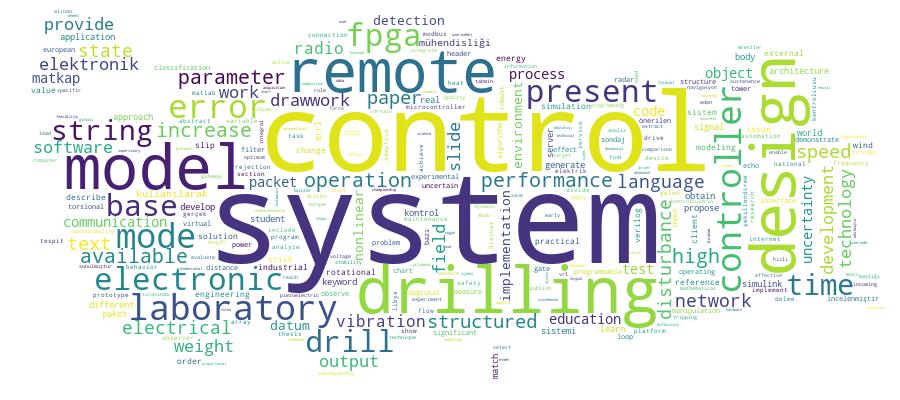
Competency Cloud

GCRIS Competency Cloud

Scholarly Output Search Results

Now showing 1 - 7 of 7
  • Conference Object
    Citation - Scopus: 4
    Distance Laboratory Applications Errl: a Study on Radio Communication in Electronic Field
    (2008) Aydin,C.Ç.; Türkmen,G.; Özyurt,E.; Aydm,E.U.; Çaǧiltay,N.E.; Özbek,M.E.; Kara,A.
    In the last decade, the effect of internet usage in education is gradually increased. When we look from academic perspective, the new technologies provided alternatives for students learning. As distance education becomes important everyday, the indispensable elements of teaching and education, laboratories must be reachable via remote connection. Consequently, the education that is going to be given to the students will be more flexible with respect to place and time constraints and students can reach laboratory facilities at any time and anywhere not only in lectures and practical hours. In this study, European Remote Radio Laboratory (ERRL) which is a distance remote Radio Frequency (RF) laboratory designed for electrical-electronics students, is described generally. The software architecture, infrastructure and experiment that can be done with a remote connection have been described.
  • Conference Object
    Citation - WoS: 17
    Citation - Scopus: 23
    Maintenance, Sustainability and Extendibility in Virtual and Remote Laboratories
    (Elsevier Science Bv, 2011) Kara, Ali; Ozbek, Mehmet Efe; Cagiltay, Nergiz Ercil; Aydin, Elif
    This study presents discussions on sustainability of Virtual and Remote Laboratories (VRL), and provides challenges toward maintenance of VRLs. Technical and pedagogical issues in extension and sustenance of VRLs are discussed with the experiences of the authors gained in the development of a VRL system, European Remote Radio Laboratory (ERRL) platform. Moreover, the study presents actions to be taken in sustenance plan and expendability of VRL system with the advances in Information and Communication Technologies (ICT) and educational technologies along with the needs of educators and learners in formal education. (C) 2011 Published by Elsevier Ltd.
  • Conference Object
    Citation - Scopus: 7
    Software Technologies, Architectures and Interoperability in Remote Laboratories
    (2010) Özbek,M.E.; Kara,A.; Ataş,M.
    A remote laboratory aims to provide access to remote lab equipment over the internet. The design and development of the client software is subject to various requirements. In this paper we discuss these requirements and propose solutions. Implementations are demonstrated for some remote experiments developed in the ERRL project. An XML format for experimental results is proposed as an attempt towards standardization of remote laboratory interfaces and enhancing the interoperability of diverse remote laboratory applications. ©2010 IEEE.
  • Conference Object
    Packet Header Classification for Network Intrusion Detection System Based on Fpga
    (Institute of Electrical and Electronics Engineers Inc., 2022) Dakhil,Y.H.; Ozbek,M.E.; Al-Kaseem,B.R.
    Network security is becoming a key problem in data communication via the Internet. Classifying the incoming packets on network devices is one of the ways that increases network se-curity. Packet header classification is a major strategy for secure networking and connectivity. An intrusion detection system (IDS) is necessary for network devices to protect the network's traffic. Packet classification is a mechanism used by Internet services and security tools to examine each incoming packet against predetermined rules. This paper introduces a new algorithm for packet header classification based on a field-programmable gate array (FPGA) using the finite state machine (FSM) technique. The introduced algorithm compares each header field of an incoming packet to a predefined rule stored in a block read-only memory (ROM) of the FPGA chip to identify matches and then executes certain snort rules to classify them. The selected FPGA platform in this work exhibited high processing speed, particularly in digital system design. The presented algorithm was written using Verilog programming language and executed in Xilinx Vivado 18.2 software. The final program was uploaded to the Artix-7 FPGA development board. The simulation results demonstrated that the developed algorithm successfully classified the incoming packets as required with a maximum throughput that reached 100 Mbps. © 2022 IEEE.
  • Conference Object
    Citation - Scopus: 20
    Design and Development of a Remote and Virtual Environment for Experimental Training in Electrical and Electronics Engineering
    (2010) Kara,A.; Aydin,E.; Ozbek,M.E.; Cagiltay,N.
    European Remote Radio Laboratory (ERRL) has been developed by the support of European Commission. It intends to provide remote access to high cost devices remotely, and perform experiments in radio frequency (RF), communications and microwave domains of Electrical ad Electronics Engineering. The system has been operational for two years, and been integrated into curriculum of some courses. In this work, the hardware and software structures of the system are presented. Then, experimental content and the motivations in the design of the system are discussed. ©2010 IEEE.
  • Conference Object
    Citation - Scopus: 7
    Lms and Interactivity - Technical Issues for Remote Laboratories
    (IEEE, 2007) Kolberg,S.; Courivaud,D.; Özbek,M.E.; Ozbek, Mehmet Efe
    Web Services has proven to be a stable and effective way of integrating resources on cross-platform systems. Web Services provides developers with interfaces that are well structured and accessible to most web programming languages. For interactive applications in LMS systems, things get more complicated. Mashups, which are composite applications, raises issues related to browser security models and static learning content. Some of these issues and possible solutions will be discussed in this paper.
  • Conference Object
    Citation - WoS: 9
    Citation - Scopus: 13
    Modeling of Subsonic Cavity Flows by Neural Networks
    (Ieee, 2004) Efe, MÖ; Debiasi, M; Özbay, H; Samimy, M
    Influencing the behavior of a flow field is a core issue as its improvement can yield significant increase of the efficiency and performance of fluidic systems. On the other hand, the tools of classical control systems theory are not directly applicable to processes displaying spatial continuity as in fluid flows. The cavity flow is a good example of this and a recent research focus in aerospace science is its modeling and control. The objective is to develop a finite dimensional representative model for the system with appropriately defined inputs and outputs. Towards the goal of reconstructing the pressure fluctuations measured at the cavity floor, this paper-demonstrates that given some history of inputs and outputs, a neural network based feedforward model can be developed such that the response of the neural network matches the measured response. The advantages of using such a model arc the representational simplicity of the model, structural flexibility to enable controller design and the ability to Store information in an interconnected structure.