
Tunç, Gökhan
Loading...
Profile URL
Name Variants
Tunç, Gökhan
G.,Tunç
G., Tunç
Tunc, Gokhan
Tunc,Gokhan
Tunç,G.
Gokhan, Tunc
Tunc,G.
T.,Gökhan
G., Tunc
Gökhan Tunç
T., Gokhan
Tunç G.
Gökhan, Tunç
T., Gökhan
G.,Tunc
T.,Gokhan
G.,Tunç
G., Tunç
Tunc, Gokhan
Tunc,Gokhan
Tunç,G.
Gokhan, Tunc
Tunc,G.
T.,Gökhan
G., Tunc
Gökhan Tunç
T., Gokhan
Tunç G.
Gökhan, Tunç
T., Gökhan
G.,Tunc
T.,Gokhan
Job Title
Doktor Öğretim Üyesi
Email Address
gokhan.tunc@atilim.edu.tr
Main Affiliation
Civil Engineering
Status
ORCID ID
Scopus Author ID
Turkish CoHE Profile ID
Google Scholar ID
WoS Researcher ID
Sustainable Development Goals
 1
1NO POVERTY
1
Research Products
 2
2ZERO HUNGER
0
Research Products
 3
3GOOD HEALTH AND WELL-BEING
0
Research Products
 4
4QUALITY EDUCATION
0
Research Products
 5
5GENDER EQUALITY
0
Research Products
 6
6CLEAN WATER AND SANITATION
0
Research Products
 7
7AFFORDABLE AND CLEAN ENERGY
0
Research Products
 8
8DECENT WORK AND ECONOMIC GROWTH
0
Research Products
 9
9INDUSTRY, INNOVATION AND INFRASTRUCTURE
3
Research Products
 10
10REDUCED INEQUALITIES
0
Research Products
 11
11SUSTAINABLE CITIES AND COMMUNITIES
20
Research Products
 12
12RESPONSIBLE CONSUMPTION AND PRODUCTION
1
Research Products
 13
13CLIMATE ACTION
0
Research Products
 14
14LIFE BELOW WATER
0
Research Products
 15
15LIFE ON LAND
0
Research Products
 16
16PEACE, JUSTICE AND STRONG INSTITUTIONS
0
Research Products
 17
17PARTNERSHIPS FOR THE GOALS
1
Research Products

Documents
20
Citations
226
h-index
8

Documents
21
Citations
189

Scholarly Output
42
Articles
30
Views / Downloads
125/221
Supervised MSc Theses
11
Supervised PhD Theses
0
WoS Citation Count
144
Scopus Citation Count
172
Patents
0
Projects
0
WoS Citations per Publication
3.43
Scopus Citations per Publication
4.10
Open Access Source
13
Supervised Theses
11
| Journal | Count |
|---|---|
| Buildings | 4 |
| Journal of the Croatian Association of Civil Engineers | 2 |
| Challenge Journal of Structural Mechanics | 1 |
| Endeavour | 1 |
| Engineering Studies | 1 |
Current Page: 1 / 4
Scopus Quartile Distribution
Competency Cloud
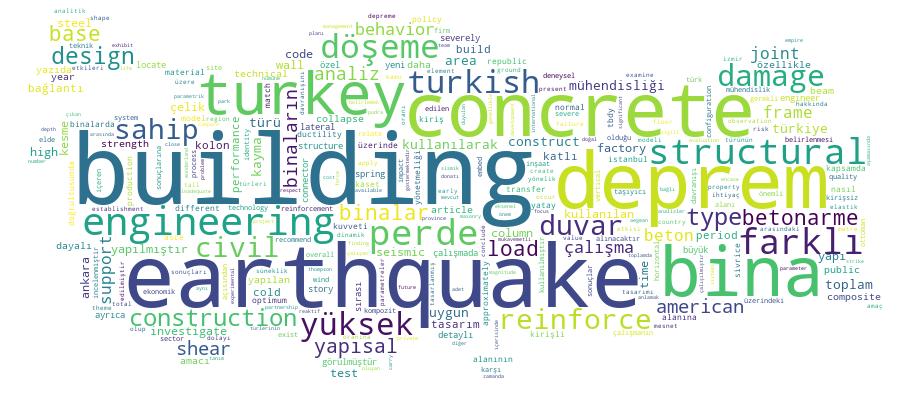
30 results
Scholarly Output Search Results
Now showing 1 - 10 of 30
Article HAFİF AGREGALI YAPISAL BETON VE TÜRKİYE GERÇEĞİ(Bilim ve Teknoloji, 2013) Tunç, GökhanTürkiye‟deki inşaat sektörünün büyük çoğunluğubetonarme yapılardan oluşmaktadır. Betonarme, beton ve donatı çeliğinin birlikte çalışma ilkesine dayalı kompozit bir malzeme olarak tariflenebilir. Bu yazıda betonarmeyi oluşturan iki bileşenden beton malzemesi üzerine yoğunlaşılacaktır. Beton; içerisinde farklı karışım oranlarında çimento, agrega ve su ihtiva eden bir yapı malzemesi türüdür. Ülkemizde üretilen yapısal beton türü, birim hacim ağırlığı 2.4 t/m3 olarak tanımlanan normal ağırlıklı betondur. Gelişmiş ülkelerde ise normal ağırlıklı betonun yanında daha hafif agregalarla oluşturulan hafif ağırlıklı beton türünün de yapısal beton olarak yaygın bir şekilde kullanıldığını görmekteyiz.Article Citation - WoS: 6A Light Bulb in Every House the Istanbul General Electric Factory and American Technology Transfer To Turkey(Johns Hopkins Univ Press, 2022) Tunc, Tanfer Emin; Tunc, GokhanIn 1946, Turkish entrepreneur Vehbi Koc signed an agreement with the U.S. firm General Electric to build and operate its first light bulb factory in the Near/Middle East, in Istanbul. This private joint venture introduced new manufacturing techniques, business practices, and consumer habits to Turkey, opening channels of postwar technological exchange. Closer examination of the GE-Koc partnership reveals that during the early Cold War, the transfer and embedding of American technologies in Turkey was a politically complicated process of innovation that required constant adaptation. Fraught with unforeseeable obstacles, it also required cautious negotiation with multiple transnational actors. The story of the GE-Koc partnership thus adds a new dimension to historical understandings of the Turkish Cold War experience and the Americanization of the region. It illustrates how transferring a nonmilitary, soft-power, domestic technologythe light bulb-played a significant role in Turkish-American relations and therefore contributes to studies of U.S. Cold War diplomacy through transnational investment in innovation.Article Public Policy and the Turkish Construction Sector(2015) Tunç, GökhanThis article discusses public policy as it has been adapted to the Turkish construction sector. The problems related to current policy are discussed along with their remedies. The power struggle that exists among the entities representing the government and the private sector are investigated. The lack of trust that exists in the construction sector is also evaluated as a key roadblock to quality management. In the recommendations section, solutions to such problems are proposed. Overall, the intent of this article is to elevate the quality of Turkey’s construction sector by eliminating and/or rehabilitating existing public policy.Article TÜRKİYE’DEKİ KAMU ÖZEL İŞBİRLİĞİ MODELİNİN İYİLEŞTİRİLMESİNE AİT ÖNERİLER(2015) Tunç, Gökhan; Özsaraç, EmrahBu makale, kamu özel işbirliği (KÖİ) modeli kullanılarak Türkiye'de inşa edilen projeler üzerine yapılan çalışmanın sonuçlarını içermektedir. KÖİ modelinin uygulandığı ülkelere özgü olarak özel sorunlar içerdiği bilinen bir gerçek olup, bu sorunların Türkiye'deki gelişimine ve farklılaşmasına yazıda değinilecektir. KÖİ modeline ait konular önce mühendislik sonra da hukuki yönlerini içerecek şekilde iki ayrı kategoride ele alınacaktır. Modelin mühendislik yönü, sözleşme ve inşaat yönetimi perspektiflerinden araştırılarak incelenecektir. Çalışmanın hukuki konuları içeren kısmında ise Türkiye'ye özgü yaşanılan sorunlar ele alınacaktır. Bu kapsamda, kamu ve özel sektörü çevreleyen belirsizlikler ve sorunları vurgulamak amacıyla güncel mevzuat ve yasalar ile yönetmelikler incelenip değerlendirilecektir. Böylelikle, KÖİ modelinin Türkiye'deki gelişim süreci mercek altına alınmış olacaktır. Finansman durumu ile sözleşme ve ruhsat projeleri de KÖİ modelini oluşturan anahtar nitelikteki risk parametreleri olarak bu yazıda ele alınacaktır. Modelin, Türkiye’ye adaptasyon sürecinde yaşanan zorluklar da incelenerek tarihsel gelişimine dair bilgiler aktarılacaktır. Özellikle son yıllarda yaygın olarak kullanılan Kentsel Dönüşüm Projeleri ile KÖİ modeli arasındaki ilişkiden de bahsedilecek ve modelin Türkiye’ye adaptasyon sürecinde yaşanılanlar tartışılacaktır.Article Citation - WoS: 4Citation - Scopus: 4A Site Survey of Damaged Rc Buildings in Izmir After the Aegean Sea Earthquake on October 30, 2020(Croatian Soc Civil Engineers-hsgi, 2023) Mertol, Halit Cenan; Tunc, Gokhan; Akis, TolgaAn earthquake with a magnitude of Mw = 6.6 and a depth of approximately 16.5 km occurred on 30 October 2020 off the cost of Samos, a Greek island 35 km southwest of Seferihisar, a town in Izmir. The earthquake caused several collapses and severe structural damage in approximately 6,000 buildings, specifically in the Bayrakli District in Izmir Bay. This paper presents the observations and findings of a technical team that visited the earthquake -affected areas immediately after the earthquake. Eleven partially or fully collapsed and several severely damaged reinforced concrete buildings were investigated. Based on the site investigations, we observed that almost all of the collapsed or severely damaged reinforced concrete buildings in the region were built between 1975 and 2000. Site observations also confirmed that the construction of these collapsed or damaged buildings did not conform to the requirements outlined in the Turkish Earthquake Codes used at the time. The failures and severe damage to buildings in earthquake-affected areas are primarily related to inadequate reinforcement configuration, poor material quality, the absence of geotechnical studies, and framing problems related to their lateral load-carrying systems. Therefore, it is recommended that all the buildings located in and around Izmir Bay, particularly those built between 1975 and 2000, be structurally evaluated to prevent any further loss of life and property during future earthquakes.Article Citation - WoS: 3Citation - Scopus: 6Experimental Analysis of the Behavior of Composite Column-Reinforced Concrete Beam Joints(Springer Heidelberg, 2021) Tunc, Gokhan; Dakhil, Abdulrrahman; Mertol, Halit CenanThis study assesses the seismic performance of steel-reinforced concrete (SRC) composite columns connected to reinforced concrete (RC) beam joints, and their ability to dissipate seismic energy through inelastic deformations. In this article, experimental aspects regarding the seismic performance of high-ductility and low-ductility steel-concrete composite frame were investigated. The principle design parameter in this study was ductility, which is considered a conceptual framework in Efficiency-Based Seismic Engineering. Thus, attention was focused on assuring various ductility ranges of joints obtained through a detailed study of the Turkish Earthquake Code (TEC 18) [Ministry of Public Works and Housing.: Turkiye Bina Deprem Yonetmeligi (Turkey's Earthquake Code for Buildings). Official Gazette (2018) (in Turkish).]. After identifying deficiencies and the energy dissipation capacity in the newly proposed joints, two half-scaled frames with specific ductility-related designs were constructed, instrumented, tested, and analyzed. The specimens were tested under displacement-controlled lateral cyclic loading that incorporated constant axial loading to create cyclic tension and compression facets across the joint areas. The test results proved that the SRC column-RC beam frames employing an extra column reinforcement ratio exhibit slightly better seismic performance. Due to the presence of structural steel, the shear failure of the joint was effectively prevented, even after the formation of the plastic hinge on the interface of the beam. During the testing, the column rebars, to some extent, made a minor contribution to the joint strength of the specimen compared to the structural steel that absorbed almost all of the load applied to the frame.Article Citation - WoS: 7Citation - Scopus: 8Finite Element Analysis of Frames With Reinforced Concrete Encased Steel Composite Columns(Mdpi, 2022) Tunc, Gokhan; Othman, Mohammed Moatasem; Mertol, Halit CenanStructural frame systems that consists of concrete-encased-steel-embedded composite columns and reinforced concrete beams are typically used in mid-rise to tall buildings. In order to understand their overall structural behavior, a total of 12 frame models with high and low ductility features were constructed and analyzed using LS-DYNA software. Two of these models were validated using the results of previously tested frames. The remaining 10 models were studied to predict the behavior of frames with varying concrete strengths, reinforcement configurations, and structural steel sections under vertical and lateral loads. The results were investigated in terms of cracks and failure patterns, load-deflection relationships, energy dissipation, and stiffness degradation. The analytical results indicated that the high ductile frame models showed slightly better lateral load carrying performances compared to low ductility frame models. Moreover, the analytical studies demonstrated that the existence of structural steel in a column, regardless of its cross-sectional shape, was the most important parameter in improving the lateral load carrying capacity of a frame.Article Citation - WoS: 2Citation - Scopus: 1A Close Examination of Ankara's Reinforced Concrete Buildings Designed and Constructed Between 1923 and 1938(Mdpi, 2023) Tunc, Gokhan; Tunc, Tanfer EminThe Republic of Turkey was established in 1923 out of the remains of the Ottoman Empire. Between 1923 and 1938, the Turkish republic underwent fifteen years of rapid expansion and growth, with Ankara as its new capital and Mustafa Kemal Ataturk (1881-1938) as its first president. During this period, reinforced concrete (RC) played a significant role in the construction of Ankara's public-use buildings. This study focuses on 57 of these structures, built either partially, or entirely, out of RC. The buildings are classified with respect to their duration, soil properties, foundation types, structural design details, construction types, materials and overall costs. In order to provide a better picture of the time period in which these buildings were designed and constructed, the technical, financial and political aspects of the projects, and the difficulties and challenges involved in their design and construction, are also discussed. Furthermore, this study outlines the impact of foreign engineers, construction workers, firms and the educational system on the development of civil engineering and use of RC in Turkey.Article İNŞAAT MÜHENDİSLİĞİ EĞİTİMİNDE GÜZEL YAZI YAZMA SANATI VE ÇİZİM BECERİLERİ(Yapı Dergisi, 2017) Tunç, GökhanMühendis kelimesi Arapça kökenli bir kelime olup hendese yani geometri bilen kişi olarak tariflenir. Mühendisin günümüzdeki tanımı ise Türk Dil Kurumu tarafından “İnsanların her türlü ihtiyacını karşılamaya dayalı yol, köprü, bina gibi bayındırlık; tarım, beslenme gibi gıda; fizik, kimya, biyoloji, elektrik, elektronik gibi fen; uçak, otomobil, motor, iş makineleri gibi teknik ve sosyal alanlarda uzmanlaşmış, belli bir eğitim görmüş kimse” olarak yapılmıştır. Tanımdan da anlaşılacağı üzere teknolojiye dayalı alanlarda çalışan ve üretim yapan mühendisler, hem teknik hem de sosyal alanlarda uzmanlaşmış kişilerdir. Bu kişiler, mesleklerinin gereklerini bilimsel verilere dayalı belirli kurallar çerçevesinde yerine getirirler. Bu yazıda, bu tür kurallar silsilesi özellikle inşaat mühendisliği açısından ele alınacak ve mühendis yetiştiren eğitim kurumlarımızda artık yeterince önem verilmeyen fakat mühendisliği tarifleyen önemli bir tanım üzerine yoğunlaşılacaktır. Tanım, mühendisin geometri ile ilgisini ve bu ilginin akademik ve özel hayatta yaratacağı faydaları tarifleyecektir. Dolayısı ile geometrik şekillerin uyumluluğu mühendislik yaşamına aktarılırken şeklin ve şekille ortaya çıkan güzel yazı yazma sanatının inceliklerine değinilecektir. Ayrıca güzel yazı yazma sanatından başlayıp son ürünün teşhirine kadar devam eden süreçteki analitik ve çözümleme aşamalarına ait konular da özetle ele alınacaktır.Article Citation - WoS: 7Citation - Scopus: 8Transferring Technical Knowledge To Turkey: American Engineers, Scientific Experts, and the Erzincan Earthquake of 1939(Royal Society Publishing, 2022) Tunc,T.E.; Tunc,G.On 27 December 1939, a 7.8 magnitude earthquake struck Erzincan, Turkey, claiming close to 33 000 lives, and leaving 100 000 injured and 250 000 homeless. World War II was in its initial stages, and the USA was particularly concerned about the vulnerable situation in Turkey, since there was a possibility that it would join forces with Germany, as the Ottoman Empire had done in World War I. Consequently, the Turkish request for information on 'a type of quake resistant concrete construction understood to have been developed in California', resulted in a flurry of correspondence between numerous Turkish and American actors, including the US State Department, which supplied this material with notable attentiveness. As this article will argue, this request not only represents an early critical juncture in the transfer of earthquake engineering knowledge from the USA to Turkey, but also illustrates how diplomacy and engineering can intersect at pivotal points in time. Engineers and other scientific experts strengthened the Turkish-American relationship during this period, thereby laying the foundation of the technical cooperation that would flourish during the Cold War. This watershed moment also resulted in immediate developments in Turkey, such as the development of a comprehensive national disaster management programme, a seismic zone map, and earthquake building codes. © 2021 The Author(s).

- «
- 1 (current)
- 2
- 3
- »