Aras, Gökşen

Loading...
Profile Picture
Name Variants
Aras, Goksen
Aras,G.
Gökşen Aras
A., Goksen
G.,Aras
A.,Goksen
Aras, Gökşen
Gökşen, Aras
A., Gökşen
Aras,Goksen
A.,Gökşen
Goksen, Aras
G., Aras
Job Title
Doktor Öğretim Üyesi
Email Address
goksen.aras@atilim.edu.tr
Main Affiliation
Department of English Language and Literature
Status
Scopus Author ID
Turkish CoHE Profile ID
Google Scholar ID
WoS Researcher ID

Sustainable Development Goals

NO POVERTY1
NO POVERTY
1
Research Products
ZERO HUNGER2
ZERO HUNGER
1
Research Products
GOOD HEALTH AND WELL-BEING3
GOOD HEALTH AND WELL-BEING
2
Research Products
QUALITY EDUCATION4
QUALITY EDUCATION
0
Research Products
GENDER EQUALITY5
GENDER EQUALITY
8
Research Products
CLEAN WATER AND SANITATION6
CLEAN WATER AND SANITATION
0
Research Products
AFFORDABLE AND CLEAN ENERGY7
AFFORDABLE AND CLEAN ENERGY
0
Research Products
DECENT WORK AND ECONOMIC GROWTH8
DECENT WORK AND ECONOMIC GROWTH
3
Research Products
INDUSTRY, INNOVATION AND INFRASTRUCTURE9
INDUSTRY, INNOVATION AND INFRASTRUCTURE
2
Research Products
REDUCED INEQUALITIES10
REDUCED INEQUALITIES
4
Research Products
SUSTAINABLE CITIES AND COMMUNITIES11
SUSTAINABLE CITIES AND COMMUNITIES
0
Research Products
RESPONSIBLE CONSUMPTION AND PRODUCTION12
RESPONSIBLE CONSUMPTION AND PRODUCTION
0
Research Products
CLIMATE ACTION13
CLIMATE ACTION
0
Research Products
LIFE BELOW WATER14
LIFE BELOW WATER
1
Research Products
LIFE ON LAND15
LIFE ON LAND
0
Research Products
PEACE, JUSTICE AND STRONG INSTITUTIONS16
PEACE, JUSTICE AND STRONG INSTITUTIONS
6
Research Products
PARTNERSHIPS FOR THE GOALS17
PARTNERSHIPS FOR THE GOALS
1
Research Products
Documents

3

Citations

0

h-index

0

This researcher does not have a WoS ID.
Scholarly Output

68

Articles

19

Views / Downloads

617/4857

Supervised MSc Theses

34

Supervised PhD Theses

8

WoS Citation Count

12

Scopus Citation Count

0

Patents

0

Projects

0

WoS Citations per Publication

0.18

Scopus Citations per Publication

0.00

Open Access Source

15

Supervised Theses

42

JournalCount
Turkish Studies (Elektronik)3
ULUSLARARASI HAKEMLİ AKADEMİK VE BEŞERİ BİLİMLER DERGİSİ3
IIB International Refereed Academic Social Sciences Journal2
Iranian Journal of Public Health2
Turkish Studies - Language and Literature2
Current Page: 1 / 3

Scopus Quartile Distribution

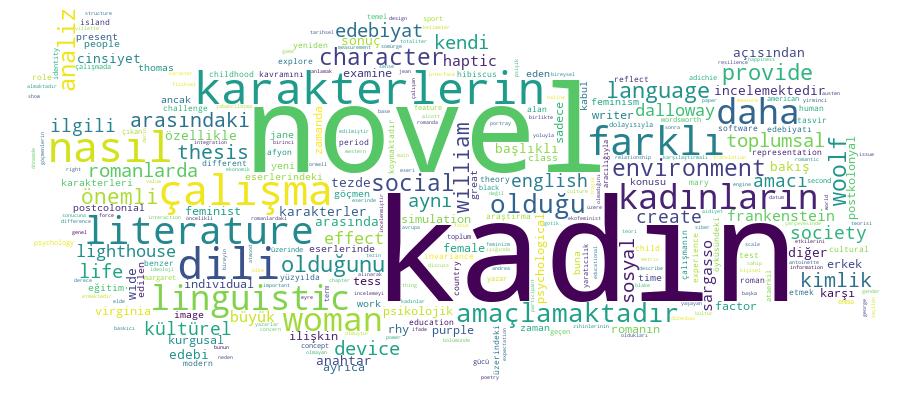
Competency Cloud

GCRIS Competency Cloud

Scholarly Output Search Results

Now showing 1 - 3 of 3
  • Conference Object
    Citation - WoS: 6
    Personality and Individual Differences: Literature in Psychology-Psychology in Literature
    (Elsevier Science Bv, 2015) Aras, Goksen
    Literature, which intertwines within such fields as history, philosophy, sociology, psychology and so on, is a discipline wherein language is used as a medium of expression so as to interpret man, existence and culture. The objective of this paper is to discuss literature in terms of its interdisciplinary structure, psychology, in particular, considering man and existence, personality and individual differences which have always been studied by writers, philosophers, artists, psychologists and psychiatrists. Several complex notions, unfathomable personalities and ambiguous motives have been associated with characters in literary genres: For example the term Bovarism is explained by means of Flaubert's Madame Bovary. Similar examples in literary works could be multiplied. Man and existence have been fundamental themes in literature, which has existed even before psychology. Works of literature and art enable individuals to be aware of their personalities and individual differences and to question life and existence, the main data in the field of psychology as well. It is overtly seen that there is a very strong correlation between literature and psychology since both of them deal with human beings and their reactions, miseries, desires, and their individual and social concerns by means of different concepts, methods, and approaches. (C) 2015 The Authors. Published by Elsevier Ltd.
  • Doctoral Thesis
    Sarah Scott'ın A Description Of Millennium Hall, Florence Dixie'nin Gloriana; Or, The Revolution Of 1900 ve Fay Weldon'nın Darcy's Utopia Adlı Eserlerinde Ütopik Söylemin İncelenmesi
    (2017) Düzgün, Şebnem; Aras, Gökşen
    Sarah Scott'ın A Description of Millenium Hall (1762), Florence Dixie'nin Gloriana; Or, The Revolution of 1900 (1890) ve Fay Weldon'ın Darcy's Utopia (1990) adlı eserleri yönetici sınıfta bulunan erkeklerin gücünü ve imtiyazlarını meşrulaştıran ataerkil politikaları eleştirir. Sırasıyla on sekizinci yüzyıl ortasında, on dokuzuncu ve yirminci yüzyıl sonlarında etkili olan feminist akımlardan etkilenmiş olan Scott, Dixie ve Weldon, kadın başkahramanları aracılığıyla feminist ütopyalarında baskıcı ataerkil ideolojiye ve söyleme karşı çıkarlar. Cinsiyet ayrımcılığını sosyo-politik bir sorun olarak ele alan kadın kahramanlar, kadınların zihinsel ve fiziksel yönlerden daha aşağı bir konumda oldukları varsayımının din, eğitim ve evlilik gibi sosyal kurumlar tarafından dayatıldığını ileri sürerler. Ayrıca, kadınların ve ikincil toplumsal, ırksal ve dini sınıfların baskılanması arasında da benzerlik kurarlar. Tez, çoğunlukla Foucault'nun ve feministlerin söylemlerine gönderme yaparak Scott, Dixie ve Weldon'ın eserlerinde kadınların ezilmesi ve sömürülmesi konusunu tartışır ve toplumsal cinsiyet meselesinin farklı sosyo-tarihsel açılardan ele alınsa da başkahramanların, kadınların ezilmesinin ideolojik olduğunu ve kadınların sözde biyolojik, zihinsel veya ahlaki açıdan güçsüzlükleriyle ilgili olmadığını savunduklarını açıklamayı amaçlar. Ayrıca, kadınların ikincil konuma itilmesinin, gücün üst sınıf Hıristiyan beyaz erkeklerin ellerinde toplanmasını savunan ataerkil devlet tarafından yasallaştırıldığını iddia ettikleri ortaya konur. Tez, Scott, Dixie ve Weldon'ın kadın kahramanlarının, kadınların erkek egemenliğinden kurtarılması için ataerkil gücü pekiştiren geleneksel sosyal, ekonomik, politik, dini ve ahlaki ideolojilerin yeniden düzenlenmesi gerektiğini savundukları sonucuna varır.
  • Article
    Demographic Features of Turkish Literature Audiences and Applied Analysis of the Factors Affecting Their Reading Preferences
    (American-Eurasian Network for Scientific Information, 2014) Poyraz,Y.; Korkmaz,M.; Yücel,A.S.; Aras,G.; Çelebi,N.
    The purpose of this study is to determine factors affecting reading preferences in parallel with the demographic features of Turkish literature audiences. The study lasted approximately for 7 months. (N=650) individuals attended the study in total. The universe of the study is Turkey while the sample of the study is composed of 8 different provinces. These provinces are Istanbul, Ankara, Izmir, Bursa, Kocaeli, Sakarya, Trabzon and Gaziantep. A questionnaire form whose reliability and validity had been ensured before and which was composed of 5 point Likert scale was used in the study. The questionnaire form was reformed in accordance with the topic of the study, it was subjected to validity and reliability test and it was carried into main practice through taking views of experts. Data acquired from the results of main practice was analyzed by using SPSS 18.0 packet program and the value of 0.924 was acquired as Cronbach’s Alpha co-efficient. This value indicates that the measuring tool used in this study is quite reliable. The questionnaire is composed of two sections. In the first section, there are questions with regard to determine demographic features of the participants while in the second section, there are scaled questions composed of 120 items. 0.05 of significance level was taken into account among variables in terms of relations and differences. Methods such as different statistics anova, factor and hypothesis tests were applied in the analysis. Moreover, 4 different literary works were mentioned in the study so as to determine attitudes and behaviors of the participants towards literary works. Opinions of the participants were demanded about novels such as Intibah (Rebirth), Araba Sevdasi (Ambition for Car), Mai ve Siyah (Blue and Black) and Çalikusu (The Wren). At the end of the study, it was found out that the participants followed academic publications more frequently, the use of computer and internet had an effect on reading e-book and up-to-date books were read more than those books written in a foreign or ancient language (Ottoman Turkish). Furthermore, it was determined that education and age variables of the participants had an effect on reading habits while gender, age and education variables had an effect in some reading factors. © 2014 AENSI Publisher All rights reserved.