Altındağ, Tuğba

Job Title:Araştırma Görevlisi
Main Affiliation:Computer Engineering
Status: Former Staff
Name Variants:
Tugba, Altindag Altındağ, Tuğba

Scholarly Output Search Results

Now showing 1 - 3 of 3
  • Conference Object
    Citation - Scopus: 7
    Semiconductor Laser Modeling With Anfis
    (2009-10) Çelebi,F.V.; Altindaǧ,T.; Yildirim,R.; Gökrem,L.
    In this study, neuro-fuzzy (NF) models are used which are well-known robust learning systems that combine the advantages of fuzzy sets and neuro-computation theory. Particularly, a single model based on the adaptive network-based fuzzy inference system (ANFIS) is successfully developed from the amplified spontaneous emission (ASE) spectra of a semiconductor laser diode in order to obtain the critical quantities and their dependences on wavelength and currents. These critical quantities are the differential gain, the induced effective index change and the linewidth enhancement factor (α parameter). The comparison of single model results and the experimental measurements validate the presented approach. ©2009 IEEE.
  • Article
    Citation - WoS: 14
    Citation - Scopus: 15
    An Accurate Optical Gain Model Using Adaptive Neuro-Fuzzy Inference System
    (Natl inst Optoelectronics, 2009) Celebi, F. V.; Altindag, T.; Computer Engineering
    This paper presents a single, simple, new and an accurate optical gain model based on adaptive neuro-fuzzy inference system (ANFIS) which combines the benefits of Artificial Neural Networks (ANNs) and Fuzzy Inference Systems (FISs). The dynamic optical gain model results are in very good agreement with the previously published experimental findings.
  • Article
    Citation - WoS: 3
    Citation - Scopus: 3
    The Impact of Cognitive and Socio-Demographic Factors at Meetings During Software Development Process
    (Univ Osijek, Tech Fac, 2011) Akman, Ibrahim; Misra, Sanjay; Altindag, Tugba; Computer Engineering
    Most of the important decisions are taken at team meetings during software development process (SDP) and the way of thinking of project leader plays an important role in achieving quality objectives at these team meetings. Considering this important issue, this paper investigates the impact of cognitive and socio-demographic factors on manager's simple thinking style towards improving the quality of team meetings in SDP. We have performed experimentations among Information and Communication Technologies' (ICT) senior professionals and managers from government and private sector organizations for this purpose. The hypotheses have been developed under different empirical categories and then statistical analysis techniques have been used to draw inferences. The results indicate that "type of team meetings", "project leader's cognitive characteristics" and "adoption of a cognitive model at team meetings" have statistically significant impact on manager's simple thinking in terms of improving productivity and contribution of team meetings.
No research topics data found.

Sustainable Development Goals

SDG data is not available
This researcher does not have a Scopus ID.
This researcher does not have a WoS ID.
No records found in other affiliations.
JournalCount
2009 International Conference on Application of Information and Communication Technologies, AICT 2009 -- 2009 International Conference on Application of Information and Communication Technologies, AICT 2009 -- 14 October 2009 through 16 October 2009 -- Baku -- 794471
Optoelectronics and Advanced Materials, Rapid Communications1
Tehnicki Vjesnik1
Current Page: 1 / 1
Scholarly Output

3

Articles

2

Views / Downloads

0/0

Supervised MSc Theses

0

Supervised PhD Theses

0

WoS Citation Count

17

Scopus Citation Count

25

Patents

0

Projects

0

WoS Citations per Publication

5.67

Scopus Citations per Publication

8.33

Open Access Source

0

Supervised Theses

0

Scopus Quartile Distribution

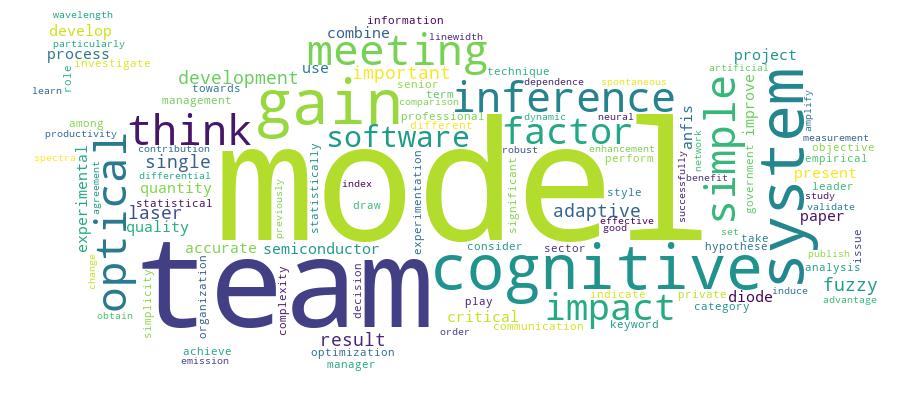
Competency Cloud

GCRIS Competency Cloud