
Yerlikaya Özkurt, Fatma
Loading...
Profile URL
Name Variants
Yerlikaya-Özkurt,F.
F., Yerlikaya Ozkurt
Y.,Fatma
Y., Fatma
Yerlikaya Özkurt,F.
Fatma Yerlikaya Özkurt
Yerlikaya Ozkurt,Fatma
Yerlikaya Ozkurt,F.
F., Yerlikaya Özkurt
Yerlikaya Ozkurt, Fatma
Fatma, Yerlikaya Özkurt
F.,Yerlikaya Özkurt
Y.Ö.Fatma
F.,Yerlikaya Ozkurt
Fatma, Yerlikaya Ozkurt
Y. Ö. Fatma
Y. O. Fatma
Yerlikaya Özkurt, Fatma
Yerlikaya-Ozkurt, Fatma
Yerlikaya-Ozkurt, Fatma
Yerlikaya-oezkurt, Fatma
Yerlikaya-Ozkurt,F.
Özkurt, Fatma Yerlikaya
Ozkurt, F. Yerlikaya
F., Yerlikaya Ozkurt
Y.,Fatma
Y., Fatma
Yerlikaya Özkurt,F.
Fatma Yerlikaya Özkurt
Yerlikaya Ozkurt,Fatma
Yerlikaya Ozkurt,F.
F., Yerlikaya Özkurt
Yerlikaya Ozkurt, Fatma
Fatma, Yerlikaya Özkurt
F.,Yerlikaya Özkurt
Y.Ö.Fatma
F.,Yerlikaya Ozkurt
Fatma, Yerlikaya Ozkurt
Y. Ö. Fatma
Y. O. Fatma
Yerlikaya Özkurt, Fatma
Yerlikaya-Ozkurt, Fatma
Yerlikaya-Ozkurt, Fatma
Yerlikaya-oezkurt, Fatma
Yerlikaya-Ozkurt,F.
Özkurt, Fatma Yerlikaya
Ozkurt, F. Yerlikaya
Job Title
Doktor Öğretim Üyesi
Email Address
fatma.yerlikaya@atilim.edu.tr
Main Affiliation
Industrial Engineering
Status
Former Staff
Website
ORCID ID
Scopus Author ID
Turkish CoHE Profile ID
Google Scholar ID
WoS Researcher ID
Sustainable Development Goals
 1
1NO POVERTY
0
Research Products
 2
2ZERO HUNGER
0
Research Products
 3
3GOOD HEALTH AND WELL-BEING
0
Research Products
 4
4QUALITY EDUCATION
0
Research Products
 5
5GENDER EQUALITY
0
Research Products
 6
6CLEAN WATER AND SANITATION
0
Research Products
 7
7AFFORDABLE AND CLEAN ENERGY
2
Research Products
 8
8DECENT WORK AND ECONOMIC GROWTH
2
Research Products
 9
9INDUSTRY, INNOVATION AND INFRASTRUCTURE
0
Research Products
 10
10REDUCED INEQUALITIES
0
Research Products
 11
11SUSTAINABLE CITIES AND COMMUNITIES
7
Research Products
 12
12RESPONSIBLE CONSUMPTION AND PRODUCTION
0
Research Products
 13
13CLIMATE ACTION
2
Research Products
 14
14LIFE BELOW WATER
0
Research Products
 15
15LIFE ON LAND
0
Research Products
 16
16PEACE, JUSTICE AND STRONG INSTITUTIONS
0
Research Products
 17
17PARTNERSHIPS FOR THE GOALS
0
Research Products

This researcher does not have a Scopus ID.

This researcher does not have a WoS ID.

Scholarly Output
18
Articles
14
Views / Downloads
53/35
Supervised MSc Theses
2
Supervised PhD Theses
0
WoS Citation Count
67
Scopus Citation Count
70
Patents
0
Projects
3
WoS Citations per Publication
3.72
Scopus Citations per Publication
3.89
Open Access Source
10
Supervised Theses
2
| Journal | Count |
|---|---|
| Natural Hazards | 2 |
| Journal of Applied Statistics | 2 |
| Journal of Industrial and Management Optimization | 2 |
| Journal of Dynamics and Games | 1 |
| Journal of Statistics and Management Systems | 1 |
Current Page: 1 / 3
Scopus Quartile Distribution
Competency Cloud
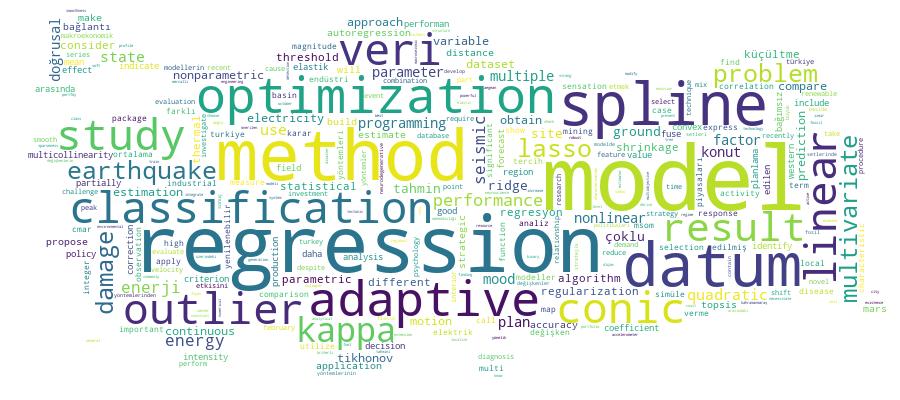
18 results
Scholarly Output Search Results
Now showing 1 - 10 of 18
Article Citation - WoS: 2Citation - Scopus: 3Modeling of Kappa Factor Using Multivariate Adaptive Regression Splines: Application To the Western Türkiye Ground Motion Dataset(Springer, 2024) Kurtulmus, Tevfik Ozgur; Yerlikaya-Ozkurt, Fatma; Askan, Aysegul; Yerlikaya–Özkurt, FatmaThe recent seismic activity on Turkiye's west coast, especially in the Aegean Sea region, shows that this region requires further attention. The region has significant seismic hazards because of its location in an active tectonic regime of North-South extension with multiple basin structures on soft soil deposits. Recently, despite being 70 km from the earthquake source, the Samos event (with a moment magnitude of 7.0 on October 30, 2020) caused significant localized damage and collapse in the Izmir city center due to a combination of basin effects and structural susceptibility. Despite this activity, research on site characterization and site response modeling, such as local velocity models and kappa estimates, remains sparse in this region. Kappa values display regional characteristics, necessitating the use of local kappa estimations from previous earthquake data in region-specific applications. Kappa estimates are multivariate and incorporate several characteristics such as magnitude and distance. In this study, we assess and predict the trend in mean kappa values using three-component strong-ground motion data from accelerometer sites with known VS30 values throughout western Turkiye. Multiple linear regression (MLR) and multivariate adaptive regression splines (MARS) were used to build the prediction models. The effects of epicentral distance Repi, magnitude Mw, and site class (VS30) were investigated, and the contributions of each parameter were examined using a large dataset containing recent seismic activity. The models were evaluated using well-known statistical accuracy criteria for kappa assessment. In all performance measures, the MARS model outperforms the MLR model across the selected sites.Conference Object Comparison of Field Survey-Based Macroseismic Intensity Map and Numerical Macroseismic Intensity Maps Using Mars and Multiple Regression Methods for 6th of February 2023 Kahramanmaraş Earthquakes(Springer Science and Business Media Deutschland GmbH, 2024) Albayrak, Kubilay; Askan, Aysegul; Yerlikaya-Ozkurt, FatmaEarthquakes are natural events that cause damage to built environments by the instant seismic energy release. This energy is measured by instrumental devices to obtain the peak ground motion parameters such as Peak Ground Acceleration (PGA) and Peak Ground Velocity (PGV). Additional measurements based on the questionnaires after the earthquakes are required to identify the felt or macro seismic intensity levels. These measurements are crucial to identify the total effects of earthquakes over not only an area but also for the spatial distribution of ground motion parameters. For this purpose, it is important to study the multi-variable criteria correlations between ground motion parameters and Modified Mercalli Intensity (MMI) levels based on linear relationships of predictor variable couples. In this regard, the Multivariate Adaptive Regression Splines (MARS) Method and the Multiple Linear Regression Method are used. The entire dataset is composed of 69 earthquakes between 2005 and 2022 with 2171 ground motion parameters coupled with MMI levels. For MMI-based correlations, the MARS method is used to identify the non-linearities between predictor variables by piecewise linear functions, but for the Multiple Linear Regression Method, the least correlated variables of PGA-Epicentral Distance and PGV-Epicentral Distance are used to obtain the relationship between MMI and PGM parameters. The resulting equations obtained for the entire Turkiye database are performed to identify MMI maps of the 6th of February 2023, Kahramanmaras Earthquakes, and these maps are used to check the accuracy of the results by the comparison of field survey-based MMI maps. Finally, the numerical MMI maps are found to be consistent with the field survey-based MMI maps.Article Citation - WoS: 3Citation - Scopus: 4Cmars: a Powerful Predictive Data Mining Package in R(Elsevier, 2023) Yerlikaya-oezkurt, Fatma; Yazici, Ceyda; Batmaz, Inci; Yerlikaya-Özkurt, FatmaConic Multivariate Adaptive Regression Splines (CMARS) is a very successful method for modeling nonlinear structures in high-dimensional data. It is based on MARS algorithm and utilizes Tikhonov regularization and Conic Quadratic Optimization (CQO). In this paper, the open-source R package, cmaRs, built to construct CMARS models for prediction and binary classification is presented with illustrative applications. Also, the CMARS algorithm is provided in both pseudo and R code. Note here that cmaRs package provides a good example for a challenging implementation of CQO based on MOSEK solver in R environment by linking R MOSEK through the package Rmosek.Master Thesis Elektrik Talep Tahminine Dayalı Karma Tam Sayılı Programlama ile Türkiye'nin Stratejik Enerji Üretimi Planlaması(2021) Yörük, Gökay; Baç, Uğur; Özkurt, Fatma YerlikayaBu tezde, Türkiye için enerji planlama problemi, stratejik planlama, enerji politikası, enerji güç kapasite planlaması, teknoloji seçimi ve çevre politikaları açısından ele alınmaktadır. Stratejik elektrik planlaması kapsamında; fosil yakıtlar, yenilenebilir enerji, nükleer enerji gibi alternatif teknolojileri göz önünde bulunduran karışık tam sayılı matematiksel programlama modeli önerilmiştir. Çalışmada maliyetin (yatırım, operasyon ve bakım) en küçüklenmesine ek olarak, CO2 emisyonunun sınırlandırılması, enerji kaynak paylaşımı kısıtlama politikaları ve yenilenebilir enerji teşvik politikaları gibi hususlar önerilen modelde ele alınmıştır. Planlama sürecinde elektrik talebini tahmin etmek için regresyon metotları, üstel düzeltme, Winter ve Otoregresif Entegre Hareketli Ortalama (ARIMA) yöntemleri gibi bir dizi tahmin tekniği kullanılmış ve farklı hata ölçüm kriterleri kullanılarak en iyi yöntem seçilmiştir. Modelin bir uygulaması olarak Türkiye'nin Stratejik Elektrik Planlama Problemi ele alınmış ve iki farklı (2021-2030 ve 2021-2040) planlama aralığı için çözülmüştür. Sonuçlar, yenilenebilir enerji üretim seçenekleri olan güneş, rüzgâr ve hidroelektrik alternatiflerinin kullanımının önemli ölçüde artacağını, enerji üretiminde fosil yakıtların kullanımının ise belirgin bir şekilde azalacağını göstermektedir. Sonuç olarak, bu araştırma yenilenebilir enerji yatırımlarının kademeli olarak artırılmasını ve uzun vadede fosil yakıt alternatiflerinin yerini almasını önermektedir. Bu değişiklik yalnızca yatırım, işletme ve bakım maliyetlerini düşürmekle kalmayacak, aynı zamanda emisyon seviyesini de önemli ölçüde düşürecektir.Article Citation - WoS: 2Citation - Scopus: 2Estimation in the Partially Nonlinear Model by Continuous Optimization(Taylor & Francis Ltd, 2021) Yerlikaya-Ozkurt, Fatma; Taylan, Pakize; Tez, MujganA useful model for data analysis is the partially nonlinear model where response variable is represented as the sum of a nonparametric and a parametric component. In this study, we propose a new procedure for estimating the parameters in the partially nonlinear models. Therefore, we consider penalized profile nonlinear least square problem where nonparametric components are expressed as a B-spline basis function, and then estimation problem is expressed in terms of conic quadratic programming which is a continuous optimization problem and solved interior point method. An application study is conducted to evaluate the performance of the proposed method by considering some well-known performance measures. The results are compared against parametric nonlinear model.Article Citation - WoS: 6Citation - Scopus: 7Strategic Electricity Production Planning of Turkey Via Mixed Integer Programming Based on Time Series Forecasting(Mdpi, 2023) Yoruk, Gokay; Bac, Ugur; Yerlikaya-Ozkurt, Fatma; Unlu, Kamil DemirberkThis study examines Turkey's energy planning in terms of strategic planning, energy policy, electricity production planning, technology selection, and environmental policies. A mixed integer optimization model is proposed for strategic electricity planning in Turkey. A set of energy resources is considered simultaneously in this research, and in addition to cost minimization, different strategic level policies, such as CO2 emission reduction policies, energy resource import/export restriction policies, and renewable energy promotion policies, are also considered. To forecast electricity demand over the planning horizon, a variety of forecasting techniques, including regression methods, exponential smoothing, Winter's method, and Autoregressive Integrated Moving Average methods, are used, and the best method is chosen using various error measures. The optimization model constructed for Turkey's Strategic Electricity Planning is obtained for two different planning intervals. The findings indicate that the use of renewable energy generation options, such as solar, wind, and hydroelectric alternatives, will increase significantly, while the use of fossil fuels in energy generation will decrease sharply. The findings of this study suggest a gradual increase in investments in renewable energy-based electricity production strategies are required to eventually replace fossil fuel alternatives. This change not only reduces investment, operation, and maintenance costs, but also reduces emissions in the long term.Article Endüstri Mühendisliği Öğrencilerinin Kariyer Yollarının, Performans Metrikleri ve Sınıflandırma Teknikleriyle Veri Temelli Olarak Tahmin Edilmesi(2025) Özkurt, Fatma Yerlikaya; Kuyrukçu, AyşeMesleklerin giderek çeşitlenmesi ve kariyer seçeneklerinin artması, iş seçme sürecini hem daha karmaşık hem de daha kritik hâle getirmiştir. Endüstri mühendisi adayları için bu süreç, disiplinlerarası eğitim yapılarından ötürü özellikle karmaşıktır. Müfredatları; üretim, modelleme, optimizasyon, veri tabanı, ekonomi ve proje yönetimi gibi mühendislik ve işletme alanlarını kapsayan geniş bir ders yelpazesinden oluşmaktadır. Diğer bazı mühendislik dallarından farklı olarak, endüstri mühendisliğinin belirgin bir meslek alanı tanımı bulunmamaktadır. Bu özgün durum, çalışmada örneklem olarak endüstri mühendisliği öğrencileri ve mezunlarının seçilmesine neden olmuştur. Bu çalışma, endüstri mühendisliği öğrencilerine yönelik zorunlu bölüm dersleri ve bu derslerden aldıkları notlar üzerine odaklanmaktadır. Örneklem grubunu, farklı sektörlerde istihdam edilen mezunlar oluşturmaktadır. Çalışmanın temel amacı, öğrencilerin aldıkları derslerle mevcut iş pozisyonları arasındaki ilişkiyi veri madenciliği teknikleri aracılığıyla ortaya koymaktır. Bu amaç doğrultusunda diskriminant analizi ve lojistik regresyon yöntemleri kullanılmıştır. Doğruluk metrikleri ve sınıflandırma performans ölçütlerine göre değerlendirilen sonuçlar, iş pozisyonu değişkeni bağımlı değişken olarak ele alındığında, doğru sınıflandırma oranlarının yüksek olduğunu göstermektedir. Ayrıca, diskriminant analizi yöntemi, hem sektör bazında hem de mesleki pozisyonlara göre verinin kategorize edilmesinde etkili bir araç olarak öne çıkmaktadır.Article Konut Piyasalarında Makroekonomik Faktörlerin Etkisi: Abd Örneği(2021) Yılmaz, Bilgi; Kestel, A. Sevtap Selçuk; Özkurt, Fatma Yerlikaya; Selcuk-kestel, Ayse SevtapBu makale makroekonomik, finansal ve emtia piyasaları göstergelerinin konut piyasaları üzerindeki etkisini analiz etmektedir. Genelleştirilmiş Doğrusal Modeller (GDM) ve Çok Değişkenli Uyarlanabilir Regresyon Eğrileri (ÇDRE) tarafından üretilen modellerin yeterliliğini konut piyasası eğilimini tahmin etmek için bağımsız ölçüm yöntemlerine göre karşılaştırıyoruz. Araştırmalarımıza göre bu modeller ilk kez makroekonomik göstergelerin konut piyasaları üzerindeki etkisini ve konut piyasalarındaki eğilimine yönelik tahmini belirlemekte kullanılmaktadır. Ampirik çalışmalar, ABD konut piyasalarına odaklanmakta ve önerilen modellerin gösterimi Ocak 1999-Haziran 2018 periyodu arasında gözlemlenen aylık S\\&P/Case-Shiller Ulusal Konut Fiyat İndeksine ve ABD macroeconomic faktörlerine uygulanmaktadır. Bu çalışma makro ekonomik göstergeler ve konut piyasaları arasındaki etkileşimi vurgulayarak ve konut piyasalarının mekanizmasını analiz ederek literatüre katkıda bulunmaktadır. Bulguları, konut fiyat eğilimlerinin daha doğru bir şekilde tahmin edildiğini ve bu modellerin açıklayıcı değişkenlerin ortak etkisini yakaladığını göstermektedir. Ayrıca, ÇDRE yönteminin tahmin ve geleceğe yönelik tahmin gücüne kıyasla GDM'den daha iyi performans gösterdiğini ortaya koymuştur.Article Citation - WoS: 19Citation - Scopus: 19A New Outlier Detection Method Based on Convex Optimization: Application To Diagnosis of Parkinson's Disease(Taylor & Francis Ltd, 2021) Taylan, Pakize; Yerlikaya-Ozkurt, Fatma; Bilgic Ucak, Burcu; Weber, Gerhard-WilhelmNeuroscience is a combination of different scientific disciplines which investigate the nervous system for understanding of the biological basis. Recently, applications to the diagnosis of neurodegenerative diseases like Parkinson's disease have become very promising by considering different statistical regression models. However, well-known statistical regression models may give misleading results for the diagnosis of the neurodegenerative diseases when experimental data contain outlier observations that lie an abnormal distance from the other observation. The main achievements of this study consist of a novel mathematics-supported approach beside statistical regression models to identify and treat the outlier observations without direct elimination for a great and emerging challenge in humankind, such as neurodegenerative diseases. By this approach, a new method named as CMTMSOM is proposed with the contributions of the powerful convex and continuous optimization techniques referred to as conic quadratic programing. This method, based on the mean-shift outlier regression model, is developed by combining robustness of M-estimation and stability of Tikhonov regularization. We apply our method and other parametric models on Parkinson telemonitoring dataset which is a real-world dataset in Neuroscience. Then, we compare these methods by using well-known method-free performance measures. The results indicate that the CMTMSOM method performs better than current parametric models.Article Citation - WoS: 2Citation - Scopus: 2Enhancing Classification Modeling Through Feature Selection and Smoothness: a Conic-Fused Lasso Approach Integrated With Mean Shift Outlier Modelling(Amer inst Mathematical Sciences-aims, 2025) Yerlikaya-Ozkurt, Fatma; Taylan, PakizeOutlier detection and variable selection are among main objectives of statistical analysis. In our study, we address the outlier problem for classification by using the Mean Shift Outlier Model (CLMSOM). Since the MSOM has more coefficients than the linear regression model, the complexity of the model MSOM is high. Therefore, we consider feature selection for MSOM by using fused Lasso (FLasso), which is beneficial and helpful in the cases where the number of explanatory variables or features is greater than the sample size. FLasso is penalizing both the coefficients and their successive differences by the L-1-norm, and it allows sparsity for both of them, while Lasso only allows the coefficients by considering a nonsmooth optimization problem. In this study, we take into account Iterated Ridge approximation which enables us to use a smooth optimization for FLasso problem. Generated smooth optimization problem is solved by using one of continuous optimization techniques called Conic Quadratic Programming (CQP), which is enabling the utilization of interior point methods. The newly developed method is called Conic FLasso for classification by MSOM (C-FLasso-CLMSOM) and is applied to real world data set to show its performance.
