Eryılmaz, Serkan

Loading...
Profile Picture
Name Variants
E., Serkan
Eryilmaz, S
E.,Serkan
S., Eryilmaz
Eryılmaz, Serkan
Eryilmaz, S.
Eryilmaz,S.
Eryilmaz, Serkan
S.,Eryılmaz
Eryilmaz S.
Serkan, Eryılmaz
Erylmaz S.
Eryılmaz S.
Eryilmaz, SN
S., Eryılmaz
Eryılmaz,S.
Serkan, Eryilmaz
S.,Eryilmaz
EryIlmaz S.
Eryilmaz S., Professor,
Job Title
Profesor Doktor
Email Address
serkan.eryilmaz@atilim.edu.tr
Main Affiliation
Industrial Engineering
Status
Website
Scopus Author ID
Turkish CoHE Profile ID
Google Scholar ID
WoS Researcher ID

Sustainable Development Goals

14

LIFE BELOW WATER
LIFE BELOW WATER Logo

0

Research Products

2

ZERO HUNGER
ZERO HUNGER Logo

0

Research Products

11

SUSTAINABLE CITIES AND COMMUNITIES
SUSTAINABLE CITIES AND COMMUNITIES Logo

0

Research Products

1

NO POVERTY
NO POVERTY Logo

0

Research Products

12

RESPONSIBLE CONSUMPTION AND PRODUCTION
RESPONSIBLE CONSUMPTION AND PRODUCTION Logo

0

Research Products

7

AFFORDABLE AND CLEAN ENERGY
AFFORDABLE AND CLEAN ENERGY Logo

12

Research Products

5

GENDER EQUALITY
GENDER EQUALITY Logo

0

Research Products

3

GOOD HEALTH AND WELL-BEING
GOOD HEALTH AND WELL-BEING Logo

0

Research Products

9

INDUSTRY, INNOVATION AND INFRASTRUCTURE
INDUSTRY, INNOVATION AND INFRASTRUCTURE Logo

0

Research Products

13

CLIMATE ACTION
CLIMATE ACTION Logo

0

Research Products

6

CLEAN WATER AND SANITATION
CLEAN WATER AND SANITATION Logo

0

Research Products

10

REDUCED INEQUALITIES
REDUCED INEQUALITIES Logo

0

Research Products

4

QUALITY EDUCATION
QUALITY EDUCATION Logo

0

Research Products

15

LIFE ON LAND
LIFE ON LAND Logo

0

Research Products

16

PEACE, JUSTICE AND STRONG INSTITUTIONS
PEACE, JUSTICE AND STRONG INSTITUTIONS Logo

0

Research Products

17

PARTNERSHIPS FOR THE GOALS
PARTNERSHIPS FOR THE GOALS Logo

0

Research Products

8

DECENT WORK AND ECONOMIC GROWTH
DECENT WORK AND ECONOMIC GROWTH Logo

0

Research Products
Documents

219

Citations

4740

h-index

39

Documents

211

Citations

4173

Scholarly Output

181

Articles

170

Views / Downloads

176/0

Supervised MSc Theses

2

Supervised PhD Theses

0

WoS Citation Count

2982

Scopus Citation Count

3453

WoS h-index

30

Scopus h-index

31

Patents

0

Projects

0

WoS Citations per Publication

16.48

Scopus Citations per Publication

19.08

Open Access Source

26

Supervised Theses

2

Google Analytics Visitor Traffic

JournalCount
Reliability Engineering & System Safety28
Journal of Computational and Applied Mathematics20
IEEE Transactions on Reliability15
Applied Stochastic Models in Business and Industry10
Statistics & Probability Letters9
Current Page: 1 / 9

Scopus Quartile Distribution

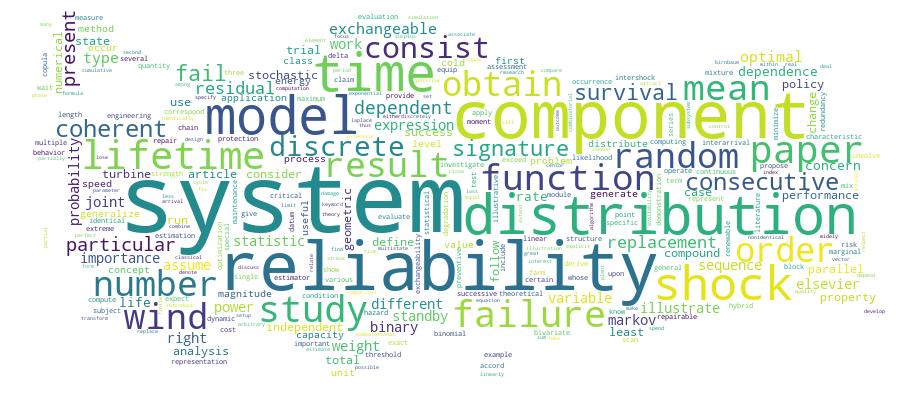
Competency Cloud

GCRIS Competency Cloud

Scholarly Output Search Results

Now showing 1 - 8 of 8
  • Article
    Citation - WoS: 64
    Citation - Scopus: 69
    Reliability and Optimal Replacement Policy for a k-out-of-n< System Subject To Shocks
    (Elsevier Sci Ltd, 2019) Eryilmaz, Serkan; Devrim, Yilser
    Consider a k-out-of-n system which is subject to shocks that occur at random times. Each shock causes failure of random number of components, and hence the system's lifetime corresponds to one of the arrival times of shocks. The reliability and mean time to failure of the system are studied when the times between shocks follow a phase type distribution. The optimal replacement time problem which is concerned with the minimization of the total long-run average cost per unit time is also defined and studied.
  • Article
    Citation - WoS: 7
    Citation - Scopus: 9
    Reliability-Based Evaluation of Hybrid Wind-Solar Energy System
    (Sage Publications Ltd, 2021) Devrim, Yilser; Eryilmaz, Serkan
    In this article, a hybrid system that consists of a specified number of wind turbines and solar modules is considered. In particular, the system is modeled using weightedk-out-of-nsystem which is also known as a threshold system in reliability literature. The system under concern consists ofn1identical wind turbines andn2identical solar modules, and each turbine and module can be in one of two states as working or failed. The probability that the entire hybrid system withn=n1+n2components produces power at minimum levelkis computed and evaluated. The importance of single-wind turbine and solar module is also calculated to measure which renewable energy component is more critical and important. Extensive numerical results that are based on real data set are presented to illustrate the model.
  • Article
    Citation - WoS: 8
    Citation - Scopus: 10
    Computing Reliability Indices of a Wind Power System Via Markov Chain Modelling of Wind Speed
    (Sage Publications Ltd, 2024) Eryilmaz, Serkan; Bulanik, Irem; Devrim, Yilser
    Statistical modelling of wind speed is of great importance in the evaluation of wind farm performance and power production. Various models have been proposed in the literature depending on the corresponding time scale. For hourly observed wind speed data, the dependence among successive wind speed values is inevitable. Such a dependence has been well modelled by Markov chains. In this paper, the use of Markov chains for modelling wind speed data is discussed in the context of the previously proposed likelihood ratio test. The main steps for Markov chain based modelling methodology of wind speed are presented and the limiting distribution of the Markov chain is utilized to compute wind speed probabilities. The computational formulas for reliability indices of a wind farm consisting of a specified number of wind turbines are presented through the limiting distribution of a Markov chain. A case study that is based on real data set is also presented.
  • Article
    Citation - Scopus: 1
    The Distribution of Wind Power from a Dispersed Array of Wind Turbine Generators and Its Reliability Based Applications
    (Elsevier, 2026) Eryilmaz, Serkan; Kan, Cihangir; Devrim, Yilser
    In this paper, the probability distribution of wind power from a dispersed array of wind turbine sites is studied considering forced outage rates of wind turbines. The wind speeds at distinct sites are assumed to be dependent and the dependence is modeled by copulas. In particular, the probability distribution of the aggregate power from two sites is exactly derived. The probability distribution of the aggregate power is also derived under the particular case when site 1 consists of n1 identical wind turbines of type 1 and site 2 consists of n2 identical wind turbines of type 2. Numerical results are presented to illustrate the theoretical findings for a chosen copula function.
  • Article
    Citation - WoS: 17
    Citation - Scopus: 25
    On the Theoretical Distribution of the Wind Farm Power When There Is a Correlation Between Wind Speed and Wind Turbine Availability
    (Elsevier Sci Ltd, 2020) Kan, Cihangir; Devrim, Yilser; Eryilmaz, Serkan
    It is important to elicit information about the potential power output of a wind turbine and a wind farm consisting of specified number of wind turbines before installation of the turbines. Such information can be used to estimate the potential power output of the wind farm which will be built in a specific region. The output power of a wind turbine is affected by two factors: wind speed and turbine availability. As shown in the literature, the correlation between wind speed and wind turbine availability has an impact on the output of a wind farm. Thus, the probability distribution of the power produced by the farm depending on the wind speed distribution and turbine availability can be effectively used for planning and risk management. In this paper, the theoretical distribution of the wind farm power is derived by considering the dependence between turbine availability and the wind speed. The theoretical results are illustrated for real wind turbine reliability and wind speed data.
  • Article
    Citation - WoS: 33
    Citation - Scopus: 43
    Reliability Based Modeling of Hybrid Solar/Wind Power System for Long Term Performance Assessment
    (Elsevier Sci Ltd, 2021) Eryilmaz, Serkan; Bulanik, Irem; Devrim, Yilser
    This paper is concerned with reliability based long-term performance assessment of hybrid solar/wind power system. In particular, an analytical expression is obtained for the theoretical distribution of the power output of the hybrid system by taking into account the reliability values of renewable energy components. An expression for the expected energy not supplied (EENS) is also derived and used to compute the energy index of reliability (EIR) that is directly related to EENS. Because the derived expressions involve reliability values which are related to mechanical states of the renewable energy components, the results enable us to evaluate properly the performance of the hybrid system. A numerical example is included to illustrate the results.
  • Article
    Citation - WoS: 18
    Citation - Scopus: 21
    Theoretical Derivation of Wind Plant Power Distribution With the Consideration of Wind Turbine Reliability
    (Elsevier Sci Ltd, 2019) Eryilmaz, Serkan; Devrim, Yilser
    The wind power generated by a wind plant has a stochastic nature due to randomness in the wind speed. Although the empirical distribution of the wind power has been extensively studied by using data sets in different regions, several works focused on theoretical distribution of the wind power produced by wind turbines. In this paper, the theoretical distribution of the wind plant power is obtained. In the derivation of the distribution of the wind plant power, wind turbine reliability is taken into account. The wind plant power distribution can be effectively used if the wind speed probability distribution is known. Theoretical results are illustrated for Weibull and Bimbaum-Saunders wind speed distributions which have been found to be suitable for real data collected at two different locations.
  • Article
    Citation - WoS: 4
    Citation - Scopus: 6
    Statistics and Probability Theory in Renewable Energy: Teaching and Research
    (Wiley, 2023) Eryilmaz, Serkan; Kateri, Maria; Devrim, Yilser
    In this paper, the key-role and utility of statistics and probability theory in the field of renewable energy are emphasized and illustrated via specific examples. It is demonstrated that renewable energy is a very suitable field to effectively teach and implement many statistical and probabilistic concepts and techniques. From a research point of view, statistical and probabilistic methods have been successfully employed in evaluating renewable energy systems. These methods will continue to be of core interest for the renewable energy sector in the future, as new and more complex renewable energy systems are developed and installed. In this context, some future research directions in relation to the evaluation of renewable energy systems are also presented.