
Cereci, İbrahim
Loading...
Profile URL
Name Variants
C., Ibrahim Cereci, İbrahim İ.,Cereci C.,Ibrahim I.,Cereci C.,İbrahim İbrahim, Cereci Cereci,İ. I., Cereci Cereci, Ibrahim Ibrahim, Cereci Cereci,I.
Job Title
Öğretim Görevlisi Doktor
Email Address
ibrahim.cereci@atilim.edu.tr
Main Affiliation
Computer Engineering
Status
Former Staff
Website
ORCID ID
Scopus Author ID
Turkish CoHE Profile ID
Google Scholar ID
WoS Researcher ID
No research topics data found.
Sustainable Development Goals
 1
1NO POVERTY
0
Research Products
 2
2ZERO HUNGER
0
Research Products
 3
3GOOD HEALTH AND WELL-BEING
0
Research Products
 4
4QUALITY EDUCATION
1
Research Products
 5
5GENDER EQUALITY
0
Research Products
 6
6CLEAN WATER AND SANITATION
0
Research Products
 7
7AFFORDABLE AND CLEAN ENERGY
0
Research Products
 8
8DECENT WORK AND ECONOMIC GROWTH
0
Research Products
 9
9INDUSTRY, INNOVATION AND INFRASTRUCTURE
0
Research Products
 10
10REDUCED INEQUALITIES
0
Research Products
 11
11SUSTAINABLE CITIES AND COMMUNITIES
0
Research Products
 12
12RESPONSIBLE CONSUMPTION AND PRODUCTION
0
Research Products
 13
13CLIMATE ACTION
0
Research Products
 14
14LIFE BELOW WATER
1
Research Products
 15
15LIFE ON LAND
0
Research Products
 16
16PEACE, JUSTICE AND STRONG INSTITUTIONS
0
Research Products
 17
17PARTNERSHIPS FOR THE GOALS
0
Research Products

This researcher does not have a Scopus ID.

This researcher does not have a WoS ID.
No records found in other affiliations.

Scholarly Output
13
Articles
0
Views / Downloads
17/40
Supervised MSc Theses
1
Supervised PhD Theses
1
WoS Citation Count
38
Scopus Citation Count
31
Patents
0
Projects
0
WoS Citations per Publication
2.92
Scopus Citations per Publication
2.38
Open Access Source
1
Supervised Theses
2
| Journal | Count |
|---|---|
| UBMK 2018 - 3rd International Conference on Computer Science and Engineering -- 3rd International Conference on Computer Science and Engineering, UBMK 2018 -- 20 September 2018 through 23 September 2018 -- Sarajevo -- 143560 | 2 |
| 26th Annual International Symposium on Computer and Information Science -- SEP 26-28, 2011 -- Royal Soc London, London, ENGLAND | 1 |
| 2nd International Workshop on Innovative Simulation for Health Innovative Simulation for Health, IWISH 2013, Held at the Int. Multidisciplinary Modeling and Simulation Multiconference, I3M 2012 -- 2nd International Workshop on Innovative Simulation for Health Innovative Simulation for Health, IWISH 2013, Held at the International Multidisciplinary Modeling and Simulation Multiconference, I3M 2012 -- 25 September 2013 through 27 September 2013 -- Athens -- 104451 | 1 |
| 3rd International Conference on Computer Science and Engineering (UBMK) -- SEP 20-23, 2018 -- Sarajevo, BOSNIA & HERCEG | 1 |
| 3rd International Symposium on Search-Based Software Engineering, SSBSE 2011 -- SEP 10-12, 2011 -- Szeged, HUNGARY | 1 |
Current Page: 1 / 2
Scopus Quartile Distribution
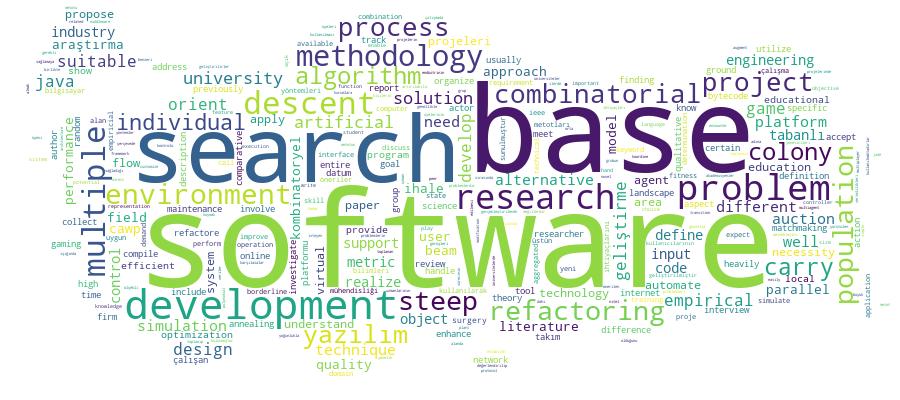
Competency Cloud
13 results
Scholarly Output Search Results
Now showing 1 - 10 of 13
Conference Object Citation - WoS: 13Search-Based Parallel Refactoring Using Population-Based Direct Approaches(Springer-verlag Berlin, 2011) Kilic, Hurevren; Koc, Ekin; Cereci, IbrahimAutomated software refactoring is known to be one of the "hard" combinatorial optimization problems of the search-based software engineering field. The difficulty is mainly due to candidate solution representation, objective function description and necessity of functional behavior preservation of software. The problem is formulated as a combinatorial optimization problem whose objective function is characterized by an aggregate of object-oriented metrics or pareto-front solution description. In our recent empirical study, we have reported the results of a comparison among alternative search algorithms applied for the same problem: pure random, steepest descent, multiple first descent, simulated annealing, multiple steepest descent and artificial bee colony searches. The main goal of the study was to investigate potential of alternative multiple and population-based search techniques. The results showed that multiple steepest descent and artificial bee colony algorithms were most suitable two approaches for an efficient solution of the problem. An important observation was either with depth-oriented multiple steepest descent or breadth-oriented population-based artficial bee colony searches, better results could be obtained through higher number of executions supported by a lightweight solution representation. On the other hand different from multiple steepest descent search, population-based, scalable and being suitable for parallel execution characteristics of artificial bee colony search made the population-based choices to be the topic of this empirical study. I In this study, we report the search-based parallel refactoring results of an empirical comparative study among three population-based search techniques namely, artificial bee colony search, local beam search and stochastic beam search and a non-populated technique multiple steepest descent as the baseline. For our purpose, we used parallel features of our prototype automated refactoring tool A-CMA written in Java language. A-CMA accepts bytecode compiled Java codes as its input. It supports 20 different refactoring actions that realize searches on design landscape defined by an adhoc quality model being an aggregation of 24 object-oriented software metrics. We experimented 6 input programs written in Java where 5 of them being open source codes and one student project code. The empirical results showed that for almost all of the considered input programs with different run parameter settings, local beam search is the most suitable population-based search technique for the efficient solution of the search-based parallel refactoring problem in terms of mean and maximum normalized quality gain. However, we observed that the computational time requirement for local beam search becomes rather high when the beam size exceeds 60. On the other hand, even though it is not able to identify high quality designs for less populated search setups, time-efficiency and scalability properties of artificial bee colony search makes it a good choice for population sizes >= 200.Conference Object F-Actor: a Multiagent Gaming Environment for Controlling Virtual Flow Networks(Univ Wolverhampton, 2008) Ocal, Ilter Kagan; Cevik, Ahmet; Cereci, Ibrahim; Kilic, Hurevren; Computer EngineeringA gaming environment that enables agent-based local control of a configurable virtual flow network is developed. The gaming software what we call F-Actor provides a graph-based discrete virtual control environment on which user-developed controller agents reside and act according to their assigned design goals. Runtime performances of user-developed controller agent codes are made observable through a graphical user interface. The proposed game can be played by different developers having different level of control and programming knowledge. By playing with F-Actor, engineers (or students) can make practices on a virtual flow environment and try alternative intelligent control algorithms before their potential implementations on field.Conference Object Citation - Scopus: 4Need for a Software Development Methodology for Research-Based Software Projects(Institute of Electrical and Electronics Engineers Inc., 2018-09) Cereci,I.; Karakaya,Z.Software development is mostly carried by a group of individuals. Software development methodologies are heavily utilized to organize these individuals and keep track of the entire software development process. Although previously proposed software development methodologies meet the needs of the industry and the firms, they are not usually suitable for research-based software projects that are carried by universities and individual researchers. In this paper, we aim to show the necessity of a new software development methodology for research-based problems carried by universities. The literature review will show the differences between industry and university software projects from certain aspects. These findings will be supported by the authors own research on the area. This qualitative research involves collecting data through interviews and applying Grounded Theory to better understand the development process. © 2018 IEEE.Conference Object The Borderline Between Serious Games and Simulations(Iated-int Assoc Technology Education & development, 2014) Guney, Sinem; Cagiltay, Nergiz Ercil; Tuner, Emre; Cereci, IbrahimGame and simulation-based environments allow trainees to develop motor and cognitive skills as well as to provide some very detailed measurement values which in turn provide a feedback mechanism. It is a well known fact that games and simulation are potentially creating safer and cheaper active learning environments. Even when several benefits of games and simulations are reported in the literature, there is no exact definition of a game and simulation drawing the borders in between. Hence this causes to some complexities and misunderstandings in the field. Accordingly, in this study a definition for simulations and games is searched by being based on the studies found in the literature. Based on these definitions a borderline for the games and simulations will be provided. Results of study aim to guide the educational technology designers by better defining their education designs and better understanding their affect on the educational environments.Conference Object Citation - WoS: 2Need for a Software Development Methodology for Research-Based Software Projects(Ieee, 2018) Cereci, Ibrahim; Karakaya, ZiyaSoftware development is mostly carried by a group of individuals. Software development methodologies are heavily utilized to organize these individuals and keep track of the entire software development process. Although previously proposed software development methodologies meet the needs of the industry and the firms, they are not usually suitable for research-based software projects that are carried by universities and individual researchers. In this paper, we aim to show the necessity of a new software development methodology for research-based problems carried by universities. The literature review will show the differences between industry and university software projects from certain aspects. These findings will be supported by the authors own research on the area. This qualitative research involves collecting data through interviews and applying Grounded Theory to better understand the development process.Conference Object Technology Enhanced Surgery Education Environments: Requirements and System Models(Caltek s.r.l., 2013) Cereci,I.; Cagiltay,N.E.; Berker,M.Minimal invasive surgery (MIS), performed by techniques such as laparoscopic and endoscopic approaches are becoming very popular because of their minimum damage on patient and improved success rates. Since those operations have some limited access to the operational area, the surgeons who are expected to perform those operations need some specific skills and they have to go through an exhaustive training process. Today, MIS education and training programs are faced with serious problems. In this study first problems of those programs are be discussed. Then the technological solutions to address those problems are discussed and analyzed. This study aims to help the educators in this field to address right technology to improve their educational environments and the technical people to better address problems of those educational environments and develop enhanced and integrated solutions specific to this field.Conference Object Citation - WoS: 2CAWP <i>A Combinatorial Auction Web Platform</i>(Scitepress, 2010) Cereci, Ibrahim; Kilic, HurevrenOnline auctions, including online Combinatorial Auctions, are important examples of e-commerce applications. In this paper, a Combinatorial Auction Web Platform (CAWP) is introduced. The platform enables both product selling and buying capabilities that can be realized in a combinatorial way. CAWP supports a Sealed-Bid Single-Unit type of Combinatorial Auctions. Easy customization for any selected problem domain is a distinguished feature of CAWP. Platform users are not expected to have any technical knowledge about how to solve the Winner Determination Problem (WDP) known to be critical for profit maximization of the auctioneers in Combinatorial Auctions.Master Thesis Cawp: Bir kombinatoryel ihale web platformu(2009) Cereci, İbrahim; Rehan, Mohammed; Kılıç, HürevrenKullanıcılarının kombinatoryel ihale ile alım ve satım yapmasını sağlayan bir internet platformu tanımlanmıştır ve geliştirilmiştir. Platform, açık artırmadaki her ürüne kalem bazında teklif verilebilen, kapalı zarf usulü çalışan bir kombinatoryel ihale sistemi geliştirme altyapısıdır. Platform kullanıcılara, kazanan ihalelerin tespitinde satıcının gelirini azami mertebeye çıkarma probleminin bilinen bir algoritma vasıtasıyla otomatik olarak çözümüne olanak tanımaktadır. İnternet üzerine kombinatoryel ihale tabanlı çalışan nadir sayıda sistem bulunmaktadır. Çoklu ihale internet platformu (Combinatorial Auction Web Platform) bu boşluğu doldurmakta ve genel internet kullanıcılarının da kombinatoryel ihalelerle mal alıp satabileceği bir ortam yaratmaktadır. Birleşik modelleme dili (Unified Modeling Language) yardımıyla sistem tanımlanmış ve platform açık kaynak teknolojiler kullanılarak geliştirilmiştir. Sistemin işlevselliğini ve yeteneklerini göstermek amacıyla da örnek olay incelemeleri (Case Study) yapılmıştır.Conference Object Citation - WoS: 2Citation - Scopus: 4Need for a Software Development Methodology for Research-Based Software Projects(Institute of Electrical and Electronics Engineers Inc., 2018-09) Cereci,I.; Karakaya,Z.Software development is mostly carried by a group of individuals. Software development methodologies are heavily utilized to organize these individuals and keep track of the entire software development process. Although previously proposed software development methodologies meet the needs of the industry and the firms, they are not usually suitable for research-based software projects that are carried by universities and individual researchers. In this paper, we aim to show the necessity of a new software development methodology for research-based problems carried by universities. The literature review will show the differences between industry and university software projects from certain aspects. These findings will be supported by the authors own research on the area. This qualitative research involves collecting data through interviews and applying Grounded Theory to better understand the development process. © 2018 IEEE.Conference Object Citation - WoS: 2Citation - Scopus: 2Process Matchmaking on a P2p Environment(Ieee Computer Soc, 2006-12) Celebi, Remzi; Çelebi, Remzi; Ellezer, Huseyin; Baylam, Cemi; Cereci, İbrahim; Cereci, Ibrahim; Kilic, Hurevreni; Çelebi, Remzi; Cereci, İbrahim; Computer Engineering; Computer EngineeringA process matchmaking environment based on P2P architecture and Gnutella protocol is established Java Agent Development Framework (JADE) is used as middleware. The processes are modeled as one-input transition systems augmented by goal state descriptions. A polynomial-time algorithm for handling matchmaking of peer process encounters is developed The environment can easily be customized to a specific application domain by simple user-interface modifications and through the development of related state ontologies.