
Şimşir, Caner
Loading...

Profile URL
Name Variants
C.,Simsir
Simsir, Caner
Şimşir, Caner
C., Simsir
Simsir,C.
C.,Şimşir
S.,Caner
S., Caner
Caner, Simsir
Şimşir,C.
Caner, Şimşir
Ş.,Caner
Simsir, C.
Simsir, Caner
Şimşir, Caner
C., Simsir
Simsir,C.
C.,Şimşir
S.,Caner
S., Caner
Caner, Simsir
Şimşir,C.
Caner, Şimşir
Ş.,Caner
Simsir, C.
Job Title
Doktor Öğretim Üyesi
Email Address
caner.simsir@atilim.edu.tr
Main Affiliation
Manufacturing Engineering
Status
Former Staff
Website
ORCID ID
Scopus Author ID
Turkish CoHE Profile ID
Google Scholar ID
WoS Researcher ID
Sustainable Development Goals
5
GENDER EQUALITY

0
Research Products
14
LIFE BELOW WATER

0
Research Products
10
REDUCED INEQUALITIES

0
Research Products
3
GOOD HEALTH AND WELL-BEING

2
Research Products
2
ZERO HUNGER

0
Research Products
9
INDUSTRY, INNOVATION AND INFRASTRUCTURE

3
Research Products
16
PEACE, JUSTICE AND STRONG INSTITUTIONS

0
Research Products
11
SUSTAINABLE CITIES AND COMMUNITIES

0
Research Products
8
DECENT WORK AND ECONOMIC GROWTH

0
Research Products
13
CLIMATE ACTION

0
Research Products
4
QUALITY EDUCATION

0
Research Products
6
CLEAN WATER AND SANITATION

0
Research Products
1
NO POVERTY

0
Research Products
15
LIFE ON LAND

0
Research Products
17
PARTNERSHIPS FOR THE GOALS

0
Research Products
7
AFFORDABLE AND CLEAN ENERGY

0
Research Products
12
RESPONSIBLE CONSUMPTION AND PRODUCTION

0
Research Products

This researcher does not have a Scopus ID.

This researcher does not have a WoS ID.

Scholarly Output
33
Articles
14
Views / Downloads
0/0
Supervised MSc Theses
12
Supervised PhD Theses
0
WoS Citation Count
176
Scopus Citation Count
228
WoS h-index
8
Scopus h-index
9
Patents
0
Projects
0
WoS Citations per Publication
5.33
Scopus Citations per Publication
6.91
Open Access Source
6
Supervised Theses
12
Google Analytics Visitor Traffic
| Journal | Count |
|---|---|
| Computational Materials Science | 3 |
| Materialwissenschaft und Werkstofftechnik | 3 |
| Hittite Journal of Science and Engineering | 2 |
| Materials Performance and Characterization | 2 |
| International Conference on the Technology of Plasticity (ICTP) -- SEP 17-22, 2017 -- Cambridge, ENGLAND | 1 |
Current Page: 1 / 3
Scopus Quartile Distribution
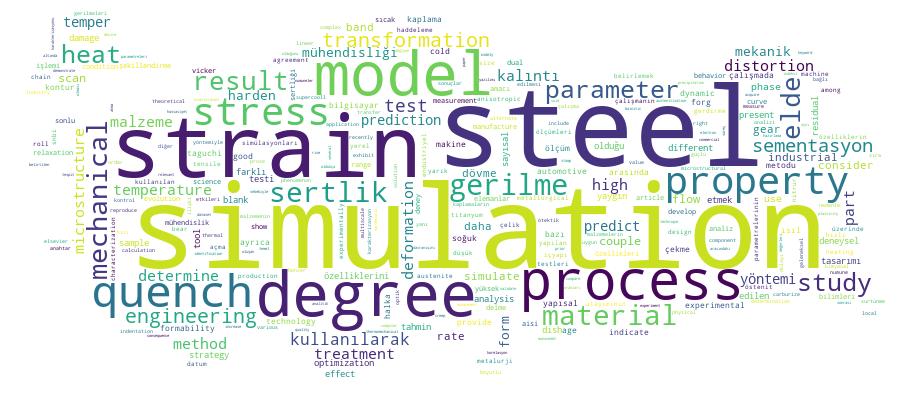
Competency Cloud
33 results
Scholarly Output Search Results
Now showing 1 - 10 of 33
Article Citation - WoS: 4Citation - Scopus: 4Simulation of Through-Hardening of Sae 52100 Steel Bearings - Part Ii: Validation at Industrial Scale(Wiley-v C H verlag Gmbh, 2016) Evcil, G. E.; Mustak, O.; Simsir, C.In this study, the material dataset presented in part I of this article is validated at industrial scale in batch through-hardening of bearing races. The material dataset acquired is implemented in a commercial heat treatment simulation software. Heat transfer coefficients for the oil and salt bath are determined by using a commercial standard quench probe. Zone temperatures and transfer times of the roller-belt furnace are measured directly from the system. Through-hardening of inner ring (IR) of 6813 bearing in oil and salt bath is simulated considering most of the industrial details. Finally, predicted dimensional changes are compared with the coordinate measurement results and a good agreement is achieved. It is concluded that determined material and process data, idealizations and simulation procedure can be considered "validated" for further improvement of the industrial process.Article Transformation Induced Plasticity (trip) of Sae 52100 Steel During Martensitic and Bainitic Transformations(2017) Şimşir, CanerTransformation induced plasticity (TRIP) of SAE 52100 steel during quenching is investigatedboth experimentally and theoretically. TRIP parameter (K) is determinedexperimentally for both martensitic and bainitic transformations by using the stresseddilatometry technique. A new method for extraction of for an incomplete transformationis suggested for the martensitic transformation. Theoretical calculations using wellestablishedmodels for the TRIP effect and the results from the literature are used forthe justification of the results of this work. The results for bainitic transformation isfound to be in good agreement with both the literature and theoretical calculations usingLeblond`s model. On the other hand, experimentally determined value is found to besignificantly different from the literature. Nevertheless, it is still in reasonable agreementwith the calculations using Leblond`s model.Article Citation - Scopus: 2Anisotropic Transformation Strain and Its Consequences on Distortion During Austenitization(Amer Soc Testing Materials, 2012) Simsir, Caner; Lubben, Thomas; Hunkel, Martin; Hoffmann, Franz; Zoch, Hans-WernerThe distribution of segregations, which is introduced in the continuous casting process and modified during succeeding manufacturing steps, is considered as an important "distortion potential carrier" for chemically banded steels. This article presents a recently developed mathematical model for integration of the effect of prior forming and cutting operations into heat-treatment simulations by considering "anisotropic transformation strain (ATS)." The model was justified experimentally by simulating the heating and austenitization of dilatometer specimens machined from the forged discs with distinct orientations with respect to the banded microstructure. After the verification, it is used in conjunction with former experimental work to demonstrate that the distribution of fiber flow is one of the important reasons of the dishing of carburized discs. The model provides promising results for process chain simulation to predict the heat-treatment distortion that cannot be predicted with currently available models.Master Thesis Soğuk Haddelenmiş Alüminyum Plakalarda Kontur Metodunun Uygulaması(2019) Mutlu, Mert; Şimşir, CanerSon zamanlarda popüler olan kontur metodu, herhangi bir parçanın enine kesitinden artık gerilmeleri ölçebilmektedir. Bu metot, diğer tekniklerde olduğu gibi herhangi bir tersinir hesaplamaya gerek duymadan 2 boyutlu gerilme haritasını verebilir. Kontur metodu ucuzdur, basittir ve birçok uygulama alanına sahiptir. Dahası, delik delme ve nötron kırınımı gibi tekniklere karşın ölçüm derinliği kontur metodu için kısıtlı değildir. Bu çalışma, soğuk haddelenmiş bir alüminyum plaka üzerinde kontur metodunun bir uygulamasını sunmaktadır. Bu tezde, kalıntı gerilmeleri kontur metodu yardımıyla belirlemek için iki adet AA 5083 numunesi kullanılmıştır. Numuneler, kıvılcımla malzeme işleme yöntemi ile ikiye kesilmiş ve daha sonra kesilen yüzeylerde bulunan konturlar odak değişimi tekniği kullanılarak optik yüzey ölçümü yapan bir makine tarafından ölçülmüştür. Elde edilen veriler MATLAB yazılımı kullanılarak işlemden geçirilmiştir. Veri işleme sonrasında ölçülen konturların tersleri sonlu elemanlar modeline uygulanmış ve kalıntı gerilmelerin iki boyutlu haritasına ulaşılmıştır. Elde edilen gerilme dağılımı profilleri, doğrulanması için dilme ve halka çekirdek yöntemlerinden elde edilen sonuçlarla karşılaştırılmış ve dilme yöntemi ile iyi bir uyum sağlanmıştır. Ayrıca, kontur metodu ile elde edilen gerilme dağılım profili, soğuk haddeleme işleminden sonra beklenen gerilme yapısına uygun olmuştur. Sonuçlar halka çekirdek metodu ile karşılaştırıldığında bazı farklılıklar ortaya çıksa da gerilme profillerinin benzer bir eğilim gösterdiği gözlemlenmiştir.Master Thesis Sementasyon ve Takip Eden Su-verme İşlemlerinin Süreç Tasarımı ve Kalite Değerlendirmesine Yönelik Malzeme Karakterizasyon Çalışmaları(2017) Yıldız, Seçil; Davut, Kemal; Şimşir, CanerSementasyon ve su-verme ısıl işlemi; aşınma ve yorulma dayancı özelliklerini iyileştirmek için düşük karbonlu çelik parçalara uygulanan bir yüzey sertleştirme işlemidir. Çarpılma, çatlak, sertlik veya sertlik derinliğinde yetersizlik bu işleme bağlı olarak en sık karşılaşılan sorunlardır. Son yirmi yılda, bu sorunları tahmin etmek ve engellemek için, analitik ve deneme-yanılma gibi geleneksel yöntemler yerine bilgisayar simülasyonları daha popüler hale gelmiştir. Bilgisayar destekli ısıl işlem simülasyonları sorunları çözmenin dışında istenilen mikroyapı ve kalıntı gerilme dağılımını sağlayan en uygun proses parametrelerinin belirlenmesini ve bu sayede parça performansının artırılmasını sağlamaktadır. Bu çalışmanın birinci amacı, DIN 22NiCrMo2-2 (SAE 8620H) çeliğine uygulanan sementasyon ve su-verme işlemlerinin simülasyonu için gerekli malzeme veri setinin geliştirilerek hesaplamalı malzeme mühendisliği yöntemlerini tamamlamaktır. Bu amaçla öncelikle, hesaplama tekniklerine gerekli girdiyi sağlamak için, kimyasal ve mikroyapısal olarak ham malzeme karakterizasyonu yapılmıştır. Ardından, su-verme aşamasında faz dönüşümleri üzerinde önemli derecede etkisi olan östenit büyüme kinetiği araştırılmıştır. Son olarak, kritik sıcaklıklar ve dönüşüm kinetiği belirlenerek, TTT ve CCT diyagramları şeklinde sunulmuştur. Ham malzeme karakterizasyon çalışmalarıyla kütüklerin makro segregasyon içermediği, eşeksenli ferritik/perlitik bantlaşmış ve homojen dağılımlı tane yapısına sahip olduğu ve bu nedenlerle proses ve doğrulama çalışmaları için uygun olduğu tespit edilmiştir. Ayrıca, deneysel ve hesaplamalı yöntemlerle belirlenen CCT diyagramlarının birbirleriyle uyumlu olduğu görülmektedir. Deneysel ve hesaplamalı yöntemlerle belirlenen TTT diyagramları arasındaki en büyük farklılık, yerel kimyasal kompozisyon ve yerel östenit tanesi boyutu gibi kontrol edilmesi zor olan faktörlere karşı daha hassas olan beynitik faz dönüşümünde gözlenmektedir. Bu çalışmanın ikinci amacı, aynı proje kapsamında yürütülen tamamlayıcı bilgisayar simülasyonları çalışmalarının geçerliliğinin belirlenmesi ve sementasyon ısıl işleminin kalite değerlendirmesi için içyapı incelemeleri yapmaktır. Bahsi geçen tamamlayıcı çalışmaların birinde, endüstriyel prosesteki değişkenliği en aza indirgemek için DIN 22NiCrMo2-2 ve DIN 16MnCr5 çeliklerinden imal edilen miller üzerinde Taguchi metodu kullanılarak Deney Tasarımı (DoE) yapılarak endüstriyel koşullarda sementasyon deneyleri yapılmıştır. Diğer tamamlayıcı çalışmada ise, aynı Deney Tasarımı (DoE) bilgisayar simülasyonu çalışmalarıyla incelenmiştir. Bu tez çalışmasında ise, içyapı ve sertlik dağılımlarının belirlenmesiyle belirtilen diğer çalışmalar tamamlanmaktadır. Elde edilen sonuçlar bilgisayar simülasyonları ve deneysel sonuçların birbirine uyumlu olduğunu göstermektedir. Sonuçların uyumu beynit dönüşüm kinetiğinin gerilim, yerel tane boyutu ve yerel kimyasal kompozisyona bağlılığını da dahil eden daha iyi karakterizasyon çalışmalarıyla iyileştirilebilir.Article Strain Hardening Behavior Characterization of Dual Phase Steels(2018) Davut, Kemal; Şimşir, Caner; Çetin, BarişThe requirements for higher passenger safety, improved fuel economy and weight reductionin automobile industry necessitates the usage of advanced high strength steel (AHSS)grades. Dual phase (DP) steels are the most widely used one among AHSS. DP steels becomeincreasingly popular, since they provide a combination of sufficient formability at room temperatureand tensile strength over 1000 MPa. The current standards for DP steels only specifiesyield and tensile strength. Steels from various producers have considerably different compositionand microstructure; however they still have the same grade name. Combined withthe inherited heterogeneous microstructure, those steels exhibit different strain hardeningbehavior. The aim of this study is to evaluate the strain hardening behavior of DP800 steels,obtained from different vendors and thus having different compositions and microstructures.The strain hardening behavior was characterized with tensile tests performed along rollingand transverse directions. The microstructure has been characterized with optical andscanning electron microscopes. The martensite fraction, grain size of ferrite and chemicalcomposition has been correlated to the strain hardening behavior. The results show thatthe steel with more micro-alloying addition has finer ferritic grain size, which cause higherinitial strain hardening rate. The steel with higher Mn and Cr has higher martensite fraction,which cause strain hardening rate to be higher at higher strain levels.Master Thesis Vickers Sertlik Ölçümü ile Kalay-bizmut Alaşımlarının Çekme Tipi Mekanik Özelliklerinin Tahmin Edilmesi(2018) Alkılanı, Nurı Aburodess Alssıd; Şengönül, Cemal Merih; Şimşir, CanerGerilim yüklemesi altındaki mekanik özellikler, malzemelerin mekanik davranışını tahmin etmek için en temel olarak kullanılanlardır. Bununla birlikte, çekme testi, yüksek teknoloji tabanlı ekipman, ayrıntılı numune hazırlama protokolleri ve oldukça yüksek maliyet gereksinimleri ile kompleks bir yöntemdir. Malzemelerin sertliği ve gerilme mukavemeti arasında güçlü bir ilişki olduğu için, literatürde bir malzemenin gerilme özellikleri ile sertlik değerleri arasında bir korelasyon kurmayı amaçlayan bazı araştırma çalışmaları vardır. Aslında, sertlik ölçümü çoğunlukla küçük ölçekli enstrümanlar kullanarak bir malzeme hakkında bilgiyi ucuz ve hızlı bir şekilde almak için karmaşık protokoller olmadan gerçekleştirilebilecek kolay bir süreçtir. Bu çalışmada, düşük erime noktalı alaşım bileşimi, kalay-bizmut (Sn-Bi) ve Vickers sertliklerinin gerilme mukavemeti, akma dayanımı, gerinim sertleşmesi katsayısı ve mukavemet sabiti gibi mekanik özellikler arasındaki analitik bir ilişkiyi elde etmek için benzer bir yaklaşım benimsenmiştir. Bu tez çalışması, bu alaşımların, özellikle ötektik bileşim için, mekanik davranışını tahmin edecek bir matematiksel ilişkiyi geliştirmek için, sertlik ve çekme deneylerinden elde edilen verilerin karşılaştırmalı bir analizini kapsamaktadır. Değişen Bi içeriğine sahip alaşımlar, bu çalışmada %30,%40,%50 ve%57 gibi Bi oranları ile kullanılmıştır. Çekme testleri oda sıcaklığında ve nihai gerilme mukavemetine kadar deforme edilerek gerçekleştirilmiş ve verilen alaşım bileşimlerinin yukarıda belirtilen mekanik özelliklerini belirlemek için analiz edilmiştir. Aynı zamanda Vickers sertlik sayılarını elde etmek için sertlik ölçümleri yapılmıştır. Sonuç olarak, gerilme mekanik özellikleri ile Sn-Bi alaşımının sertliği ve mekanik özelliklerin çoğunun istatistiksel olarak anlamlı olduğu yerleşik sayısal model arasında güçlü bir ilişki olduğunu tespit edilmiştir.Article Citation - WoS: 7Citation - Scopus: 9Parameter Identification for an Armstrong-Frederick Hardening Law for Supercooled Austenite of Sae 52100 Steel(Elsevier, 2010) Wolff, Michael; Suhr, Bettina; Simsir, CanerThe mechanical properties of the supercooled austenite phase are sensitive parameters for the prediction of distortion of the components during heat treatments as the inelastic deformation occurs mostly on the soft austenite phase. Recent studies clarified that one of the overlooked issues related with the thermomechanical behavior of supercooled austenite during heat treatment and welding is its complicated cyclic hardening behavior (cf. Simsir et al., Acta Materialia, 2010). Based on those concerns, this article presents an optimization method for determination of temperature-dependent parameters for an Armstrong-Frederick model with combined non-linear kinematic and isotropic hardening, which can potentially pull the quality of simulations through. The results indicate that the proposed approach yields satisfactory results for simulation of heat treatments and welding even with a small and imperfect experimental data pool. (C) 2010 Elsevier B.V. All rights reserved.Master Thesis Soğuk haddelenmiş plakalarda kalıntı gerilmelerin ölçümleri için yarık açma yöntemi uygulaması(2018) Aksungur, Doğan Kıvanç; Şimşir, CanerSoğuk haddeleme kalıntı gerilmelerinin bazı hasar mekanizmaları ile iliĢkilendirildiği ve sonraki üretim iĢlemlerinin performansını etkilediği bilinmektedir. Bu nedenle, hammadde üreticileri bu gerilimleri gerdirme ve presleme gibi bazı iĢlemlerle azaltmaya çalıĢırlar. Kalınlık boyunca kalıntı gerilme profilinin belirlenmesi, hem haddeleme, hem de gerilme giderme proseslerinin tasarımı için önemlidir. Bu bilgiler, bükme ve kaynak yapma gibi yaygın imalat iĢlemlerinin tasarımında da yararlı olabilir ve nötron / sinkrotron kırınımı, yarık açma, kontur yöntemi vb. gibi çeĢitli artık gerilme ölçüm teknikleriyle elde edilebilir. Bu çalıĢmada, soğuk haddelenmiĢ ve gerginlikten arındırılmıĢ AA 5083 levhadan iĢlenen dikdörtgen plakaların kalınlığı boyunca kalıntı gerilme dağılımını ölçmek için yarık açma ve halka delme yöntemi uygulanmıĢtır. Yarık açma yöntemi için uyum matrisi, Sonlu Elemanlar Analizi (SEA) kullanılarak türetilmiĢtir ve halka delme yöntemi kalibrasyon matrisi [1] 'den elde edilmiĢtir. Sonuçlar, iyi bir soğuk haddeleme gerilme profili ile paralellik göstermekle birlikte, yarık açma yöntemi, varsayılan soğuk haddelenmiĢ gerilme profiline göre enine gerilmelerin ihmalinden kaynaklanan gerilmeleri biraz fazla tahmin etmektedir. Ek olarak, gerilmelerin dilme yöntemi sonuçlarını doğrulamak için halka delme yöntemiyle kalıntı gerilme ölçümleri yapılmıĢtır. Halka delme yöntemle yapılan ölçümler, maksimum 20 mm kalınlığın dörtte biri derinliğe kadar yapılabilmiĢtir. Bu koĢullar altında, yarık açma ve halka delme yöntemleri arasında kalıntı gerilme profili belli bir derinlik için paralel olarak gözlenmiĢtir.Master Thesis Gerdirerek Şekillendirme İşleminin Deneysel ve Sayısal İncelenmesi(2013) Alkaş, Celal Onur; Karadoğan, Celalettin; Şimşir, CanerGerdirerek şekillendirme operasyonu, yaygın olarak havacılık sektöründe kullanılmakta olan geniş sac panelleri imal etmek için kullanılan bir yöntemdir. Bu prosesin başarısı büyük ölçüde sac malzemenin mekanik özellikleri, takım-iş parçası ara yüzeyindeki sürtünme koşulu, takım ve çenelerin birbirine göre bağıl hareketleri gibi işlem parametrelerine bağlıdır. Deneme yanılma prosedürü ile en iyi proses parametrelerinin tespiti oldukça zor ve maliyetlidir, bu nedenle sonlu elemanlar analizine ihtiyaç duyulmaktadır.Bu çalışmanın amacı, gerdirerek şekillendirme prosesi için sonlu elemanlar modeli (SEM) geliştirmektir. Bu amaç için, hassas malzeme ve güvenilir temas modeli gerekmektedir. Modele girdi oluşturabilmek için, yaygın olarak kullanılan alüminyum alaşımlarına yönelik mekanik malzeme karakterizasyon testleri yürütülmüştür. Alüminyum sac malzemenin deformasyon davranışı ve anizotropik özelliklerini elde etmek için; standart çekme, basma, hidrolik şişirme testi (HŞT) ve şekillendirme sınır diyagramı (ŞSD) testleri gerçekleştirilmiştir. Malzeme deformasyonu süresince, ŞSD'lerin ve HŞT ile akma eğrilerinin tespiti için yüksek çözünürlüklü CCD kameraları kullanılmıştır. Ayrıca, ters analiz tekniği kullanılarak gerdirme operasyonunda karşılaşılan farklı yağlama koşulları için sürtünme katsayılarının tespiti yapılmıştır.Bu girdiler kullanılarak; çene kullanılarak gerdirme, kalıp kullanılarak gerdirme ve senkronize edilmiş takım hareketleri ile gerdirme gibi üç temel gerdirerek şekillendirme takım hareketleri sayısal olarak modellenmiştir.Modelin iyileştirilmesi ve analiz sonuçlarının doğrulanması amacıyla 3-B optik deformasyon ölçüm cihazı olan, GOM-Argus kullanılarak deneysel çalışmalar gerçekleştirilmiştir. Daha sonra, seçilen üç farklı havacılık sac malzemesi analiz edilmiş ve sayısal modelin başarısı endüstriyel uygulamalar için kanıtlanmıştır.
