Işık, Mehmet

Loading...
Profile Picture
Name Variants
Mehmet, Işık
M.,Işık
Isik, Mehmet
Mehmet, Isik
I., Mehmet
I.,Mehmet
Işık,M.
Isik,M.
I.,Mehmet
M.,Isik
Işık, Mehmet
M., Isik
Isik, M.
Job Title
Profesör Doktor
Email Address
mehmet.isik@atilim.edu.tr
Main Affiliation
Department of Electrical & Electronics Engineering
Status
Former Staff
Website
ORCID ID
Scopus Author ID
Turkish CoHE Profile ID
Google Scholar ID
WoS Researcher ID

Sustainable Development Goals

2

ZERO HUNGER
ZERO HUNGER Logo

0

Research Products

11

SUSTAINABLE CITIES AND COMMUNITIES
SUSTAINABLE CITIES AND COMMUNITIES Logo

0

Research Products

14

LIFE BELOW WATER
LIFE BELOW WATER Logo

1

Research Products

6

CLEAN WATER AND SANITATION
CLEAN WATER AND SANITATION Logo

0

Research Products

1

NO POVERTY
NO POVERTY Logo

0

Research Products

5

GENDER EQUALITY
GENDER EQUALITY Logo

0

Research Products

9

INDUSTRY, INNOVATION AND INFRASTRUCTURE
INDUSTRY, INNOVATION AND INFRASTRUCTURE Logo

0

Research Products

16

PEACE, JUSTICE AND STRONG INSTITUTIONS
PEACE, JUSTICE AND STRONG INSTITUTIONS Logo

0

Research Products

17

PARTNERSHIPS FOR THE GOALS
PARTNERSHIPS FOR THE GOALS Logo

0

Research Products

15

LIFE ON LAND
LIFE ON LAND Logo

1

Research Products

10

REDUCED INEQUALITIES
REDUCED INEQUALITIES Logo

0

Research Products

7

AFFORDABLE AND CLEAN ENERGY
AFFORDABLE AND CLEAN ENERGY Logo

11

Research Products

8

DECENT WORK AND ECONOMIC GROWTH
DECENT WORK AND ECONOMIC GROWTH Logo

0

Research Products

4

QUALITY EDUCATION
QUALITY EDUCATION Logo

0

Research Products

12

RESPONSIBLE CONSUMPTION AND PRODUCTION
RESPONSIBLE CONSUMPTION AND PRODUCTION Logo

0

Research Products

3

GOOD HEALTH AND WELL-BEING
GOOD HEALTH AND WELL-BEING Logo

1

Research Products

13

CLIMATE ACTION
CLIMATE ACTION Logo

0

Research Products
This researcher does not have a Scopus ID.
This researcher does not have a WoS ID.
Scholarly Output

173

Articles

169

Views / Downloads

442/794

Supervised MSc Theses

3

Supervised PhD Theses

0

WoS Citation Count

1806

Scopus Citation Count

1866

WoS h-index

20

Scopus h-index

20

Patents

0

Projects

0

WoS Citations per Publication

10.44

Scopus Citations per Publication

10.79

Open Access Source

11

Supervised Theses

3

Google Analytics Visitor Traffic

JournalCount
Optical Materials17
Physica B: Condensed Matter16
Journal of Luminescence15
Materials Science in Semiconductor Processing14
Journal of Materials Science: Materials in Electronics12
Current Page: 1 / 10

Scopus Quartile Distribution

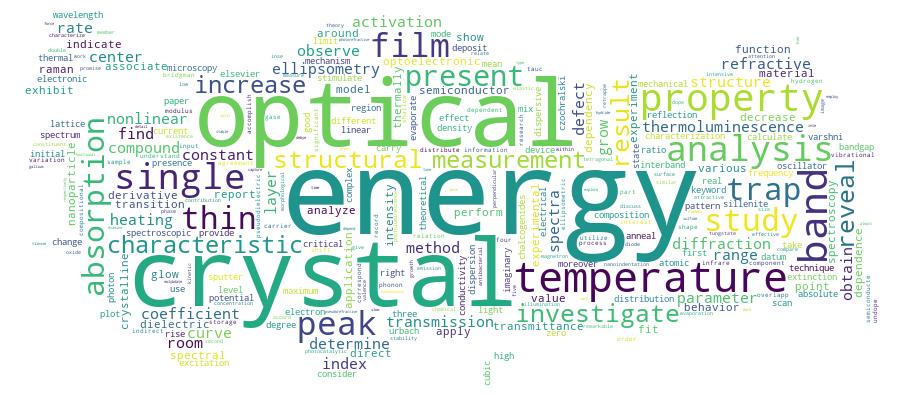
Competency Cloud

GCRIS Competency Cloud

Scholarly Output Search Results

Now showing 1 - 10 of 26
  • Article
    Citation - WoS: 8
    Citation - Scopus: 8
    Temperature-Tuned Bandgap Characteristics of Bi12tio20< Sillenite Single Crystals
    (Springer, 2021) Isik, M.; Delice, S.; Gasanly, N. M.; Darvishov, N. H.; Bagiev, V. E.
    Bi12MO20 (M: Si, Ge, Ti, etc.) compounds are known as sillenites having fascinating photorefractive characteristics. The present paper reports the structural and optical characteristics of one of the members of this family, Bi12TiO20 single crystals, grown by Czochralski method. X-ray diffraction pattern of the crystal presented sharp and intensive peaks associated with planes of cubic crystalline structure with lattice constant of a = 1.0142 nm. The optical properties were studied by means of room temperature Raman and temperature-dependent transmission experiments at various temperatures between 10 and 300 K. Raman spectrum indicated peaks around 127, 162, 191, 219, 261, 289, 321, 497 and 537 cm(-1). The analyses of transmittance spectra indicated the increase of direct bandgap energy from 2.30 to 2.56 eV as temperature was decreased from room temperature to 10 K. The temperature-dependent bandgap characteristics of Bi12TiO20 were analyzed by means of Varshni and O'Donnell-Chen models. The analyses under the light of these models resulted in absolute zero bandgap energy of E-g(0) = 2.56(4) eV, rate of change of bandgap energy of gamma = - 1.11 x 10(-3) eV/K and average phonon energy of < E-ph & rang; = 8.6 meV.
  • Article
    Citation - WoS: 19
    Citation - Scopus: 19
    Temperature-Dependent Band Gap Characteristics of Bi12sio20< Single Crystals
    (Amer inst Physics, 2019) Isik, M.; Delice, S.; Gasanly, N. M.; Darvishov, N. H.; Bagiev, V. E.
    Bi12SiO20 single crystals have attracted interest due to their remarkable photorefractive characteristics. Since bandgap and refractive index are related theoretically to each other, it takes much attention to investigate temperature dependency of bandgap energy to understand the behavior of photorefractive crystals. The present study aims at investigating structural and optical characteristics of photorefractive Bi12SiO20 single crystals grown by the Czochralski method. The structural characterization methods indicated that atomic composition ratios of constituent elements were well-matched with the chemical compound Bi12SiO20, and grown crystals have a cubic crystalline structure. Optical properties of crystals were investigated by room temperature Raman spectroscopy and temperature-dependent transmission measurements between 10 and 300 K. The analyses of transmittance spectra by absorption coefficient and derivative spectrophotometry techniques resulted in energy bandgaps decreasing from 2.61 to 2.48 eV and 2.64 to 2.53 eV as temperature was increased from 10 to 300 K. The Varshni model was applied to analyze temperature-bandgap energy dependency.
  • Article
    Citation - WoS: 5
    Citation - Scopus: 5
    Revealing Defect Centers in Pbwo4 Single Crystals Using Thermally Stimulated Current Measurements
    (Aip Publishing, 2024) Isik, M.; Gasanly, N. M.
    The trap centers have a significant impact on the electronic properties of lead tungstate (PbWO4), suggesting their crucial role in optoelectronic applications. In the present study, we investigated and revealed the presence of shallow trap centers in PbWO4 crystals through the utilization of the thermally stimulated current (TSC) method. TSC experiments were performed in the 10-280 K range by applying a constant heating rate. The TSC spectrum showed the presence of a total of four peaks, two of which were overlapped. As a result of analyzing the TSC spectrum using the curve fit method, the activation energies of revealed centers were found as 0.03, 0.11, 0.16, and 0.35 eV. The trapping centers were associated with hole centers according to the comparison of TSC peak intensities recorded by illuminating the opposite polarity contacts. Our findings not only contribute to the fundamental understanding of the charge transport mechanisms in PbWO4 crystals but also hold great promise for enhancing their optoelectronic device performance. The identification and characterization of these shallow trap centers provide valuable insights for optimizing the design and fabrication of future optoelectronic devices based on PbWO4.
  • Article
    Citation - WoS: 1
    Citation - Scopus: 3
    Optical constants and critical point energies of (AgInSe2)0.75-(In2Se3)0.25 single crystals
    (Springer, 2020) Isik, M.; Nasser, H.; Guseinov, A.; Gasanly, N. M.
    AgInSe2 and In2Se3 are two attractive semiconducting materials for various technological applications especially for photovoltaic applications. In the present study, structural and optical properties of (AgInSe2)(x)-(In2Se3)(1-x) crystals for composition of x = 0.75 corresponding to chemical formula of Ag3In5Se9 were characterized by X-ray diffraction, energy-dispersive spectroscopy, room temperature transmission, and ellipsometry experiments. The transmittance spectrum was analyzed to reveal energy band gap. The derivative spectrophotometry analysis resulted in band gap energy of 1.22 eV. The spectra of complex dielectric function, refractive index and extinction coefficient were presented between 1.6 and 6.2 eV from the outcomes of ellipsometry analyses. Critical point energies have been determined using the derivative analyses of dielectric function. Five critical points at 2.70, 3.30, 4.05, 4.73, and 5.42 eV were revealed from the analyses. Crystal structure and atomic composition in semiconducting compound were also reported in the present work. The obtained results were compared with those reported for constituent compounds.
  • Article
    Citation - WoS: 4
    Citation - Scopus: 4
    TL and OSL studies on gallium sulfide (GaS) single crystals
    (Elsevier, 2020) Isik, M.; Yuksel, M.; Topaksu, M.; Gasanly, N. M.
    [No Abstract Available]
  • Article
    Citation - WoS: 15
    Citation - Scopus: 15
    Deep Traps Distribution in Tlins2 Layered Crystals
    (Polish Acad Sciences inst Physics, 2009) Isik, M.; Gasanly, N. M.; Ozkan, H.
    The trap centers and distributions in TlInS2 were studied in the temperature range of 100-300 K by using thermally stimulated currents technique. Experimental evidence was found for the presence of three trapping centers with activation energies 400, 570, and 650 meV. Their capture cross-sections were determined as 6.3 x 10(-16), 2.7 x 10(-12), and 1.8 x 10(-11) cm(2), respectively. It was concluded that in these centers retrapping is negligible as confirmed by the good agreement between the experimental results and the theoretical predictions of the model that assumes slow retrapping. An exponential distribution of hole traps was revealed from the analysis of the thermally stimulated current data obtained at different light excitation temperatures. This experimental technique provided a value of 800 meV/decade for the trap distribution.
  • Article
    Citation - WoS: 6
    Citation - Scopus: 6
    Low-Temperature Thermo Luminescence Studies on Tlins2 Layered Single Crystals
    (Polish Acad Sciences inst Physics, 2014) Isik, M.; Delice, S.; Gasanly, N. M.
    Thermoluminescence characteristics of TlInS2 layered single crystals grown by the Bridgman method were investigated in the low temperature range of 10-300 K. The illuminated sample with blue light (approximate to 470 nm) at 10 K was heated at constant heating rate. Curve fitting, initial rise and various heating rate methods were used to determine the activation energy of the trap levels. All applied methods showed good consistency about the presence of five trapping centers located at 14, 19, 350, 420, and 520 meV. Behavior of the TL curve for various heating rates was investigated. Traps distribution has also been studied. The activation energies of the distributed trapping centers were found to be increasing from 14 to 46 meV.
  • Article
    Citation - WoS: 3
    Citation - Scopus: 4
    Analysis of Temperature-Dependent Transmittance Spectra of Zn0.5in0.5< (zis) Thin Films
    (Springer, 2019) Isik, M.; Gullu, H. H.; Delice, S.; Gasanly, N. M.; Parlak, M.
    Temperature-dependent transmission experiments of ZnInSe thin films deposited by thermal evaporation method were performed in the spectral range of 550-950nm and in temperature range of 10-300K. Transmission spectra shifted towards higher wavelengths (lower energies) with increasing temperature. Transmission data were analyzed using Tauc relation and derivative spectroscopy. Analysis with Tauc relation was resulted in three different energy levels for the room temperature band gap values of material as 1.594, 1.735 and 1.830eV. The spectrum of first wavelength derivative of transmittance exhibited two maxima positions at 1.632 and 1.814eV and one minima around 1.741eV. The determined energies from both methods were in good agreement with each other. The presence of three band gap energy levels were associated to valence band splitting due to crystal-field and spin-orbit splitting. Temperature dependence of the band gap energies were also analyzed using Varshni relation and gap energy value at absolute zero and the rate of change of gap energy with temperature were determined.
  • Article
    Citation - WoS: 14
    Citation - Scopus: 15
    Thermoluminescence Characteristics of Bi 12 Sio 20 Single Crystals
    (Elsevier, 2020) Isik, M.; Sarigul, N.; Gasanly, N. M.
    [No Abstract Available]
  • Article
    Citation - WoS: 4
    Citation - Scopus: 4
    Optical Characterization of (tlins2)0.5< Crystal by Ellipsometry: Linear and Optical Constants for Optoelectronic Devices
    (Springer, 2023) Guler, I.; Isik, M.; Gasanly, N.
    TlInSSe [(TlInS2)(0.5)(TlInSe2)(0.5)] crystals have garnered significant attention as promising candidates for optoelectronic applications due to their exceptional optoelectrical characteristics. This study focused on investigating the linear and nonlinear optical properties of TlInSSe layered single crystals through ellipsometry measurements. The X-ray diffraction analysis revealed the presence of four distinct peaks corresponding to a monoclinic crystalline structure. In-depth analysis was conducted to examine the variations of refractive index, extinction coefficient, and complex dielectric function within the energy range of 1.25-6.15 eV. By employing derivative analysis of the absorption coefficient and utilizing the Tauc relation, the indirect and direct bandgap energies of TlInSSe crystals were determined to be 2.09 and 2.26 eV, respectively. Furthermore, this research paper presents findings on oscillator energy, dispersion energy, Urbach energy, zero and high frequency dielectric constants, plasma frequency, carrier density to effective mass ratio, nonlinear refractive index, and first-order and third-order nonlinear susceptibilities of TlInSSe crystals.