Akçay, Emre Caner

Loading...
Profile Picture
Name Variants
E. C. Akçay
Emre Caner, Akcay
E.C.Akçay
Akçay,E.C.
E., Akcay
A., Emre Caner
Emre Caner, Akçay
Akcay, Emre Caner
Akcay,Emre Caner
E.,Akçay
Akcay,E.C.
E.C.Akcay
Emre Caner Akçay
A.,Emre Caner
Akçay, Emre Caner
E. C. Akcay
Job Title
Doçent Doktor
Email Address
caner.akcay@atilim.edu.tr
Main Affiliation
Civil Engineering
Status
Website
Scopus Author ID
Turkish CoHE Profile ID
Google Scholar ID
WoS Researcher ID

Sustainable Development Goals

NO POVERTY1
NO POVERTY
1
Research Products
ZERO HUNGER2
ZERO HUNGER
0
Research Products
GOOD HEALTH AND WELL-BEING3
GOOD HEALTH AND WELL-BEING
0
Research Products
QUALITY EDUCATION4
QUALITY EDUCATION
0
Research Products
GENDER EQUALITY5
GENDER EQUALITY
0
Research Products
CLEAN WATER AND SANITATION6
CLEAN WATER AND SANITATION
0
Research Products
AFFORDABLE AND CLEAN ENERGY7
AFFORDABLE AND CLEAN ENERGY
8
Research Products
DECENT WORK AND ECONOMIC GROWTH8
DECENT WORK AND ECONOMIC GROWTH
2
Research Products
INDUSTRY, INNOVATION AND INFRASTRUCTURE9
INDUSTRY, INNOVATION AND INFRASTRUCTURE
5
Research Products
REDUCED INEQUALITIES10
REDUCED INEQUALITIES
0
Research Products
SUSTAINABLE CITIES AND COMMUNITIES11
SUSTAINABLE CITIES AND COMMUNITIES
0
Research Products
RESPONSIBLE CONSUMPTION AND PRODUCTION12
RESPONSIBLE CONSUMPTION AND PRODUCTION
5
Research Products
CLIMATE ACTION13
CLIMATE ACTION
2
Research Products
LIFE BELOW WATER14
LIFE BELOW WATER
0
Research Products
LIFE ON LAND15
LIFE ON LAND
0
Research Products
PEACE, JUSTICE AND STRONG INSTITUTIONS16
PEACE, JUSTICE AND STRONG INSTITUTIONS
0
Research Products
PARTNERSHIPS FOR THE GOALS17
PARTNERSHIPS FOR THE GOALS
4
Research Products
Documents

18

Citations

122

h-index

6

Documents

9

Citations

49

Scholarly Output

19

Articles

11

Views / Downloads

39/0

Supervised MSc Theses

4

Supervised PhD Theses

0

WoS Citation Count

49

Scopus Citation Count

69

Patents

0

Projects

0

WoS Citations per Publication

2.58

Scopus Citations per Publication

3.63

Open Access Source

8

Supervised Theses

4

JournalCount
Buildings3
Engineering, Construction and Architectural Management2
Dicle Üniversitesi Mühendislik Fakültesi Mühendislik Dergisi1
International Conference on Construction in the 21st Century -- 14th International Conference on Construction in the 21st Century, CITC 2024 -- 2 September 2024 through 5 September 2024 -- Rio de Janeiro -- 2086011
JOURNAL OF CIVIL ENGINEERING AND MANAGEMENT1
Current Page: 1 / 3

Scopus Quartile Distribution

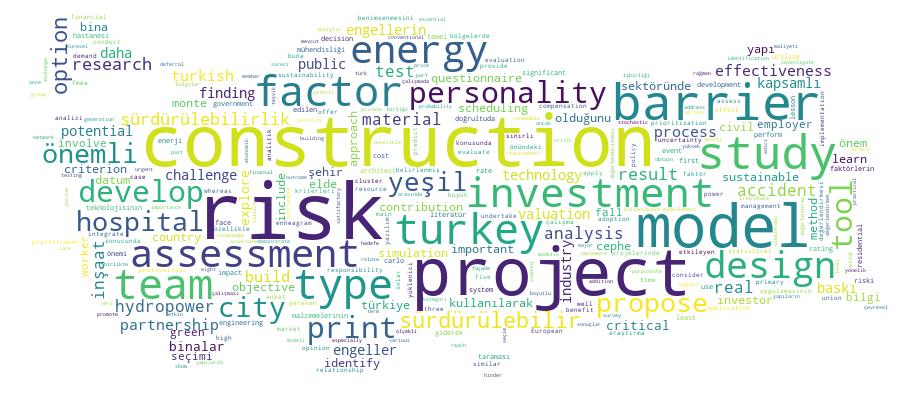
Competency Cloud

GCRIS Competency Cloud

Scholarly Output Search Results

Now showing 1 - 4 of 4
  • Conference Object
    Drivers for Adopting 3D Printing Technology in Turkiye
    (European Council on Computing in Construction (EC3), 2025) Latifiilkhechi, L.; Aminbakhsh, S.; Akcay, E.C.
    This study investigates the factors driving the adoption of 3D printing technology in construction industry, focusing on Turkiye and developing EU countries. A comprehensive literature review identified 27 key drivers, which were evaluated through a survey of 106 professionals using Relative Importance Index (RII). Results reveal that faster construction, lower rate of site accidents and fatalities, and reduction in material waste are the most significant drivers, while freedom in design due to less strict standards was found to be the least important. The research emphasizes the need for targeted initiatives to enhance the integration of 3D printing in construction projects. © 2025, European Council on Computing in Construction (EC3). All rights reserved.
  • Conference Object
    Real Options Valuation of Solar Energy Projects: a Systematic Review
    (Association of Researchers in Construction Management, 2024) Ustun, F.S.; Bilgin, G.; Akcay, E.C.
    Energy plays an essential role in the development of countries, addressing the basic needs of people, and advancing technological progress. As the world's population and the energy demand in the industrial sector increase rapidly, the limited non-renewable energy resources prove insufficient to supply this demand. Consequently, both developed and developing countries are shifting towards renewable energy sources to meet their energy needs. As a result, the number of renewable energy projects in the world has been increasing day by day. Solar energy technology stands as an exemplar within the realm of renewable energy resources, playing a pivotal role in contributing to their overall share. Assessing the economic feasibility of solar energy projects is crucial to ensure their success. Traditional economic analysis methods often disregard managerial flexibility, leading to prefer the real options valuation for analysing the economic feasibility of solar energy projects. Therefore, the objective of this research is to review the application of the real options valuation for valuing solar energy projects in the existing literature. The findings of this study may provide a roadmap for future research efforts. © Association of Researchers in Construction Management
  • Conference Object
    Barriers To Bim Implementation in Sustainable Building Projects in Türkiye
    (East Carolina University, 2024) Aksoy, I.; Akcay, E.C.
    As the construction industry is a major contributor to greenhouse gas emissions, sustainable building projects play a vital role in mitigating its harmful environmental impact. Building energy analysis is particularly important for sustainable projects. Building Information Modeling (BIM), which enables comprehensive data management and analysis throughout the building lifecycle, has emerged as an indispensable tool at every stage of sustainable building projects. This study aims to investigate the barriers hindering the implementation of BIM in sustainable building projects in Türkiye. For this purpose, potential barriers were initially identified through literature searches in databases such as Scopus and Web of Science. Following the literature review, a structured questionnaire was designed to evaluate the significance of 18 identified barriers on the use of BIM technology in green buildings. The results indicate that significant impediments include financial barriers such as high licensing costs, the high costs of BIM experts, and high training costs. The findings highlight the critical need for support mechanisms to facilitate the broader adoption of BIM in sustainable construction practices. © 2024 International Conference on Construction in the 21st Century. All rights reserved.
  • Conference Object
    Investigating the Barriers To the Adoption of 3d Printing Technology in the Turkish Construction Industry
    (Springer International Publishing Ag, 2025) Latifiilkhechi, Leva; Aminbakhsh, Saman; Akcay, Emre Caner
    In recent years, 3D printing has emerged as a transformative force in construction technology. This innovative technology has found applications in many construction and bridge-building projects, starting a new era of automation and efficiency. Notably, the impact of 3D printing on the construction industry has been profound, yielding benefits such as reduced labor requirements, minimized material waste, accelerated project timelines, and a significant reduction in hazardous tasks for human workers. In contrast to conventional construction approaches, 3D printing stands out for its environmentally friendly characteristics, challenging traditional notions of geometric complexities and constraints in construction processes. While 3D printing technology undeniably offers a multitude of advantages over traditional methodologies, it is crucial to acknowledge that it also introduces its own set of unique challenges and risks. The main aim of this study is to investigate the barriers that hinder the adoption of 3D printing technology in the Turkish construction industry. Towards this, first, the list of potential barriers was extracted from multiple reputable sources, including Scopus, ScienceDirect and Web of Science databases. Based on this list, an online questionnaire was prepared to assess the impact of 19 potential barriers on the implementation of 3D printing technology in the Turkish construction industry. The findings and research directions articulated in this study create fresh pathways for further inquiry and substantial contributions to the evolving field of 3D printing in the construction industry.