
Akçay, Emre Caner
Loading...
Profile URL
Name Variants
E. C. Akçay
Emre Caner, Akcay
E.C.Akçay
Akçay,E.C.
E., Akcay
A., Emre Caner
Emre Caner, Akçay
Akcay, Emre Caner
Akcay,Emre Caner
E.,Akçay
Akcay,E.C.
E.C.Akcay
Emre Caner Akçay
A.,Emre Caner
Akçay, Emre Caner
E. C. Akcay
Emre Caner, Akcay
E.C.Akçay
Akçay,E.C.
E., Akcay
A., Emre Caner
Emre Caner, Akçay
Akcay, Emre Caner
Akcay,Emre Caner
E.,Akçay
Akcay,E.C.
E.C.Akcay
Emre Caner Akçay
A.,Emre Caner
Akçay, Emre Caner
E. C. Akcay
Job Title
Doçent Doktor
Email Address
caner.akcay@atilim.edu.tr
Main Affiliation
Civil Engineering
Status
Website
ORCID ID
Scopus Author ID
Turkish CoHE Profile ID
Google Scholar ID
WoS Researcher ID
Sustainable Development Goals
 1
1NO POVERTY
1
Research Products
 2
2ZERO HUNGER
0
Research Products
 3
3GOOD HEALTH AND WELL-BEING
0
Research Products
 4
4QUALITY EDUCATION
0
Research Products
 5
5GENDER EQUALITY
0
Research Products
 6
6CLEAN WATER AND SANITATION
0
Research Products
 7
7AFFORDABLE AND CLEAN ENERGY
8
Research Products
 8
8DECENT WORK AND ECONOMIC GROWTH
2
Research Products
 9
9INDUSTRY, INNOVATION AND INFRASTRUCTURE
5
Research Products
 10
10REDUCED INEQUALITIES
0
Research Products
 11
11SUSTAINABLE CITIES AND COMMUNITIES
0
Research Products
 12
12RESPONSIBLE CONSUMPTION AND PRODUCTION
5
Research Products
 13
13CLIMATE ACTION
2
Research Products
 14
14LIFE BELOW WATER
0
Research Products
 15
15LIFE ON LAND
0
Research Products
 16
16PEACE, JUSTICE AND STRONG INSTITUTIONS
0
Research Products
 17
17PARTNERSHIPS FOR THE GOALS
4
Research Products

Documents
18
Citations
122
h-index
6

Documents
9
Citations
49

Scholarly Output
19
Articles
11
Views / Downloads
78/4854
Supervised MSc Theses
4
Supervised PhD Theses
0
WoS Citation Count
49
Scopus Citation Count
69
Patents
0
Projects
0
WoS Citations per Publication
2.58
Scopus Citations per Publication
3.63
Open Access Source
8
Supervised Theses
4
| Journal | Count |
|---|---|
| Buildings | 3 |
| Engineering, Construction and Architectural Management | 2 |
| Dicle Üniversitesi Mühendislik Fakültesi Mühendislik Dergisi | 1 |
| International Conference on Construction in the 21st Century -- 14th International Conference on Construction in the 21st Century, CITC 2024 -- 2 September 2024 through 5 September 2024 -- Rio de Janeiro -- 208601 | 1 |
| JOURNAL OF CIVIL ENGINEERING AND MANAGEMENT | 1 |
Current Page: 1 / 3
Scopus Quartile Distribution
Competency Cloud
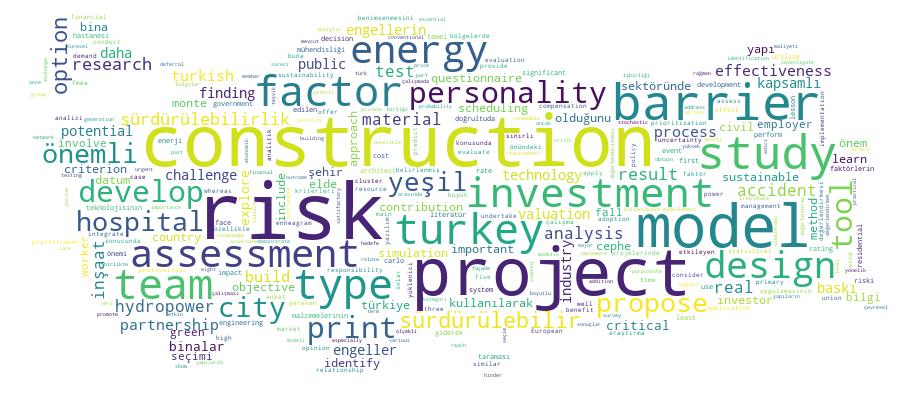
10 results
Scholarly Output Search Results
Now showing 1 - 10 of 10
Article Citation - WoS: 13Citation - Scopus: 17An Analytic Network Process Based Risk Assessment Model for Ppp Hydropower Investments(Vilnius Gediminas Tech Univ, 2021) Akcay, Emre CanerThe number of public-private partnership (PPP) projects has gone up especially in developing countries. The risk assessment of PPP projects is essential in ensuring project success. The objective of this study is to develop an Analytic Network Process (ANP) based risk assessment model for hydropower investments, and a tool to facilitate quantification of risk ratings based on this model. The results show that the three most important risk factors that affect the overall risk rating of a PPP hydropower investment are legal risks, contractor/subcontractor risks, and operator risks. In addition, the three most important risk clusters were identified as stakeholders, government requirements, and resources, whereas market was the least important cluster. The tool that measures the risk rating of a PPP of hydropower project was tested on ten real cases, and satisfactory results were obtained in terms of its predictive capability. The contributions of this research include (1) identification of the risk factors and clusters of factors associated with PPP hydropower investments; (2) determination of the priority of each risk factor and cluster; (3) development a tool that guides the investors through the risk assessment of PPP hydropower investments.Article Citation - Scopus: 1An Activity-Based Lessons Learned Model To Support Scheduling Decisions in Construction(Emerald Group Publishing Ltd, 2025) Yilmaz, Anil; Akcay, Emre Caner; Dikmen, Irem; Birgonul, M. TalatPurposeThe aim of this study is to develop an activity-based lessons-learned model that allows construction companies to capture, store, classify and reuse activity-related lessons learned (LL) from previous projects, thereby increasing the reliability of time estimates in scheduling.Design/methodology/approachScheduling is a knowledge-intensive process that requires the utilization of data and expert opinion elicitation from various levels of an organization in construction projects. This research consists of five successive steps: performing a needs analysis, proposing an activity-based lessons-learned process model, validating the proposed process model, developing a tool to apply the proposed model in a computer environment and testing the applicability of the tool. To implement the proposed model in practice, a web-based tool, namely the Construction Industry Scheduling with Activity-Based Lessons Learned Tool (ConSALL Tool), was developed. Its functionality was evaluated using black-box testing. The tool was then applied in a real construction project.FindingsResults show that ConSALL has the potential to improve scheduling decisions in construction projects by incorporating data and experience from previous projects. Findings from this research can be used to develop similar models and AI tools to foster activity-based learning in other project-based industries as well as the construction industry.Originality/valueThis paper presents an innovative approach to enhancing construction project scheduling by leveraging LL from past projects. The development and application of the ConSALL Tool demonstrate a practical implementation of the proposed model, providing a framework that can be adapted to other industries to improve project planning and execution.Article Design Team Effectiveness and Architects' Personality Types(Emerald Group Publishing Ltd, 2026) Alan, Ece; Arditi, David; Gunaydin, Husnu Murat; Akcay, Emre CanerPurposeThe personalities of the design team members constitute one of the factors that influence team effectiveness. In this study, 223 members of the "American Institute of Architects" who are employed by the largest architectural design firms in the United States of America were categorized according to their personality types by using "The Enneagram Personality Type Model." Also, the respondents' opinions about eight team effectiveness outcomes were recorded in order to explore the relationship between team members' personality types and team effectiveness outcomes.Design/methodology/approachThe information was collected by a questionnaire where the first part included 144 pairs of statements that were used to identify respondents' personality types. The second part sought designers' opinions about the importance of eight team effectiveness outcomes rated on a Likert scale ranging from 1 to 5. The results were assessed by performing the Kruskal-Wallis test first and Dunn's post-hoc test with Bonferroni adjustment subsequently.FindingsThe findings highlight the significance of personality types in effective design teams. While Type 6 (loyalist and skeptic) and Type 3 (achiever and performer) architects prioritize team effectiveness the most, Type 7 architects (enthusiasts and epicureans) assign the lowest importance. However, the presence of Type 1 (reformist and perfectionist) and Type 8 (challenger and protector) architects within the same design team may involve challenges or conflicts.Originality/valueThe primary contribution of this study is that it is the first study in the construction management literature that utilizes The Enneagram of Personality Test to understand the relationship between team members' personality types and team effectiveness outcomes. This study is of direct relevance to practitioners and could be utilized in design team-building activities.Article Yeşil Binalar için Analitik Ağ Süreci (aas) Kullanılarak Yüklenici Seçimi(2020) Akçay, Emre CanerBinalar, dünyadaki tükenebilen kaynakların azalmasında ve enerji tüketiminde önemli bir paya sahiptir. Buçevresel etkileri en aza indirmek için yeşil binalar dünyada giderek önem kazanmaya başlamıştır. Yeşil binalarıngiderek önem kazandığı ve sayısının her geçen gün arttığı ülkelerden birisi de Türkiye’dir. Yeşil bina yaptırmakisteyen yatırımcıların en önemli sorunlarından biri, yeşil bina inşaatını yapacak olan yüklenici firmanın seçimidir.Bu çalışmada çok kriterli seçim yöntemlerinden biri olan Analitik Ağ Süreci (AAS) kullanılarak yeşil binalar içinyüklenici seçim modeli oluşturulması hedeflenmiştir. Buna göre, önce kavramsal bir model geliştirilmiş dahasonra AAS kullanılarak önerilen modelin pratikte nasıl uygulanabileceği Ankara’da gerçekleştirilmesi planlananbir yeşil bina projesinde gösterilmiştir. Oluşturulan bu modelin yeşil binalar için yüklenici seçimi yapanyatırımcılara yardımcı olacağı düşünülmektedir.Article Citation - WoS: 2Citation - Scopus: 2A Comparative Analysis of the Criteria for Choosing Sustainable Materials for Façades in Turkey and the European Union(Mdpi, 2024) Daskin, Haney Basak; Barbulescu, Alina; Muntean, Radu; Akcay, Emre CanerOne of the primary contributors to energy consumption is the construction industry. To address the urgent demand for eco-friendly approaches in this field, this study conducted an investigation on Scopus and Web of Science databases to identify the criteria for selecting sustainable materials for facades. Three groups of criteria were derived after a systematic review: Environmental, Social/economic and Technical. The main goal of the research was to answer the question of whether there are differences in these materials' selection between Turkey and European Union countries. After applying statistical tests, it was found that there are significant differences in selecting eco-friendly material only from the social/economic perspective. The most important sub-criterion is the economic cost. Comparisons with results from China and US confirm this finding.Article Prioritization of Risk Events in Ppp Wind Power Projects Using Integrated Fmea and Monte Carlo Simulation(2021) Akçay, Emre CanerThe popularity of public private partnership (PPP) projects has grown all over the world, especially indeveloping countries. The success of PPP projects heavily depends on how effectively risk assessments areperformed. Failure Mode and Effects Analysis (FMEA) enables risk assessment by considering the impact,the probability, and the detection rate of risk events. However, it is very difficult to predict a single value forthese variables. The objective of this research is to integrate FMEA and Monte Carlo simulation, and to usethis model to perform risk assessment and prioritization of risks in PPP projects. The proposed model wasapplied to a real wind power generation investment located in the Aegean region of Turkey. The top threeimportant risk events are “unfavorable wind speed”, “fluctuation in exchange rates”, and “interest ratevolatility”. The model perfumed to the satisfaction of experts. The primary contributions of this researchinclude (1) a method that allows the identification of the risk events in PPP projects; (2) a model that performsrisk assessment and prioritization of risk events in PPP projects; (3) an integrated FMEA and Monte Carlosimulation model that performs stochastic risk assessment in PPP projects. Both public agencies and privateconsortia should benefit from the proposed model.Article Citation - WoS: 4Citation - Scopus: 5Predicting Employer and Worker Responsibilities in Accidents That Involve Falls in Building Construction Sites(Mdpi, 2022) Akcay, Emre Caner; Arditi, DavidFall-related accidents have received more attention in building construction than in civil construction as fall-from-heights is more common in building construction. In addition to social costs, construction companies face a significant financial burden when fall-related accidents occur. The major portion of the direct cost of accidents that involve falls includes the compensation paid by the employer to the worker. The employer and the worker try to reach an agreement on the size of the compensation, however, most of the time the process is contentious. The objective of this study is to predict the parties' responsibilities for a fall-related accident by modeling the relationship between the employer and the worker using a multi-agent system. The research pursued a three-step method, including collection of data, development of a multi-agent model, and testing of the model. The model provides satisfactory results and can be used to quantify the employer's and the worker's responsibilities in construction fall accidents, hence avoiding any escalation to pursue arbitration or litigation.Article Citation - WoS: 16Citation - Scopus: 28Barriers To Undertaking Green Building Projects in Developing Countries: a Turkish Perspective(Mdpi, 2023) Akcay, Emre CanerGreen buildings (GBs) play an important role in achieving sustainable development goals. However, the implementation of green technologies in building projects has not reached the desired level in developing countries such as Turkey because of barriers stemming from country-related factors as well as factors related to design and construction. The objective of this study was to explore the barriers to undertaking GB projects in Turkey. A questionnaire survey was administered to 116 construction practitioners to analyze the criticality of barriers to GB design and construction in the Turkish construction industry. Both descriptive and inferential statistics were adopted to evaluate the data obtained from the questionnaire survey. The findings suggest that the major barriers that hinder the adoption of GBs in Turkey are higher construction cost, lack of knowledge about GBs, lack of an authorized GB rating system, unavailability of GB materials, and inadequate market demand, whereas longer design time is the least critical barrier. The results of factor analysis indicate that the barriers to undertaking GB projects can be grouped under five "factors", i.e., cost- and demand-related barriers, market-related barriers, people-related barriers, government-related barriers, and time-related barriers. In light of the results, policy makers and construction practitioners can devise strategies to promote GBs in Turkey, which can also be valid in other developing countries with similar socio-economic conditions.Article Citation - WoS: 9Citation - Scopus: 11Real Options Valuation of Photovoltaic Investments: a Case From Turkey(Pergamon-elsevier Science Ltd, 2024) Or, Bartu; Bilgin, Gozde; Akcay, Emre Caner; Dikmen, Irem; Birgonul, M. TalatInvestments in renewable energy resources have become inevitable due to increasing energy demand and energy prices, diminishing non-renewable energy resources, and the outgrowth of carbon footprints. Photovoltaic (PV) systems offer high solar energy potential in sustainable energy production whereas their high initial costs necessitate critical strategic valuation of investments. Valuation with conventional methods has been challenging due to existence of uncertainties such as fluctuating PV panel prices, changing meteorological conditions with certain effects on power generation, and governmental policies on energy market regulations. This study aims to propose a real options approach to valuation of residential rooftop PV system investments considering these uncertainties and demonstrate benefits of this approach with an application on the residential PV investment decisions in Turkey. The proposed method, Real Options Valuation (ROV) with Least-Squares Monte Carlo Simulation (LSMC) considers the deferral option of the investor by utilizing stochastic simulations, the discounted cash flow method, linear regression, and backward dynamic programming and thus evaluates the effects of uncertainties on financial attractiveness of residential PV investments. The case study findings proved that ROV with LSMC having a 7-years deferral option supported the investment decision with realizable cost-effective options while "NPV method" resulted in an infeasible investment. Scenario analysis was also conducted to explore policy options that can be used to promote solar energy investments in Turkey. This study has a potential to have practical contributions for investors as well as implications for policy-makers.Article Citation - WoS: 5Citation - Scopus: 5Exploring the Critical Risk Factors of Public-Private Partnership City Hospital Projects in Turkey(Mdpi, 2024) Dogan Erdem, Tugba; Birgonul, Zeynep; Bilgin, Gozde; Akcay, Emre CanerGovernments face challenges in delivering essential public services due to their limited funds. This has led to an increasing reliance on the Public-Private Partnership (PPP) model, an alternative financing model involving a long-term collaboration between the private and public sectors to provide public services. Turkey, as a developing country facing financial limitations, has embraced the PPP model to address urgent public needs. Over the past decade, the Turkish Government has extensively utilized the PPP model, particularly in executing city hospital projects. However, investors have faced challenges in project execution due to various risk factors. Therefore, the main objective of this study is to explore the critical risk factors associated with PPP city hospital projects in Turkey. In this context, a comprehensive literature review was conducted to identify potential risks related to PPP city hospital projects. A questionnaire survey was implemented to assess the probability of occurrence and the severity of the impact of these risk factors. The collected data underwent analysis to determine the priority of these risk factors. The findings revealed that the top five most critical risk factors in PPP city hospital projects in Turkey are "foreign exchange rate fluctuations", "inflation rate volatility", "high finance costs", "fiscal issues", and "economic crises". Conversely, "unavailability of equipment" was identified as the least significant risk factor. The insights gained from this research can offer valuable guidance for prospective investors interested in participating in PPP city hospital projects in Turkey and other developing countries with similar conditions.
