
Çiğdemoğlu, Ceyhan
Loading...
Profile URL
Name Variants
Ceyhan, Çiğdemoğlu
Çiğdemoğlu C.
C.,Ceyhan
Çiğdemoğlu,C.
Çiğdemoğlu, Ceyhan
Cigdemoglu, Ceyhan
C., Ceyhan
C.,Çiğdemoğlu
C.,Cigdemoglu
Ceyhan, Cigdemoglu
Ç.,Ceyhan
Cigdemoglu C.
C., Cigdemoglu
Ç., Ceyhan
C., Çiğdemoğlu
Cigdemoglu,C.
Çığdemoğlu, Ceyhan
Cigdemoglu, C.
Çiğdemoğlu C.
C.,Ceyhan
Çiğdemoğlu,C.
Çiğdemoğlu, Ceyhan
Cigdemoglu, Ceyhan
C., Ceyhan
C.,Çiğdemoğlu
C.,Cigdemoglu
Ceyhan, Cigdemoglu
Ç.,Ceyhan
Cigdemoglu C.
C., Cigdemoglu
Ç., Ceyhan
C., Çiğdemoğlu
Cigdemoglu,C.
Çığdemoğlu, Ceyhan
Cigdemoglu, C.
Job Title
Doçent Doktor
Email Address
ceyhan.cigdemoglu@atilim.edu.tr
Main Affiliation
Public Relations and Advertising
Status
Website
ORCID ID
Scopus Author ID
Turkish CoHE Profile ID
Google Scholar ID
WoS Researcher ID
Sustainable Development Goals
 1
1NO POVERTY
0
Research Products
 2
2ZERO HUNGER
0
Research Products
 3
3GOOD HEALTH AND WELL-BEING
1
Research Products
 4
4QUALITY EDUCATION
5
Research Products
 5
5GENDER EQUALITY
0
Research Products
 6
6CLEAN WATER AND SANITATION
0
Research Products
 7
7AFFORDABLE AND CLEAN ENERGY
0
Research Products
 8
8DECENT WORK AND ECONOMIC GROWTH
2
Research Products
 9
9INDUSTRY, INNOVATION AND INFRASTRUCTURE
0
Research Products
 10
10REDUCED INEQUALITIES
0
Research Products
 11
11SUSTAINABLE CITIES AND COMMUNITIES
0
Research Products
 12
12RESPONSIBLE CONSUMPTION AND PRODUCTION
3
Research Products
 13
13CLIMATE ACTION
3
Research Products
 14
14LIFE BELOW WATER
0
Research Products
 15
15LIFE ON LAND
0
Research Products
 16
16PEACE, JUSTICE AND STRONG INSTITUTIONS
0
Research Products
 17
17PARTNERSHIPS FOR THE GOALS
1
Research Products

Documents
16
Citations
458
h-index
9

Documents
10
Citations
187

Scholarly Output
52
Articles
30
Views / Downloads
223/1610
Supervised MSc Theses
17
Supervised PhD Theses
0
WoS Citation Count
275
Scopus Citation Count
458
Patents
0
Projects
0
WoS Citations per Publication
5.29
Scopus Citations per Publication
8.81
Open Access Source
13
Supervised Theses
17
| Journal | Count |
|---|---|
| Chemistry Education Research and Practice | 3 |
| World Conference on Educational Technology Researches (WCETR) -- JUL 05-09, 2011 -- East Univ, Nicosia, CYPRUS | 2 |
| İşletme Araştırmaları Dergisi | 2 |
| Science & Education | 2 |
| Science Education International | 2 |
Current Page: 1 / 4
Scopus Quartile Distribution
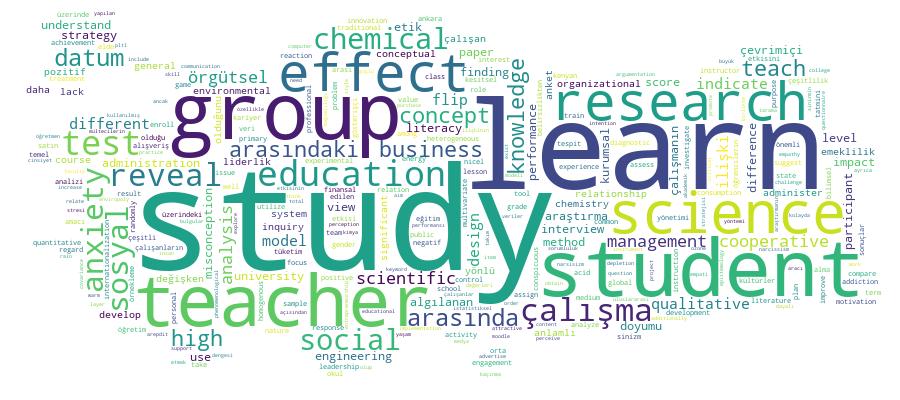
Competency Cloud
16 results
Scholarly Output Search Results
Now showing 1 - 10 of 16
Article Citation - WoS: 17Citation - Scopus: 21Improving Science Teachers' Views About Scientific Inquiry: Reflections From a Professional Development Program Aiming To Advance Science Centre-School Curricula Integration(Springer, 2019) Cigdemoglu, Ceyhan; Çiğdemoğlu, Ceyhan; Koseoglu, Fitnat; Çiğdemoğlu, Ceyhan; Public Relations and Advertising; Public Relations and AdvertisingThe present study specifically focuses on science teachers' views about scientific inquiry and their use of scientific inquiry in their lesson plans, which were prepared at a professional development workshop designed for better utilization of science centers (SCs). As an impact evaluation research, qualitative data was collected from 41 purposively selected volunteer science teachers. The project team provided the participants with intense instruction in inquiry, and fostered them to learn nature of science and nature of scientific inquiry explicitly. The participants designed lesson plans that integrate school science curricula with exhibits at SCs before and after the workshop. An open-ended questionnaire about the views about scientific inquiry (VASI) was administered before and after the workshop, and teachers' post-lesson plans were analyzed to detect the presence of scientific inquiry aspects. The majority of teachers exhibited improved views about scientific inquiry based on the VASI instrument. Also, lesson plan analyses indicated that teachers, who showed more improvement in VASI, included more scientific inquiry (SI) elements in their post-lesson plans. It was observed that science teachers' lesson plans are limited in terms of teaching science in line with real scientific inquiries in SCs to make students learn about the nature of scientific inquiry while learning science. Only two groups embedded SI properly in the SC-oriented lesson plans, and teachers rather used inquiry-based methods of teaching (e.g., argumentation, predict-observe-explain) and process skills (e.g., questioning, explanations). Accordingly, further studies are suggested to develop a specific pedagogical content knowledge framework for teaching with/in SCs.Article Citation - WoS: 1Citation - Scopus: 7Science Teachers' Professional Development About Science Centers Enhancing Science Teachers' Views Concerning Nature of Science(Springer, 2020) Eren-Sisman, Ece N.; Cigdemoglu, Ceyhan; Kanli, Uygar; Koseoglu, FitnatThe purpose of this study is twofold: first, to delve into professional development (PD) of science teachers' views about nature of science (NOS) throughout activities linking NOS aspects to science centers (SCs), and second, to reveal how a science teacher uses NOS aspects while teaching in SCs. An instrumental qualitative case study method with different data sources was used. There were 18 elementary science teachers participating voluntarily in this study. Additionally, one science teacher among the participants was observed two times during her SCs visit with her grade 6th and 7th students. Researchers trained science teachers for using the facilities of SCs and supported their understanding of NOS. Before and after the workshop, open-ended VNOS-C questionnaire was administered, and follow-up interviews were conducted. Observations in SCs were made to check whether the teacher were able to use NOS concepts while teaching science. Findings revealed that the majority of science teachers exhibited improved views about NOS, and improvement was attained particularly on the aspects of tentativeness, methods of scientific investigation, social and cultural embeddedness, and creativity and imagination, while the least improvement was noted for scientific theories and laws. During the SC visits, the teacher employed all aspects of NOS except the theory and law tenet and mostly discuss about the observation, inference, and experiment while teaching. Further PD activities are suggested to support teachers to develop their own teaching plans specific to each exhibit by employing NOS concepts for teaching with/in SCs.Article Citation - WoS: 1Citation - Scopus: 1An examination of the relationship among conspicuous consumption, social media addiction, narcissism, and empathy: a research on university students(inderscience Enterprises Ltd, 2024) Akbulut, Ayse; Esiyok, Elif; Cigdemoglu, Ceyhan; Ozgen, OzlenThe purpose of this study is to reveal the relationship between conspicuous consumption behaviour, social media addiction, narcissistic characteristics, and empathy for university students. Using a cross-sectional survey design, with a non-random sampling strategy, a total of 1,215 participants completed the online survey. Data were analysed through the structural equation modelling technique using the AMOS statistical analysis package to discover the relationship among variables. Findings indicated that social media addiction has a moderately positive relationship with conspicuous consumption, a weak negative relationship with empathy, and a moderately positive relationship with narcissism. As a result, both empathy and narcissism have an impact on conspicuous consumption, and social media addiction affects empathy. This study contributes to the literature in terms of exploring the relationship between empathy and conspicuous consumption together for young consumers.Article Citation - WoS: 39Citation - Scopus: 50Individual Flipped Learning and Cooperative Flipped Learning: Their Effects on Students' Performance, Social, and Computer Anxiety(Routledge Journals, Taylor & Francis Ltd, 2019) Eryilmaz, Meltem; Cigdemoglu, CeyhanThe purpose of this study is to differentiate the effect of cooperative learning strategy integrated with a flipped learning (FL) model from sole FL implementation in promoting students' performances while decreasing their social and computer anxiety in an undergraduate course. As a method, a classical experimental design is used. The participants were from the department of English Language and Literature, and Translation and Interpretation. Students were randomly assigned to individual FL (the control group) class; and FL with cooperative activities (experimental group) class. The groups were randomly assigned as experimental and control by tossing a coin. The implementation took 10 weeks. Students' performances (grades), social anxiety, and computer anxiety were dependent variables of the study and they were compared through multivariate analysis of variance. The results indicated that there is no significant mean difference between groups' performances; however; the group of FL with cooperative activities had less social anxiety, but no significant change occurred at their computer anxiety level.Article Citation - WoS: 5Heterogeneity in Classes: Cooperative Problem-Solving Activities Through Cooperative Learning(Fac Teacher Education, 2014) Cigdemoglu, Ceyhan; Kapusuz, Kamil Yavuz; Kara, AliTeachers, from primary schools to college, experience challenges regarding both increased class sizes and a greater diversity of students having a broad spectrum of abilities, interests, needs, and goals. The aim of this paper is to investigate the effect of cooperative learning through Cooperative Problem-Solving (CPS) activities on homogenous and heterogeneous grouping in an engineering course. As a mixed method design, the study utilized both quantitative and qualitative data. The participants, 47 engineering students selected conveniently, were enrolled in a communication systems course. The analysis of the quantitative data indicated that no significant difference (p=.791) exists between the ways in which the students in homogenous and the students in heterogeneous group understand communication systems. In order to reveal the perceptions of students regarding the implementation, they were interviewed at the end of the semester. The qualitative data obtained from these interviews suggests that students prefer heterogeneous to homogenous grouping. The findings also imply that further research should concentrate on heterogeneous grouping strategies and more detailed qualitative data in order to reveal what kind of patterns emerge from students' interactions in different groupings.Conference Object Citation - WoS: 15Citation - Scopus: 21Taking Attention on Environmental Issues by an Attractive Educational Game: Enviropoly(Elsevier Science Bv, 2011) Arslan, Harika Ozge; Moseley, Christine; Cigdemoglu, CeyhanResearches in interdisciplinary teaching methodologies on environmental education and in assessing their impact were recommended in Thessaloniki Declaration (UNESCO, 1997). Therefore, the purpose of this qualitative study was to develop and field test an educational game, EnviroPoly, to promote environmental literacy. The game was piloted with 44 elementary/mid-level pre-service teachers. Afterwards five pre-service teachers met in a focus group to discuss the game and its procedures. The discussions and observations of the large group of teachers during play and the smaller focus group indicated that EnviroPoly is attractive, motivating, enjoyable and useful. Additionally the game was found to be applicable for different grade levels by adapting reading and question cards. (C) 2011 Published by Elsevier Ltd.Conference Object Determinants of General Chemistry Success of Engineering Students in Pltl and Traditional Classroom: State Anxiety and Test Anxiety(E D P Sciences, 2018) Eren-Sisman, Ece N.; Cigdemoglu, Ceyhan; Geban, OmerThe purpose is to find out whether state and test anxiety can predict general chemistry grade in peer-led team learning group (PLTL) and non-PLTL groups and to explore their predictability of the grade after controlling the influence of trait anxiety. The sample consisted of a total 128 freshman engineering students attending general chemistry in a private university. STAI and RTT instruments and exams were used to generate data which were analyzed by using standard and hierarchical multiple regression. The findings revealed that in both groups the combination of predictors is significantly related to general chemistry grade, having the strongest unique contribution of test anxiety; however, it was only statistically significant for PLTL group. After controlling the effect of trait anxiety, test anxiety still makes a unique significant contribution for PLTL group. Accordingly, test anxiety can be used to predict the general chemistry grade of PLTL students.Conference Object Use of Ict Tools and Their Effect on Teaching and Learning; Students' and Instructor's Views(Iated-int Assoc Technology Education & development, 2016) Cigdemoglu, Ceyhan; Akay, Hasan U.This study aims to reveal how instructors use ICT tools in their courses and determine what ICT tools they utilize as well as assessing the contribution of ICT to learning and teaching from both students' and instructors' perspectives. As a qualitative case study research, semi-structured interviews with instructors and focus group interviews with students were conducted. Both students' and instructors' responses indicated that there is a common belief that when these tools are employed, students' success will increase. Students verified that the use of educational technologies makes them to feel more successful. Instructors stated that such tools create more organized learning and alert instructor to search for best tools for students, and let course materials accessible whenever students need. Instructors stated that although there are number of factors impeding the whole utilization of ICT tools, they agree that traditional teaching is old fashioned and ineffective in these days. Based on the responses obtained, we can state that instructors lack in explaining and evaluating carefully the impact of ICT tools that may enhance or support students' in-depth learning. Their statements are generally anecdotal rather than data driven. Also, lack of motivation among faculty members due to time restrictions was perceived as obstacle to adopting ICT fully.Article Citation - WoS: 3Economic, Socio-Cultural and Existential Engagement Strategies During Covid-19 Pandemic: a Scenario-Based Experiment(Univ Utara Malaysia Press, 2023) oezoran, Beris Artan; Cigdemoglu, Ceyhan; Seyidov, Ilgar; Ozoran, Beris ArtanThe purpose of this study is to reveal the impact of the different engagement strategies used to respond to the economic, sociocultural and existential pressures on the purchase intention of the adult consumers and to compare the purchase intentions of the engagement strategies across gender and income. We embodied a scenario-based within-group experimental design to investigate the effect of engagement strategies on purchase intention. We used a convenience sampling strategy with 221 university students enrolled in an elective course on public relations in Turkey. The results showed that the engagement strategies that respond to the existential pressures are at least essential as those strategies that respond to the economic pressures during the Covid-19 pandemic. Additionally, the findings showed the purchase intentions on the different engagement strategies change across gender whereas there is no significant difference in various income groups. Unlike similarly themed studies, this study employed the quantitative analytical approach. This study shows that the engagement strategies developed for existential pressures have become as important as the economic pressures.Article Citation - WoS: 4Citation - Scopus: 7Extending Peer-Led Team Learning To Management Education: the Effects on Achievement, Critical Thinking, and Interest(Elsevier Sci Ltd, 2022) Tuzlukaya, Sule; Sahin, Neriman Gonca Guzel; Cigdemoglu, CeyhanAs an attempt to extend the implementation of peer-led team learning to management education, this study proposes to investigate business students' achievement, critical thinking skills, and interest in learning environment across academic ability groups and attitudes towards team leaders. Using a one-shot pre/post experimental design, 108 conveniently selected students participated in the treatment throughout ten weeks. Researchers collected data using the critical thinking scale and interest scales both at the beginning and at the end of the treatment. In addition, students' course achievement is used as a dependent variable. To answer research questions, paired-samples t-test, one-way repeated measure analysis of variance (ANOVA), and multivariate analysis of variance (MANOVA) were used. Results indicate that the mean scores of achievement are significantly different for different ability group students and different levels of attitudes towards team leaders. Besides, students' interest scores increased at the end of the implementation; however, their scores on critical thinking skills decreased. Further studies are suggested to consider these issues in implementing peer-led team learning in social science courses.
