Akbal, Yıldırım

Loading...
Profile Picture
Name Variants
Akbal,Y.
Y.,Akbal
Akbal, Yıldırım
A., Yildirim
Yildirim, Akbal
A.,Yıldırım
Y., Akbal
A.,Yildirim
Yıldırım, Akbal
Akbal, Yildirim
Job Title
Doçent Doktor
Email Address
yildirim.akbal@atilim.edu.tr
Main Affiliation
Mathematics
Status
Former Staff
Website
ORCID ID
Scopus Author ID
Turkish CoHE Profile ID
Google Scholar ID
WoS Researcher ID

Sustainable Development Goals

NO POVERTY1
NO POVERTY
0
Research Products
ZERO HUNGER2
ZERO HUNGER
0
Research Products
GOOD HEALTH AND WELL-BEING3
GOOD HEALTH AND WELL-BEING
0
Research Products
QUALITY EDUCATION4
QUALITY EDUCATION
0
Research Products
GENDER EQUALITY5
GENDER EQUALITY
0
Research Products
CLEAN WATER AND SANITATION6
CLEAN WATER AND SANITATION
0
Research Products
AFFORDABLE AND CLEAN ENERGY7
AFFORDABLE AND CLEAN ENERGY
2
Research Products
DECENT WORK AND ECONOMIC GROWTH8
DECENT WORK AND ECONOMIC GROWTH
0
Research Products
INDUSTRY, INNOVATION AND INFRASTRUCTURE9
INDUSTRY, INNOVATION AND INFRASTRUCTURE
0
Research Products
REDUCED INEQUALITIES10
REDUCED INEQUALITIES
0
Research Products
SUSTAINABLE CITIES AND COMMUNITIES11
SUSTAINABLE CITIES AND COMMUNITIES
0
Research Products
RESPONSIBLE CONSUMPTION AND PRODUCTION12
RESPONSIBLE CONSUMPTION AND PRODUCTION
0
Research Products
CLIMATE ACTION13
CLIMATE ACTION
0
Research Products
LIFE BELOW WATER14
LIFE BELOW WATER
0
Research Products
LIFE ON LAND15
LIFE ON LAND
0
Research Products
PEACE, JUSTICE AND STRONG INSTITUTIONS16
PEACE, JUSTICE AND STRONG INSTITUTIONS
0
Research Products
PARTNERSHIPS FOR THE GOALS17
PARTNERSHIPS FOR THE GOALS
0
Research Products
This researcher does not have a Scopus ID.
This researcher does not have a WoS ID.
Scholarly Output

7

Articles

7

Views / Downloads

2/0

Supervised MSc Theses

0

Supervised PhD Theses

0

WoS Citation Count

44

Scopus Citation Count

47

Patents

0

Projects

0

WoS Citations per Publication

6.29

Scopus Citations per Publication

6.71

Open Access Source

2

Supervised Theses

0

JournalCount
Canadian Journal of Mathematics1
Colloquium Mathematicum1
Communications in Algebra1
International Journal of Green Energy1
International Journal of Number Theory1
Current Page: 1 / 2

Scopus Quartile Distribution

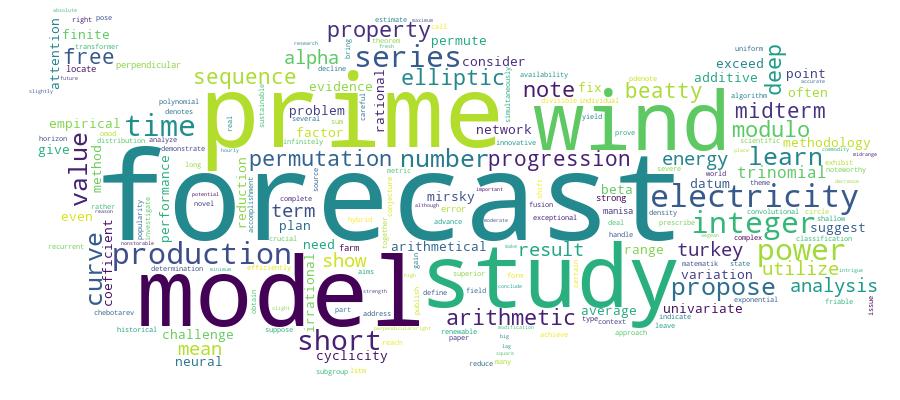
Competency Cloud

GCRIS Competency Cloud

Scholarly Output Search Results

Now showing 1 - 4 of 4
  • Article
    Citation - WoS: 2
    Citation - Scopus: 3
    A Short Note on Permutation Trinomials of Prescribed Type
    (Taylor & Francis inc, 2020) Akbal, Yildirim; Temur, Burcu Gulmez; Ongan, Pinar
    We show that there are no permutation trinomials of the form hox 1/4 x5 ox5oq1 xq1 1 over Fq2 where q is not a power of 2. Together with a result of Zha, Z., Hu, L., Fan, S., hox permutes Fq2 if q 1/4 2k where k 2 omod 4, this gives a complete classification of those q's such that hox permutes F-q(2).
  • Article
    Citation - WoS: 23
    Citation - Scopus: 27
    A Univariate Time Series Methodology Based on Sequence-To Learning for Short To Midterm Wind Power Production
    (Pergamon-elsevier Science Ltd, 2022) Akbal, Yildirim; Unlu, Kamil Demirberk
    The biggest wind farm of Turkey is placed at Manisa which is located in the Aegean Region. Electricity is a nonstorable commodity for that reason, it is very important to have a strong forecast and model of the potential electricity production to plan the electricity loads. In this study, the aim is to model and forecast electricity production of the wind farms located at Manisa by using a univariate model based on sequence-to-sequence learning. The forecasting range of the study is from short term to midterm. The strength of the proposed model is that; it only needs its own lagged value to make forecasts. The empirical evidences show that the model has high coefficient of variation (R-2) in short term and moderate R-2 in the midterm forecast. Although in the midrange forecasts R-2 slightly decreases mean squared error and mean absolute error shows that the model is accurate also in the midterm forecasts. The proposed model is not only strong in hourly electricity production forecasts but with a slight modification also in forecasting the minimum, maximum and average electricity production for a fixed range. This study concludes with two fresh and intriguing future research ideas.
  • Article
    Citation - WoS: 4
    Citation - Scopus: 3
    A Note on Values of Beatty Sequences That Are Free of Large Prime Factors
    (Ars Polona-ruch, 2020) Akbal, Yildirim
    Let alpha and beta be fixed real numbers and suppose that alpha > 1 is irrational and of finite type. We study values of the non-homogeneous Beatty sequence {left perpendicular alpha n + beta right perpendicular}(n=1)(infinity)that are free of large prime factors, where left perpendicularxright perpendicular is the largest integer not exceeding x.
  • Article
    Citation - WoS: 9
    Citation - Scopus: 9
    A Hybrid Deep Learning Methodology for Wind Power Forecasting Based on Attention
    (Taylor & Francis inc, 2024) Akbal, Yildirim; Unlu, Kamil Demirberk
    Wind energy, as a sustainable energy source, poses challenges in terms of storage. Therefore, careful planning is crucial to utilize it efficiently. Deep learning algorithms are gaining popularity for analyzing complex time series data. However, as the "no free lunch" theorem suggests, the trade-off is: they need a lot of data to achieve the benefits. This even brings up a severe challenge for time series analysis, as the availability of historical data is often limited. This study aims to address this issue by proposing a novel shallow deep learning approach for wind power forecasting. The proposed model utilizes a fusion of transformers, convolutional and recurrent neural networks to efficiently handle several time series simultaneously. The empirical evidence demonstrates that the suggested innovative method exhibits exceptional forecasting performance, as indicated by a coefficient of determination (R2) of 0.99. When the forecasting horizon reaches 48, the model's performance declines significantly. However, when dealing with long ranges, utilizing the mean as a metric rather than individual point estimates would yield superior results. Even when forecasting up to 96 hrs in advance, obtaining an R2 value of 0.50 is considered a noteworthy accomplishment in the context of average forecasting.