Şengül, Gökhan

Loading...
Profile Picture
Name Variants
Gokhan, Sengul
Sengul, Gokhan
Sengul,G.
Gökhan, Şengül
Engul G.
Şengül G.
Şengül, Gökhan
G.,Sengul
Sengul, G.
S.,Gokhan
Sengul G.
Ş., Gökhan
G.,Şengül
G., Sengul
Şengül,G.
G., Şengül
S., Gokhan
Ş.,Gökhan
Job Title
Profesor Doktor
Email Address
gokhan.sengul@atilim.edu.tr
Main Affiliation
Computer Engineering
Status
Website
ORCID ID
Scopus Author ID
Turkish CoHE Profile ID
Google Scholar ID
WoS Researcher ID

Sustainable Development Goals

NO POVERTY1
NO POVERTY
0
Research Products
ZERO HUNGER2
ZERO HUNGER
0
Research Products
GOOD HEALTH AND WELL-BEING3
GOOD HEALTH AND WELL-BEING
4
Research Products
QUALITY EDUCATION4
QUALITY EDUCATION
1
Research Products
GENDER EQUALITY5
GENDER EQUALITY
1
Research Products
CLEAN WATER AND SANITATION6
CLEAN WATER AND SANITATION
0
Research Products
AFFORDABLE AND CLEAN ENERGY7
AFFORDABLE AND CLEAN ENERGY
1
Research Products
DECENT WORK AND ECONOMIC GROWTH8
DECENT WORK AND ECONOMIC GROWTH
0
Research Products
INDUSTRY, INNOVATION AND INFRASTRUCTURE9
INDUSTRY, INNOVATION AND INFRASTRUCTURE
2
Research Products
REDUCED INEQUALITIES10
REDUCED INEQUALITIES
0
Research Products
SUSTAINABLE CITIES AND COMMUNITIES11
SUSTAINABLE CITIES AND COMMUNITIES
1
Research Products
RESPONSIBLE CONSUMPTION AND PRODUCTION12
RESPONSIBLE CONSUMPTION AND PRODUCTION
0
Research Products
CLIMATE ACTION13
CLIMATE ACTION
0
Research Products
LIFE BELOW WATER14
LIFE BELOW WATER
1
Research Products
LIFE ON LAND15
LIFE ON LAND
0
Research Products
PEACE, JUSTICE AND STRONG INSTITUTIONS16
PEACE, JUSTICE AND STRONG INSTITUTIONS
1
Research Products
PARTNERSHIPS FOR THE GOALS17
PARTNERSHIPS FOR THE GOALS
0
Research Products
Documents

40

Citations

343

h-index

12

Documents

17

Citations

106

Scholarly Output

83

Articles

49

Views / Downloads

104/187

Supervised MSc Theses

9

Supervised PhD Theses

3

WoS Citation Count

217

Scopus Citation Count

331

Patents

0

Projects

0

WoS Citations per Publication

2.61

Scopus Citations per Publication

3.99

Open Access Source

18

Supervised Theses

12

JournalCount
Biomedical Research (India)5
UBMK 2018 - 3rd International Conference on Computer Science and Engineering -- 3rd International Conference on Computer Science and Engineering, UBMK 2018 -- 20 September 2018 through 23 September 2018 -- Sarajevo -- 1435604
3rd International Conference on Computer Science and Engineering (UBMK) -- SEP 20-23, 2018 -- Sarajevo, BOSNIA & HERCEG2
2016 24th Signal Processing and Communication Application Conference, SIU 2016 - Proceedings -- 24th Signal Processing and Communication Application Conference, SIU 2016 -- 16 May 2016 through 19 May 2016 -- Zonguldak -- 1226052
International Journal of Engineering Education2
Current Page: 1 / 9

Scopus Quartile Distribution

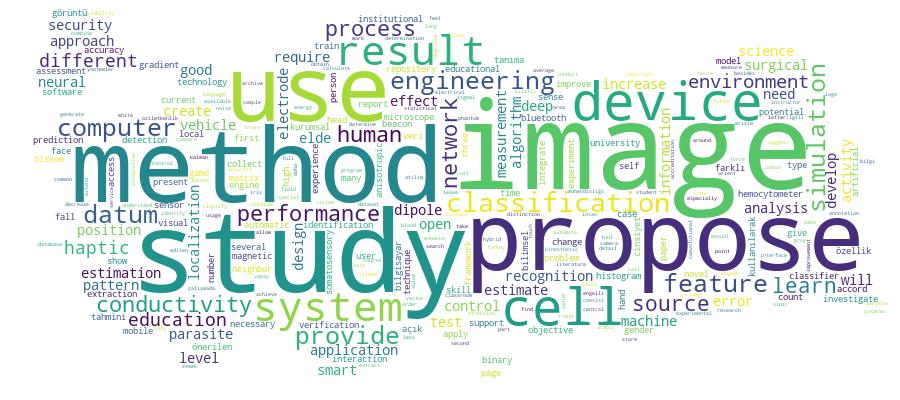
Competency Cloud

GCRIS Competency Cloud

Scholarly Output Search Results

Now showing 1 - 6 of 6
  • Conference Object
    Application of Kalman Filter for the Estimation of Human Head Tissue Conductivities;
    (2011) Şengül,G.; Baysal,U.
    In this study Extended Kalman Filtering is proposed for the estimation of human head tissue conductivities by using EEG data. The proposed method first linearizes the relationship between the tissue conductivities and surface potentials (EEG measurements) and then iteratively estimates the tissue conductivities. In the study the mathematical background of the proposed method is presented and then performance of the proposed method is investigated by a simulation study. In the simulation study a three layered realistic head model (composed of scalp, skull and brain compartments) obtained from MR images of a real patient is used. The surface potential is calculated by using an arbitrarily chosen conductivity distribution. Then conductivity estimation is iteratively performed by using the calculated potentials and at each iteration relative error rates are calculated by comparing the orginal conductivities and estimated ones. It is found that the relative error rates decrease below of 1% after five iterations. © 2011 IEEE.
  • Conference Object
    The Effect of Split Attention in Surgical Education
    (Springer Verlag, 2014) Özçelik,E.; Ercil Cagiltay,N.; Sengul,G.; Tuner,E.; Unal,B.
    Surgical education through simulation is an important area to improve the level of education and to decrease the risks, ethical considerations and cost of the educational environments. In the literature there are several studies conducted to better understand the effect of these simulation environments on learning. However among those studies the human-computer interaction point of view is very limited. Surgeons need to look at radiological images such as magnetic resonance images (MRI) to be sure about the location of the patient's tumor during a surgical operation. Thus, they go back and forth between physically separated places (e.g. the operating table and light screen display for MRI volume sets). This study is conducted to investigate the effect of presenting different information sources in close proximity on human performance in surgical education. For this purpose, we have developed a surgical education simulation scenario which is controlled by a haptic interface. To better understand the effect of split attention in surgical education, an experimental study is conducted with 27 subjects. The descriptive results of study show that even the integrated group performed the tasks with a higher accuracy level (by traveling less distance, entering less wrong directions and hitting less walls), the results are not statistically significant. Accordingly, even there are some evidences about the effect of split attention on surgical simulation environments, the results of this study need to be validated by controlling students' skill levels on controlling the haptic devices and 2D/3D space perception skills. The results of this study may guide the system developers to better design the HCI interface of their designs especially for the area of surgical simulation. © 2014 Springer International Publishing.
  • Conference Object
    A Fully Automatic Photogrammetric System Design Using a 1.3 Mp Web Camera To Determine Eeg Electrode Positions;
    (2010) Şengül,G.; Baysal,U.
    In this study a fully automatic fotogrammetric system is designed to determine the EEG electrode positions in 3D. The proposed system uses a 1.3 MP web camera rotating over the subject's head. The camera is driven by a step motor. The camera takes photos in every 7.20 angles during the rotation. In order to realize full automation, electrodes are labeled by colored circular markers and an electrode identification algorithm is develeoped for full automation. The proposed method is tested by using a realistic head phantom carrying 25 electrodes. The positions of the test electrodes are also measured by a conventional 3-D digitizer. The measurements are repeated 3 times for repeatibility purposes. It is found that 3-d digitizer localizes the electrodes with an average error of 8.46 mm, 7.63 mm and 8.32 mm, while the proposed system localizes the electrodes with an average error of 1.76 mm, 1.42 mm and 1.53 mm. ©2010 IEEE.
  • Article
    Citation - WoS: 1
    Citation - Scopus: 3
    Three-Dimensional Visualization With Large Data Sets: a Simulation of Spreading Cortical Depression in Human Brain
    (Hindawi Publishing Corporation, 2012) Erturk, Korhan Levent; Sengul, Gokhan
    We developed 3D simulation software of human organs/tissues; we developed a database to store the related data, a data management system to manage the created data, and a metadata system for the management of data. This approach provides two benefits: first of all the developed system does not require to keep the patient's/subject's medical images on the system, providing less memory usage. Besides the system also provides 3D simulation and modification options, which will help clinicians to use necessary tools for visualization and modification operations. The developed system is tested in a case study, in which a 3D human brain model is created and simulated from 2D MRI images of a human brain, and we extended the 3D model to include the spreading cortical depression (SCD) wave front, which is an electrical phoneme that is believed to cause the migraine.
  • Article
    Citation - WoS: 11
    Citation - Scopus: 13
    Gesture-Based Interaction for Learning: Time To Make the Dream a Reality
    (Wiley, 2012) Ozcelik, Erol; Sengul, Gokhan
    [No Abstract Available]
  • Conference Object
    The Effect of Split Attention in Surgical Education
    (Springer-verlag Berlin, 2014) Ozcelik, Erol; Cagiltay, Nergiz Ercil; Sengul, Gokhan; Tuner, Emre; Unal, Bulent
    Surgical education through simulation is an important area to improve the level of education and to decrease the risks, ethical considerations and cost of the educational environments. In the literature there are several studies conducted to better understand the effect of these simulation environments on learning. However among those studies the human-computer interaction point of view is very limited. Surgeons need to look at radiological images such as magnetic resonance images (MRI) to be sure about the location of the patient's tumor during a surgical operation. Thus, they go back and forth between physically separated places (e.g. the operating table and light screen display for MRI volume sets). This study is conducted to investigate the effect of presenting different information sources in close proximity on human performance in surgical education. For this purpose, we have developed a surgical education simulation scenario which is controlled by a haptic interface. To better understand the effect of split attention in surgical education, an experimental study is conducted with 27 subjects. The descriptive results of study show that even the integrated group performed the tasks with a higher accuracy level (by traveling less distance, entering less wrong directions and hitting less walls), the results are not statistically significant. Accordingly, even there are some evidences about the effect of split attention on surgical simulation environments, the results of this study need to be validated by controlling students' skill levels on controlling the haptic devices and 2D/3D space perception skills. The results of this study may guide the system developers to better design the HCI interface of their designs especially for the area of surgical simulation.