Şengül, Gökhan

Loading...
Profile Picture
Name Variants
Gokhan, Sengul
Sengul, Gokhan
Sengul,G.
Gökhan, Şengül
Engul G.
Şengül G.
Şengül, Gökhan
G.,Sengul
Sengul, G.
S.,Gokhan
Sengul G.
Ş., Gökhan
G.,Şengül
G., Sengul
Şengül,G.
G., Şengül
S., Gokhan
Ş.,Gökhan
Job Title
Profesor Doktor
Email Address
gokhan.sengul@atilim.edu.tr
Main Affiliation
Computer Engineering
Status
Website
ORCID ID
Scopus Author ID
Turkish CoHE Profile ID
Google Scholar ID
WoS Researcher ID

Sustainable Development Goals

NO POVERTY1
NO POVERTY
0
Research Products
ZERO HUNGER2
ZERO HUNGER
0
Research Products
GOOD HEALTH AND WELL-BEING3
GOOD HEALTH AND WELL-BEING
4
Research Products
QUALITY EDUCATION4
QUALITY EDUCATION
1
Research Products
GENDER EQUALITY5
GENDER EQUALITY
1
Research Products
CLEAN WATER AND SANITATION6
CLEAN WATER AND SANITATION
0
Research Products
AFFORDABLE AND CLEAN ENERGY7
AFFORDABLE AND CLEAN ENERGY
1
Research Products
DECENT WORK AND ECONOMIC GROWTH8
DECENT WORK AND ECONOMIC GROWTH
0
Research Products
INDUSTRY, INNOVATION AND INFRASTRUCTURE9
INDUSTRY, INNOVATION AND INFRASTRUCTURE
2
Research Products
REDUCED INEQUALITIES10
REDUCED INEQUALITIES
0
Research Products
SUSTAINABLE CITIES AND COMMUNITIES11
SUSTAINABLE CITIES AND COMMUNITIES
1
Research Products
RESPONSIBLE CONSUMPTION AND PRODUCTION12
RESPONSIBLE CONSUMPTION AND PRODUCTION
0
Research Products
CLIMATE ACTION13
CLIMATE ACTION
0
Research Products
LIFE BELOW WATER14
LIFE BELOW WATER
1
Research Products
LIFE ON LAND15
LIFE ON LAND
0
Research Products
PEACE, JUSTICE AND STRONG INSTITUTIONS16
PEACE, JUSTICE AND STRONG INSTITUTIONS
1
Research Products
PARTNERSHIPS FOR THE GOALS17
PARTNERSHIPS FOR THE GOALS
0
Research Products
Documents

40

Citations

343

h-index

12

Documents

17

Citations

106

Scholarly Output

83

Articles

49

Views / Downloads

104/187

Supervised MSc Theses

9

Supervised PhD Theses

3

WoS Citation Count

217

Scopus Citation Count

331

Patents

0

Projects

0

WoS Citations per Publication

2.61

Scopus Citations per Publication

3.99

Open Access Source

18

Supervised Theses

12

JournalCount
Biomedical Research (India)5
UBMK 2018 - 3rd International Conference on Computer Science and Engineering -- 3rd International Conference on Computer Science and Engineering, UBMK 2018 -- 20 September 2018 through 23 September 2018 -- Sarajevo -- 1435604
3rd International Conference on Computer Science and Engineering (UBMK) -- SEP 20-23, 2018 -- Sarajevo, BOSNIA & HERCEG2
2016 24th Signal Processing and Communication Application Conference, SIU 2016 - Proceedings -- 24th Signal Processing and Communication Application Conference, SIU 2016 -- 16 May 2016 through 19 May 2016 -- Zonguldak -- 1226052
International Journal of Engineering Education2
Current Page: 1 / 9

Scopus Quartile Distribution

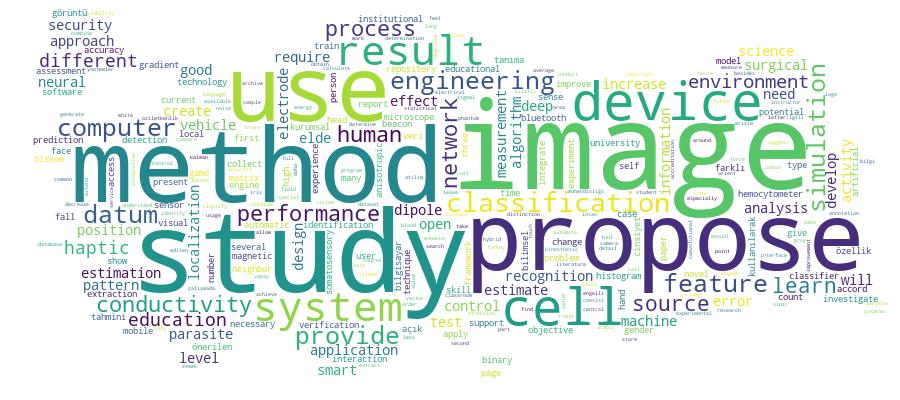
Competency Cloud

GCRIS Competency Cloud

Scholarly Output Search Results

Now showing 1 - 5 of 5
  • Article
    Citation - WoS: 50
    Citation - Scopus: 70
    Deep Learning Based Fall Detection Using Smartwatches for Healthcare Applications
    (Elsevier Sci Ltd, 2022) Sengul, Gokhan; Karakaya, Murat; Misra, Sanjay; Abayomi-Alli, Olusola O.; Damasevicius, Robertas
    We implement a smart watch-based system to predict fall detection. We differentiate fall detection from four common daily activities: sitting, squatting, running, and walking. Moreover, we separate falling into falling from a chair and falling from a standing position. We develop a mobile application that collects the acceleration and gyroscope sensor data and transfers them to the cloud. In the cloud, we implement a deep learning algorithm to classify the activity according to the given classes. To increase the number of data samples available for training, we use the Bica cubic Hermite interpolation, which allows us to improve the accuracy of the neural network. The 38 statistical data features were calculated using the rolling update approach and used as input to the classifier. For activity classification, we have adopted the bi-directional long short-term memory (BiLSTM) neural network. The results demonstrate that our system can detect falling with an accuracy of 99.59% (using leave-one-activityout cross-validation) and 97.35% (using leave-one-subject-out cross-validation) considering all activities. When considering only binary classification (falling vs. all other activities), perfect accuracy is achieved.
  • Article
    Citation - WoS: 18
    Citation - Scopus: 24
    Fusion of Smartphone Sensor Data for Classification of Daily User Activities
    (Springer, 2021) Sengul, Gokhan; Ozcelik, Erol; Misra, Sanjay; Damasevicius, Robertas; Maskeliunas, Rytis
    New mobile applications need to estimate user activities by using sensor data provided by smart wearable devices and deliver context-aware solutions to users living in smart environments. We propose a novel hybrid data fusion method to estimate three types of daily user activities (being in a meeting, walking, and driving with a motorized vehicle) using the accelerometer and gyroscope data acquired from a smart watch using a mobile phone. The approach is based on the matrix time series method for feature fusion, and the modified Better-than-the-Best Fusion (BB-Fus) method with a stochastic gradient descent algorithm for construction of optimal decision trees for classification. For the estimation of user activities, we adopted a statistical pattern recognition approach and used the k-Nearest Neighbor (kNN) and Support Vector Machine (SVM) classifiers. We acquired and used our own dataset of 354 min of data from 20 subjects for this study. We report a classification performance of 98.32 % for SVM and 97.42 % for kNN.
  • Article
    Crack Detection on Asphalt Runway Using Unmanned Aerial Vehicle Data with Non-Crack Object Removal and Deep Learning Methods
    (Pontificia Univ Catolica Chile, Escuela Construccion Civil, 2025) Tapkin, Serkan; Tercan, Emre; Bostan, Atila; Sengul, Gokhan
    Unmanned aerial vehicles are extensively utilized for image acquisition in a cheap, fast, and effective way. In this study, an automatic crack detection method with non-crack object removal and deep learning-based approaches are developed and tested on images captured by unmanned aerial vehicle. The motivation of this study is to detect either a crack exists or not in the asphalt-runway. The novelty of this study lies in integrating a non-crack artifact removal process with six classical edge detectors and comparing the resulting performance with four lightweight CNN models on the same UAV-acquired runway image dataset, enabling a unified evaluation of classical and learning-based approaches. For deep learning-based approach, four lightweight CNN models, namely GoogleNet, SqueezeNet, MobileNetv2, and ShuffleNet, are trained and the best accuracy of %87.9 is obtained whenever GoogleNet model is used. For the non-crack object removal approach, exclusion of non-crack objects from the images is the first step, where crack-detection which makes use of edge-detection techniques is the latter. In the study, Sobel, Prewitt, Canny, Laplacian of Gaussian, Roberts and Zero Cross edge detection algorithms are examined and their success rates in detecting cracks are comparatively presented. With sensitivity=0.981, specificity=0.744, accuracy=0.917, precision=0.912 and F-score=0.945 values Canny algorithm performs significantly better than others in detecting the cracks. This study provides enough evidence for the practicability of automated crack detection on unprocessed digital photographs by the results of the study conducted on asphalt runway.
  • Article
    Citation - WoS: 2
    Citation - Scopus: 3
    A Hybrid Approach for Semantic Image Annotation
    (Ieee-inst Electrical Electronics Engineers inc, 2021) Sezen, Arda; Turhan, Cigdem; Sengul, Gokhan
    In this study, a framework that generates natural language descriptions of images within a controlled environment is proposed. Previous work on neural networks mostly focused on choosing the right labels and/or increasing the number of related labels to depict an image. However, creating a textual description of an image is a completely different phenomenon, structurally, syntactically, and semantically. The proposed semantic image annotation framework presents a novel combination of deep learning models and aligned annotation results derived from the instances of the ontology classes to generate sentential descriptions of images. Our hybrid approach benefits from the unique combination of deep learning and semantic web technologies. We detect objects from unlabeled sports images using a deep learning model based on a residual network and a feature pyramid network, with the focal loss technique to obtain predictions with high probability. The proposed framework not only produces probabilistically labeled images, but also the contextual results obtained from a knowledge base exploiting the relationship between the objects. The framework's object detection and prediction performances are tested with two datasets where the first one includes individual instances of images containing everyday scenes of common objects and the second custom dataset contains sports images collected from the web. Moreover, a sample image set is created to obtain annotation result data by applying all framework layers. Experimental results show that the framework is effective in this controlled environment and can be used with other applications via web services within the supported sports domain.
  • Article
    Citation - WoS: 11
    Citation - Scopus: 31
    An Improved Random Bit-Stuffing Technique With a Modified Rsa Algorithm for Resisting Attacks in Information Security (rbmrsa)
    (Cairo Univ, Fac Computers & information, 2022) Mojisola, Falowo O.; Misra, Sanjay; Febisola, C. Falayi; Abayomi-Alli, Olusola; Sengul, Gokhan; Falayi Febisola, C.
    The recent innovations in network application and the internet have made data and network security the major role in data communication system development. Cryptography is one of the outstanding and powerful tools for ensuring data and network security. In cryptography, randomization of encrypted data increases the security level as well as the Computational Complexity of cryptographic algorithms involved. This research study provides encryption algorithms that bring confidentiality and integrity based on two algorithms. The encryption algorithms include a well-known RSA algorithm (1024 key length) with an enhanced bit insertion algorithm to enhance the security of RSA against different attacks. The security classical RSA has depreciated irrespective of the size of the key length due to the development in computing technology and hacking system. Due to these lapses, we have tried to improve on the contribution of the paper by enhancing the security of RSA against different attacks and also increasing diffusion degree without increasing the key length. The security analysis of the study was compared with classical RSA of 1024 key length using mathematical evaluation proofs, the experimental results generated were compared with classical RSA of 1024 key length using avalanche effect in (%) and computational complexity as performance evaluation metrics. The results show that RBMRSA is better than classical RSA in terms of security but at the cost of execution time. (C) 2022 THE AUTHORS. Published by Elsevier B.V. on behalf of Faculty of Computers and Information, Cairo University.