Billur, Eren

Loading...
Profile Picture
Name Variants
Billur, E.
Eren, Billur
E., Billur
E.,Billur
B.,Eren
B., Eren
Billur, Eren
Billur,E.
Job Title
Doktor Öğretim Üyesi
Email Address
eren.billur@atilim.edu.tr
Main Affiliation
Automotive Engineering
Status
Former Staff
Website
ORCID ID
Scopus Author ID
Turkish CoHE Profile ID
Google Scholar ID
WoS Researcher ID

Sustainable Development Goals

3

GOOD HEALTH AND WELL-BEING
GOOD HEALTH AND WELL-BEING Logo

2

Research Products

7

AFFORDABLE AND CLEAN ENERGY
AFFORDABLE AND CLEAN ENERGY Logo

1

Research Products

9

INDUSTRY, INNOVATION AND INFRASTRUCTURE
INDUSTRY, INNOVATION AND INFRASTRUCTURE Logo

1

Research Products
This researcher does not have a Scopus ID.
This researcher does not have a WoS ID.
Scholarly Output

9

Articles

4

Views / Downloads

29/75

Supervised MSc Theses

1

Supervised PhD Theses

0

WoS Citation Count

40

Scopus Citation Count

43

WoS h-index

3

Scopus h-index

3

Patents

0

Projects

0

WoS Citations per Publication

4.44

Scopus Citations per Publication

4.78

Open Access Source

3

Supervised Theses

1

Google Analytics Visitor Traffic

JournalCount
28th International Conference on Metallurgy and Materials (METAL) -- MAY 22-24, 2019 -- Brno, CZECH REPUBLIC1
5th International Conference on Hot Sheet Metal Forming of High-Performance Steel (CHS2 2015) -- MAY 31-JUN 03, 2015 -- Toronto, CANADA1
Hittite Journal of Science and Engineering1
International Conference on the Technology of Plasticity (ICTP) -- SEP 17-22, 2017 -- Cambridge, ENGLAND1
International Journal of Hydrogen Energy1
Current Page: 1 / 2

Scopus Quartile Distribution

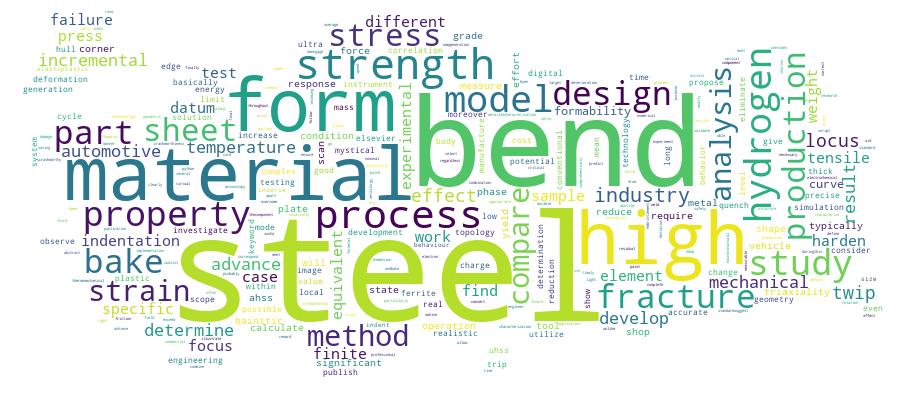
Competency Cloud

GCRIS Competency Cloud

Scholarly Output Search Results

Now showing 1 - 3 of 3
  • Conference Object
    Citation - WoS: 3
    From Part Design To Part Production - Virtual Hot Forming Engineering Illustrated - Focus Material Modelling
    (verlag Wissenschaftliche Scripten, 2015) Billur, Eren; Porzner, Harald; Lorenz, D.; Holecek, Martin; Vrojlik, M.; Hoss, M.; Skrikerud, Martin
    In a press hardening process, significant efforts are necessary to model material behavior and combinations of material in one part, patch work, and die spotting. In this paper, a focus will be put on accurate modeling of material and process, being able to complete the die and process design in a timely manner A new material model has been developed that allows measuring and modelling material behavior along measurable phase paths. The reward of precise material and process modelling is a realistic determination of the deviation of the formed shape from the nominal part shape, accurate quenching time determination, correct material properties and residual stresses at the end of the process, and significant time savings in the try-out period.
  • Conference Object
    Predicting the Topology of the Bending Corner in Bending of Ultra High Strength Steels Through Finite Element Analysis
    (Tanger Ltd, 2019) Cetin, Baris; Billur, Eren; Baranoglu, Besim; Toptas, Ugur; Alic, Ozgur; Manufacturing Engineering; Automotive Engineering
    In bending of plates, unlike the case of sheet metal forming, a 3-D stress state is valid. Moreover, apart from the some very specific cases, the plane strain assumption is not appropriate either. Therefore; bending of thick ultra-high strength steel (UHSS) plates is a deformation process where 3-D stress and strain states exist in general. This study basically focuses on the prediction of the bending corner topology with non-linear finite element analysis method, since the laser-cut edges of the UHSS are particularly prone to edge cracking during bending operation. Within the scope of this study, an experimental set-up is designed which consists of bending tools and a servo mechanical press. The samples were bent by means of this set-up in an air-bending operation up to 90 degrees. This experimental work was followed by optical scanning measurements. And finally, the FEA results and the scanning data were compared in 3-D space. The results showed good correlation. As a future study, the 3-D strain field of the bending corner will be tried to be measured by a professional digital image correlation (DIC) system which could probably give more precise data when combined with the data from FEA.
  • Conference Object
    Citation - WoS: 3
    Citation - Scopus: 4
    A Potential Solution To Mystical Materials in Indentation Test
    (Elsevier Science Bv, 2017) Billur, E.; Cetin, B.; Music, O.; Simsir, C.; Davut, K.
    Various methods have been designed to determine the elasto-plastic properties of metals. Instrumented indentation test (IIT) is considered to be a good candidate to determine local properties after manufacturing operations. In order to acquire elastoplastic properties from IIT, either dimensional analysis or inverse analysis of the force-displacement curve is performed. However, the major drawback of those methods is the uniqueness of the solution. Some materials may exhibit almost identical force-depth curves, although they have different elastoplastic properties. Those materials are referred as "mystical materials". In this contribution, topological features of the indentation surfaces, i.e. indent size, pile-up and sink-in behaviour, are investigated to find a differentiating property. According to the results, indent size, pile-up and sink-in behaviour may help to find the unique solution to the inverse problem. (C) 2017 The Authors. Published by Elsevier Ltd. Peer-review under responsibility of the scientific committee of the International Conference on the Technology of Plasticity.