
Cihaner, Atilla
Loading...
Profile URL
Name Variants
C.,Atilla
A., Cihaner
C., Atilla
Cihaner A.
A.,Cihaner
Cihaner, Atilla
Cihaner,A.
Atilla Cihaner
Atilla, Cihaner
Cihaner,Atilla
Cihaner, A.
Cihaner, A
A., Cihaner
C., Atilla
Cihaner A.
A.,Cihaner
Cihaner, Atilla
Cihaner,A.
Atilla Cihaner
Atilla, Cihaner
Cihaner,Atilla
Cihaner, A.
Cihaner, A
Job Title
Profesör Doktor
Email Address
atilla.cihaner@atilim.edu.tr
Main Affiliation
Chemical Engineering
Status
Website
ORCID ID
Scopus Author ID
Turkish CoHE Profile ID
Google Scholar ID
WoS Researcher ID
Sustainable Development Goals
 1
1NO POVERTY
0
Research Products
 2
2ZERO HUNGER
0
Research Products
 3
3GOOD HEALTH AND WELL-BEING
1
Research Products
 4
4QUALITY EDUCATION
0
Research Products
 5
5GENDER EQUALITY
0
Research Products
 6
6CLEAN WATER AND SANITATION
1
Research Products
 7
7AFFORDABLE AND CLEAN ENERGY
3
Research Products
 8
8DECENT WORK AND ECONOMIC GROWTH
0
Research Products
 9
9INDUSTRY, INNOVATION AND INFRASTRUCTURE
0
Research Products
 10
10REDUCED INEQUALITIES
0
Research Products
 11
11SUSTAINABLE CITIES AND COMMUNITIES
0
Research Products
 12
12RESPONSIBLE CONSUMPTION AND PRODUCTION
0
Research Products
 13
13CLIMATE ACTION
0
Research Products
 14
14LIFE BELOW WATER
0
Research Products
 15
15LIFE ON LAND
0
Research Products
 16
16PEACE, JUSTICE AND STRONG INSTITUTIONS
0
Research Products
 17
17PARTNERSHIPS FOR THE GOALS
0
Research Products

Documents
101
Citations
2366
h-index
28

Documents
103
Citations
2258

Scholarly Output
121
Articles
108
Views / Downloads
61/0
Supervised MSc Theses
12
Supervised PhD Theses
0
WoS Citation Count
2257
Scopus Citation Count
2347
Patents
0
Projects
13
WoS Citations per Publication
18.65
Scopus Citations per Publication
19.40
Open Access Source
6
Supervised Theses
12
| Journal | Count |
|---|---|
| Electrochimica Acta | 15 |
| Journal of Electroanalytical Chemistry | 13 |
| Turkish Journal of Chemistry | 6 |
| Dyes and Pigments | 6 |
| Organic Electronics | 6 |
Current Page: 1 / 8
Scopus Quartile Distribution
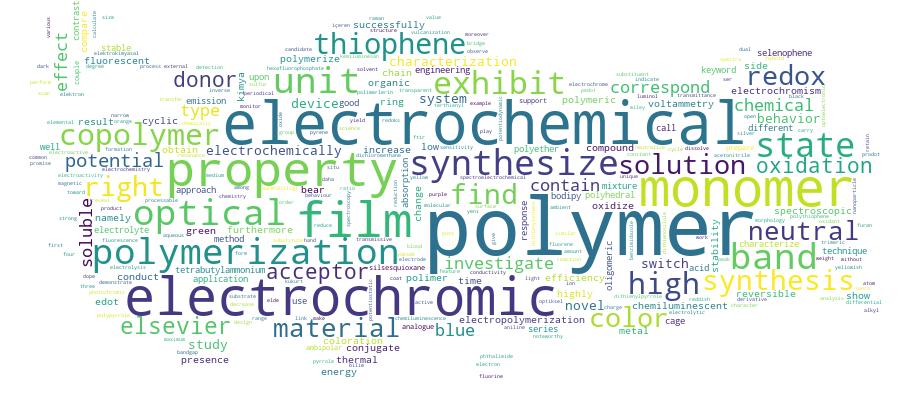
Competency Cloud
121 results
Scholarly Output Search Results
Now showing 1 - 10 of 121
Article Citation - WoS: 1Citation - Scopus: 1Synthesis and Characterization of New Dithienosilole Based Copolymers(Electrochemical Soc inc, 2016) Karabay, Lutfiye Canan; Al-Jumaili, Mohammed; Cihaner, Atilla2-Ethylhexyl substituted dithienosilole based soluble polymers including thiophene (1) and bithiophene (2) units were synthesized via Stille coupling reaction. The presence of 2-ethylhexyl substituents on the silole ring gave solubility property to the polymers in common solvents. According to gel permeation chromatography measurements, the weight average molecular weights of the polymers 1 and 2 were found to be as 70,977 with a polydispersity index of 2.30 and 110,439 with a PDI of 1.42, respectively. Fluorescent polymers in toluene solution have maximum emisssion bands at 634 nm for the polymer 1 and 613 nm for the polymer 2. Chemical and electrochemical doping of the polymers in the solution and in the film forms were monitored by using ultraviolet-visible spectroscopic technique. The polymers exhibited chromic (chemochromic and electrochromic) properties. While the colors of the neutral polymer films are purple for the polymer 1 and reddish brown for the polymer 2, both polymers are transparent sky blue at their oxidized states. The bandgaps of polymers in film forms were calculated as 1.81 eV for the polymer 1 and 1.92 eV for the polymer 2. Also, electrochromic device applications of the polymers were done. Electrochemical and optical behaviors of the polymers demonstrated that they can be good candidates for optoelectronic applications. (C) 2016 The Electrochemical Society. All rights reserved.Master Thesis Yağ Asitlerinden Yüksek Kükürt İçerikli Polimerik Malzemelerin Sentezi ve Karakterizasyonu(2021) Berk, Hasan; Cihaner, AtillaDoğal kaynaklardan ve petrol rafinerilerinden elde edilen elementel kükürt, yaygın olarak bulunabilen ve pahalı ve zehirli olmayan bir malzeme olmasına rağmen, onun için büyük ölçekli üretken kullanımlar bulmak önemli bir ilerleme olacaktır. Öte yandan, gelecekte bitkisel yağların yenilenebilir kaynaklardan polimer üretiminde kilit rol oynaması beklenmektedir. Bu çalışmada, çeşitli miktarlarda yağ asitleri (oleik asit (OA), linoleik asit (LA) ve linolenik asit (LnA)) içeren yüksek kükürt içerikli yeni bir polimer serisi ters vulkanizasyon yöntemi ile sentezlenmiş ve başarılı bir şekilde karakterize edilmiştir. Özellikle, çift bağların ve serbest alkil zincirlerinin polikükürt kopolimerleri üzerindeki etkisi, bir çift bağlı OA, iki çift bağlı LA ve üç çift bağlı LnA kullanılarak sistematik olarak araştırılmıştır. İlgili kopolimerler yaygın organik çözücülerde çözünür, işlenebilir ve elektroaktiftir. Öte yandan, polimer yapısında yağ asitlerinin bulunması nedeniyle, kopolimerler reaktif fonksiyonel birimlere (karboksilik grup-COOH) sahiptir ve diol ile kimyasal modifikasyonları ester bağlarının oluşumuna yol açar. Bu post polimerizasyon, yüksek moleküler ağırlıklı yeni polimerlerin elde edilmesi ile sonuçlanır. Son olarak, kopolimerlerin ağır metal iyonlarının (Paladyum (II) ve Cıva (II)) uzaklaştırılmasında ve kullanımı test edilmiştir. Sonuçlar, polimerlerin ağır metal iyonu uzaklaştırma için potansiyel malzeme olabileceğini göstermiştir.Article Citation - WoS: 6Citation - Scopus: 5Synthesis of a regular polymer containing pseudo-polyether cages(Elsevier Science Sa, 2005) Cihaner, A; Önal, AMA new compound consisting of 2-thienyl units linked by polyether bridge has been synthesized and its electrochemical polymerization was performed via constant potential electrolysis (CPE) in an electrolytic solution containing 0.1 M tetrabutylammonium hexafluorophosphate (TBAPF(6)) dissolved in CH3CN. Chemical polymerization was carried out using FeCl3 as oxidizing agent. It is found that both methods gave the same polymer product without any cleavage of the polyether bridge between thiophene (Th) rings. Although as synthesized polymers exhibited no conductivity, they gain conductivity via chemical doping using 12 vapor exposure. The polymers were characterized using FTIR spectroscopic technique and 12 doping was monitored using in-situ electron spin resonance (ESR) spectroscopy. Thermal behavior of electrochemically prepared polymer was investigated using differential scanning calorimetry, DSC and thermogravimetric analysis, TGA. (c) 2005 Elsevier B.V. All rights reserved.Article Citation - WoS: 28Citation - Scopus: 30Functionalized Polysulfide Copolymers With 4-Vinylpyridine Via Inverse Vulcanization(Elsevier Science Bv, 2019) Berk, Hasan; Balci, Burcu; Ertan, Salih; Kaya, Murat; Cihaner, AtillaA new series of functional polysulfide copolymers called poly(sulfur-random-4-vinylpyridine) (poly(S-r-4VP)) was synthesized via inverse vulcanization technique by ring opening polymerization of elemental sulfur in the presence of 4-vinylpyridine (4VP). The corresponding copolymers can be post functionalized by using amine group in 4VP unit to get polymers bearing various properties. Elemental sulfur was heated up to 160 degrees C and 4VP was added slowly to a clear yellowish orange colored liquid at this temperature. The reaction mixture was vitrified to form a reddish-brown polymeric material at 180 degrees C in 1 h. The products were characterized by using FTIR, NMR, and Raman spectroscopic techniques. Poly(S-r-4VP) copolymers are soluble in common solvents like dichloromethane, chloroform and tetrahydrofuran. Weight-average molecular weights of poly(S-r-4VP) copolymers with different wt% 4VP were measured by using gel permeation chromatography technique. The polysulfide copolymers with different wt% 4VP have high weight-average molecular weights with polydispersity indeces (PDI) in a range from 1.88 to 4.06 measured by gel permeation chromatography. Post functionalization of the copolymer with 50 wt% 4VP as an example was performed successfully by using alkyl bromide to get N-alkyl quaternized 4VP in polymer backbone.Article Citation - WoS: 1Citation - Scopus: 1Spectroelectrochemical Investigation of the Anodic Oxidation of Dibenzo-18(Elsevier Science Sa, 2004) Cihaner, A; Önal, AMPoly(dibenzo-18-crown-6) (poly-DB18C6) was synthesized by electrochemical oxidation of dibenzo-18-crown-6 (DB18C6) using a mixture of acetonitrile and dichloromethane as the solvent and tetrabutylammonium tetrafluoroborate (TBABF(4)) or tetrabutylammonium hexafluorophosphate (TBAPF(6)) as supporting electrolyte. The anodic polymerization of DB18C6 was investigated using in situ ESR and in situ UV-Vis spectroscopic techniques. Spectroelectrochemical (SPEL), properties and thermal analysis of the resulting polymers have been investigated using UV-Vis spectroscopy, differential scanning calorimetry (DSC) and thermogravimetric analysis (TGA). (C) 2004 Elsevier B.V. All rights reserved.Article Citation - WoS: 52Citation - Scopus: 57Members of Cmy Color Space: Cyan and Magenta Colored Polymers Based on Oxadiazole Acceptor Unit(Amer Chemical Soc, 2012) Ozkut, Merve Icli; Algi, Melek Pamuk; Oztas, Zahide; Algi, Fatih; Onal, Ahmet M.; Cihaner, AtillaIn this study, three novel oxadiazole-based polymers were synthesized and their electrochemical and optical properties were investigated. The polymers were found to have both p- and n-type doping properties accompanied by electrochromic response. Two polymer films exhibit cyan and magenta colors, which constitute two legs of CMY color spaces, in their neutral states and they are soluble in common-organic solvents. According to the color mixing theory, all colors in the visible spectrum including black color can be obtained by using these polymers with a yellow colored electrochromic polymer. Among these polymers, the polymer bearing propyledioxythiophene donor units has some superior properties like high stability (it retains 94% of its electroactivity after 2000 cycles), solubility, and high coloration efficiency (230 cm(2)/C), whereas as expected ethylenedioxythiophene containing one has the lowest band gap as 1.08 eV.Article Citation - WoS: 1Citation - Scopus: 1Electrochemical Polymerization and Characterization of Polyether-Substituted Aniline Derivatives(Wiley, 2007) Tirkes, Seha; Cihaner, Atilla; Oenal, Ahmet M.; Önal, Ahmet M.New compounds consisting of aniline units linked by polyether bridges have been synthesized and their electrochemical polymerization was performed via constant potential electrolysis and cyclic voltammetry in an aqueous solution containing 3.0 moI L-1 H2SO4. Chemical polymerization was carried out using (NH4)(2)S2O8 as oxidizing agent. It was found that both methods gave the same polymer product without any cleavage of the polyether bridge between aniline rings. The polymers were characterized using the Fourier transform infrared spectroscopic technique and the thermal behavior of electrochemically prepared polymers was investigated using thermogravimetric analysis. Spectroelectrochemical properties of the films were investigated using the in situ UV-visible spectroscopic technique. (c) 2007 Society of Chemical Industry.Article Citation - WoS: 16Citation - Scopus: 16Electrochemical and Optical Characterization of a Multielectrochromic Copolymer Based on 3,4-Ethylenedioxythiophene and Functionalized Dithienylpyrrole Derivative(Pergamon-elsevier Science Ltd, 2019) Tutuncu, Esra; Ozkut, Merve Icli; Balci, Burcu; Berk, Hasan; Cihaner, Atilla; Icli Ozkut, MerveA novel conjugated copolymer, namely poly(3,4-ethylenedioxythiophene-co-1-(3,5-bis(trifluoromethyl)phenyl)-2,5-di(thiophen-2-yl)-1H-pyrrole) (P(EDOT-co-1)) was synthesized via electropolymerization method from a mixture of 3,4-ethylenedioxythiophene and 1-(3,5-bis(trifluoromethyl)phenyl)-2,5-di(thiophen-2-yl)-1H-pyrrole comonomers. The corresponding copolymer has an optical band gap of 1.7 eV and 41% optical contrast at 525 nm with a coloration efficiency of 258 cm(2)/C and 1.4 s switching time. The copolymer has a multi-electrochromic behavior: It has dark purple, purple, gray, green and cyan colors at different oxidation states. Electrochemical stability of P(EDOT-co-1) copolymer was also investigated and it was observed that the copolymer retained 86% of its stability under ambient conditions in the presence of oxygen (without purging the electrolyte solution with any inert gas) according to the current density and 83% according to the deposited charge even after 1000 redox cycles.Article Citation - WoS: 6Citation - Scopus: 6Synthesis and Polymerization of 2-And 3-Substituted Thiophene Derivatives Linked by Polyether Bridges(Elsevier Science Sa, 2004) Tirkes, S; Cihaner, A; Önal, AMNew compounds consisting of 2- and 3-thienyl units linked by polyether bridges have been synthesized and their electrochemical polymerization was performed via constant potential electrolysis (CPE) in an electrolytic solution containing 0.1 M tetrabutylammonium hexafluorophosphate (TBAPF(6)) dissolved in CH3CN. 2-Thienyl monomers (I and II), but not 3-thienyl monomers (III and IV), were also polymerized via chemical oxidation, which yielded broken pi-conjugated polymer products. The polymers were characterized using H-1 NMR and FT-IR spectroscopic techniques. It was found that both chemical and electrochemical oxidation of 2-thienyl monomers gave mainly poly(2,2'-bithiophenemethylene) due to elimination of polyether chains during the polymerization reaction. On the other hand, electrochemical oxidation of 3-thienyl monomers resulted in corresponding polymers without any cleavage of polyether bridges. Spectroelectrochemical (SPEL) properties of the products were investigated using UV-Vis spectroscopic techniques. (C) 2004 Elsevier B.V. All rights reserved.Article Polysulfur Copolymer as a Support Material for the Preparation of a Novel Multifunctional Photocatalytic Composite Material(Springer, 2025) Kesimal, Busra; Guner, Zuhal Vanli; Cihaner, Atilla; Kaya, Murat; Vanli Guner, ZuhalOne-step addition of magnetic nanoparticles and titanium dioxide nanoparticles into polysulfur copolymer as cheap and available support was reported for the first time to prepare the magnetically separable heterogeneous catalyst, PolyS-MNP-TiO2. The photocatalytic activities of the PolyS-MNP-TiO2 composite material and its constituents were examined in the methylene blue (MB) degradation, textile-based wastewater simulant, exposed to solar light. Detailed characterization of the catalysts was performed with SEM, TEM, and EDX measurements. The photocatalytic activity of the resulting composite was figured out in the removal of methylene blue dye by using a solar simulator. Significantly, the as-prepared PolyS-MNP-TiO2 exhibits exceptional photocatalytic activity and total degradation of dye molecules was achieved in 60 min. Additionally, the prepared novel photocatalyst showed enhanced stability and reusability due to the magnetic behavior of the composite material and the same portion of catalyst was used in five successive tries without apparent loss in catalytic activity by eliminating long and work-loaded processes like filtration and centrifugation.
